








Quick Overview of the Cayman Islands' New Virtual Asset Regulations
TechFlow Selected TechFlow Selected
Quick Overview of the Cayman Islands' New Virtual Asset Regulations
The implementation of the 2025 Cayman VASP regulatory new rules marks that Cayman virtual asset compliance has entered a period of governance deepening.
 Navigating Web3 tides with focused insights
Authors: Iris, Bai Qin
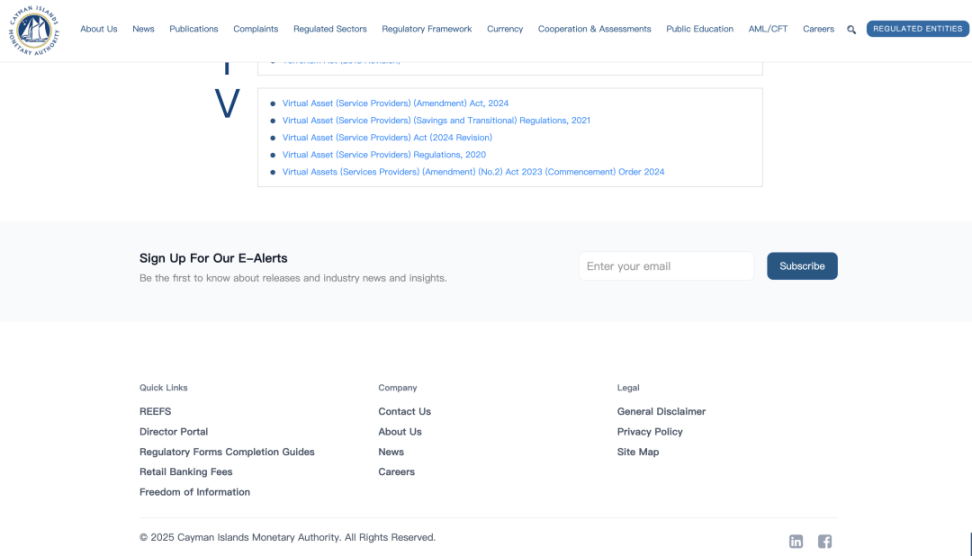
Since the release of the VASP regulatory framework—the *Virtual Asset (Service Providers) Regulations, 2020*—Cayman Islands, a top destination for global expansion, has successively issued four key legal documents. These have gradually established a comprehensive compliance system for Virtual Asset Service Providers (VASPs), covering registration and licensing, anti-money laundering (AML), governance structures, and regulatory enforcement. The key documents include:
-
Transitional provisions following the implementation of the 2020 VASP Act: *Virtual Asset (Service Providers) (Savings and Transitional) Regulations, 2021*
-
Commencement Order for the second amendment to the VASP Act in 2023: *Virtual Asset (Service Providers) (Amendment) (No.2) Act, 2023 (Commencement) Order, 2024*
-
Consolidated revised version of the VASP Act after multiple amendments since 2020: *Virtual Asset (Service Providers) Act (2024 Revision)*
-
Latest amendment to the VASP Act released at the end of 2024: *Virtual Asset (Service Providers) (Amendment) Act, 2024*
The Cayman Islands’ virtual asset compliance framework has evolved from foundational setup to deeper governance. It now sends a clear message to all Web3 projects, funds, and virtual asset service providers seeking international expansion via the Cayman Islands: compliance thresholds are rising, governance requirements are tightening, and attempts at superficial or borderline compliance will no longer be tolerated.
As we enter 2025, the Cayman Islands will implement revised cryptocurrency licensing regulations starting April 1, requiring all Virtual Asset Service Providers (VASPs)—including trading platforms and custodial services—to obtain licenses from the Cayman Islands Monetary Authority (CIMA). Existing VASPs must submit their license applications by June 29, 2025.
So, what is the core of this new regulation?
How does it further strengthen previous policies?
After this series of revisions, will the Cayman Islands—the once most popular offshore jurisdiction—shift its regulatory stance toward VASPs?
And how should Web3 entrepreneurs planning to establish operations in the Cayman Islands adjust their strategies accordingly?
Mankun Law Firm will walk you through each of these questions below.
Cayman VASP’s Latest Amendment Act
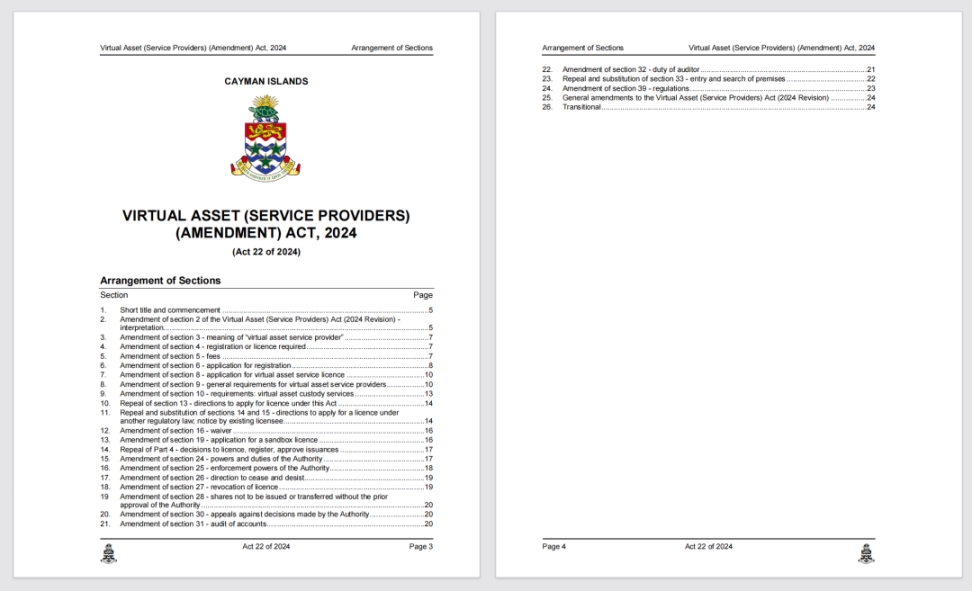
The *Virtual Asset (Service Providers) (Amendment) Act, 2024*, published on December 19, 2024, aims to further refine and strengthen the regulatory framework for Virtual Asset Service Providers (VASPs). Overall, the amendments cover six core areas:
1. Industry Definitions
New definitions introduced include “Convertible Virtual Asset” and “Senior Officer.” The definitions of “Director” and “Shareholder” have also been refined, with additional clarity on affiliated shareholding and beneficial ownership identification.
Meanwhile, outdated terms such as “existing licensee,” “fintech service,” and “operator” have been removed.
For example, under the Sandbox licensing application, applicants are now referred to as “Supervised Persons,” replacing the old term “existing licensee.” Fee names have also been standardized as “prescribed sandbox licence fee.”
2. Registration and Licensing
The amendment clearly states that individuals can no longer register or hold licenses; all VASP applicants must be corporate entities.
Secondly, the dual-track system for registration and licensing has been clarified. Low-risk activities—such as non-custodial wallet services and basic technology infrastructure provision—may opt for registration. High-risk activities—including custody, trade matching, platform operation, and issuance services—must apply for full licensing.
In addition, any entity not registered or licensed by CIMA must not claim to be regulated by CIMA; doing so constitutes a violation.
All application fees, annual fees, and license fees are non-refundable regardless of approval status. Once an application is approved, the applicant must pay all required fees within 30 days; otherwise, the approval becomes void.
3. Operational Requirements
In terms of governance structure, the amendment requires each licensed VASP to appoint at least three directors, including at least one independent director, to prevent internal conflicts of interest and enhance board independence and transparency.
Operationally, VASPs must strictly adhere to their approved business plans. Any proposed changes or expansions—such as adding custody services or new tradable assets—require prior written approval from CIMA. Unauthorized expansion of services is prohibited.
Additionally, shares in a company or partnership cannot be issued or transferred without CIMA’s prior written consent.
The amendment also mandates that VASPs establish and maintain effective risk management systems covering AML, technical security, customer identity verification, and market manipulation prevention. Where appropriate, CIMA may require submission of audit reports and reserve the right to appoint auditors.
For custodial VASPs, the amendment specifies enhanced client asset protection measures, including separate custody of client assets, establishment of trust or bankruptcy-remote accounts, clear segregation of accounts, internal controls such as asset audit procedures, dual-signature management, and third-party audit arrangements.
4. Anti-Money Laundering and Customer Information Collection
The amendment details the information VASPs must collect for virtual asset transfers, including: the originator’s name, account address, virtual asset address, and identity information; the beneficiary’s name, account address, and virtual asset address; and specifics about the type and amount of virtual asset involved.
Beyond collection and recordkeeping, VASPs must retain customer and transaction records for at least five years and produce them within 48 hours upon request by CIMA or law enforcement.
Regarding AML and counter-terrorism financing (CTF), obligations are strengthened: VASPs must comply fully with the Cayman Islands’ existing AML regulations, including KYC, identity verification, suspicious transaction reporting (STR), and ongoing monitoring. If a customer or transaction is suspected of involvement in terrorism financing, money laundering, or high-risk jurisdictions, VASPs must promptly report to CIMA and cooperate with investigations.
5. Auditing and Supervision
Licensed VASPs must engage a CIMA-approved auditor annually to conduct audits and submit complete financial statements. CIMA retains authority to specify the timing, scope, and content of audits. If CIMA suspects misleading or false financial disclosures, it may directly appoint a special auditor at the VASP’s expense.
The amendment also clarifies auditor responsibilities: auditors must act independently, avoid conflicts of interest or misconduct, and proactively report significant risks to CIMA. Failure to fulfill duties may result in disqualification by CIMA and prohibition from future engagements.
Moreover, the amendment strengthens CIMA’s supervisory and enforcement powers, including the right to: enter VASP premises at any time; inspect electronic records, devices, and account information; directly access ledgers and customer transaction data; require technical personnel to assist in system reviews; revoke licenses or registrations; appoint advisors to oversee remediation; petition courts for VASP liquidation in cases of serious violations; and issue immediate “cease and desist” orders against unlicensed operators or those falsely claiming regulatory oversight.
6. Transitional Arrangements
A 90-day transition period is granted from the effective date of the amendment. During this time, existing VASPs must complete licensing or registration applications and adjust their operations to meet all requirements regarding governance, AML, board composition, and custody.
Applicants who submitted applications before the amendment but have not yet received approval may withdraw under the old rules and reapply under the new regime.
Trend Analysis of Cayman VASP Regulation
This amendment goes beyond mere "gap-filling" upgrades—it reflects the Cayman regulators’ comprehensive expectations for market transparency, standardized governance, and rigorous AML accountability. Going forward, both compliance entry barriers and ongoing operational costs for the virtual asset industry will rank among the highest globally.
From this amendment, we can clearly identify the following distinct trends shaping the evolution of the Cayman Islands’ VASP regulatory framework:
1. Expanding Regulatory Scope: Broader Coverage of Entities and Virtual Asset Types
With the introduction of “convertible virtual asset” and removal of outdated terms like “existing licensee,” the regulatory scope is now more precisely defined, encompassing previously gray-area small service providers and emerging virtual asset categories. This means that whether traditional exchanges, custodians, infrastructure developers, or DAO-style projects, any entity offering virtual asset services may fall under VASP regulation—clearly demarcating the industry's compliance boundaries.
2. Standardized Governance Structures: Transparency and Control Identification as Core Priorities
By refining board structures and beneficial ownership disclosure requirements—including minimum director numbers and mandatory independent directors—the regulator raises the bar for governance transparency. Projects using multi-shareholder arrangements, multisig wallets, layered ownership, or DAO governance models must ensure that ultimate controlling parties are clearly identifiable, eliminating hidden shareholders or shadow directors.
3. Elevated Compliance and Entry Barriers: Tiered Management of High- and Low-Risk Activities
High-risk activities—such as trading, custody, and issuance—require full licensing, accompanied by stringent capital, internal control, AML, and financial audit requirements, significantly increasing setup and operational costs. In contrast, low-risk activities—like non-custodial wallets and infrastructure services—can still register, but CIMA imposes clear expectations on disclosure and governance, closing off opportunities for regulatory arbitrage.
4. AML/CFT Standards Aligned with International Norms: Technical Systems Must Support the “Travel Rule”
Detailed collection of customer identities, fund sources, and transaction data, extended data retention periods, 48-hour response times, and explicit high-risk client management requirements are now enforced. Moreover, inter-VASP transfers must be supported by technical systems capable of transmitting originator and beneficiary information, aligning with FATF’s “Travel Rule” and raising the technical compliance threshold.
5. Stricter Financial Transparency and Audit Regime: Enhanced Substantive Oversight by CIMA
CIMA now requires annual financial audits by designated accountants and reserves the right to appoint special auditors in cases of suspected misrepresentation or material risk—costs borne by the VASP. Shareholder changes, business expansions, and operational adjustments require prior written approval, enabling CIMA to intervene throughout the lifecycle—from entry to ongoing operations—significantly increasing the cost of non-compliance.
6. Strengthened On-Site Enforcement and Suspension Powers: No Room for Sham Compliance
This amendment grants CIMA stronger enforcement tools—including on-site inspections, asset freezes, license revocation, and direct petitions for liquidation—maintaining a high-pressure stance against unlicensed operations, false claims, and AML violations. Regulatory loopholes and arbitrage tactics are largely sealed off.
7. Shortened Transition Period: Existing Projects Face Tight Deadlines
Existing VASPs have only 90 days to restructure governance, arrange audits, and upgrade AML systems. Those failing to comply face immediate revocation risks. Even pending applicants must quickly revise materials or resubmit, leaving minimal room for adjustment.
Mankun Law Firm Recommendations
The implementation of the 2025 Cayman VASP regulatory updates marks the entry into a new phase of governance deepening for virtual asset compliance in the Cayman Islands.
For Web3 projects aiming to go global via the Cayman Islands, simply holding a license is no longer sufficient. What matters more is whether governance structures, asset custody arrangements, board transparency, and AML systems can withstand intrusive regulatory scrutiny.
To this end, Mankun Law Firm recommends that Web3 projects tailor their compliance strategies based on business nature, proactively restructure and build risk controls to steadily navigate the regulatory challenges post-2025.
1. For High-Risk Business Operators
-
Immediately restructure governance: Ensure at least three directors are appointed, including one independent director with verifiable qualifications and capacity to serve, avoiding appointments from affiliated parties.
-
Assess capital adequacy: Based on business scale, appropriately increase capital reserves to support regulatory reporting and risk mitigation needs.
-
Strengthen custody compliance: Custodial service providers must implement bankruptcy remoteness, segregated accounts, dual-signature mechanisms, and third-party audits to avoid last-minute compliance pressures.
-
Plan business expansion in advance: If planning to add new trading pairs, cross-chain custody, or token issuance, initiate CIMA approval processes early to avoid compliance roadblocks from unplanned growth.
Build a dedicated compliance team: Internally appoint qualified AML/CFT officers, finance leads, and technical risk managers. When necessary, engage third-party consultants to help establish AML and system compliance frameworks.
2. For Low-Risk Business Operators
-
Leverage the registration system wisely: Given lower registration costs, infrastructure-focused projects can use registration to gain compliance credibility in the Cayman Islands.
-
Still prioritize disclosure and governance: Even without a full license, ensure truthful and transparent disclosure of board members and ultimate controllers, avoiding exaggerated claims about regulatory coverage in marketing materials.
-
Be mindful of technical compliance integration: If offering cross-VASP functionalities (e.g., payment routing, bridging services), assess early whether such linkages could classify your service as high-risk.
3. For Existing Applicants or VASPs in Transition
-
Immediately review submitted materials: Cross-check against new rules on board structure, AML systems, and custody arrangements. Consider withdrawing old applications if needed, close compliance gaps, then reapply.
-
Launch a 90-day transition action plan: Set clear timelines for completing governance restructuring, policy updates, audit arrangements, and KYC system enhancements to avoid last-minute compliance failures and enforcement risks.
At the same time, all VASPs should pay attention to: self-auditing public communications, pre-deploying audit and data systems, and strengthening high-risk customer identification frameworks.
In response to the urgent compliance demands during the 90-day transition period surrounding the enactment of the *Virtual Asset (Service Providers) (Amendment) Act, 2024*, Mankun Law Firm—having long specialized in Web3 international expansion and virtual asset compliance—has built a comprehensive compliance service system. We assist clients in swiftly completing governance restructuring, strengthening AML frameworks, optimizing director appointments, and submitting license or registration applications, ensuring seamless alignment with transitional requirements.
We welcome Web3 entrepreneurs, funds, and virtual asset service providers planning to establish a presence in the Cayman Islands to contact us for customized compliance solutions and secure a first-mover advantage in regulatory readiness.
Join TechFlow official community to stay tuned
Telegram:https://t.me/TechFlowDaily
X (Twitter):https://x.com/TechFlowPost
X (Twitter) EN:https://x.com/BlockFlow_News










