"Autonomous Economy" is rising through Web3
TechFlow Selected TechFlow Selected
"Autonomous Economy" is rising through Web3
Welcome to the dawn of Web3 self-sovereign economy.
 Navigating Web3 tides with focused insights
Author: 0xJeff
Translation: TechFlow
Every technological revolution gives rise to a new economic model:
-
Industrial Revolution ➔ Manufacturing Economy
-
Personal Computers ➔ Software Economy
-
Internet ➔ E-commerce Economy
-
Streaming Media ➔ Subscription Economy
-
Public Cloud ➔ SaaS (Software-as-a-Service) Economy
-
iPhone ➔ App Economy
-
Social Media ➔ Creator Economy
-
Bitcoin and Blockchain ➔ Cryptocurrency/Web3 Economy ➔ Decentralized Finance (DeFi) Economy
-
Electric Vehicles ➔ Clean/Green Tech Economy
-
Artificial Intelligence/Machine Learning (AI/ML, pre-large language models) ➔ Prediction/Automation Economy
-
Large Language Models (LLMs) ➔ Agentic Economy
The Rise of Giants
In each of these technological shifts, dominant giants emerge, capturing the majority of the emerging economy:
-
Industrial Revolution: General Electric, Ford, Siemens, Caterpillar
-
Software Economy: Microsoft, IBM, Oracle, Adobe
-
E-commerce: Amazon, eBay, Alibaba, Shopify
-
Subscription Economy: Netflix, Spotify, Disney+, Hulu
-
SaaS Economy: AWS, Microsoft Azure, Google Cloud, Salesforce, ServiceNow
-
App Economy: Apple, Google Play (Android), Tencent (WeChat), Meta (Instagram/WhatsApp)
-
Creator Economy: Meta (Facebook, Instagram), YouTube, TikTok, Patreon, Substack
-
Crypto Economy: Coinbase, Binance, Ethereum, Solana, Uniswap, Aave
-
Green Tech Economy: Tesla, BYD, Rivian, Lucid, ChargePoint, CATL (batteries)
-
Prediction/Automation Economy: Google DeepMind, Palantir, Nvidia, UiPath
-
Agentic Economy: OpenAI, Anthropic, Grok, DeepSeek, Alibaba, Hugging Face
The Disruptors' Entry Point
These giants attempt to predict and capture the next emerging economy. However, due to their scale and strategic focus, they cannot cover every niche. This creates opportunities for smaller, more agile companies that can rapidly experiment and focus on extremely specific markets:
-
Notion: Disrupted traditional enterprise collaboration and knowledge management tools (e.g., Confluence, SharePoint)
-
Perplexity: Disrupted search and information retrieval (e.g., Google Search, Wikipedia)
-
Substack: Disrupted traditional publishing and media (e.g., blogs, newsrooms, Medium)
-
Grab/Uber: Disrupted urban transportation and logistics (e.g., taxis, car rentals, delivery services)
-
Netflix: Disrupted cable TV and physical media (e.g., Blockbuster, traditional broadcasting)
-
Airbnb: Disrupted the hotel and hospitality industry (e.g., traditional hotels, travel agencies)
-
Amazon: Disrupted brick-and-mortar retail (e.g., Walmart, local stores, Sears)
Once these disruptors transform how industries operate, they themselves become the new giants in their domains—creating fresh opportunities for future players to disrupt them in turn.
The Agentic Economy
In the agentic economy, AI agents (Agentic AI) fundamentally transform operations across industries. These AI agents act as digital labor forces, proactively completing tasks. Agentic AI interfaces are now widespread, drastically reducing user time investment while boosting productivity. This shift makes goods and services significantly more efficient—especially in industries where humans previously performed repetitive tasks—allowing AI and AI agents to substantially reduce costs and improve efficiency.
In the Web2 era, the top incubator and distribution network for showcasing AI and AI agent applications has been @ycombinator, particularly evident in recent batches.
-
Midship: Uses AI to scale financial auditing work
-
Cuckoo: Provides real-time AI translation for global sales, marketing, and support
-
Tempo: Enables designers and developers to collaborate for 10x faster product delivery
-
Ascend: AI-powered financial statement analysis platform
As large language models (LLMs) continue to improve, AI capabilities grow stronger, disrupting more industries and enhancing productivity across an increasing number of roles and responsibilities (though full replacement has not yet occurred).
Consumer AI in Web3 is Brewing
In the Web2 era, Y Combinator served as the primary distribution network, incubating and promoting many leading AI startups. In the Web3 space, @virtuals_io is playing a similar role through the Agent Commerce Protocol (ACP). ACP is an open standard for commercial collaboration among multiple AI agents, enabling them to invoke services from one another, negotiate prices, execute tasks, and provide feedback.
This mechanism is giving rise to a Web3-powered Agentic Economy, where agents collaborate to create greater value for users. Autonomous hedge funds and autonomous media companies will be the first pilot projects for ACP, launching this entirely new economic system.
A Trillion-Dollar Opportunity
As @sequoia noted:
"The core of the cloud transformation was Software-as-a-Service (SaaS). Software companies transformed into cloud service providers, unlocking a $350 billion market opportunity. Now, thanks to agentic reasoning, the core of the AI transformation is Service-as-Software. Software companies are turning labor into software. This means the addressable market is no longer just the software market—it's the multi-trillion-dollar service market."
Now, imagine a Web3-powered AI agent economy capturing even a small fraction of this ~$10 trillion service market, amplified by crypto-native use cases (such as trading, yield farming, and crypto investing) and token incentives that accelerate growth. The opportunity is immense.
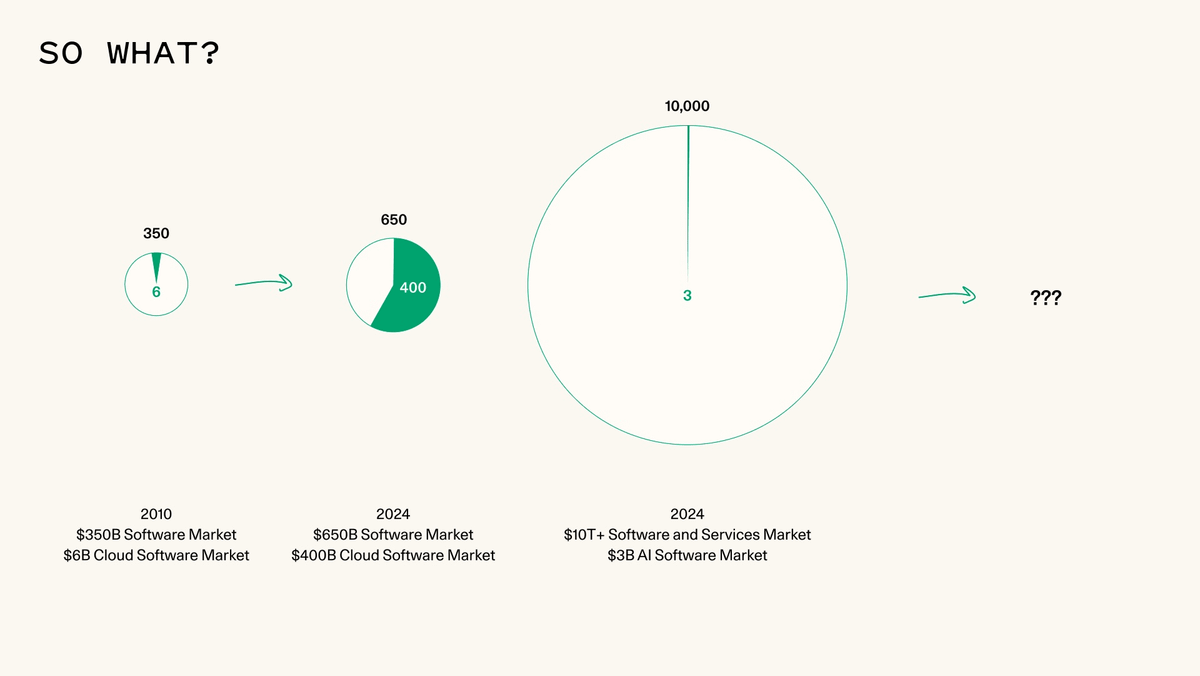
Source: Sequoia
Distribution Layer = The Winning Edge
During the transition to the Agentic Economy, the distribution network / coordination layer will be the biggest beneficiary. This is because crypto tokens become central to Web3 AI monetization models: users must stake, burn, or hold tokens to access core agent products or use cases; tokens serve as the primary currency for paying computational resources and/or service fees.
This demand for tokens, along with the natural alignment of long-term supporters’ incentives with the project, ensures there will always be trading volume to capture—whether on decentralized exchanges (DEXs) or token launch platforms. The distribution layer that successfully coordinates the agentic economy and captures this volume will become a top player in the space, claiming a significant share of the ~$10 trillion market.
Welcome to the dawn of the Web3 Agentic Economy. The future is here—it’s bold and free. This is the age of Web3’s agentic rise.
Join TechFlow official community to stay tuned
Telegram:https://t.me/TechFlowDaily
X (Twitter):https://x.com/TechFlowPost
X (Twitter) EN:https://x.com/BlockFlow_News