EU MiCA Officially Takes Effect: Understanding the CASP Authorization Framework and the Compliance Landscape of Mainstream Trading Platforms
TechFlow Selected TechFlow Selected
EU MiCA Officially Takes Effect: Understanding the CASP Authorization Framework and the Compliance Landscape of Mainstream Trading Platforms
To understand the CASP authorization framework under MiCA, one must look more closely at which specific service types it covers.
 Navigating Web3 tides with focused insights
Author: Black Mario
As of July 1 this year, the CASP transition period of the MiCA Act officially ended, which also means that, in principle, any crypto-asset trading platform that has not obtained CASP authorization will no longer be able to continue providing services to users in the EU region.
For the entire industry, this day is more like a watershed.
Some are happy, some are worried: some mainstream platforms have obtained licenses and smoothly entered the MiCA regulatory framework; but there are still many platforms that have not made substantial progress, and may have to face pressures such as business contraction, user migration, or even gradual exit from the EU market.
In fact, as early as the end of 2024, the regulatory framework for crypto-asset service providers under MiCA had already formally applied. It's just that in the past year or so, the market has mostly been digesting rules, applying for licenses, and adjusting business structures during the transition period. With the end of the transition period, MiCA is beginning to truly enter the implementation phase.
Of course, currently many people still lack a relatively clear understanding of how MiCA's CASP authorization is classified, what differences exist in regulatory requirements faced by different platforms, and what actual impact this will have on exchanges and EU users.
Markets in Crypto-Assets Regulation
MiCA is a unified regulatory framework established by the EU for the crypto-asset market, the full name is Markets in Crypto-Assets Regulation, translated as the "Crypto-Asset Markets Act".
Its core purpose is to establish a set of commonly applicable crypto-asset regulatory rules within the 27 EU member states, covering the issuance, trading, custody, exchange, order execution, asset transfer, and related service provision of crypto-assets such as stablecoins, so as to unify the crypto regulatory rules originally scattered among EU member states, allowing crypto-asset issuers and crypto-asset service providers to conduct business under clear licensing, capital, governance, risk control, information disclosure, and client asset protection requirements.
Actually, focusing on the MiCA framework itself, it mainly targets two types of entities:
The first category is crypto-asset issuers, especially issuers of Asset-Referenced Tokens (ART) and Electronic Money Tokens (EMT).
Such entities need to obtain corresponding issuer authorization, disclose white papers according to regulatory requirements, establish reserve fund arrangements, and meet governance, risk management, and continuous compliance requirements.
For the market, ART and EMT are the two core objects of MiCA issuance-side regulation, among which ART is more偏向 multi-asset anchored stablecoins, and EMT mainly corresponds to stablecoins anchored to a single fiat currency, such as USDC.
However, issuance-side regulation is not the focus of this article. Later we can actually open a new article to discuss this part in detail.
The second category is Crypto-Asset Service Providers, referred to as CASPs.
This category mainly includes crypto exchanges, custodians, brokers, order execution parties, crypto-asset transfer service providers, etc. Different from the issuer system, the focus of CASP regulation is how platforms provide crypto-asset related services to clients, including trading, custody, exchange, order execution, investment advice, portfolio management, and asset transfer.
Correspondingly, MiCA's regulatory requirements for CASPs are also mainly focused on capital, corporate governance, risk control, client asset protection, information disclosure, and operational compliance.
Since July 1 this year, only crypto-asset service providers that have obtained corresponding CASP service authorization can compliantly provide client asset custody, trading matching, asset exchange, order execution, and asset transfer services within the EU.
It is particularly important to note here that, strictly speaking, CASP is not a so-called "all-around exchange license". Under the MiCA framework, "obtaining CASP authorization" and "being able to operate a trading platform" cannot be simply equated.
CASP itself is actually authorized according to specific service types. That is to say, what business a platform can actually do depends on which service codes it has specifically applied for and obtained authorization for. This is somewhat similar to the business scope on a business license:同样是 CASP 授权主体,different entities authorized as CASPs may have different approved business scopes.
Currently, there are 279 entities that have obtained MiCA CASP authorization, among which there are about 222 main service providers that can provide crypto trading related services such as trading, exchange, or order execution.
But among these entities, there are actually only 18 entities that are truly approved to operate crypto-asset trading platforms, that is, have obtained MiCA Class b service authorization.
Therefore, understanding the CASP authorization system under MiCA requires looking more at which specific service types it covers.
Below, we will elaborate on this point in detail.
How Exactly Are MiCA CASP Authorizations Classified
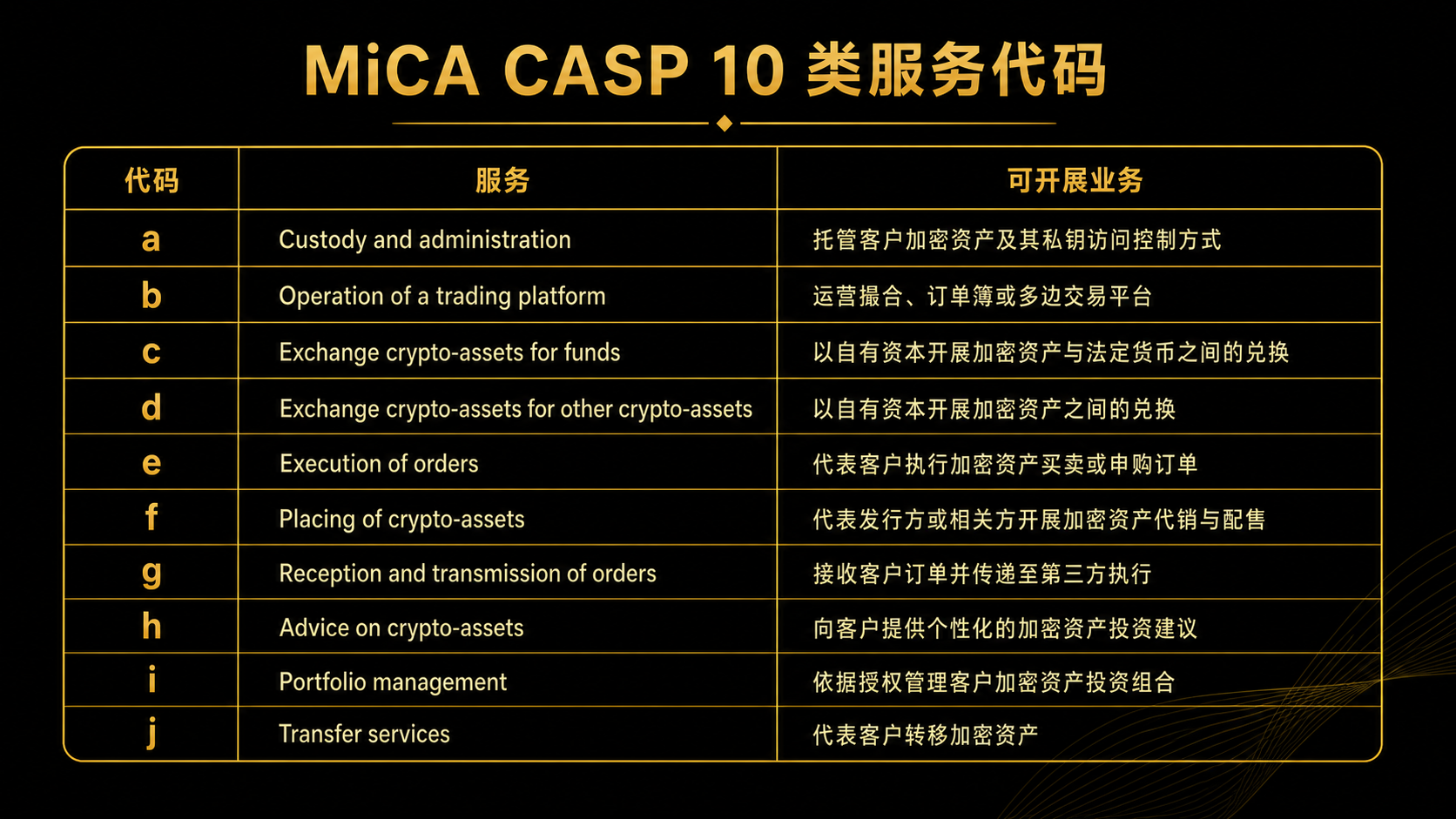
In the MiCA CASP authorization system, crypto-asset services are subdivided into 10 major categories, that is, 10 service codes from a to j, which determine the business the platform is permitted to operate.
On the basis of these 10 categories of services, MiCA also divides the minimum capital requirements for CASPs into three levels of Class 1, Class 2, and Class 3 through Annex IV, determining what minimum capital requirements the platform needs to meet.
10 Service Codes
Class a: Custody and administration of client crypto-assets (Custody and administration)
Class a mainly corresponds to custody business, that is, the platform keeps crypto-assets for clients, or controls the way clients access these assets, such as private keys, account permissions, custody wallets, etc.
For CEXs, as long as users keep coins in platform accounts, the platform actually assumes custody responsibilities. The core focus of this type of business is more on client asset security, private key management, asset segregation, and whether the platform can control client assets.
Class b: Operation of a trading platform (Operation of a trading platform)
Class b is actually closest to what everyone usually understands as "exchange business". It refers to the platform operating a trading system, allowing multiple buyers and sellers to match transactions under platform rules, such as order books, matching engines, multilateral trading facilities, all belong to typical scenarios of this category.
Therefore, if a platform only trades with customers itself, it is not necessarily Class b, but if it allows many users to trade with each other through an order book, it will fall into the category of trading platform operation.
Class c: Exchange of crypto-assets for funds (Exchange crypto-assets for funds)
Class c refers to the platform using its own capital to exchange crypto and funds with clients. Simply put, users use funds such as Euros or US Dollars to buy coins, or sell coins to the platform in exchange for fiat currency, and the platform itself is the counterparty, somewhat similar to what we often call OTC trading.
Of course, the focus here is that the platform is not simply matching others to trade, but uses its own asset pool to exchange crypto-assets and fiat currency with clients.
Class d: Exchange of crypto-assets for other crypto-assets (Exchange crypto-assets for other crypto-assets)
Class d is what we commonly call crypto-to-crypto trading services, that is, trading and exchange between crypto-assets. If the platform uses its own capital or asset pool to complete the exchange with clients, it belongs to this category.
Class e: Execution of orders on behalf of clients (Execution of orders)
Class e refers to the platform executing buy, sell, or subscribe orders for crypto-assets on behalf of clients. It is a bit like broker business. After the user places an order, the platform completes the transaction execution for the client, not just the user operating directly on the trading platform. The platform not only receives orders, but actually helps the client complete the transaction.
Class f: Placing of crypto-assets (Placing of crypto-assets)
Class f mainly corresponds to issuance-side business. If the platform promotes, sells, or places a certain crypto-asset to investors on behalf of the project party, issuer, or related parties, it may belong to this category. For example, Launchpad, IEO, new coin issuance agency, many times can be classified into this type of service.
Class g: Reception and transmission of orders (Reception and transmission of orders)
Class g refers to the platform receiving client orders and then transmitting the orders to a third party for execution. It is actually easy to confuse with Class e. However, the difference is that e is the platform completing execution on behalf of the client, g is the platform just receiving orders and transmitting them out, and the final execution may happen on another platform or third party.
Some aggregators, order routing platforms, brokerage entrances, may all involve this type of service.
Class h: Advice on crypto-assets (Advice on crypto-assets)
Class h refers to providing clients with personalized advice on crypto-assets, such as recommending clients to buy, sell, or use certain crypto-asset services based on the client's personal situation, risk preference, investment goals, that is, more偏向 consulting advice services.
Class i: Portfolio management of crypto-assets (Portfolio management)
Class i corresponds to crypto-asset management business, that is, the user authorizes the platform or service provider, and the other party manages the crypto-asset portfolio for them. The service provider must have a certain discretion over the client's asset allocation, that is, the platform can buy, sell, adjust positions, and manage the portfolio for the client according to authorization.
Class j: Transfer services of crypto-assets (Transfer services)
Class j refers to the platform transferring crypto-assets from one address or account to another address or account on behalf of the client, such as the exchange helping users withdraw coins, the custody platform helping clients transfer funds, the payment platform completing crypto-asset transfers on behalf of clients, all may belong to this category.
Minimum Capital Classification
In addition to these 10 service codes, Class 1, Class 2, Class 3 of MiCA are also often mentioned in the market.
In fact, Class 1/2/3 are actually not three different MiCA licenses. It is essentially the minimum capital requirement classification in MiCA Annex IV.
Class 1
Class 1 corresponds to services e, f, g, h, i, j, including order execution, placing of crypto-assets, reception and transmission of orders, investment advice, portfolio management, and transfer services, with a minimum capital requirement of 50,000 Euros.
These services are relatively more偏向 brokerage, consulting, asset management, order transmission, and transfer. Because they do not necessarily involve the platform itself custodying a large amount of client assets and operating trading platforms, the minimum capital requirement is 50,000 Euros.
Class 2 is based on Class 1, adding services a, c, d, that is, in addition to the original services, also includes client asset custody, exchange of crypto for funds, exchange of crypto for crypto, minimum capital requirement is 125,000 Euros.
Class 2 starts to involve client asset custody, and the platform uses its own capital to conduct exchange transactions with clients, that is, on the basis of basic brokerage, orders, consulting, transfer, etc., further covering custody and exchange business.
The key to Class 3 includes Class b trading platform operation, that is, Class 3 can be solely for b, or can overlay custody, exchange, order execution, transfer, etc. (on the basis of Class 2 complete or partial, adding b). Class 3 is actually closest to complete exchange business, minimum capital requirement is 150,000 Euros.
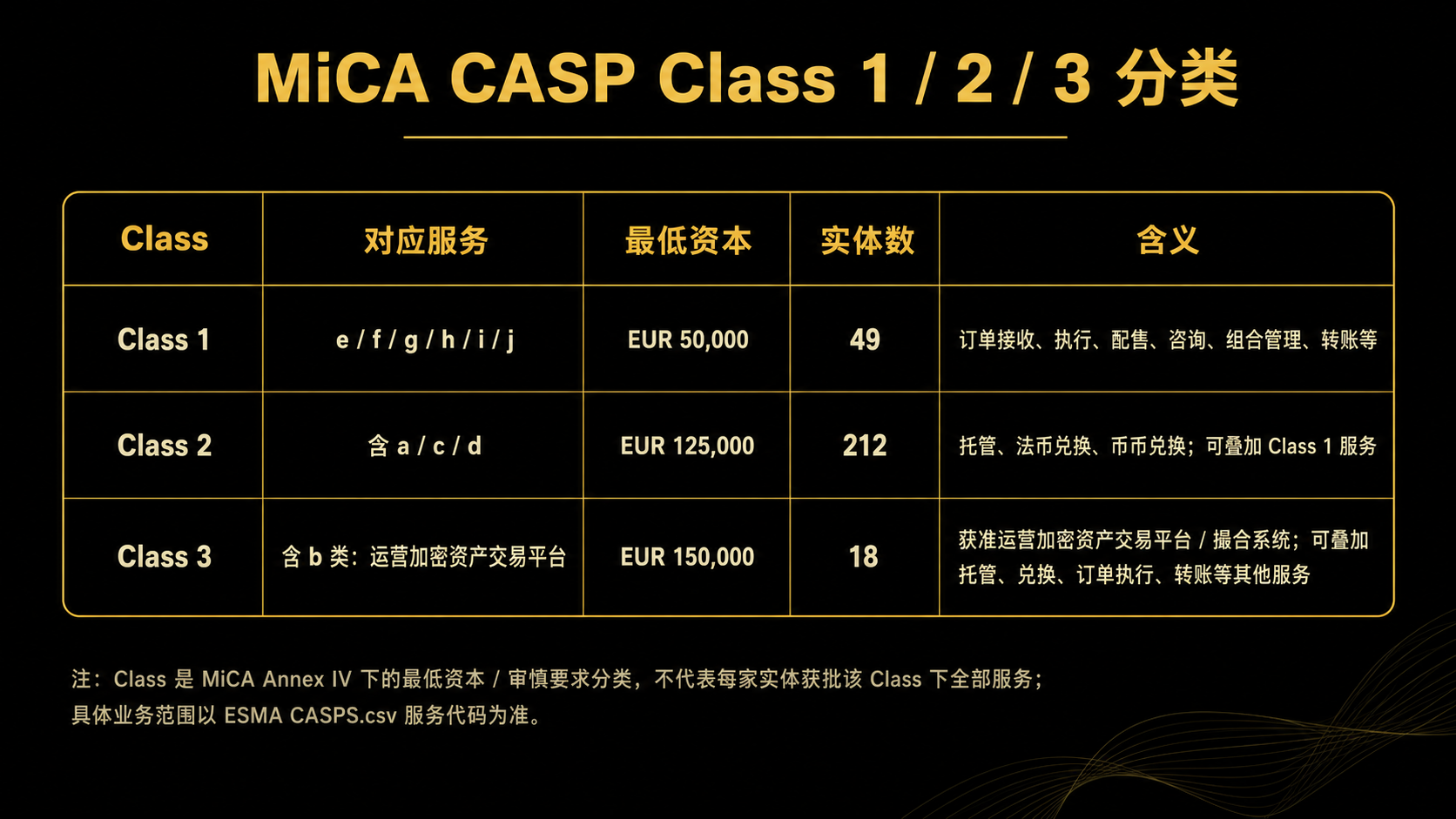
So overall, the core of MiCA CASP is authorization by service code. The authorization codes a to j represent which specific crypto-asset services the platform can do. Class 1/2/3 are just setting different minimum capital requirements based on the risk and business complexity of these services.
So if you understand this rule, you can actually better judge which business a platform can compliantly conduct under MiCA.
Authorization Status of Major Crypto Trading Platforms
As of ESMA's update on July 3, 2026 (updated weekly), there are a total of 279 MiCA CASP authorized entities. Except for Class 1, the vast majority belong to Class 2, and a small part belong to Class 3.
Class 3: Includes Class b "Operation of a Trading Platform" Authorization
Currently, there are a total of 18 entities that have obtained Class 3 authorization and include the Class b trading platform operation service code.
1. OKX
OKX obtained MiCA CASP authorization through the Maltese entity OKX Europe Limited, with an authorization date of January 27, 2025. Its service codes are a, b, c, d, e, f, g, i, j, covering client asset custody, trading platform operation, fiat exchange, crypto-to-crypto exchange, order execution, placing of crypto-assets, order reception and transmission, portfolio management, and crypto-asset transfer services. From the perspective of service code coverage, OKX belongs to one of the Class 3 platforms with a relatively complete authorization scope.
2. Gate.io EU
Gate.io EU obtained MiCA CASP authorization through the Maltese entity Gate Technology Limited, with an authorization date of September 29, 2025. Its service codes are a, b, c, d, e, j, covering client asset custody, trading platform operation, fiat exchange, crypto-to-crypto exchange, order execution, and crypto-asset transfer services.
3. Kraken
Kraken obtained MiCA CASP authorization through the Irish entity Payward Global Solutions Limited, with an authorization date of June 25, 2025. Its service code is b, that is, trading platform operation service. It should be noted that Kraken also has another Class 2 service entity, and the two undertake different service scopes.
4. BSDex
BSDex obtained MiCA CASP authorization through the German entity Baden-Württembergische Wertpapierbörse GmbH, with an authorization date of July 3, 2025. Its service code is b, that is, trading platform operation service.
5. flatexDEGIRO / 360T
flatexDEGIRO / 360T obtained MiCA CASP authorization through the German entity 360 Treasury Systems AG, with an authorization date of April 2, 2025. Its service code is b, that is, trading platform operation service.
6. PAYMIUM
PAYMIUM obtained MiCA CASP authorization through the French entity PAYMIUM SAS, with an authorization date of June 22, 2026. Its service codes are a, b, c, d, e, j, covering client asset custody, trading platform operation, fiat exchange, crypto-to-crypto exchange, order execution, and crypto-asset transfer services.
7. Coinmate
Coinmate obtained MiCA CASP authorization through the Czech entity COINMATE a.s., with an authorization date of February 27, 2026. Its service codes are a, b, c, d, j, covering client asset custody, trading platform operation, fiat exchange, crypto-to-crypto exchange, and crypto-asset transfer services.
8. Webot
Webot obtained MiCA CASP authorization through the Irish entity Pionew Ireland Limited, with an authorization date of December 18, 2025. Its service codes are a, b, c, j, covering client asset custody, trading platform operation, fiat exchange, and crypto-asset transfer services.
9. RULEMATCH
RULEMATCH obtained MiCA CASP authorization through the Liechtenstein entity RULEMATCH Europe AG, with an authorization date of June 1, 2026. Its service codes are a, b, j, covering client asset custody, trading platform operation, and crypto-asset transfer services.
10. Bitstamp
Bitstamp obtained MiCA CASP authorization through the Luxembourg entity Bitstamp Europe S.A., with an authorization date of May 15, 2025. Its service codes are a, b, c, d, e, g, j, covering client asset custody, trading platform operation, fiat exchange, crypto-to-crypto exchange, order execution, order reception and transmission, and crypto-asset transfer services.
11. Kanga Exchange EU
Kanga Exchange EU obtained MiCA CASP authorization through the Latvian entity SIA AlphaRoute, with an authorization date of June 18, 2026. Its service codes are a, b, c, d, f, j, covering client asset custody, trading platform operation, fiat exchange, crypto-to-crypto exchange, placing of crypto-assets, and crypto-asset transfer services.
12. Anycoin
Anycoin obtained MiCA CASP authorization through the Czech entity MP Developers s.r.o., with an authorization date of February 11, 2026. Its service codes are a, b, c, d, e, covering client asset custody, trading platform operation, fiat exchange, crypto-to-crypto exchange, and order execution services.
13. Revolut Crypto
Revolut Crypto obtained MiCA CASP authorization through the Cypriot entity Revolut Digital Assets (Europe) Ltd, with an authorization date of October 20, 2025. Its service codes are a, b, c, d, f, j, covering client asset custody, trading platform operation, fiat exchange, crypto-to-crypto exchange, placing of crypto-assets, and crypto-asset transfer services.
14. ZBX
ZBX obtained MiCA CASP authorization through the Maltese entity Zillion Bits Limited, with an authorization date of February 6, 2025. Its service codes are a, b, c, d, e, f, g, j, covering client asset custody, trading platform operation, fiat exchange, crypto-to-crypto exchange, order execution, placing of crypto-assets, order reception and transmission, and crypto-asset transfer services.
15. Bitvavo
Bitvavo obtained MiCA CASP authorization through the Dutch entity Bitvavo B.V., with an authorization date of June 26, 2025. Its service codes are a, b, j, covering client asset custody, trading platform operation, and crypto-asset transfer services.
16. One Trading
One Trading obtained MiCA CASP authorization through the Dutch entity One Trading Exchange B.V., with an authorization date of May 15, 2025. Its service codes are a, b, covering client asset custody and trading platform operation services.
17. zerohash Europe
zerohash Europe obtained MiCA CASP authorization through the Dutch entity zerohash europe B.V., with an authorization date of October 29, 2025. Its service codes are a, b, c, d, j, covering client asset custody, trading platform operation, fiat exchange, crypto-to-crypto exchange, and crypto-asset transfer services.
18. FIRI AS
FIRI AS obtained MiCA CASP authorization through the Norwegian entity FIRI AS, with an authorization date of May 22, 2026. Its service codes are a, b, c, d, e, j, covering client asset custody, trading platform operation, fiat exchange, crypto-to-crypto exchange, order execution, and crypto-asset transfer services.
Class 2, Most Mainstream Exchanges Are Concentrated in This Category (Review of Some Major Platforms)
As mentioned above, unlike Class 3, Class 2 can usually cover custody, fiat exchange, crypto-to-crypto exchange, order execution, placing, order reception and transmission, investment advice, portfolio management, and transfer services, but does not include Class b trading platform operation. Many mainstream platforms are currently mainly concentrated in Class 2.
Coinbase
Coinbase obtained authorization through the Luxembourg entity Coinbase Luxembourg S.A., with an authorization date of June 20, 2025. Service codes are a, c, d, e, f, g, j, covering custody, fiat exchange, crypto-to-crypto exchange, order execution, placing, order reception and transmission, and transfer services.
Kraken
Kraken's service entity in Class 2 is still the Irish Payward Europe Solutions Limited, with an authorization date of June 25, 2025. Service codes are a, c, d, e, f, g, i, j, covering custody, fiat exchange, crypto-to-crypto exchange, order execution, placing, order reception and transmission, portfolio management, and transfer services.
Bybit EU
Bybit EU obtained authorization through the Austrian entity Bybit EU GmbH, with an authorization date of May 28, 2025. Service codes are a, c, d, f, j, covering custody, fiat exchange, crypto-to-crypto exchange, placing, and transfer services.
Crypto.com
Crypto.com obtained authorization through the Maltese entity Foris DAX MT Limited, with an authorization date of January 27, 2025. Service codes are a, c, d, e, g, j, covering custody, fiat exchange, crypto-to-crypto exchange, order execution, order reception and transmission, and transfer services.
Gemini
Gemini obtained authorization through the Maltese entity Gemini Intergalactic EU Ltd, with an authorization date of August 21, 2025. Service codes are a, c, d, e, f, g, j, covering custody, fiat exchange, crypto-to-crypto exchange, order execution, placing, order reception and transmission, and transfer services.
Bitpanda
Bitpanda has authorized entities in both Austria and Malta. Among them, the authorization date of the Austrian entity Bitpanda GmbH is April 9, 2025, and service codes are a, c, d, e, f, g, j; the authorization date of the Maltese entity BP23 CA Limited is January 27, 2025, and service codes are a, c, d, e, g, j. Both mainly cover custody, fiat exchange, crypto-to-crypto exchange, order execution, order reception and transmission, and transfer services, among which the Austrian entity also includes placing services.
KuCoin EU
KuCoin EU obtained authorization through the Austrian entity KuCoin EU Exchange GmbH, with an authorization date of November 27, 2025. Service codes are a, c, d, f, j, covering custody, fiat exchange, crypto-to-crypto exchange, placing, and transfer services.
Blockchain.com
Blockchain.com obtained authorization through the Maltese entity Blue Cube (Malta) Limited, with an authorization date of October 22, 2025. Service codes are a, c, d, e, j, covering custody, fiat exchange, crypto-to-crypto exchange, order execution, and transfer services.
eToro Crypto
eToro Crypto obtained authorization through the Cypriot entity eToro (Europe) Ltd, with an authorization date of January 16, 2025. Service codes are a, c, e, g, h, i, j, covering custody, fiat exchange, order execution, order reception and transmission, investment advice, portfolio management, and transfer services.
Robinhood Europe
Robinhood Europe obtained authorization through the Lithuanian entity Robinhood Europe UAB, with an authorization date of May 29, 2025. Service codes are a, e, g, j, covering custody, order execution, order reception and transmission, and transfer services.
Bullish Europe
Bullish Europe obtained authorization through the German entity Bullish Europe GmbH, with an authorization date of September 4, 2025. Service codes are a, c, d, e, j, covering custody, fiat exchange, crypto-to-crypto exchange, order execution, and transfer services.
Backpack EU
Backpack EU obtained authorization through the Latvian entity "Trek Technologies" SIA, with an authorization date of May 27, 2026. Service codes are a, c, d, e, j, covering custody, fiat exchange, crypto-to-crypto exchange, order execution, and transfer services.
Strike Europe
Strike Europe obtained authorization through the Maltese entity Zap (Strike) Europe Limited, with an authorization date of June 25, 2026. Service codes are a, c, e, j, covering custody, fiat exchange, order execution, and transfer services.
FalconX
FalconX obtained authorization through the Maltese entity FalconX Limited, with an authorization date of June 26, 2026. Service codes are a, c, d, e, j, covering custody, fiat exchange, crypto-to-crypto exchange, order execution, and transfer services.
APLO
APLO obtained authorization through the French entity APLO SAS, with an authorization date of June 30, 2026. Service codes are a, c, d, e, j, covering custody, fiat exchange, crypto-to-crypto exchange, order execution, and transfer services.
MoonPay
MoonPay obtained authorization through the Dutch entity MoonPay Europe B.V., with an authorization date of December 30, 2024. Service codes are c, d, j, covering fiat exchange, crypto-to-crypto exchange, and transfer services.
Overall, mainstream platforms such as Coinbase, Bybit, Crypto.com, Gemini, KuCoin, Robinhood Europe, eToro Crypto, although they have entered the MiCA CASP authorization system, are mainly reflected as Class 2 in this table, rather than Class 3 which includes Class b trading platform operation services.
Major Platforms That Have Not Obtained MiCA Authorization
Some global mainstream crypto trading platforms have not yet seen corresponding authorization records in the ESMA CASP authorization table.
Including: Binance, Bitget, MEXC, HTX / Huobi, Upbit, Nexo, Deribit, Bitfinex, Poloniex, Phemex, BingX, BitMart, LBank, CoinEx
These platforms currently do not show clear corresponding MiCA CASP authorized entities in the ESMA CASP authorization table. Subsequently, with the further advancement of MiCA regulatory implementation and the continuous adjustment of each platform's European compliance layout, it is not excluded that more entities will complete authorization applications and enter the regulatory list.
Join TechFlow official community to stay tuned
Telegram:https://t.me/TechFlowDaily
X (Twitter):https://x.com/TechFlowPost
X (Twitter) EN:https://x.com/BlockFlow_News