
What did YZi invest in during the wind-down phase of crypto VC?
TechFlow Selected TechFlow Selected
What did YZi invest in during the wind-down phase of crypto VC?
Long Tail is not the ending.
 Navigating Web3 tides with focused insights
Author: Zuo Ye
VC is probably dead. Web2 venture capital refuses to take risks, merely co-investing after government-led industrial funds. Web3 seed rounds generate buzz but attract little funding. VCs and FAs are increasingly merging in reverse, with launching projects on Binance becoming the industry consensus. All insights and memos are now converted into info to fuel endless yap.
In terms of overall landscape, more large VCs are entering projects at token launch, using secondary market strategies to build primary market dreams. This differs from early equity investment, initial coin offerings (IXO), and even hybrid stock/coin models. The market is rapidly maturing—though it requires sacrificing small VCs as tribute.
Since CZ's return, he has centered his approach around investments, used education as a slogan, made tweets his core medium, and focused primarily on all-in bets on BNB Chain memes. On January 23, Binance Labs rebranded to YZi Labs, increasingly resembling a family office.
Risk aversion and preference for investment stability aren't just about late-stage or mature project investing—they also mean projects have grown less experimental. Taking YZi Labs as an example, we can observe how new money evolves into old money’s investment style, offering lessons for those preparing to shift gears after making their fortune.
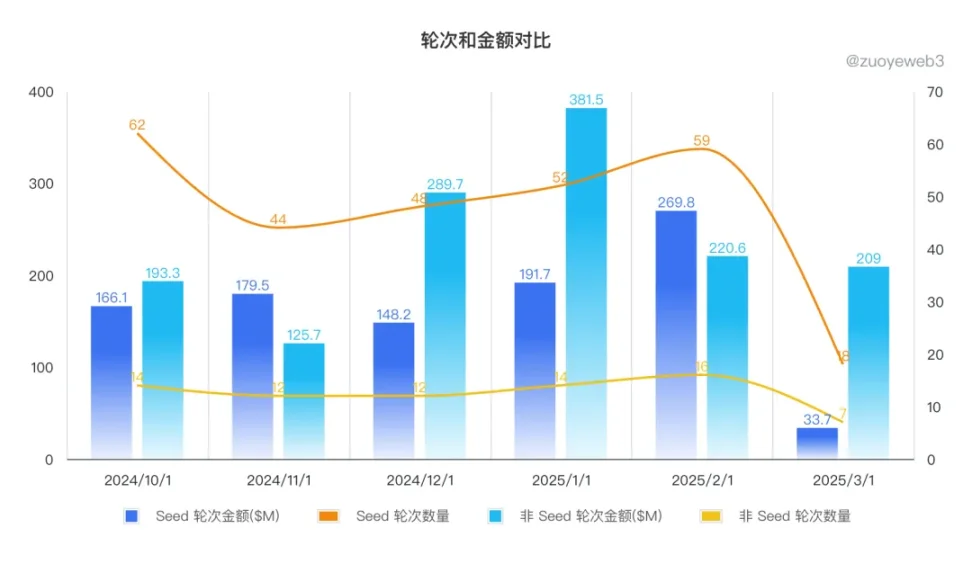
Data source: Decentralised Co., Chart by @zuoyeweb3
Under normal conditions, seed rounds should vastly outnumber later stages, while subsequent rounds should involve significantly larger amounts.
However, data from the past six months shows that seed round counts don’t dominate A/B/C rounds. Worse, funding amounts across stages are strikingly similar. The erosion of distinct crypto funding stages is real: those who get small sums will keep getting them; those who don’t will remain unfunded.
Invest When AI Is Cold, Hype During Meme-Season
Whether Web2 or Web3, AI is currently cooling off—but CZ thinks it needs to cool further before he acts. Only true builders and the most faithful believers need apply.
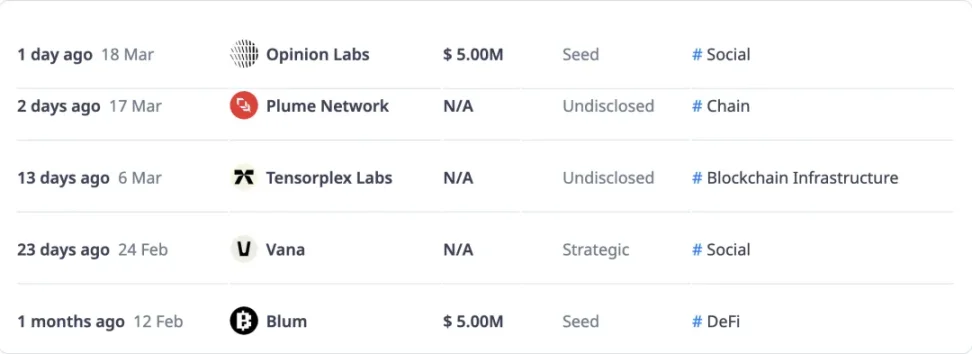
Caption: YZi's portfolio projects. Image source: CryptoRank
That said, YZi does show interest in AI. In fact, most projects today can somehow tie into AI, so they fall into two arbitrary categories: “using crypto for AI,” such as Vana and Tensorplex Labs, and “using AI for crypto,” like Plume Network, Blum, and Opinion Labs.
This classification is forced and lacks practical value. In an era where AI enhances postpartum care for sows, debating the necessity of AI feels equally absurd.
Let’s walk through each project chronologically and highlight their features.
1. Opinion Labs = Kaito + Polymarket
Opinion Labs is a human opinion-driven prediction market. I’d speculate its future lies in leveraging Twitter KOLs for predictions and trading—tapping into InfoFi trends while riding the evergreen appeal of speculative trading, flexible both offensively and defensively.
2. Plume Network = Everything Can Be RWA
RWA isn’t new, but Plume Network’s journey is legendary. After securing $30 million from top-tier firms like Galaxy, it surprisingly chose Gate.io for an IEO this January before receiving investment from YZi—and saw its token price surge as a result.
Calm under pressure, flexible in execution—this is the demeanor shaped by crypto experience. Launching tokens early, then raising capital later is an opportunity unique to this era.
3. Tensorplex Labs = LSD + AI
I believe decentralized AI is a pseudo-concept. Tensorplex Labs aims to use LSDfi to ensure decentralization in LLM training and datasets. While this holds little productive value, in a crypto ecosystem eager to contribute to AI, securing funding from niche investors isn’t uncommon.
Still, this matters for future token prices—after all, product and token value often diverge. Otherwise ADA and XRP would be deeply embarrassed.
4. Vana = Cyclical AI Concept Token
Funded by Polychain in 2021, Paradigm in 2022, Coinbase in 2024, and now YZi Labs in 2025, Vana has successfully entered Binance Launchpool.
A classic VC-backed token from the last cycle, it offers no relevance to current or future projects—just evokes envy.
5. Blum = The Sole Seed Round Contender + Trading
This epitomizes Binance Labs’ investment style: DeFi products with trading focus, rare as a seed-stage pick. Even rarer? Joint investment by OKX and YZi—proving that despite past rivalries, brothers reunite when going overseas.
Forgive me for not diving deep into mechanisms or tokenomics—they’re meaningless anyway. What defines a meme’s fundamentals? How is a community different from a pump group? What actual role does tokenomics play? I call these the three unsolved mysteries of crypto.
Embracing Family Office Aesthetics: Stability Above All
YZi is highly representative and familiar to Chinese audiences. Yet following the wealth creation wave of 2017–2021, crypto’s new money has gradually transitioned into old-school family offices—less focused on sky-high returns, more on project stability.
Two years ahead of CZ, BitMEX founder and original derivatives king Arthur Hayes established his family office, Maelstrom, funded entirely from personal assets. Like CZ recalling Ella Zhang, Maelstrom is run daily by former BitMEX executive Akshat Vaidya.
History proves Arthur Hayes not only created perpetual futures perfectly suited to crypto natives, but also developed a unique investment eye—backing Ethena, the post-UST stablecoin innovation that kicked off on-chain protocols profiting from exchange fee rebates, and Pendle, a cross-era DeFi breakthrough.
A full feature on Arthur Hayes will follow—he’s an OG worth studying far more than Sun Zhengyi or CZ.
Like YZi, Maelstrom prioritizes stability: avoiding memes, focusing instead on meme-adjacent tools and infrastructure like Time.Fun. Success isn’t measured by ROI—it’s all about consistency, stability first.
Yet YZi’s style remains fluid. In Binance Labs’ history, guaranteed listing on Binance main site was a powerful advantage. But now, the landlord’s grain silo is empty. By end-2024, YZi began transferring invested project tokens to Gate.io—once again, Gate bears the burden of all.
Unlike Arthur Hayes, who personally champions Ethena, CZ hasn’t deeply bonded with any single project. YZi hasn’t developed a clear investment thesis either. As previously noted, Binance Labs favors trading-related products. But beyond the DeFi high-yield era, Ethena and Pendle are exceptions. Most are just “Crypto + AI” token sales—scraps from Web2 AI, minor pride points for Web3 AI.
As YZi increasingly operates outside Binance’s ecosystem, its true strength awaits market validation—a test especially dependent on CZ’s personal investing acumen. Judging from his moves—waiting for AI to cool further, building the BNB Chain meme ecosystem post-$TRUMP—I find them less elegant than his earlier guidance to Ben Zhou on rejecting user withdrawals and precisely capturing OKX DEX market share.
Though perhaps that’s because CZ truly doesn’t trade—only builds trading platforms.
Conclusion
The world of yesterday is gone forever.
Crypto venture capital truly began with the IXO era, peaked before FTX’s collapse (I must always mention SBF—he single-handedly reshaped industry trends), and now merely completes existing investment pipelines. It endures retail fury, striving only to finish token distributions.
There was never really crypto VC to begin with. It’s just that after enough investments were made, risk emerged.
Join TechFlow official community to stay tuned
Telegram:https://t.me/TechFlowDaily
X (Twitter):https://x.com/TechFlowPost
X (Twitter) EN:https://x.com/BlockFlow_News
 @zuoyeweb3