Huobi Growth Academy | In-depth Research Report on Ethereum Prague Upgrade: Technical Innovations, Ecosystem Impact, and Future Outlook
TechFlow Selected TechFlow Selected
Huobi Growth Academy | In-depth Research Report on Ethereum Prague Upgrade: Technical Innovations, Ecosystem Impact, and Future Outlook
From an investment perspective, every Ethereum upgrade could serve as a key catalyst for shifts in market sentiment.
 Navigating Web3 tides with focused insights
1. Introduction: A Look Ahead at the Prague Upgrade
Since its official launch in 2015, Ethereum has remained a central hub for technological innovation and application exploration within the blockchain industry. As a pioneering platform, Ethereum not only led the wave of smart contracts and decentralized applications (DApps), but also profoundly influenced fields such as decentralized finance (DeFi), non-fungible tokens (NFTs), and other blockchain-based applications. However, Ethereum's technical evolution has never stopped. From its initial Proof-of-Work (PoW) consensus mechanism to the completion of "The Merge" in September 2022—marking the transition to Proof-of-Stake (PoS)—Ethereum has continuously pursued more efficient, environmentally friendly, and scalable solutions. Today, the upcoming Prague Upgrade is once again drawing widespread market attention.
The Prague Upgrade represents another significant technical iteration for Ethereum, following closely after the Cancun Upgrade in March 2024, further optimizing network performance, reducing transaction costs, and enhancing the programmability of smart contracts. Compared to previous upgrades, Prague involves not only adjustments to the underlying protocol, but also includes a series of impactful EIPs (Ethereum Improvement Proposals), including optimizations for the Ethereum Virtual Machine (EVM), staking mechanisms, Rollup performance, interaction cost reduction, and storage management improvements. These changes enhance the overall efficiency of the Ethereum mainnet while providing stronger infrastructure support for Layer 2 solutions, DeFi protocols, NFT markets, and beyond.
Every major Ethereum upgrade brings sharp market fluctuations and deep community discussions, and the Prague Upgrade is no exception. For developers, new features and optimizations mean more powerful development tools, more efficient smart contract execution, and lower computational and storage costs—further incentivizing the creation of more complex and innovative applications on the Ethereum network. For regular users, the Prague Upgrade could mean faster transactions, lower fees, and a safer on-chain experience. More importantly, given the massive scale of the Ethereum ecosystem, this upgrade will impact not only Ethereum itself but ripple across the entire cryptocurrency industry—especially projects relying on Ethereum’s infrastructure, such as Layer 2 scaling solutions, cross-chain bridges, and decentralized exchanges (DEXs).
Additionally, from an investment perspective, each Ethereum upgrade may act as a key catalyst for shifts in market sentiment. Historical patterns show that major upgrades often reshape market expectations about Ethereum’s future, influencing ETH price volatility. As the Prague Upgrade approaches, market participants are closely watching its potential price implications: on one hand, improved network performance may increase ETH utility and thus its intrinsic value; on the other hand, uncertainties around successful implementation, potential risks, or short-term instability could dampen market confidence.
2. Overview of the Prague Upgrade
2.1 What Is the Prague Upgrade?
The Prague Upgrade is a significant update to the Ethereum protocol, continuing and expanding upon core goals from prior upgrades—optimizing network performance, lowering transaction costs, enhancing smart contract functionality, and laying the groundwork for future scalability and innovation. This upgrade forms part of Ethereum’s long-term technology roadmap, shaped by community consensus, developer needs, and real-world feedback, further strengthening Ethereum’s competitiveness as the leading global smart contract platform. Ethereum upgrades typically occur via "hard forks," requiring all nodes to upgrade their software to maintain network compatibility. The Prague Upgrade is also a hard fork, meaning it will activate at a specific block height and be implemented synchronously across the entire network. Once activated, all Ethereum nodes must run clients with the new protocol rules, or they will fall out of sync with the network. This process demands thorough preparation from developers, validators, stakers, and ordinary users to ensure a smooth transition.
Technically, the Prague Upgrade integrates a suite of optimization measures approved through Ethereum Improvement Proposals (EIPs) and community discussion. These enhancements touch critical areas such as the Ethereum Virtual Machine (EVM), gas fee structure, storage management, and contract execution efficiency. The EVM, as Ethereum’s core execution environment responsible for deploying and running smart contracts, means any modifications can have broad ecosystem-wide effects. In this upgrade, the EVM receives new instruction set optimizations, accelerating smart contract execution and reducing computation costs. Additionally, gas calculation logic is refined to allocate resources more fairly across different operations, mitigating fee spikes during network congestion.
For end users, the Prague Upgrade directly improves transaction cost and execution efficiency. High transaction fees have long been a top concern for users, especially during peak network usage when gas prices can surge, making small transactions prohibitively expensive and hindering adoption of DeFi, NFTs, and blockchain gaming. By optimizing gas pricing, improving transaction bundling strategies, and enhancing Layer 2 compatibility, the Prague Upgrade delivers a more stable and predictable cost structure. This improves user experience and strengthens Ethereum’s competitive edge against other blockchains like Solana, Avalanche, and BNB Chain.
Furthermore, the Prague Upgrade enhances native support for Layer 2 solutions. In recent years, rapid growth in Ethereum’s Layer 2 ecosystem has significantly alleviated mainnet congestion, allowing users to conduct faster, cheaper transactions via Rollup technologies. However, Layer 2 development remains constrained by limitations in the mainnet architecture—such as data availability, bridge security, and withdrawal delays. The Prague Upgrade addresses these issues, improving Ethereum’s native support for Layer 2 systems and enabling more efficient and secure operation of second-layer networks. This advancement supports the continued growth of Rollups and lays technical foundations for future modular blockchain architectures.
In the long term, the Prague Upgrade is not merely a technical improvement—it marks a crucial step toward greater scalability, superior user experience, and a more vibrant developer ecosystem. It sets the stage for future upgrades, further refinements of Ethereum 2.0, and long-term plans like Danksharding, ensuring Ethereum remains at the forefront of blockchain innovation. As the upgrade draws near, the market, developers, investors, and users alike are closely monitoring its final outcomes and potential cascading impacts on both the Ethereum ecosystem and the broader crypto industry.
3. Technical and Ecosystem Impact of the Prague Upgrade
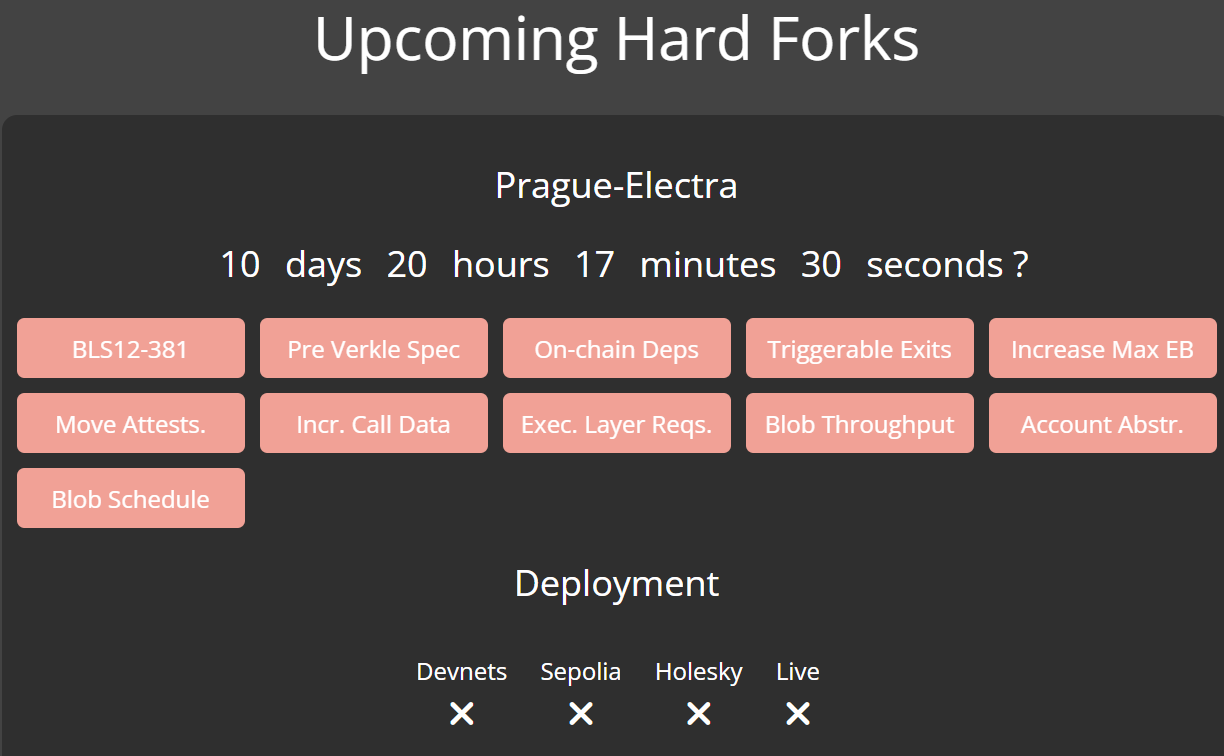
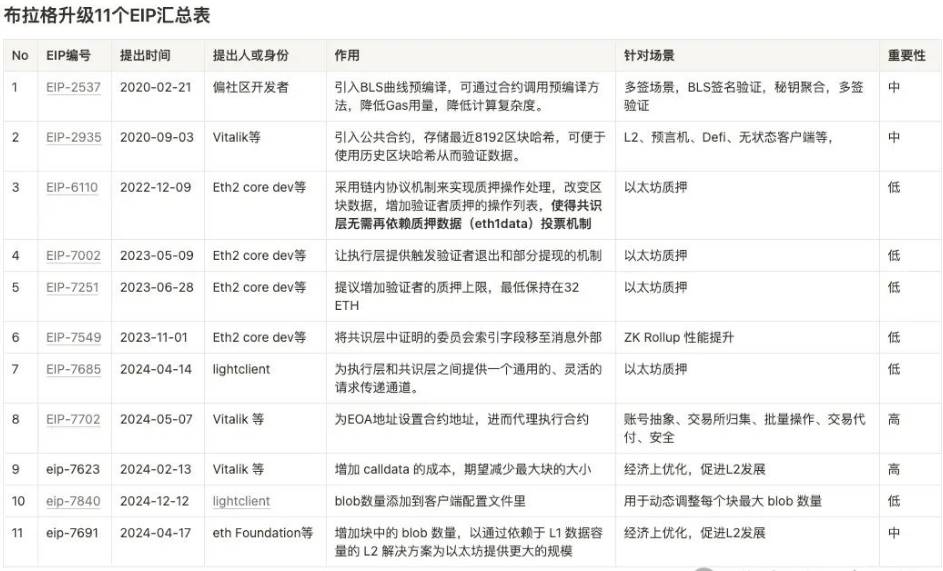
The Ethereum Prague Upgrade is a comprehensive hard fork focused on enhancing the ecosystem’s scalability, security, and user experience. This release introduces multiple technical adjustments aimed at improving on-chain operations, staking mechanisms, and Layer 2 (L2) network support, further advancing Ethereum’s ecosystem. Below are the key EIPs included in the Prague Upgrade:
3.1 Account Abstraction (EIP-7702)
EIP-7702 is a pivotal proposal in the Prague Upgrade, introducing account abstraction to change how Ethereum accounts are managed. Users will no longer need to convert between account types (EOA → CA), and can instead use their externally owned accounts (EOAs) directly for various operations such as authorization and fee delegation. This significantly reduces operational costs and makes on-chain interactions simpler and smoother.
Key Implications:
User Experience Enhancement: By simplifying workflows, users avoid the need to register or manage complex account structures, lowering entry barriers.
Impact on DApps: For DApps like exchanges, batch collection capabilities reduce operational overhead and improve efficiency. However, this also introduces security risks—account abstraction increases the complexity of permission management.
3.2 Staking Mechanism Optimizations
The Prague Upgrade introduces several improvements to Ethereum’s staking mechanism, aiming to enhance security and flexibility while preserving decentralization.
EIP-6110: Streamlines staking operations by integrating validator-related actions directly into the execution layer, removing reliance on consensus-layer voting mechanisms.
EIP-7251: Increases the maximum effective stake limit per validator to 2048 ETH, reducing management complexity and system redundancy.
EIP-7549: Enhances staking flexibility by enabling validators to perform partial withdrawals and exits more easily.
These improvements aim to strengthen network security while mitigating risks of validator centralization. For stakers, these updates offer greater flexibility and compounding opportunities, though they also raise concerns about potential centralization trade-offs.
3.3 Support for Layer 2 Networks (L2 Optimization)
With the continuous expansion of Ethereum’s L2 ecosystem, the Prague Upgrade places special emphasis on L2 support and optimization.
EIP-7623 & EIP-7691: These proposals enhance L2 storage capacity and throughput. EIP-7623 increases gas costs for calldata to reduce L2 dependence on mainnet data, while EIP-7691 expands Blob capacity to increase available storage space.
Blob Optimization: Ethereum increases the capacity and configuration flexibility of Blob data structures, strengthening support for L2 networks. This enables more L2 solutions to operate efficiently on the Ethereum main chain and improves their processing capabilities.
These efforts reflect Ethereum’s strategy to build a stronger L2 ecosystem capable of supporting high-frequency trading and large-scale applications.
3.4 Improvements in Data Availability and Throughput
The Prague Upgrade also focuses on data availability and throughput, particularly in support of stateless clients. For example, EIP-2935 optimizes the storage of historical block hashes, allowing clients to access recent block data without storing the full chain history. This is significant for future optimizations such as Verkle trees, as well as for applications like Rollups and oracles.
3.5 Impact of the Prague Upgrade on the Ethereum Ecosystem
Although the Prague Upgrade has not generated the same level of public excitement as "The Merge," it plays a vital role in Ethereum’s long-term development. It positions Ethereum more effectively for the L2 era, improving scalability, security, and decentralization. With upcoming upgrades (such as Osaka and Amsterdam hard forks), Ethereum will continue to evolve toward ambitious goals like "The Surge" (millions of transactions per second) and "The Scourge" (minimizing centralization risks).
The Prague Upgrade is a crucial milestone in Ethereum’s evolution. While it hasn’t sparked widespread market frenzy like the "London" or "Merge" upgrades, its technical refinements lay a stronger foundation for scalability and decentralization. Through account abstraction, staking optimizations, and enhanced L2 support, Prague makes Ethereum more efficient, user-friendly, and resilient. Going forward, Ethereum is expected to continue a series of upgrades to achieve higher performance and reduced centralization risks, further solidifying its dominant position in the blockchain ecosystem.
4. Challenges and Controversies of the Prague Upgrade
The Prague Upgrade marks a significant evolution for the Ethereum network. Despite bringing numerous technical improvements, its implementation faces several challenges and controversies. These stem not only from technical hurdles but also from balancing stakeholder interests and defining Ethereum’s long-term direction. Key challenges include:
4.1 Security Risks Introduced by Account Abstraction
EIP-7702 in the Prague Upgrade introduces account abstraction, enabling more flexible transaction methods at the protocol layer. The core idea is to eliminate distinctions between account types on-chain, allowing users to perform advanced operations directly from externally owned accounts (EOAs) without first converting to contract accounts (CAs). This optimization greatly reduces interaction costs and enables functions like delegated authorization and execution within a single account. However, this flexibility introduces potential security vulnerabilities. While interaction costs are lowered, permission management becomes more complex. If wallet providers fail to properly implement this feature, unexpected security flaws may emerge. Previously, user losses were typically limited to assets on a single chain. But with account abstraction, a single vulnerability could lead to cross-chain losses or even cascading attacks. Hackers might exploit implementation flaws for phishing attacks, especially if wallets do not adapt correctly. Therefore, despite usability gains, security remains a major concern in the Prague Upgrade.
4.2 Challenges in the L2 Ecosystem and Scalability
The Prague Upgrade emphasizes optimization of Ethereum’s Layer 2 (L2) ecosystem, particularly in data storage and computational efficiency. Through EIP-7623 and EIP-7691, the upgrade enhances L2 storage and processing power, enabling L2s to handle more transactions and data. However, managing and optimizing transaction costs and liquidity across L2s remains a significant challenge. Although EIP-7623 increases calldata fees to reduce L2 dependency on the mainnet, this may raise operating costs for some L2s. If L2 systems cannot adapt efficiently, it could harm their sustainability and user experience. Moreover, while L2 scaling relieves pressure on the Ethereum mainnet, interoperability among different L2s continues to plague the ecosystem. As more L2 solutions emerge, coordination across chains—regarding communication, transactions, and data sharing—becomes increasingly complex. Fragmented liquidity and security across L2s could undermine overall ecosystem stability and efficiency. Thus, despite substantial efforts to optimize L2s, the actual effectiveness remains to be seen—particularly regarding L1-L2 coordination and ensuring transparency and verifiability of L2 transactions.
4.3 Adaptation Challenges for Developers and the Community
The Prague Upgrade incorporates multiple EIPs, some of which bring profound changes to the Ethereum ecosystem. While these changes theoretically enhance network performance and user experience, practical adoption may face resistance from developers and users. The introduction of new technologies like account abstraction and BLS signatures may require developers to refactor existing DApps, creating short-term development and adaptation pressure.
More critically, core proposals such as EIP-7702 and EIP-2537 may demand significant time and effort from developers to learn new frameworks and standards. If the developer community fails to keep pace, some DApps may not adapt in time, potentially harming the healthy growth of the Ethereum ecosystem. Additionally, community acceptance of these technical changes varies. Ethereum has experienced past disagreements and divisions, and certain aspects of the Prague Upgrade—particularly around staking mechanisms and L2 optimizations—could spark renewed debate. Balancing technological innovation with decentralization and network security remains an ongoing challenge for Ethereum’s developers and community.
4.4 Market Response and Pressure from Competing Chains
While the Prague Upgrade aims to improve Ethereum’s scalability, user experience, and security, competition in the multi-chain landscape is intensifying. Ethereum faces strong pressure from alternative public chains such as Solana, Aptos, and Polkadot, as well as from Layer 2 solutions like Arbitrum and Optimism. These competing platforms often offer higher transaction speeds and lower fees. While Ethereum’s L2 optimizations help mitigate this gap, if the L2 ecosystem underperforms, Ethereum risks losing market share. Furthermore, although the Prague Upgrade introduces many technical improvements, the market’s actual response remains uncertain. If Ethereum fails to attract more developers and users in the short term, its market position could be challenged. Additionally, while Prague enhances throughput and efficiency, maintaining Ethereum’s original decentralization and avoiding excessive concentration remain focal points for the market and community.
The Prague Upgrade is undoubtedly a pivotal moment in Ethereum’s history, representing significant progress in network performance, scalability, and user experience. However, the path forward is not without obstacles. Centralization risks, security vulnerabilities, L2 management issues, and community adaptation challenges all pose serious hurdles to the upgrade’s successful implementation and long-term success. Nevertheless, the Prague Upgrade lays essential groundwork for Ethereum’s future. As these issues are gradually addressed, Ethereum is poised to evolve into a more efficient, secure, and decentralized network.
5. Future Outlook
The Prague Upgrade is a landmark event in Ethereum’s development, establishing a critical foundation for its future trajectory. As technology advances, the upgrade will have far-reaching effects on the Ethereum ecosystem—particularly in scalability, decentralization, security, and user experience. Below, we explore two dimensions of the Prague Upgrade’s impact and future prospects.
5.1 Positive Impacts of the Prague Upgrade
Through a series of technical optimizations and protocol enhancements, the Prague Upgrade delivers notable improvements to the Ethereum network. By refining transaction data storage, computational efficiency, and interaction models, Ethereum can now process more transactions and smart contracts with greater efficiency, significantly boosting network throughput. Especially through enhanced support for Layer 2 (L2) solutions, the upgrade substantially reduces the burden on the Ethereum mainnet and strengthens overall scalability. L2 solutions not only enable faster, cheaper transactions but also increase Ethereum’s transaction capacity, supporting a wider range of DApps and user demands. With support from proposals like EIP-7623 and EIP-7691, the integration of L2 solutions on Ethereum becomes more seamless. By offloading computation and data processing to L2s, the Prague Upgrade effectively alleviates mainnet congestion, paving the way for future application growth.
Multiple optimizations in the Prague Upgrade—including account abstraction (EIP-7702) and revised fee models—greatly improve transaction efficiency and lower costs. Account abstraction allows users greater flexibility in executing transactions, simplifying complex logic. Meanwhile, optimized gas fees and reduced execution costs enable higher-frequency interactions without sacrificing user experience, increasing overall network efficiency. These improvements particularly benefit users and developers in DeFi and NFT markets. Lower fees and higher throughput make it easier for users to engage with DeFi protocols and boost activity in the NFT marketplace.
At the same time, the Prague Upgrade strengthens Ethereum’s security, especially in Proof-of-Stake (PoS) and staking system optimizations. Staking improvements enhance the network’s resilience against attacks, increase staking thresholds, expand the validator pool, and promote validator diversity—reducing the risk of 51% attacks. The updated staking model leads to a more distributed validation node network, minimizing single points of failure and strengthening resistance to malicious behavior.
Another key enhancement is the introduction of stronger consensus algorithms, particularly support for BLS signatures, which improves the security of data verification and storage. By reinforcing network security, the Prague Upgrade enhances Ethereum’s stability in high-risk environments, especially for financial applications, ensuring a safer and more reliable transaction environment.
Although staking centralization remains a point of contention, the Prague Upgrade overall strengthens Ethereum’s decentralization. By increasing validator diversity, lowering entry barriers, and supporting smaller validators, the upgrade advances Ethereum’s decentralization journey.
Finally, account abstraction and smart contract optimizations empower developers with new tools to build decentralized applications (DApps). Combined with lower transaction costs and improved execution speed, these upgrades foster innovation in the decentralized ecosystem. The Prague Upgrade not only enhances network flexibility but also provides technical support for emerging innovations in DAOs and DeFi.
5.2 Future Outlook: The Ethereum Ecosystem Post-Prague
With the successful implementation of the Prague Upgrade, Ethereum’s future ecosystem will unlock numerous new possibilities. Below are several key outlooks:
5.2.1 Ethereum Will Become a More Efficient Multi-Chain Hub
By strengthening support for L2 solutions, the Prague Upgrade provides robust technical foundations for Ethereum to expand into a multi-chain ecosystem. In the future, Ethereum will no longer function merely as a standalone blockchain but as a central hub connecting and collaborating with other public chains like Polkadot and Cosmos through cross-chain interoperability and data exchange. As L2 technologies mature and optimize, the Ethereum network will host more DApps and smart contracts that operate efficiently and affordably. Further improvements in cross-chain capabilities will position Ethereum as the core nexus for decentralized finance (DeFi) and digital asset management, where cross-chain protocols and asset flows become integral to ecosystem growth. The Prague Upgrade reinforces Ethereum’s strategic role as a cross-chain hub, enhancing its competitiveness in multi-chain interoperability.
5.2.2 Accelerated Growth of Decentralized Finance (DeFi)
Lower transaction fees and higher throughput create favorable conditions for the expansion of the DeFi ecosystem. DeFi protocols will no longer face bottlenecks from mainnet congestion and high costs, enabling broader participation from users and developers. New transaction models, more efficient lending markets, liquidity pools, and decentralized derivatives markets will mature under the Prague framework, giving rise to richer financial products. Particularly in automated market makers (AMMs) and decentralized exchanges (DEXs), the Prague Upgrade’s enhanced network support and improved transaction models will drive the large-scale adoption of DeFi. Beyond basic lending and trading, DeFi may soon encompass financial derivatives, insurance, and stablecoin issuance.
5.2.3 Continued Prosperity of the NFT and Digital Art Markets
The Prague Upgrade also lays a stronger foundation for NFT market growth. Low transaction costs and efficient smart contract execution make minting, trading, and transferring NFTs more economical and streamlined. Artists, creators, and brands will gain greater opportunities to publish and trade digital works on Ethereum, while the diversity and innovation of NFTs will continue to propel the digital art market forward. NFT smart contracts will extend beyond art trading into gaming, music, entertainment, and more. The Prague Upgrade delivers a more efficient transaction experience for NFTs and makes NFT-based business models more sustainable.
5.2.4 Enhanced Decentralized Governance in the Ethereum Ecosystem
The Prague Upgrade is not just a technical refinement—it also strengthens Ethereum’s decentralized governance. By increasing staking transparency, promoting validator diversity, and reducing reliance on centralized entities, Ethereum’s governance structure becomes more open and decentralized. In the future, as DAO (decentralized autonomous organization) models mature, more governance decisions will be made through community consensus, achieving true decentralized autonomy. These governance improvements also serve as a model for other blockchain projects, encouraging wider adoption of blockchain innovations in organizational governance.
In summary, the Prague Upgrade is a milestone in Ethereum’s development, ushering in unprecedented technological progress. Going forward, Ethereum will continue to break new ground in performance, ecosystem diversity, and decentralized governance, offering users worldwide a more efficient, secure, and decentralized blockchain platform. Despite facing technical and governance challenges, the post-Prague Ethereum ecosystem holds immense potential—worthy of our continued attention and anticipation.
Join TechFlow official community to stay tuned
Telegram:https://t.me/TechFlowDaily
X (Twitter):https://x.com/TechFlowPost
X (Twitter) EN:https://x.com/BlockFlow_News
 @HTXAcademy