The Underrated Solana DeFi: How to Break the "Internal Friction" Between High-Yield Staking and Lending Protocols?
TechFlow Selected TechFlow Selected
The Underrated Solana DeFi: How to Break the "Internal Friction" Between High-Yield Staking and Lending Protocols?
After the MEME craze subsided, Solana's on-chain transaction volume plummeted over 90%; the 7%-8% staking yield from validator nodes acts like a black hole absorbing liquidity, leaving lending protocols struggling under suppressed yields.
 Navigating Web3 tides with focused insights
Author: Frank, PANews
Traditional financial giant Franklin Templeton recently released a research report on the Solana DeFi ecosystem, pointing out that despite Solana's DeFi sector significantly outperforming Ethereum in terms of transaction volume growth and protocol revenue, its related token market capitalization remains severely undervalued. Data shows that in 2024, the average growth rate of leading Solana DeFi projects reached as high as 2,446% (compared to just 150% for Ethereum), while the market cap-to-revenue ratio stood at only 4.6x (versus 18.1x for Ethereum), making it appear distinctly like an undervalued market.
However, as the market focuses on Solana’s DEX transaction volume capturing 53% of the entire network—a remarkable achievement—its ecosystem's "other side" is quietly turbulent. After the MEME coin frenzy subsided, on-chain trading volume plummeted over 90%. Meanwhile, staking yields of 7%-8% from validator nodes act like a black hole, draining liquidity, leaving lending protocols struggling under suppressed returns. Behind this data paradox and the ensuing value revaluation game, Solana’s DeFi ecosystem now stands at a critical crossroads—will it continue playing the role of a “Crypto Nasdaq,” or take the risk to transform into an all-in-one financial protocol arena? The upcoming vote on the SIMD-0228 inflation reduction proposal may determine the final direction of this ecological revolution.
Solana DEX Transaction Volume Now Holds Half of Global Market Share
Franklin Templeton’s report primarily uses Solana’s DEX market share as its foundational argument. Indeed, over the past year, Solana’s DEX transaction volume has achieved impressive results.
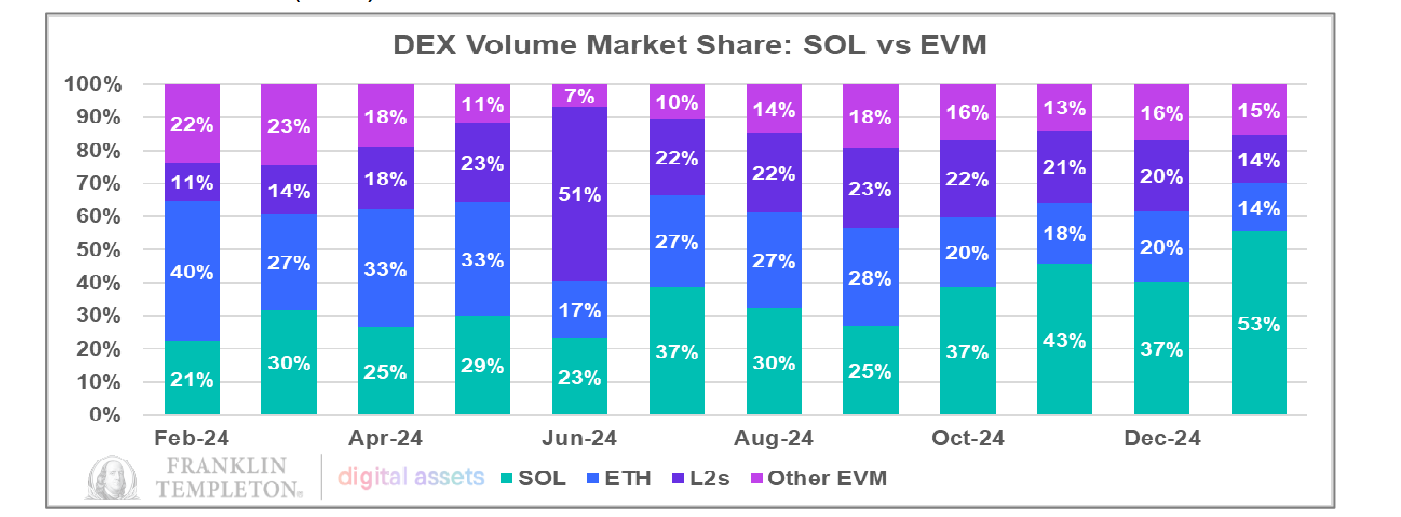
In January, Solana’s DEX transaction volume surpassed not only Ethereum’s DEX volume but also the combined volume of all EVM-based DEXs, accounting for 53% of total global DEX volume.
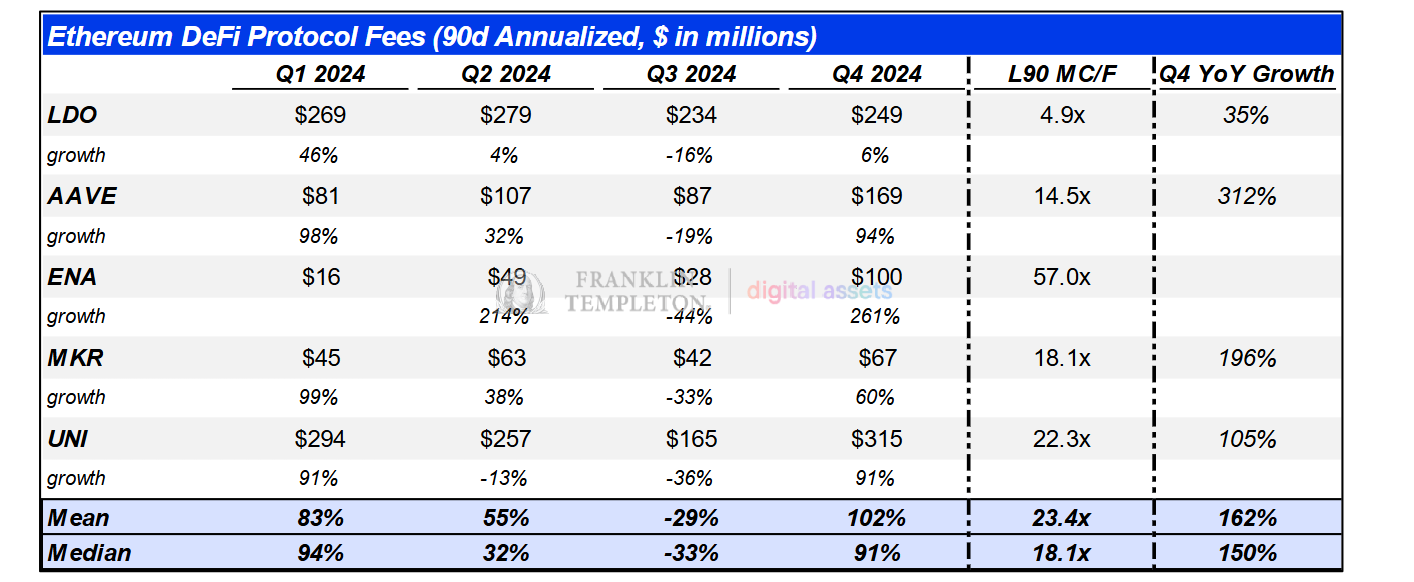
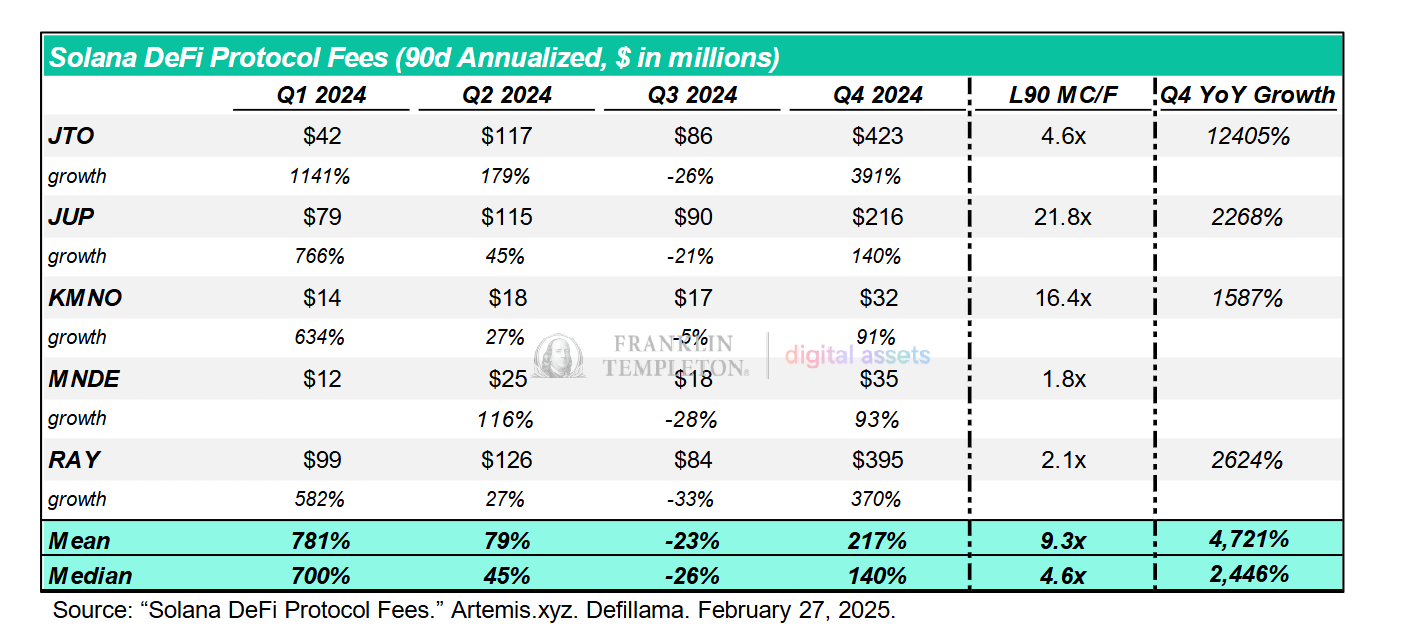
By comparing top-ranking DeFi projects on Solana and Ethereum, it can be seen that in 2024, the top five DeFi projects on Solana achieved an average growth rate of 2,446%, whereas Ethereum’s average was only 150%. In terms of market cap-to-revenue ratio, Ethereum averages 18.1x, while Solana stands at just 4.6x. From this perspective, Solana’s DeFi projects indeed hold clear advantages in revenue and transaction volume. However, whether this truly indicates that Solana’s DeFi is undervalued, and whether DeFi development will become the dominant trend going forward, requires deeper understanding of both ecosystems’ characteristics.
Ecological Positioning Choice: Trading Hub or Full-Service Bank?
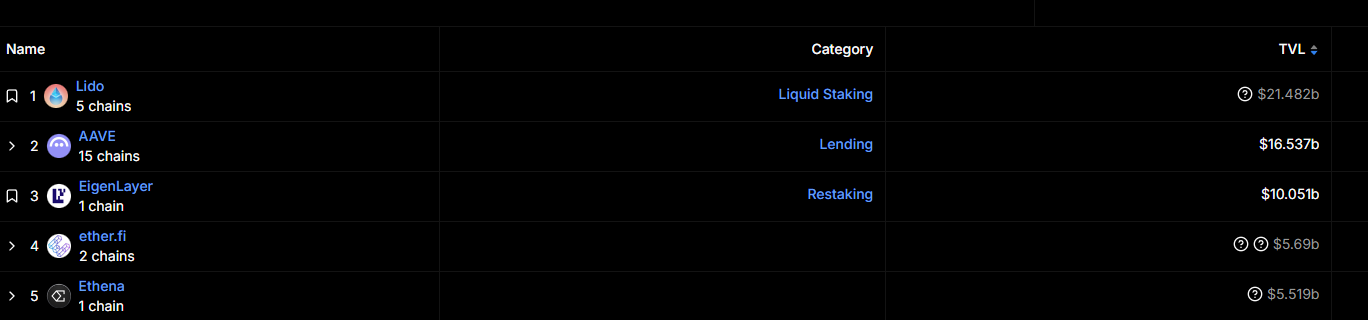
A comparison between DeFi protocols on Ethereum and Solana reveals that the top five DeFi projects on Ethereum are almost entirely focused on staking and lending.
On Solana, however, the top five projects by TVL are mostly aggregators or DEXs. Clearly, trading dominates Solana’s ecosystem.
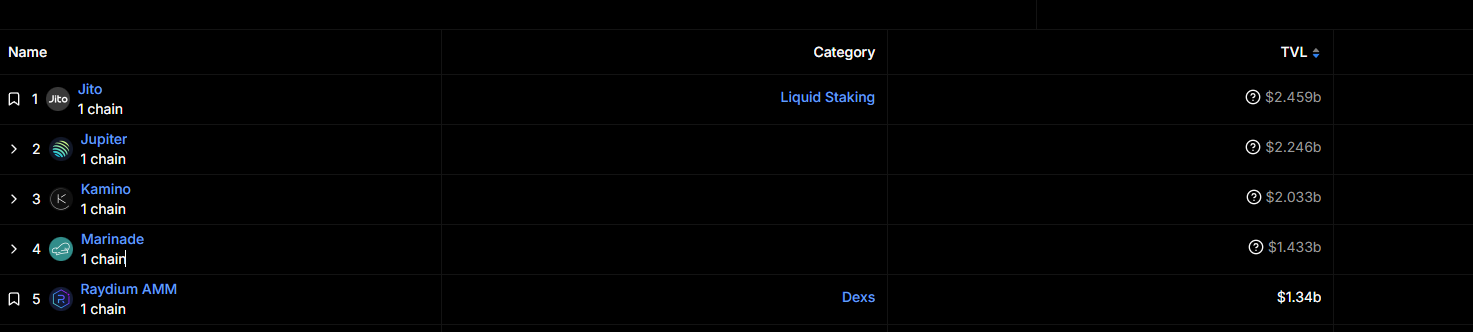
From this standpoint, if we compare both ecosystems to financial institutions, Ethereum resembles a bank, while Solana acts more like a securities exchange—one specializing in credit services, the other in trading. Their positioning differs significantly.
Currently, both face notable challenges. Ethereum, focused on credit, has struggled with value retention. Solana, centered on trading, clearly faces a shrinking market liquidity trend.
Given this imbalance in ecosystem positioning, expanding credit-related services might be a viable path for Solana. Yet such a transformation is long and difficult. Solana’s TVL has dropped 40% since January, though this decline is largely due to the falling price of SOL. In terms of SOL quantity, on-chain TVL hasn’t changed much.

Since Donald Trump launched his personal token, Solana’s DEX transaction volume has been declining. On January 18, DEX volume hit a record high of $35 billion, but by March 7, it had fallen to $2 billion.
After MEME Hype Fades, Capital Chases Staking Yields
Conversely, as SOL prices fall and MEME coins cool down, the number of tokens staked on-chain has actually continued rising recently. Take Jito, ranked first in TVL: the amount of staked SOL keeps climbing, reaching a total of 16.47 million SOL. In terms of inflows, the asset has remained in a net-inflow state recently. Since January 1, 2025, net inflows into SOL staking have increased by 12% year-on-year. Clearly, this TVL growth stems mainly from staking rather than active trading.

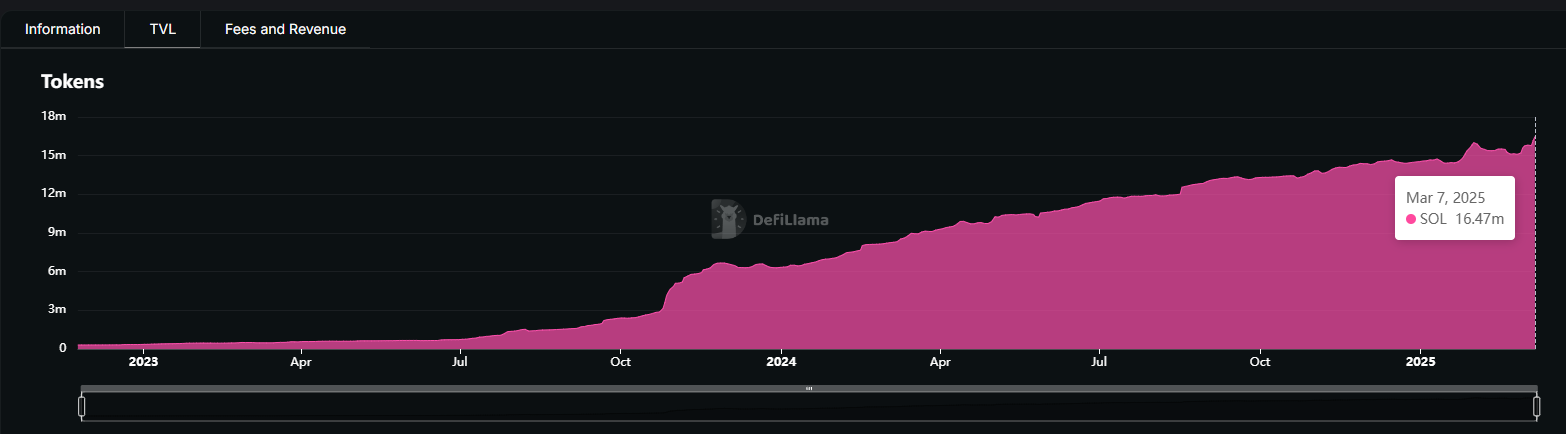
Yet this asset growth does not seem to flow into lending protocols—it instead goes directly to validators’ staking rewards. Even as validator staking yields decline, they still attract the majority of SOL’s TVL.
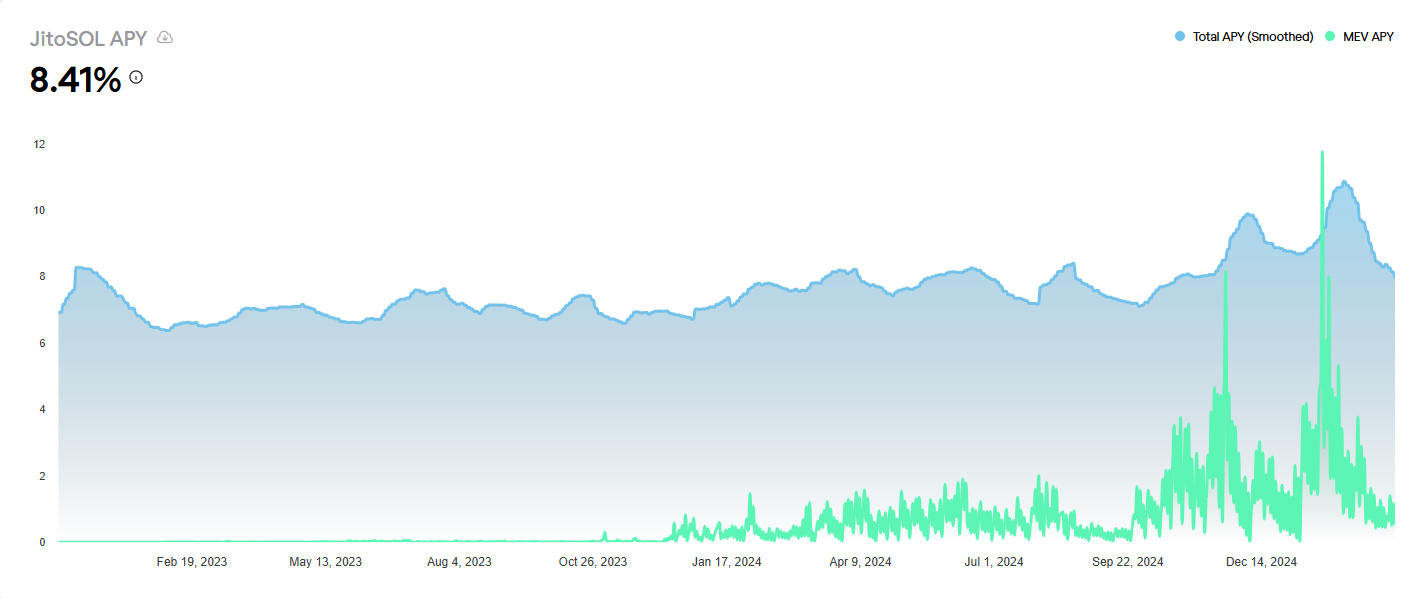
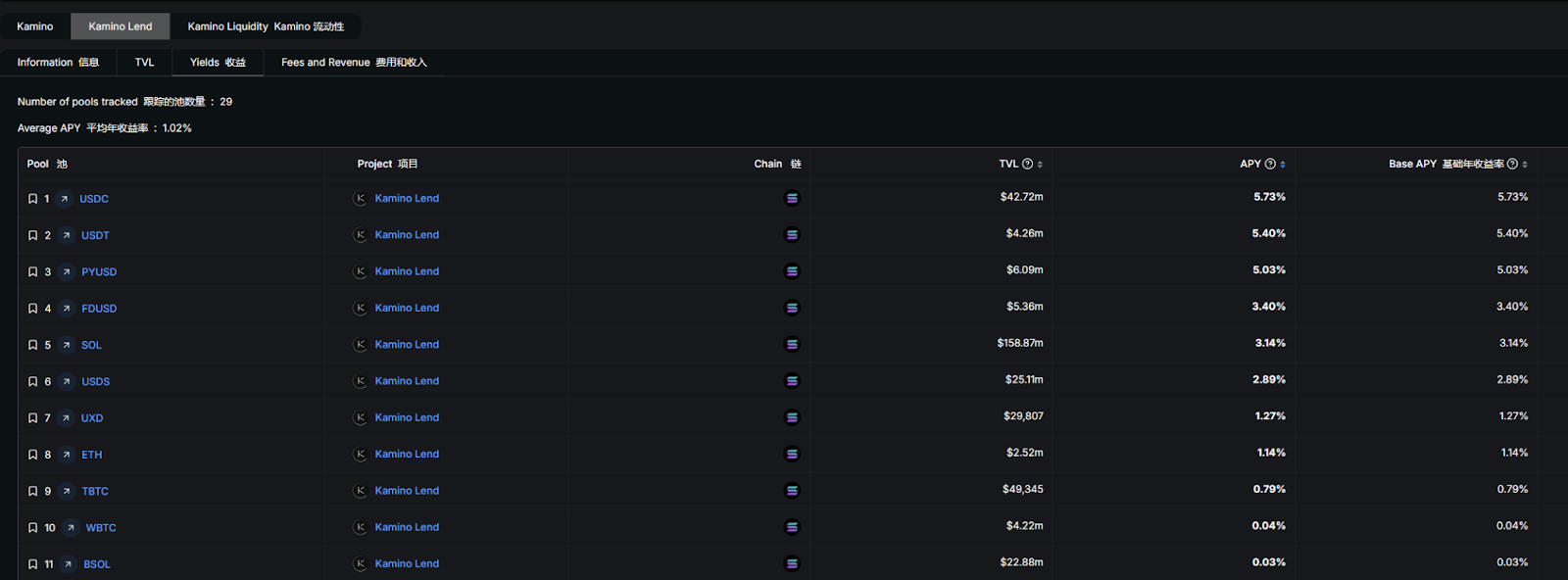
According to Jito data, since February, JitoSOL’s APY has been steadily declining, mirroring drops in bundled transaction counts and priority fee income across the network. As of March 7, JitoSOL’s APY has fallen to 8.41%. Still, compared to other staking categories on Kamino, it remains at least 3 percentage points higher.
8% Validator Yield Suppresses DeFi Liquidity; SIMD-0228 Proposal Aims to Unlock the Deadlock
In reality, validator staking yields on Solana consistently hover around 7%–8%, generally higher than returns from other types of DeFi protocols. This explains why a large portion of funds on Solana choose to stake with validator nodes rather than deposit into lending protocols like Kamino.
Recently, the SIMD-0228 proposal was introduced on Solana, aiming to dynamically adjust the inflation rate, cutting annual SOL issuance by 80%, while simultaneously lowering staking yields to encourage capital flow into other DeFi sectors. (Related reading: Solana’s Inflation Revolution: SIMD-0228 Sparks Community Debate, 80% Issuance Cut Hides “Death Spiral” Risk)
According to simulation results of the new proposal, if staking levels remain constant, on-chain staking yields would drop to 1.41%, an 80% decrease. Consequently, most funds might exit validator staking and shift toward other DeFi yield products.
But there's a logical issue here: the best way to drive capital into DeFi should be enhancing yields from other DeFi products—not reducing existing staking yields. After all, when capital exits validator nodes, it doesn't necessarily stay within the Solana ecosystem. Given capital’s profit-seeking nature, it's more likely to seek higher-yielding opportunities elsewhere.
Comparing several top TVL products on Ethereum such as AAVE and Lido, typical annualized yields for mainstream assets range between 1.5% and 3.7%. By comparison, Kamino on Solana still holds a certain yield advantage.
Still, for large-scale capital, another key consideration is liquidity depth. Currently, Ethereum remains the largest capital reservoir among all public blockchains. As of March 7, Ethereum accounts for 52% of total TVL—still half the market. Solana’s share is about 7.53%. The highest TVL project on Solana is Jito, with approximately $2.32 billion, a figure that would rank only 13th within Ethereum’s ecosystem.
For now, Solana’s DeFi still relies heavily on high yields. SVM and restaking platform Solayer recently announced native SOL staking with direct yields reaching around 12%. However, according to PANews' observation, these high yields are still achieved through combinations of validator staking.
If the SIMD-0228 proposal passes, DeFi protocols dependent on validator staking yields may face a "stampede risk" of capital withdrawal. After all, these major high-yield products primarily derive their returns from validator staking.
In the evolution of Solana’s DeFi ecosystem, although the brief peak in DEX transaction volume validates its technical architecture’s explosive potential, the negative coupling between staking yields and DeFi development looms like a Sword of Damocles over the ecosystem. The SIMD-0228 proposal attempts to sever this knot, but forced yield resets could trigger more complex butterfly effects across the chain than anticipated. Lily Liu, Chairperson of the Solana Foundation, expressed concern about the proposal on X, stating that “Proposal 0228 is too much of a prototype,” and could bring greater uncertainty.
From a strategic ecosystem perspective, what Solana needs to build is not merely a realignment of the yield curve, but a revolution in its fundamental value capture mechanism. Only when validator staking transforms from a yield fortress into a liquidity hub—or when lending protocols create compound yield models surpassing simple staking—can Solana truly unlock a closed-loop value cycle in DeFi. Ultimately, true ecosystem prosperity lies not in piling numbers within staking pools, but in enabling capital to form a perpetual motion cycle across lending, derivatives, and composability strategies—this may well be the “Goldbach’s Conjecture” that so-called “Ethereum killers” must collectively solve.
Join TechFlow official community to stay tuned
Telegram:https://t.me/TechFlowDaily
X (Twitter):https://x.com/TechFlowPost
X (Twitter) EN:https://x.com/BlockFlow_News
 PANews