WOO X Research: DeFi + Pump Fun, Can Super Exchanges Hold Their Ground in This Cycle?
TechFlow Selected TechFlow Selected
WOO X Research: DeFi + Pump Fun, Can Super Exchanges Hold Their Ground in This Cycle?
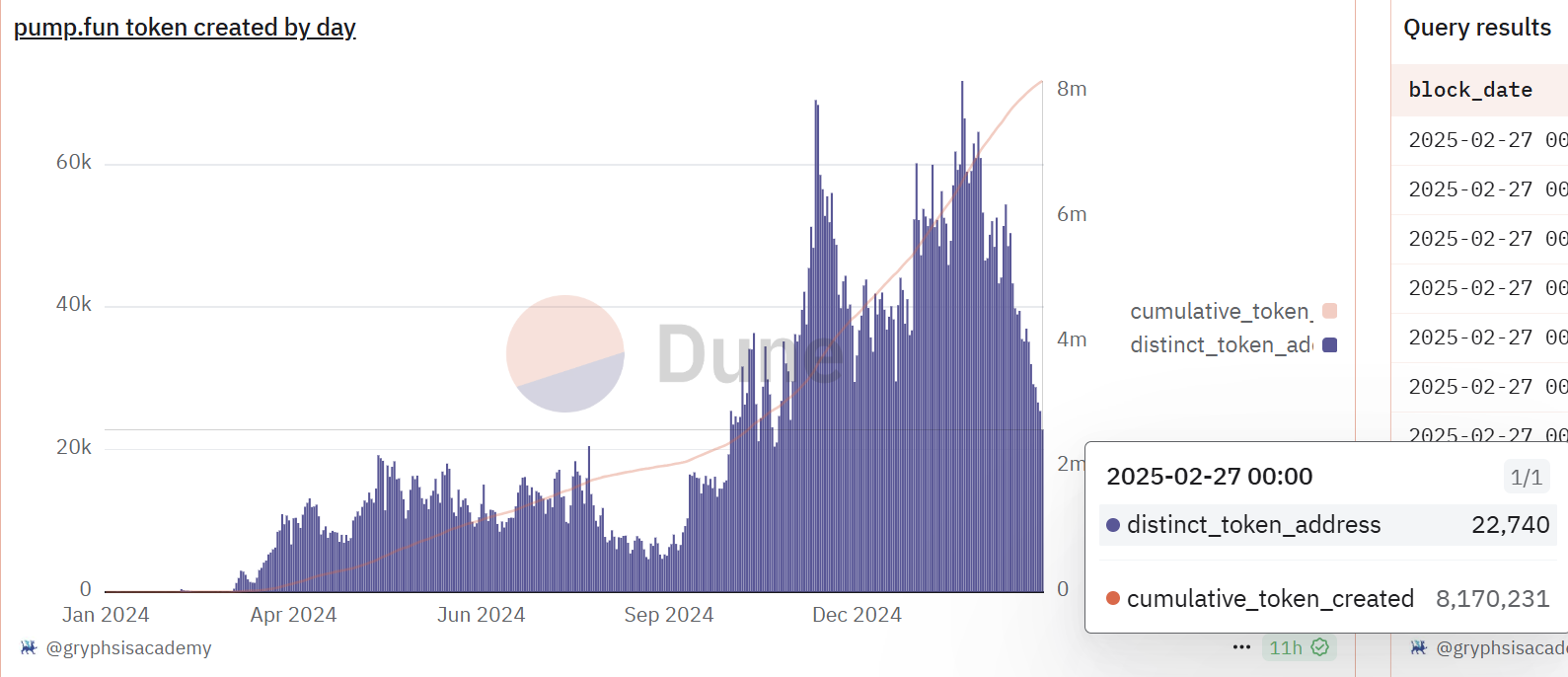
Pump Fun weakens, with affiliated token count dropping over 60%.
 Navigating Web3 tides with focused insights
As widely known, Solana's performance this cycle has been closely tied to Pump Fun. Pump Fun allows everyone to issue tokens at extremely low cost, industrializing asset issuance. At its peak in late January, it deployed around 60,000 tokens per day, generating up to $15 million in daily revenue. In terms of trading volume, tokens related to Pump Fun accounted for over 50% of Solana’s total.
On the external front, a series of negative events have piled up: broader market downturns, the Trump family launching their own tokens diverting market attention, followed by celebrities and countries jumping on the token-issuance bandwagon, diluting the impact. The final straw was Argentine President Milei’s Libra, which crushed the entire crypto market’s hopes in less than three hours.
Turning back to Pump Fun itself, since launch the platform has continuously dumped SOL. Since 2025, it has transferred 1,322,830 SOL—worth approximately $260 million—to Kraken exchange.
Recently, they’ve begun testing Pump Fun Swap, preparing to launch their own DEX. This would replace the previous model where liquidity was deployed on Raydium once bonding curves were maxed out internally. Their "winner-takes-all" ambition is now unmistakable.
Looking at recent data, the number of newly deployed tokens has plummeted from a high of 60,000 to around 22,000—back to October 2024 levels, coincidentally when memes and AI agents began gaining momentum.
Pump Fun’s mechanism resembles “fast food”—prices are more easily manipulated. When market liquidity is abundant, it generates endless stories of overnight wealth. But during bearish phases with shrinking liquidity, tokens inevitably face downward pressure on market caps and weaker price sustainability. Could adding DeFi elements to Pump Fun’s original design extend its longevity?
Source: Dune
Super Exchange = Pump Fun with Smoother Pricing
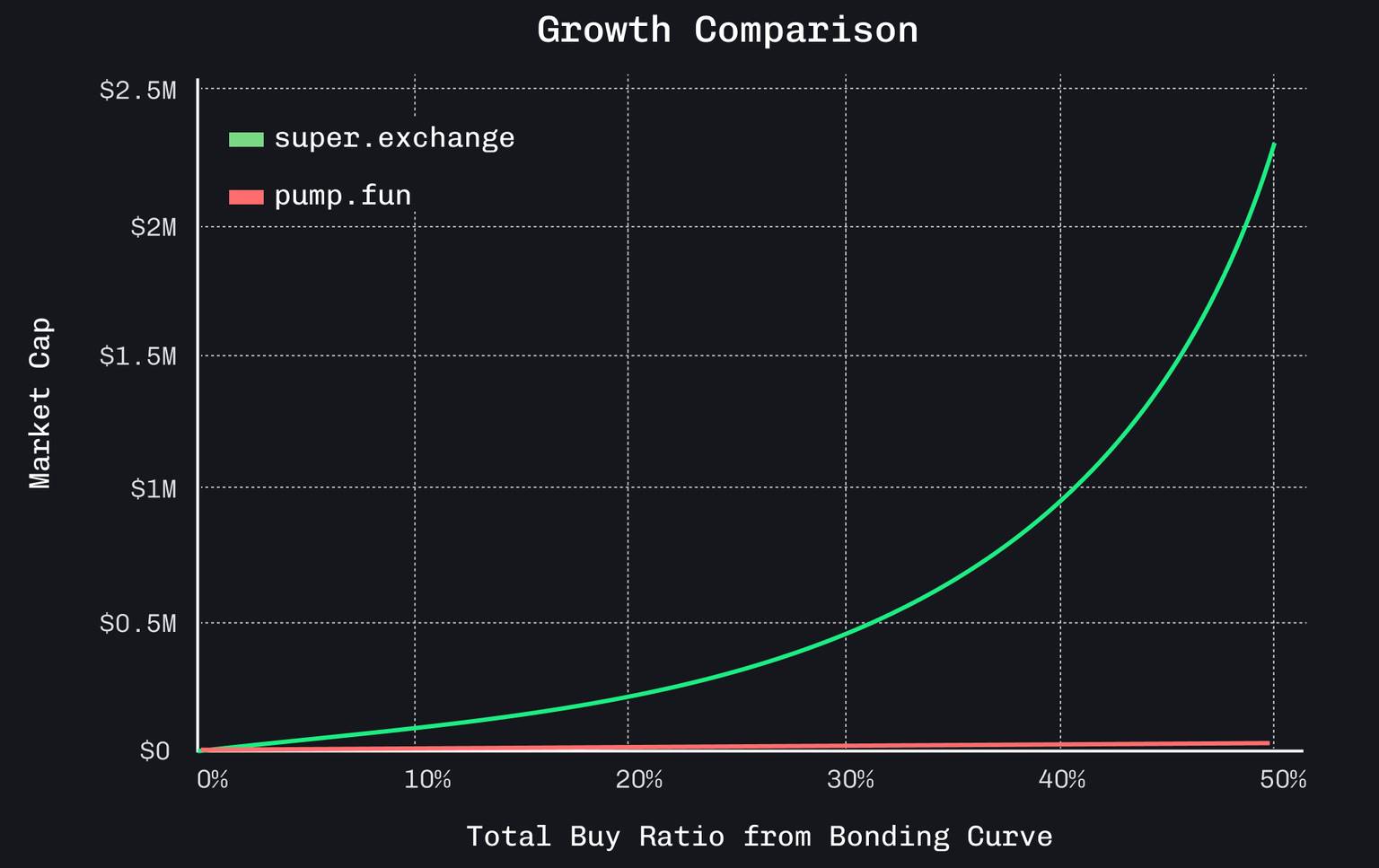
Like Pump Fun, Super Exchange is a token launch platform but uses an Infinite Bonding Curve pricing mechanism. Unlike Pump Fun’s hybrid model (internal bonding curve + external AMM), Super Exchange relies entirely on bonding curves, resulting in smoother price discovery and making it harder for early investors to accumulate and manipulate supply.
For example, acquiring 80% of a token’s supply on Super Exchange costs 40,269 times more than the initial price, compared to just 15x on Pump.fun. This means malicious actors face significantly higher costs to corner the market.
Source: super.exchange
How to Participate in Super Exchange?
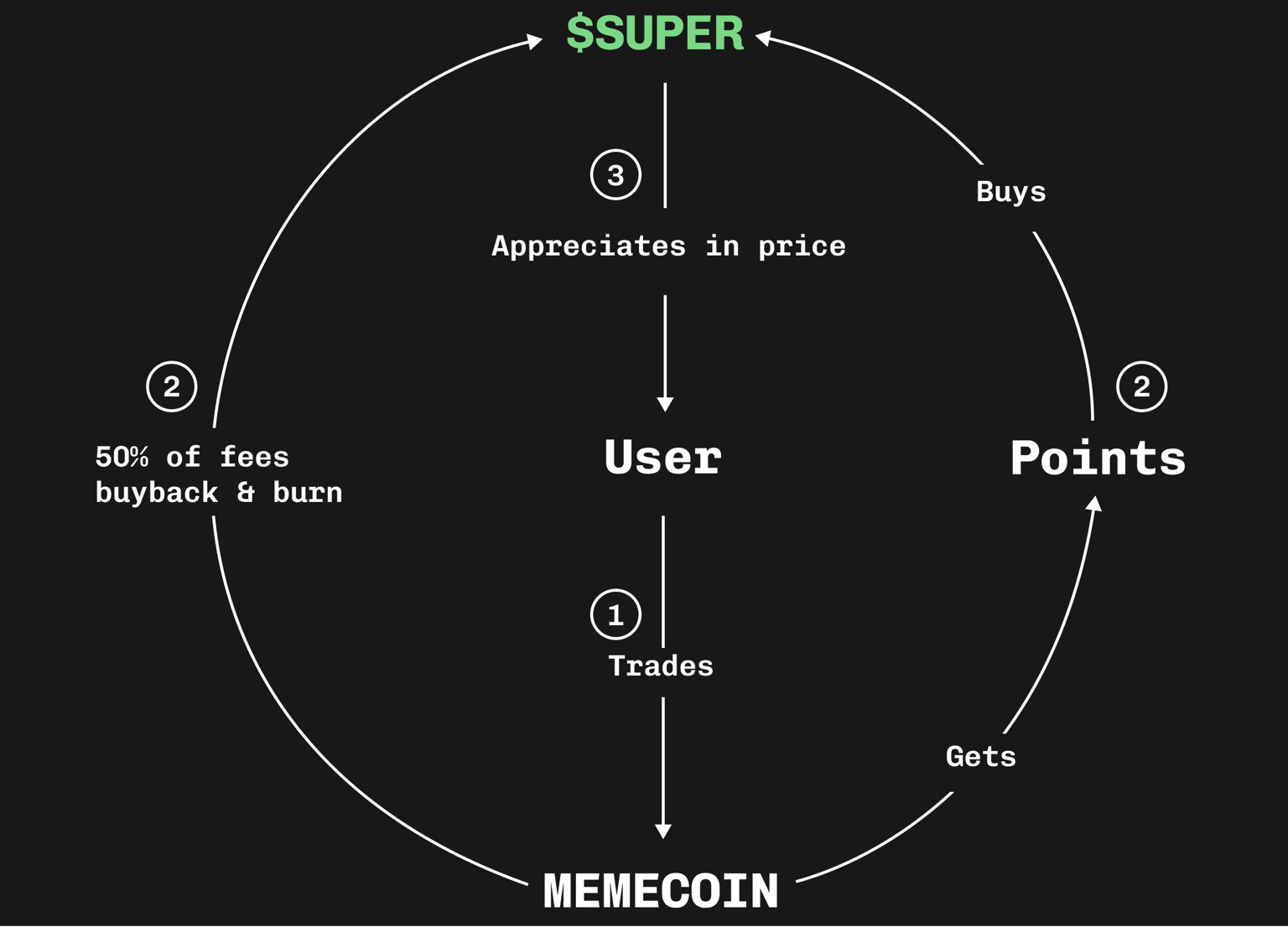
The platform token SUPER has a total supply of 1 billion, 100% allocated to the community. 50% of platform transaction fees are used in real-time to buy back and burn SUPER. However, users cannot directly purchase SUPER. Instead, they must first trade meme coins on the platform to earn points, then use those points to acquire SUPER—which can later be redeemed for SOL.
Source: super.exchange
Once you understand the rules, there are two main ways to participate:
-
Boost Trading Volume: Your point earnings depend on your trading volume and the performance of the tokens traded (market cap × log of trader count). The higher the volume and the more active the token (higher Token Parameter), the more points you earn, which can then be used to buy SUPER.
-
Buy & Hold Top Tokens: As shown above, the system incentivizes participation in popular tokens. Liquidity and volume will naturally concentrate around top tokens. To sustain trading activity, prices must hold or rise. Therefore, if you believe in Super Exchange’s long-term potential, buying and holding leading tokens is a viable strategy.
If the flywheel successfully kicks in, the cycle would look like this:
Traders boost volume on top token (SEND) → SEND price rises → 50% of trading fees buy back SUPER → users earn points to purchase SUPER → SUPER price increases → more traders join to trade SEND
This chain reaction shows that the sustained price increase of SEND is crucial—it determines the overall platform volume.
Conclusion: Not a Launchpad, But a Capital Game
Super Exchange is inherently exclusionary by design—only top-tier tokens receive significant volume and attention. Due to the points system, other tokens are destined to be ignored. While Super Exchange brands itself as a fairer launchpad, in reality it establishes a dual-token mechanism where the top token and SUPER mutually inflate each other. If the market cap gap between the leading token and others becomes too large, the rest become meaningless.
For other tokens to compete for the top spot and access the same flywheel effect with SUPER, they’d need to either pay heavily to pump their price or invest in aggressive marketing—neither of which is feasible for average retail users minting new tokens. Thus, the so-called “fairness” exists only in mathematical formulas; in practice, the decentralization of asset issuance faces extreme exclusivity. Claims of solving Pump Fun’s issues and promoting fairness are questionable. A more accurate framing would be a Ponzi-like, profit-driven mining game.
Join TechFlow official community to stay tuned
Telegram:https://t.me/TechFlowDaily
X (Twitter):https://x.com/TechFlowPost
X (Twitter) EN:https://x.com/BlockFlow_News
 @WOOXResearch