








Only a fool would think Elon Musk is incompetent
TechFlow Selected TechFlow Selected
Only a fool would think Elon Musk is incompetent
Underestimating such a person will put you in danger.
 Navigating Web3 tides with focused insights
By: Noah Smith
Translation: Block unicorn
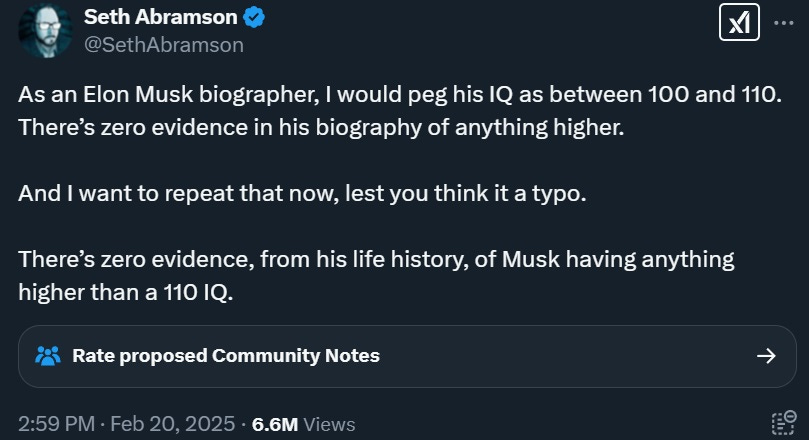
I'm writing a longer piece, but it's taken me two days and I still haven't finished. In the meantime, I want to share a particularly absurd claim I recently came across: "Elon Musk isn't smart. His IQ is probably around 100, maybe even lower. The only reason he's achieved what he has is because he was born into a wealthy family and had incredible luck."
Of course, this is false. According to biographer Walter Isaacson, Musk scored 1400 on his second attempt at the SAT in the late 1980s. SAT scores are highly correlated with IQ, and by all accounts I’ve seen, a 1400 at that time corresponded to an IQ in the low 130s. Moreover, Musk holds a bachelor’s degree in physics and was admitted into a materials science PhD program in the 1990s. His intellect is far above average.
But the absurdity of Abramson’s statement lies not in its content, but in its intent—to downplay Elon Musk’s intelligence in order to reduce American society’s fear of Musk and his role in U.S. politics. This is profoundly foolish.
First, IQ is not a good measure of the abilities Musk excels in—such as organizing and improving companies, identifying talent, managing large teams, raising capital, creating and communicating a vision for the future, etc. Research by Keuschnigg et al. (Cognitive ability flattens at high incomes, 2023) shows that beyond a certain level of wealth, IQ becomes less predictive:
"We analyze Swedish register data containing cognitive ability and labor market outcomes for 59,000 males who took mandatory military conscription tests. Surprisingly, we find that while the overall relationship between ability and wages is strong, the effect of ability flattens out above annual earnings of 60,000 euros, rising only one standard deviation above the mean. The top 1% earners have slightly lower cognitive ability than those just below them."
In the past, Americans valued abilities that couldn’t be measured by tests—real-world business acumen was often more respected than book smarts. But as the knowledge economy has grown in importance and the power and status of the educated professional class has risen, American society has begun to worship pure intellect. Even Americans who would insist when pressed that IQ is a racist and meaningless concept will reflexively call others “idiots” or mock their low IQ during social media arguments.
Yet regardless of Musk’s IQ, he has clearly accomplished extraordinary feats of organizational building throughout his career. Here’s a passage from a post I wrote about Musk last October, where I described entrepreneurship as a superpower:
"While American manufacturing (and that of countries like Germany and Japan) has hollowed out due to competition from China, and our great legacy firms have stumbled and declined, one entrepreneur has managed to build and scale massive, cutting-edge, high-tech manufacturing companies in the United States that lead the world. That person is Elon Musk."
Take SpaceX. Without Musk’s company, the U.S. would be far behind China in the space race. With SpaceX, the U.S. is far ahead—and SpaceX is a manufacturing giant. Despite nearly all production occurring in the U.S., the company outcompetes China’s entire manufacturing base in its domain… SpaceX has launched so many Starlink communication satellites into low Earth orbit that Musk’s satellite constellation now exceeds the total number of all other active satellites and spacecraft combined…
It’s not as if no other entrepreneurs have tried to enter the space industry. Jeff Bezos, founder of the world’s top e-commerce site and cloud computing network, created Blue Origin, a company competing with SpaceX—but it lags far behind…
But SpaceX is neither a fluke nor an exception. Despite increasing competition, Tesla still completely dominates the U.S. electric vehicle market… And when Musk recently built a cluster of GPUs to train his new AI model, he did so at speeds far beyond what Nvidia CEO Jensen Huang believed possible.
As an industrialist, Musk is unmatched in American history—the closest historical analogue, Henry Ford, failed outright in the aerospace industry.
Seth Abramson could not build SpaceX, Tesla, or anything Musk has built, no matter how much money someone gave him. Dear reader, neither could I, nor could you. I suspect even Terence Tao or any other super-genius mathematician with the highest IQ on Earth couldn’t do it either. Any of us, even spending a lifetime and burning through a trillion dollars, might fail to create anything close to Musk’s high-tech industrial empire.
Why would we fail? Even without institutional barriers, we couldn’t identify the best managers and engineers. Even if we found them, we often couldn’t persuade them to work for us—and even if they joined, we might fail to inspire them to give their all week after week. We’d struggle to promote top performers, giving them greater authority and responsibility, or decisively fire underperformers. We couldn’t raise tens of billions at favorable interest rates to fund our ventures. We couldn’t negotiate government contracts or generate consumer excitement. And so on.
Beyond that, Musk likely does many less visible things that we simply cannot replicate:
Marc Andreessen says a key driver of Musk’s success is his relentless focus on solving problems quickly—he often works directly with engineers or programmers facing difficulties… The legendary venture capitalist shared insights from his close collaboration with Musk at X, xAI, and SpaceX… Unlike many CEOs, Musk is committed to understanding every detail of his businesses, says the A16Z co-founder and general partner. He “goes to the front lines, talks directly to the people doing the actual work,” and acts as the “chief problem-solver in the organization.”
For over a decade, I’ve watched Musk succeed in building seemingly impossible companies and pushing them to new heights. Each time, social media mocks him as an idiot, a fraud, a charlatan, claiming his companies are about to collapse. While Musk hasn’t fulfilled every promise, again and again he has proven the skeptics wrong.
And he’s done this despite the entire U.S. system of proceduralism and anti-development policies working against him. It’s notoriously difficult to build factories in the U.S. due to land acquisition costs, procedural hurdles like NEPA, regulations, high labor costs, and more. Yet as of 2023, Tesla produced more cars in the U.S. than in China:
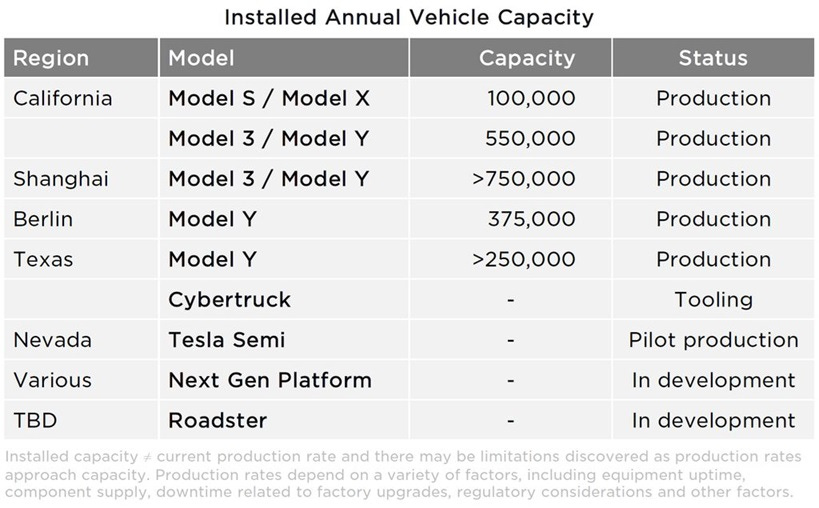
California is widely known as one of the hardest states to build in, yet SpaceX manufactures most of its rockets there—rockets vastly superior to anything made in China—almost single-handedly reviving the aerospace industry in the Los Angeles area. And when Musk wanted to build a data center for his new AI company xAI—a process that normally takes years—it’s reported he completed it in just 19 days.
Contrary to Nate Silver’s view, these achievements have little to do with Elon’s IQ.
Some progressives persist in mocking Musk’s intelligence, partly due to the educated elite’s traditional class resentment toward industrial titans. But I think more often it’s simply what young people call “cope.” Right now, Musk is applying all the talents he used to build his companies—motivating employees, bypassing red tape, rapidly identifying and breaking through bottlenecks—to his effort to reshape the U.S. civil service via DOGE. Telling themselves that Musk actually has no talent, or that he’s just lucky, or that he’s a fraud, or that he succeeded only because of government help—these are ways progressives comfort themselves, believing Musk’s efforts are doomed to fail.
Another way some cope with Musk’s “blitzkrieg” is by stubbornly insisting that history isn’t driven by “great men,” but by slow, unstoppable forces:
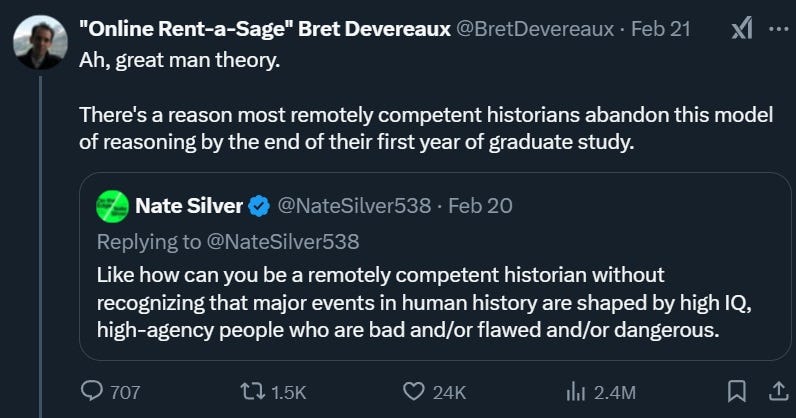
Of course, history is extremely complex and happens only once, so historians can’t truly know how much is driven by “great men” versus slow, unstoppable forces. When pressed, they admit this:
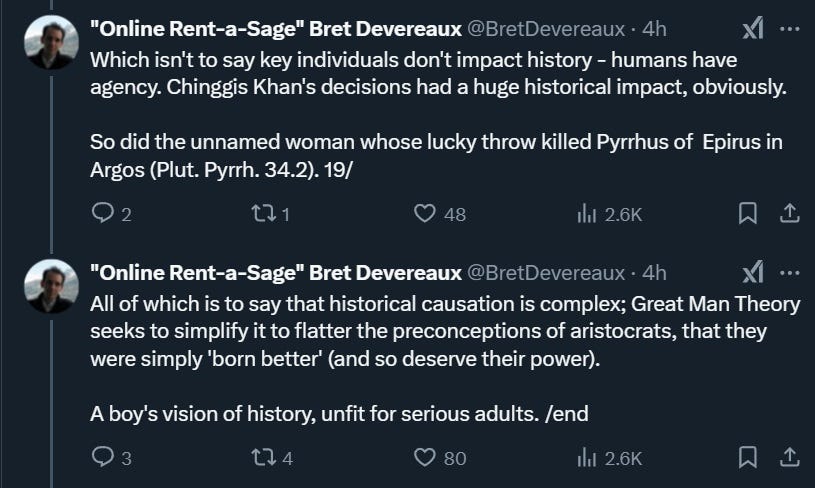
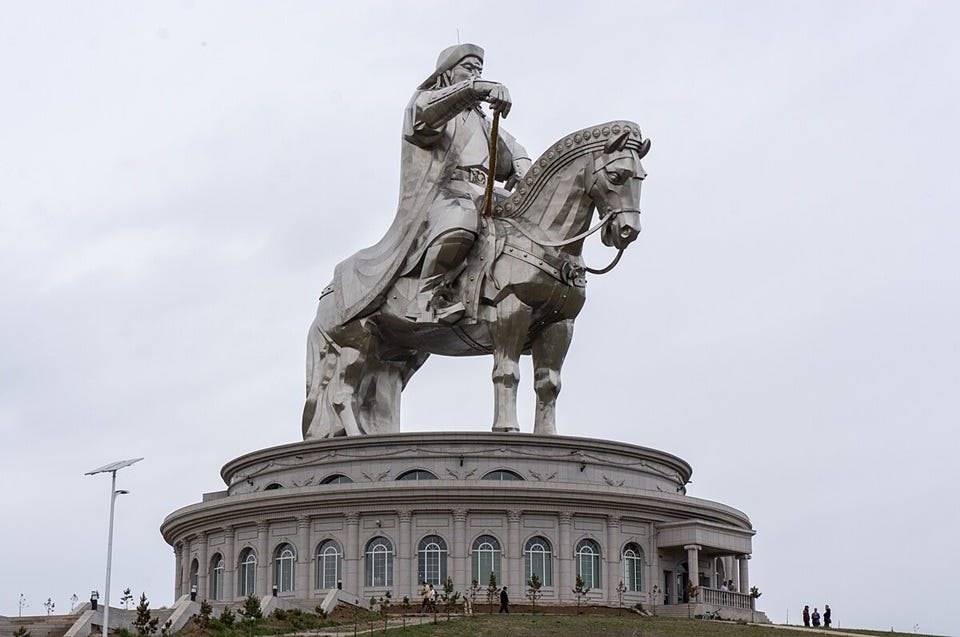
Note Genghis Khan as a key example. Of course, factors beyond his decisions shaped history; many other steppe warlords tried to conquer the world and failed. Genghis Khan may have benefited from being in the right place at the right time, but he likely possessed organizational and motivational talents that made him the only person in history capable of conquering so much territory.
Of course, Musk himself hasn’t overlooked this comparison:
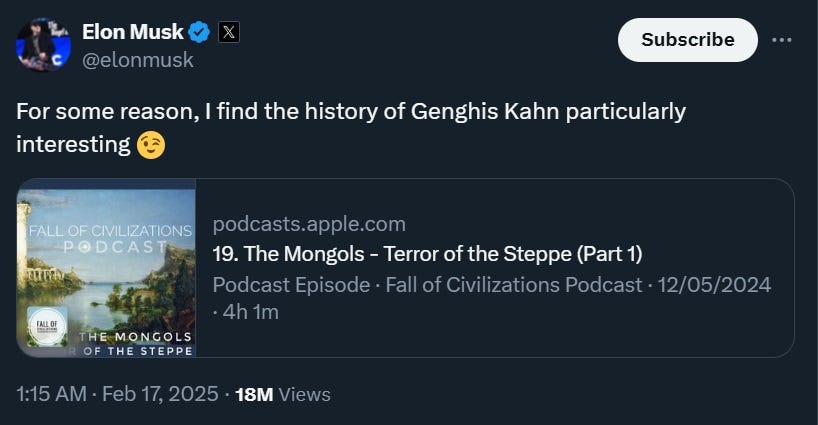
Before you rush to mock Musk for misspelling “Khan,” remember that Genghis Khan himself couldn’t spell his own name, having never learned to read or write—again vividly illustrating that book smarts and organizational talent are very different things. Progressives who comfort themselves by saying Musk could never conquer their country because he doesn’t have the highest IQ are as foolish as 13th-century scholars telling themselves their nation would never fall to a horseback-riding illiterate.
Beyond these “coping mechanisms” and class biases, I think there’s another reason some progressives try to label Musk a “fool.” Over the past 15 years, mass social media has replaced external reality in many people’s lives, making events on Twitter/X feel more real than what happens on the streets. In this virtual world of denunciation and insults, the only way to attack and defeat someone is to constantly call them “stupid” and get many others to do the same. The idea is that if enough people simultaneously call someone “stupid,” they are defeated and you win. That’s why everyone on Twitter/X is always calling someone an idiot, moron, or similar.
Yet outside that tiny X app on your phone, merely calling someone “stupid” doesn’t actually defeat them—just as Rachel Maddow trashing Trump on MSNBC doesn’t actually “destroy Trump.” Maybe claiming Musk’s IQ is only 110 makes you feel like you’ve defeated him in your little fantasy world, but in reality, he’s still dismantling your national institutions at an astonishing pace.
Those who think disparaging Musk’s abilities will somehow defeat him or make him disappear are simply fools—not low-IQ fools, but unwise in their suboptimal response to external challenges. In many crucial ways, Elon Musk is the most capable person in America, and denying this fact will only backfire on us.
Join TechFlow official community to stay tuned
Telegram:https://t.me/TechFlowDaily
X (Twitter):https://x.com/TechFlowPost
X (Twitter) EN:https://x.com/BlockFlow_News
 @Noahpinion


