China's $1.30 AI headphones are疯狂收割foreigners
TechFlow Selected TechFlow Selected
China's $1.30 AI headphones are疯狂收割foreigners
We still underestimate humanity's need for communication.
 Navigating Web3 tides with focused insights
Image source: Generated by Wujie AI
AI-powered Bluetooth headphones with translation features have exploded in popularity in the United States.
On TikTok, you can see various influencers recommending $9.9 "translation earphones" to foreign consumers—especially in the U.S., where enthusiasm for AI innovation runs high, driving strong demand for these so-called "AI-connected" Bluetooth earphones.
Unsurprisingly, behind these viral hits are numerous Chinese startups, including well-known companies like MINISO, all jumping on the wave of promoting "AI earphones."
While large model companies are still figuring out how to monetize AI for consumers, others have already sold this new type of "AI hardware"—earbuds—all over the world, aggressively tapping into foreign consumers' wallets.
How did they do it? And what are those overseas users who are frantically ordering during livestreams actually using these "AI earphones" for?
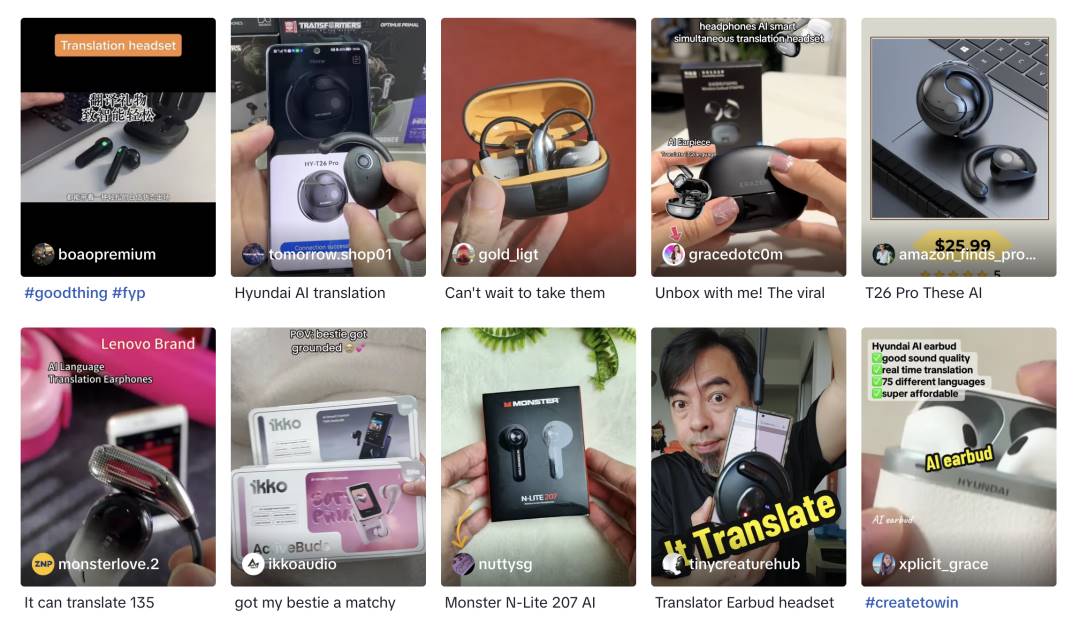
Diverse ads for AI translation earphones on TikTok | Image source: TikTok
01. “AI Earphones” Go Viral Overseas
"Translation earphones are selling out."
Zejie Zhang, head of NebulaBuds—a company providing app solutions including translation and AI assistant features for Bluetooth earphones—told GeekPark that one of his Bluetooth headphone clients was making around 2 million yuan per month in sales on TikTok. After integrating AI assistant and translation functions into the earphone app, monthly sales jumped to 8 million yuan.
A Shenzhen-based OEM headphone factory owner also shared his observations: A partner team from Huaqiangbei, which provides software solutions for small headphone brands, struggled to pay a few thousand yuan at the beginning of 2024 but by year-end was showing up to business meetings in luxury cars. He remarked that this is the classic "Huaqiangbei story" of ordinary people seizing an opportunity and striking it rich:
"They were lucky last year—the speed at which they made money was incredible."
The surge in demand for translation earphones completely caught him off guard.
Zhang serves not only small and mid-sized brands but also major players such as Huawei and realme. NebulaBuds’ solution mainly adds simultaneous interpretation, audio/video call translation, AI assistant, and noise cancellation features via an app, without changing the earphones' hardware configuration. According to Zhang: "Some of our clients had large inventories of regular Bluetooth earphones; after connecting to our app, they could sell them overseas and clear their stock successfully."
Currently, the U.S. is the largest market for translation earphones, followed by the Middle East.
Zhang explained: "We originally assumed everyone in the U.S. speaks English, but we later realized there's a large Hispanic population and many non-English speakers who need translation. The same goes for the Middle East. There’s also market demand in Southeast Asia, India, and Europe. Surprisingly, purchasing power in Africa even exceeds that of Southeast Asia."
"Demand for AI translation functionality continues to grow steadily—we’re seeing hundreds of thousands of activations on our platform every month," said Zhang.
Translation and AI features have become a key to sales success in the earphone market. One e-commerce seller added:
"As long as you highlight the AI capabilities of the earphones on e-commerce platforms, they almost always sell better."
During the U.S. Black Friday season, the sales legends of translation earphones on TikTok seem to confirm this trend: A MINISO translation earphone model generated over $2 million in sales within 30 days; another digital store sold $30 translation earphones and achieved $1.8 million in monthly revenue, ranking among top sellers.
In addition, some TikTok influencers earned $300,000 in commission income from short videos promoting translation earphones.
"In the past, when I pitched our software solution to earphone manufacturers, I’d explain specific features like AI or translation—but now I don’t bother," said Zhang.
"I just say one thing: Plug in and it’ll go viral."

We underestimated the translation needs in diverse immigrant communities | Image source: Visual China
02. Immigrant Communities Drive Demand for AI Earphones
Through discussions with multiple OEM manufacturers, software solution providers, and cross-border earphone sellers, GeekPark found that while targeted marketing contributed to the sudden rise of translation earphones, the core driver lies in meeting the essential communication needs of diverse immigrant populations.
On TikTok, several typical scenarios featured in brand-sponsored video ads have drawn widespread attention. For example, Americans often visit nail and hair salons, where many technicians are Vietnamese immigrants. One popular short video shows customers finally understanding their nail artist’s conversation after wearing translation earphones.
A comment section response confirms the real need for this scenario: "The moment you mentioned nail/hair services plus translation, I was convinced in two seconds."
Another common scenario involves taxi drivers serving passengers from different countries—by wearing translation earphones, they can easily understand what passengers are saying.
These marketing cases demonstrate that in multicultural, immigrant-heavy regions like Europe and North America, translation earphones offer strong practical value—an unmet need until now.
Besides functionality, low price is another key factor driving sales.
MINISO’s translation earphones sold on TikTok range from $13.99 to $23.99—just over 100 RMB—while some brands offer discounted models as low as $8.99, significantly lowering the barrier for trial use.
One seller noted that higher-end earphones with stronger AI features and better experiences typically cost 1,000–2,000 RMB but don’t sell well. In contrast, the success of low-cost smart earphones proves consumers want to try AI features—if the entry threshold is low enough.
Technologically, improvements in large model technology have greatly enhanced translation performance, contributing significantly to sales growth. Zhang said that since the rise of large models, speech recognition has become more accurate, and AI assistants are no longer "dumb"—they’ve become genuinely usable tools. "Compared to the smart speaker era, when devices either didn't understand or couldn't respond, AI functionality became vastly more practical after reaching the ChatGPT stage."
Another important backdrop enabling this boom: The overall earphone market has been growing rapidly. Canalys data shows that in Q3 2024, TWS earphone shipments reached 92.3 million units, up 15% year-on-year. Xiaomi and Huawei both achieved over 50% annual growth globally. Open-ear headphones saw particularly explosive growth. IDC reports that from January to August 2024, open-ear headphones shipped 16.36 million units, a 271.5% increase year-on-year.

Open-ear headphones are gaining popularity | Image source: TikTok
03. AI Goes Mainstream—Huaqiangbei Leads the Way
The popularity of translation earphones highlights the massive potential of positioning AI features as a selling point.
The Huaqiangbei OEM factory owner serving multiple earphone brands observed that in the second half of 2024, there had been little innovation in earphone design or hardware technology. As a result, the industry shifted focus to app-side enhancements, seeking new growth levers. At this moment, the emergence of the "AI concept" perfectly met the needs of many manufacturers.
AI is sparking new consumer demands—"Users increasingly care about the capabilities offered by earphone apps."
From the supply side, a new consensus is forming: AI functionality will be the most critical growth driver for future earphones. He revealed that in 2025, many earphone brands will heavily invest in AI features.

Huaqiangbei commercial district in Shenzhen | Image source: Visual China
Multiple industry insiders said the recent surge in AI translation earphone sales also benefited from extensive promotion of AI capabilities by major tech firms and large-model startups, which effectively educated the market and gradually introduced users to AI.
NebulaBuds currently integrates DouBao and DeepSeek as AI assistants in China (and ChatGPT overseas), with AI assistant usage requiring a subscription. "Although DouBao has its own free standalone app, we found many users are still willing to use DouBao through our app—proving real demand for AI features," said Zhang.
While tech entrepreneurs and investors from top-tier firms debate whether AI hardware is viable or sufficient, Shenzhen entrepreneurs are already capturing global markets with $8.99 earphones.
Zhang gave an example: After DeepSeek went viral before Chinese New Year, "We spent the entire holiday studying DeepSeek. Clients for Bluetooth earphones and watches kept urging us to integrate DeepSeek—we realized we needed to act fast. It was a two-way push." Indeed, Shenzhen’s hardware makers are extremely quick at bringing products to market and chasing emerging consumer trends.
On one hand, AGI requires idealists to explore the future; on the other, AGI also needs real-world applications. Pragmatic "lucky ones" have already started profiting. Combining technological vision with commercial reality may be the best path for AI to reach the mass market.
Join TechFlow official community to stay tuned
Telegram:https://t.me/TechFlowDaily
X (Twitter):https://x.com/TechFlowPost
X (Twitter) EN:https://x.com/BlockFlow_News
 极客公园
极客公园