








Forbes Exclusive Interview with Gavin: Five Key Criteria and Future Trends Determining the Long-term Success of Blockchain
TechFlow Selected TechFlow Selected
Forbes Exclusive Interview with Gavin: Five Key Criteria and Future Trends Determining the Long-term Success of Blockchain
namely: resilience, performance, versatility, accessibility, and consistency.
 Navigating Web3 tides with focused insights
Author: Marie Poteriaieva
Translation: OneBlock+
Beyond market capitalization and hype, what truly determines the long-term success of a blockchain? Gavin Wood, co-founder of Ethereum, creator of the Web3 concept, and founder of Polkadot, shares his five key criteria for evaluating blockchains.
In an interview with Forbes, the visionary figure in the crypto industry explained which factors lead to the success or failure of blockchain projects. He also shared practical evaluation metrics and offered direct analysis of some of today’s most popular blockchain platforms.
His analytical framework helps clarify the price volatility of leading blockchain cryptocurrencies. For example, why did ETH's market cap drop from its 2021 peak of $575 billion to $394 billion today? Why has SOL’s market cap surged to a record high of $115 billion while Polkadot’s DOT (launched around the same time) has fallen to $9 billion? Wood looks beyond these numbers to uncover the underlying drivers behind such shifts.
Gavin Wood speaking at Decoded conference in Brussels, July 2024
Gavin Wood’s Five Criteria for Evaluating Blockchains
There are now hundreds of blockchains, each with unique technologies, use cases, and applications. To help identify those with real potential, Gavin Wood outlines five fundamental evaluation criteria.
-
Resilience: The foundation of Web3, resilience combines cryptography, decentralization, and game theory to protect the blockchain from attacks and ensure long-term stability.
-
Performance: More than just scalability, performance measures how efficiently a network processes and completes tasks.
-
Generality: A blockchain’s ability to support diverse applications and programmability.
-
Accessibility: How easy it is for users, developers, apps, and bots to interact with the network.
-
Coherence: A system’s ability to maintain fast and consistent communication across its network.
Resilience: A Non-Negotiable Standard
While blockchains may emphasize different features, one standard must never be compromised: decentralization and resilience. This criterion is difficult to assess and requires long-term observation, yet it remains the most important.
Gavin Wood states: "Blockchains that neglect decentralization and resilience should not be called Web3."
He continues: "For instance, we see Layer 2 networks on Ethereum with fixed validator sets managed by specific companies, right? This clearly does not represent a Web3 characteristic."
Evaluating a blockchain’s resilience often comes down to assessing its level of decentralization. Wood proposes several questions for this assessment:
-
Who makes protocol decisions?
-
Is the governance structure transparent or accessible with low entry barriers?
-
What is the Nakamoto coefficient, which measures the number of participants required to compromise the network?
-
Finally, Wood raises a broader concern—whether a single entity dominates the project's direction and "completely controls the ecosystem, suppressing other voices and perspectives."
Gavin expresses satisfaction with Polkadot’s decentralization, noting its high Nakamoto coefficient. According to Nakaflow data, Polkadot currently has a Nakamoto coefficient of 149, meaning at least 149 independent validators must collude to disrupt the network. In contrast, other major blockchains score significantly lower—Solana scores 19, and Ethereum only 2.
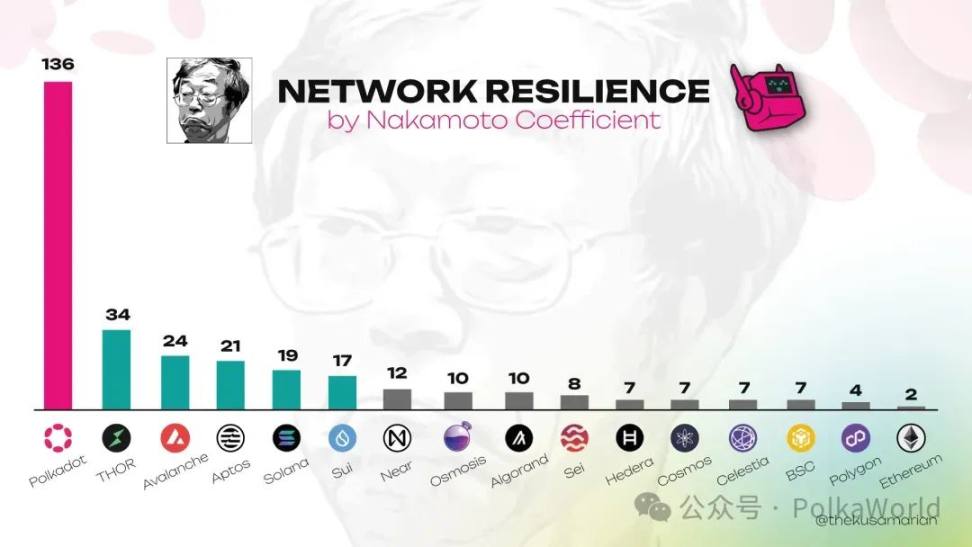
However, entry barriers remain an issue.
Maurantonio Caprolu, research scientist at KAUST in Saudi Arabia who co-authored multiple papers on Polkadot with Professor Roberto Di Pietro, describes the high threshold involved.
"Until 2022, becoming an active validator required staking approximately 1.8 million DOT (worth about $32 million at the time). Even now, the minimum stake requirement remains high, effectively favoring institutions capable of affording large amounts of DOT tokens."
From Gavin’s defined resilience perspective, Ethereum’s weaknesses become apparent. Ethereum is frequently criticized for Vitalik Buterin’s outsized influence. This controversy intensified recently when he posted on X: “It was me who decided the new EF (Ethereum Foundation) leadership team.”

One might ask: Given Gavin Wood’s prominent role, does Polkadot face similar risks of being narrative-dominated by him? Wood acknowledges his name carries weight but emphasizes that Polkadot’s governance is community-driven. He cites examples of successful community-led proposals, such as reducing DOT’s inflation rate, demonstrating decentralized decision-making in action.
The Polkassembly governance platform further promotes community involvement and introduced a framework compatible with OpenGov in 2023. Caprolu and his team believe OpenGov can “expand inclusivity and reduce power concentration.” However, researchers note: “Since this system is still in its early stages, more time and data are needed to verify whether OpenGov can successfully mitigate the tendencies toward centralized control observed in Governance 1.0 (Polkadot’s previous model).”
Performance: At What Cost?
Different blockchains adopt varying strategies to improve performance, but they all face the common challenge of balancing performance, decentralization, and coherence.
Take Ethereum as an example. Wood explains: “Initially, they planned to use sharding technology, adding EVM shards into the network. But later they abandoned this approach and instead opted to support Layer 2 solutions. Essentially, they did nothing themselves but let others build chains secured by Ethereum.” This approach leads to a lack of coherence and even impacts security. Wood argues, “The combination of Ethereum and L2s isn’t truly Ethereum because L2s don’t provide the same security guarantees.”
Additionally, Gavin believes Solana sacrifices decentralization.
“Solana’s strategy involves making its validators more powerful and ensuring excellent connectivity among them. To achieve this, Solana reduces the number of validators. Because improving connectivity between two validators usually requires limiting their total number. As a result, Solana’s Nakamoto coefficient drops—fewer validators mean fewer parties controlling the network, thus reducing decentralization.”
Gavin Wood refers to Solana as “a highly synchronized scaling strategy,” whose speed is limited by the processing and synchronization capabilities of individual machines. While this method enables rapid scaling early on, it eventually hits bottlenecks imposed by hardware and network limitations.
According to Wood, “Many other proof-of-stake chains are similar. They lack a coherent scaling strategy; to handle more data, they simply reduce validator count and increase speed.”
Polkadot takes a different architectural path—it scales and optimizes the network by increasing the number of validators. Specifically, Polkadot enhances decentralization by adding more validators rather than reducing them. With greater participation, Polkadot maintains decentralization while achieving faster network performance. In short, Polkadot scales to optimize performance instead of sacrificing decentralization for speed.
Generality: True Turing Completeness
Gavin Wood defines a blockchain’s generality by measuring how easily Web2 applications can transition to Web3. More precisely, he evaluates generality based on the variety and complexity of computational tasks a blockchain can support.
Ethereum introduced the concept of Turing completeness, meaning it can theoretically execute any computable task. But as Wood points out, Ethereum hasn't fully achieved this due to gas limits and block size constraints. Computations must complete within these bounds, restricting the scope of complex problems it can solve.
Polkadot aims to eliminate these constraints through its parachain model. Parachains execute logic within a WebAssembly environment, as long as computations finish within seconds. This setup allows parachains to process larger datasets. Currently, Ethereum allows about 15 million EVM gas per block, whereas Polkadot supports the equivalent of 18 billion gas.
Nonetheless, like Ethereum, Polkadot’s generality remains quantitative rather than qualitative. It expands computational capacity without fundamentally altering the range of computation. This will change with the upcoming JAM upgrade, which promises to enable “continuations”—computations that can pause and resume across blocks.
Professor Soulla Louca, head of the Blockchain Initiative at the University of Nicosia in Cyprus, believes removing single-block computation limits could be a breakthrough. She explains:
“While other blockchains have mechanisms for handling complex computations (e.g., Layer 2 solutions, optimistic rollups), no other blockchain currently offers a built-in continuation mechanism like the one proposed in JAM. This capability could give Polkadot a significant advantage, enabling more complex and general-purpose applications, especially advanced use cases like sophisticated financial instruments, large-scale data processing, and on-chain AI/ML.”
Coherence: Removing Barriers
Coherence is a major challenge in blockchain ecosystems. Both Ethereum’s L2s and Polkadot’s parachains struggle in this area. As Wood describes, they operate in isolated environments where cross-chain interactions are typically slow, expensive, and potentially insecure unless a co-sequencing system is introduced. Yet such systems bring their own challenges, requiring supercomputer-like infrastructure for sequencing, inevitably leading to centralization.
Wood admits coherence is not Polkadot’s primary focus. Although some integrations and bridges have been developed over the past year, parachains still face coherence issues.
This concern is echoed by Tomaz Levak, founder of OriginTrail. His company developed a DeSci (decentralized science) protocol designed to structure and connect real-world data for AI and enterprise applications, running on its own Polkadot parachain. Levak notes that while “the performance and customization enabled by Polkadot’s technical design are uniquely suited to our needs,” he hopes to see “improved bridging infrastructure between blockchain ecosystems.”
Accessibility: Usability Test
In the blockchain space, there's a common perception that Polkadot’s technology is powerful but hard to understand. However, Wood points out that thanks to improvements in the XCM (cross-consensus messaging) system and ecosystem wallets, Polkadot’s accessibility has significantly improved over the past year. Similarly, Tomaz Levak says OriginTrail’s end users “rarely interact directly with the blockchain layer, as user-friendly interfaces ensure a smooth experience.”
Nevertheless, coherence issues continue to hinder accessibility. Wood says JAM will address this by providing shared data availability storage, where services can be built to completely hide coherence challenges from users.
Regarding developer engagement, Wood proudly highlights that Polkadot has consistently attracted many “serious” full-time developers. In fact, Electric Capital’s Developer Report ranks Polkadot’s tech stack third in the crypto space. Currently, Polkadot has 467 full-time developers, trailing only Solana (599) and Ethereum (3,562). Still, Wood believes the actual number is higher, as 35 teams working on JAM operate in closed-source environments and are not included in the report.
Overall, no blockchain today perfectly masters all five criteria. As Gavin Wood puts it:
“Some blockchain systems perform very well but lack coherence, such as Polkadot. Others like Ethereum have good coherence but poor performance. If you look at Solana, it excels in coherence but lacks resilience and decentralization. So the current reality is that you can prioritize certain characteristics, but no blockchain satisfies all requirements simultaneously.”
The true winners will be those blockchains that adapt without compromising Web3’s core principles. The question is: Which blockchain will strike the balance first?
Join TechFlow official community to stay tuned
Telegram:https://t.me/TechFlowDaily
X (Twitter):https://x.com/TechFlowPost
X (Twitter) EN:https://x.com/BlockFlow_News
 Forbes











