A CFO spoke a few extra words during a livestream, causing an NVIDIA-related stock to lose half its market value.
TechFlow Selected TechFlow Selected
A CFO spoke a few extra words during a livestream, causing an NVIDIA-related stock to lose half its market value.
Retail investors think they’ve squeezed into NVIDIA’s table, but they don’t even have a seat.
 Navigating Web3 tides with focused insights
Author: Kuli, TechFlow
A single sentence can halve the valuation of an AI-related stock in one day. Yesterday, during U.S. market hours, a small company named POET Technologies provided a textbook example of how *not* to do it.
POET is a photonic communication chipmaker dual-listed in Canada and the U.S., specializing in optical engines that enable GPU-to-GPU communication via light signals inside data centers. Its market cap stood below $500 million earlier this year—and for most of the past decade, it posted annual losses.
According to POET’s financial report released on March 31, its revenue for Q4 2025 was $341,000, with a net loss of $42.7 million. By AI-stock standards, that scale is roughly equivalent to an academic research project.
Yet yesterday, POET’s share price plunged 47%—its largest single-day drop since listing.
Even stranger: Over the preceding five trading days, its share price surged from just above $7 to $15.50—a weekly gain of 108%, its highest in 11 years.
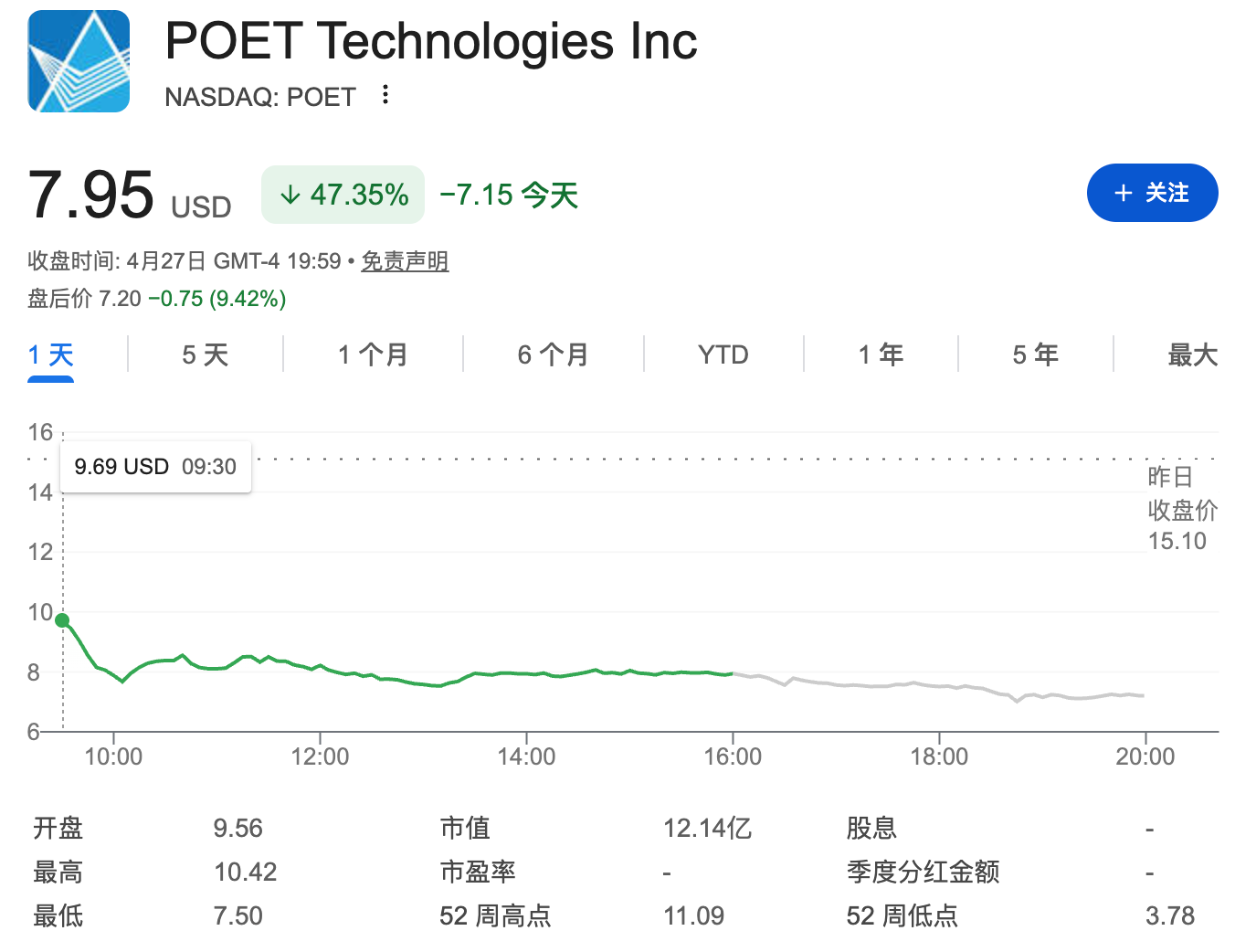
Up 100% in seven days, then down 50% in two—uninitiated observers might mistake it for a meme coin.
Such volatility usually signals one of two things: either the market has completely revised its view of a factual reality—or it had been betting on a story that never materialized. POET falls squarely into the latter category.
The story that sent its stock soaring involved a customer relationship POET publicly disclosed.
That customer is Marvell, a U.S.-based AI data center chipmaker. On March 31, NVIDIA invested $2 billion in Marvell, integrating it into NVIDIA’s NVLink Fusion ecosystem.
Overnight, Marvell transformed from a supplier of supporting chips for data centers into one of NVIDIA’s most critical partners within its AI ecosystem.
POET sits one step further downstream in this chain: it supplies a photonic interconnect subsidiary under Marvell. The market thus labeled POET as the farthest supplier within NVIDIA’s AI ecosystem.
It’s not at the table—but at least it’s still beside it.
What brought the stock crashing down was, ironically, that same relationship. On April 23, Marvell sent POET a letter canceling all orders—with just one line as justification: “You are alleged to have breached confidentiality obligations.”
As for how POET itself sabotaged that relationship, we need to rewind to a financial livestream held a week earlier.
A CFO Far From the Table, Who Spoke Out of Turn
How far is POET from NVIDIA’s table? Two companies stand between them.
NVIDIA invested in Marvell, bringing it into NVIDIA’s AI ecosystem. Marvell acquired Celestial AI, a startup focused on photonic interconnects. And POET has been supplying Celestial AI for several years—as a minor vendor at the very end of this chain.
This is a relationship akin to distant relatives. At the tail end of this chain, POET’s market cap was still under $500 million earlier this year—and it holds no direct relationship with NVIDIA whatsoever.
Yet the market chose to straighten the chain: POET, via Marvell, brushed up against NVIDIA’s AI ecosystem. That brush was enough.
On April 21, POET’s CFO Thomas Mika appeared on Stocktwits’ financial interview series. Stocktwits is a U.S.-based financial community platform—think a hybrid of Snowball, GuBa, and a live financial broadcast platform—catering primarily to retail investors.
Its video interview program invites executives from listed companies to discuss recent developments, targeting users actively discussing those stocks on the platform.
When the host asked about the Marvell collaboration, Mika inadvertently revealed several details—including confirmation that Marvell had already placed orders exceeding $5 million, with shipments scheduled for next quarter.

In the five trading days following the video’s release, POET’s share price climbed steadily from the $7 range to an intraday high of $15.50—a 108% weekly gain, its strongest in 11 years. Top-voted posts in discussion forums all bore titles featuring the word “NVIDIA.”
But the cost of speaking up arrived just two business days later.
On April 23, Marvell issued POET a formal written notice canceling all orders. The reason was brief: POET had disclosed procurement order and shipment information, breaching confidentiality obligations. Every word the CFO uttered on livestream was cited verbatim in Marvell’s official determination of the confidentiality breach.
POET remained silent—until April 27, when it finally issued a public announcement informing shareholders. That day, POET’s share price plunged 47%, setting a new record for its largest single-day drop since listing—and nearly erasing the prior week’s 108% rally.
Unsurprisingly, retail investors across investment communities felt profoundly misled.
The next day, several U.S. law firms began posting online calls for retail investors who lost money on the stock to join a class-action lawsuit against POET’s executives.
And just like that, a “distant-relative” NVIDIA概念股 completed its five-day dream.
The Valuation of AI-Related Stocks Is a Rope Woven from Imagination
POET’s total revenue last quarter was $341,000. Its net loss for the same quarter was $42.7 million.
By fundamental valuation standards, a company of this scale shouldn’t command a market cap exceeding its cash on hand. POET holds $430 million in cash—raised largely through successive equity offerings over the past two years. In other words, stripped of financing proceeds, POET’s core business is worth a negative sum.
But the market doesn’t operate that way.
At the start of April, POET’s market cap was still under $500 million; by April 25, it briefly spiked above $800 million. That extra $300 million came purely from market belief that POET’s orders were backed by NVIDIA.
A few-million-dollar indirect supply contract, multiplied by the phrase “NVIDIA AI ecosystem,” doubled its valuation overnight.
Clearly, such valuation rests on a rope spun entirely from imagination. POET supplies a startup acquired by Marvell, which itself received an investment from NVIDIA. Each link in the chain appears plausible individually—but two layers separate POET from NVIDIA, and neither layer is under POET’s control.
Should any single link break, FOMO around small-cap AI概念股 evaporates instantly.
Domestic readers should be intimately familiar with this valuation method.
A long-standing A-share sector known as “Apple Supply Chain概念股” comprises Chinese companies supplying Apple’s supply chain. At its peak, their combined market cap exceeded RMB 1 trillion. Their valuation logic mirrors POET’s exactly: staying on Apple’s supplier list sustains valuation; removal from the list triggers immediate valuation collapse.
For instance, GoerTek dropped 30% over two days in 2022 after losing Apple orders; O-Film fell 80% over three years after being removed from Apple’s supply chain in 2021.
NVIDIA is the Apple of the AI era.
Around NVIDIA, global capital markets have grown an entire ecosystem of “NVIDIA概念股”—companies supplying NVIDIA directly, supplying NVIDIA’s customers, supplying NVIDIA’s customers’ customers…
POET—the protagonist of this article—occupies the outermost ring of that ecosystem: the farthest from NVIDIA. The farther out, the thinner the rope.
The edges of NVIDIA’s table are crowded with companies like POET. Each relies on its own slender rope for valuation. This week, POET’s rope snapped. Next week, whose will snap? No one knows in advance.
Join TechFlow official community to stay tuned
Telegram:https://t.me/TechFlowDaily
X (Twitter):https://x.com/TechFlowPost
X (Twitter) EN:https://x.com/BlockFlow_News
 深潮TechFlow