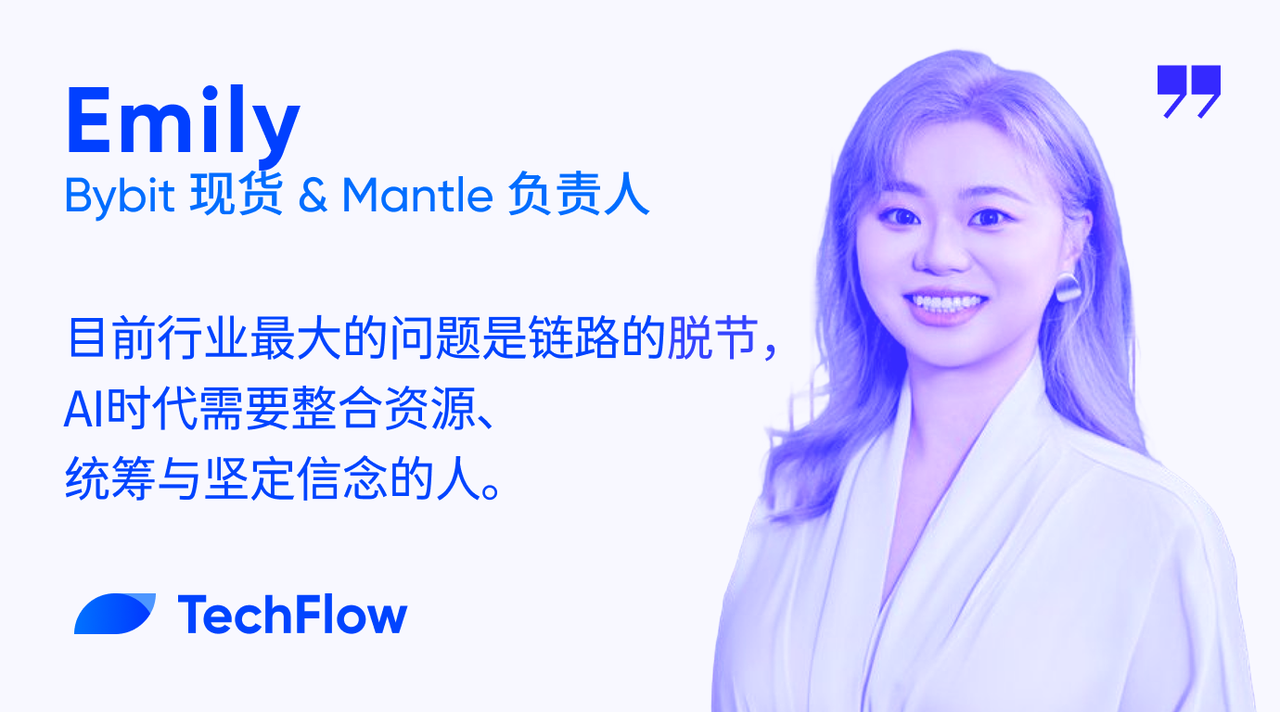
Interview with Emily: The biggest current industry challenge is the disconnection across value chains; the AI era demands individuals who can integrate resources, coordinate holistically, and uphold firm convictions.
TechFlow Selected TechFlow Selected
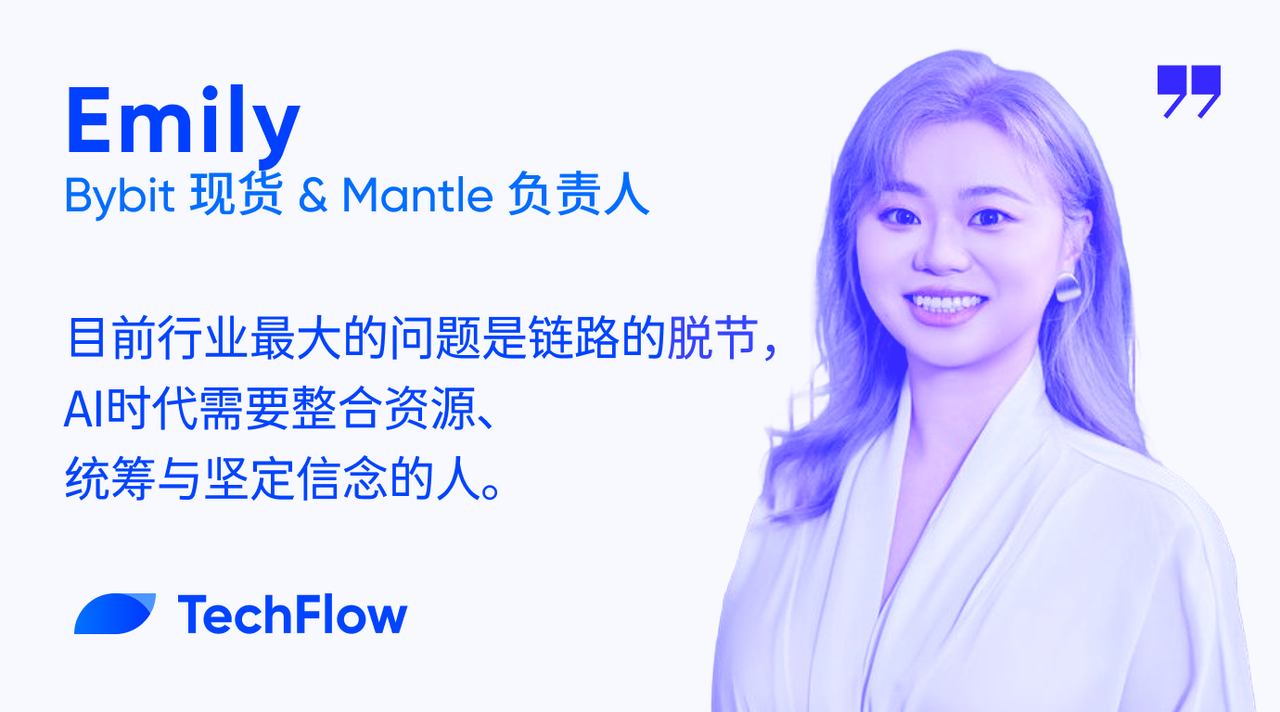
Interview with Emily: The biggest current industry challenge is the disconnection across value chains; the AI era demands individuals who can integrate resources, coordinate holistically, and uphold firm convictions.
Focusing on Mantle’s core logic of subsidy-free growth, the practical outcomes and key metrics of its three-ecosystem synergy, and dissecting Emily’s critical moves and strategic decision-making in cross-domain operations and ecosystem co-construction.
 Navigating Web3 tides with focused insights
Author: TechFlow
Today’s Web3 public chains and DeFi ecosystems are trapped in an industry-wide crisis of subsidy-driven competition and liquidity raiding. Most projects rely on hefty incentives and “vampire attacks” to lure capital—making value-driven ecosystem growth increasingly rare.
Mantle, however, has achieved an industry miracle: partnering with Aave, it drove its TVL up by $1.4 billion in just six weeks—without deploying a single dollar from its treasury for liquidity subsidies.
We’re honored to host Emily, Head of Spot Trading at Bybit and Mantle Ecosystem Lead, for an in-depth interview. As a seasoned builder spanning three core domains—CEX operations, public-chain infrastructure, and innovation incubation—Emily not only spearheaded this landmark collaboration but also serves as Head of Token Listing at Bybit Spot and Founder of Byreal, forging synergies across centralized exchange traffic, public-chain infrastructure, and early-stage innovation to create a self-reinforcing ecosystem flywheel.
This exclusive interview explores Mantle’s subsidy-free growth logic, tangible results and key metrics from its triple-ecosystem synergy, and Emily’s pivotal actions and strategic thinking behind cross-domain execution and collaborative ecosystem building.
Part 1|Starting from $1.4B TVL: How Did Mantle Attract Capital “Without Subsidies”?
Q1: We’re thrilled to welcome Emily for this exclusive interview. Emily, could you please start with a brief introduction?
Emily: Absolutely—thank you for the invitation. Hello everyone, I’m Emily. You may have met me through Bybit’s livestreams. Currently, I oversee three distinct yet deeply interconnected initiatives: Bybit’s spot trading business; the ongoing development of the Mantle network ecosystem; and Byreal—the Solana-native decentralized exchange I founded.
Though these appear to be three separate roles, they all serve one unified mission: identifying high-quality assets, building tailored infrastructure for them, and designing scalable liquidity pathways. I operate across both centralized (CEX) and decentralized exchanges (DEX), and am equally immersed in both the EVM and Solana ecosystems. That’s who I am.
Q2: The recent Mantle–Aave partnership has become a textbook case: $1.4 billion in TVL added within six weeks—zero treasury-funded liquidity subsidies. Congratulations to Mantle on this achievement. Most impressively, none of this growth relied on Mantle’s own incentive programs—a standout contrast in today’s landscape, where most public chains compete fiercely via massive incentives or even “vampire attacks.” What, in your view, is the core secret behind Mantle’s growth?
Emily: Thank you for the kind words. I’m genuinely proud of this milestone—but I’d like to begin with timing, because context gives this achievement real weight. Had this happened during a broad-based market risk-on phase—like DeFi Summer, when liquidity was abundant and new narratives were hot—the number would still be impressive, but far less persuasive. In fact, Mantle Markets launched in February this year amid a deep market correction characterized by de-risking, deleveraging, and deflation of bubbles.
At that time, institutional partners were cautious and hesitant to deploy capital. What the market truly craved was genuine security and real yield—not empty stories. Honestly, I wasn’t especially optimistic about early performance. But when Artemis data showed Mantle’s total deposits surpassing $1 billion in just 18 days—breaking Polygon’s previous record of 24 days—I and the entire team were stunned.
Looking back, this outcome validates a long-held conviction of mine: DeFi’s core demand has never disappeared—it continues to attract authentic DeFi miners, institutional capital, and yield-seekers. The market hasn’t stopped buying; it’s simply stopped buying fake growth. All investors and DeFi participants have grown more discerning. To achieve this record, we got three things critically right:
First, strategic repositioning. Starting last August, we ceased positioning Mantle as just another Layer 2—and moved beyond vague labels like “DeFi layer” or “liquidity layer.” Instead, we explicitly pivoted to becoming a Real World Assets (RWA) public chain. From then on, every initiative—from infrastructure development to protocol onboarding—has been laser-focused on RWAs.
Second, anchoring high-impact partnerships. Aave is no ordinary partner—it’s a top-tier protocol. Its decision to launch on Mantle wasn’t just a technical integration; it represented a market-wide reassessment of credibility and a critical trust signal. When a leading protocol chooses a chain, it brings more than traffic and assets—it declares to the market: “This chain and its ecosystem deserve long-term capital allocation.” That’s our second win.
Third, integrated execution—not siloed efforts. Real growth never comes from a single team working in isolation. It emerges from coordinated action: aligning underlying assets, ecosystem partners, market sentiment, and internal execution—all anchored around a flagship use case. We also activated strong synergies between the Mantle network and the Bybit ecosystem to jointly accelerate growth.
Q3: Everyone who’s lived through several crypto cycles knows that TVL built purely on liquidity stacking is inherently fragile. As the core architect behind Mantle’s leap from zero to $1.4 billion, what do you consider the ultimate metric—beyond TVL—for gauging a public chain’s true moat and ecosystem health? And if you could travel back one year—to Mantle’s cold-start inflection point—what would you do differently in terms of ecosystem strategy or resource allocation?
Emily: You’re absolutely right—TVL built on stacking is extremely fragile. Strip away that $1.4 billion lens, and internally, I track only two rarely discussed—but critically decisive—metrics:
- Asset turnover rate: $100 million sitting idle in a single pool earning interest is stagnant water. But if that same $100 million is collateralized to borrow stablecoins, those stablecoins used as margin for perpetual futures, and the resulting profits deployed into full-chain games—that’s flowing water. TVL is just reservoir capacity; turnover rate is the turbine’s power output. What defines Mantle’s moat is deep composability across protocols.
- Share of native yield-generating assets: What proportion of capital on this chain is generating real returns—anchored in RWAs or Liquid Staking Tokens (LSTs)—rather than dependent on Ponzi-style subsidies? The higher this share, the stronger the chain’s macro-level resilience.
On doing things differently: If I could rewind time, I’d abandon the “applications-first” dogma entirely—and fully commit to “assets define ecosystems.”
This is perhaps my biggest reflection over the past year. Returning to Mantle’s cold-start crossroads with today’s insight, one thing I’d do more decisively is: cut all resources aimed at scaling the ecosystem via “DApp wars” or developer headcount—and go all-in on the asset side from Day One.
For years, the public-chain playbook has been: launch mainnet → run expensive hackathons → beg developers to build DEXs, lending protocols, or chain games → hope applications drive users. But reality is harsh: In Web3, applications don’t generate assets—assets define applications.
If I could restart, I’d focus all energy on building hard currency—deeply integrating compliant fiat on/off-ramps for RWAs. First make Mantle the undisputed “clearing hub” for high-quality, yield-bearing assets. Once you hold billions—or even hundreds of billions—in premium, income-generating underlying assets, you won’t need to beg developers. Top-tier DeFi Lego pieces will organically assemble themselves on your chain.
Q4: As Mantle’s core advisor and the driving force behind this partnership, what was the biggest obstacle or challenge you faced throughout the end-to-end process—from outreach and negotiation to execution? Could you share one or two pivotal decisions or behind-the-scenes details—unknown to outsiders—that directly shaped the final outcome?
Emily:
The greatest challenge wasn’t technical integration—it was dismantling arrogance and rebuilding trust.
Top-tier protocols receive countless partnership proposals daily. Most negotiations inevitably converge on incentives, budgets, and liquidity support: “You pay X, we pay Y, let’s make the launch numbers look good—retention can wait.” This is the industry’s default playbook—and it often works. But the problem is, overreliance on this model distorts growth. If the first conversation centers on “how much to spend to hit target metrics,” the foundational logic for long-term success hasn’t yet been established—that’s the deepest hurdle.
Our solution was simple: don’t talk subsidies—talk assets. We shifted focus to how Mantle’s already-established high-quality assets—such as mETH’s deep liquidity—could be smoothly channeled into Aave via thoughtful mechanism design. When Aave’s team saw we weren’t pitching vaporware, but presenting a clear asset-flow path backed by real user demand, their stance fundamentally shifted. Insisting on zero subsidies forced us to refine our underlying logic to its absolute limit.
The second challenge was aligning internal success criteria. Some prioritized TVL, others launch metrics, others long-term retention. Without shared definitions, teams work at cross-purposes. I consistently emphasized: first align on the core question and objective—then seek answers and execute. These two challenges were the hardest to overcome in this collaboration.
Part 2|Bybit, Mantle, Byreal: Is a True Ecosystem Flywheel Actually Taking Shape?
Q5: Let’s now turn to the multiple roles you mentioned earlier. As you’ve noted, you wear three hats: Head of Token Listing at Bybit Spot, Mantle Core Advisor, and Founder of Byreal. From reshaping Bybit’s token listing standards and upgrading its Web3 strategy to guiding Mantle’s pivot toward an RWA public chain—you’ve precisely captured inflection points across all three sectors. Behind the scenes, how did you identify these breakthrough opportunities? And what strategy enabled you to successfully navigate all three transitions?
Emily: This is a question I’m often asked. People see me straddling CEX and DEX, deeply engaged in both EVM and Solana ecosystems, juggling multiple roles. Internally, I even have a nickname: “Mother of Dragons”—like raising three children: one mature and independent, one still learning to walk in its early stage, and one “adopted” teenage project—Mantle. But as I said earlier, I see myself more as a bridge. Most people view the market from a single vantage point—either as a CEX operator or a DEX builder. I’m uniquely positioned to connect both worlds—and to anchor myself in both EVM and Solana ecosystems.
This lets me assess the market with a more holistic lens. I don’t fixate on whether a product is good, whether a token launch succeeds, or whether a public chain goes viral. Instead, I ask: Where does the chain—from idea to product, from infrastructure to liquidity—break down? These three roles reinforce a growing conviction: the industry’s biggest problem isn’t lack of ideas, innovation, or builders—it’s the persistent disconnection across the idea → product → infrastructure → liquidity chain.
Put plainly: primary and secondary markets remain structurally fragmented; on-chain and off-chain liquidity remain misaligned. Many projects fail—not because their products are flawed—but because their growth pathways are poorly designed: launch, TGE, community growth—none are orchestrated cohesively. Let me illustrate with concrete examples across each role:
First, as Byreal Founder (builder perspective): Many outstanding builders craft lean, logically sound, technically robust, and elegantly designed products—but rarely ask upfront: Who’s the target user? Where will liquidity come from? Who are the natural partners to scale the platform? Without clarity on these early questions, even excellent products struggle to achieve product-market fit (PMF) and fade quickly. That’s the builder-side misalignment I observe.
Next, from the Mantle ecosystem perspective: Public chains and Layer 2s can’t build authentic ecosystems by passively waiting for projects to onboard. They must proactively define which native innovations and core builders the ecosystem needs—and who among potential partners can catalyze chemistry. Only coordinated action among infrastructure providers, capital allocators, and other stakeholders determines how the market—and builders—perceive your ecosystem. A healthy public-chain ecosystem isn’t built on sheer project count, but on high-quality project-and-asset combinations and well-designed liquidity pathways. That’s the market-level issue I see from the ecosystem-builder lens.
Finally, from the Bybit CEX perspective: As Head of Token Listing, I review projects daily—but frankly, high-quality candidates are scarce lately. Over the past few years, many projects boasted eye-catching metrics—high TVL, vibrant social activity, star-studded institutional backing—yet deeper due diligence revealed weak tokenomics, poor user retention, and growth fueled entirely by short-term incentives and token emissions. This is a longstanding industry disease. Such projects may flare briefly—but they lack the fundamentals to enter large-scale liquidity systems or deliver lasting value. I’m not singling out any specific project—this is a systemic industry issue.
Bringing together all three perspectives makes the core contradiction unmistakable: the primary market excels at storytelling; builders build around narratives; on-chain ecosystems provide launch infrastructure; while the secondary market excels at amplifying liquidity, PR, and listing—but now demands extreme rigor on asset quality. Underpinning all these problems is the opportunity to eliminate information asymmetry, timing gaps, and chain fragmentation. That’s why I say: what I do is simple—connect new assets with new infrastructure, build ecosystems, and design liquidity pathways.
I deeply understand CEX liquidity logic—and know how to guide successful token launches. A TGE is the single most important PR event across a project’s lifecycle. Today’s market is highly compressed: projects no longer have time to methodically build a product, then grow, then approach a CEX for listing. Since 2024, market logic has completely shifted.
Market compression means core issues must be solved upfront. While designing a product, you must already answer: Is the product logic sound? Is the demand real? Does it solve a genuine user problem? Who’s the target user? Who are the core partners? Does token value capture align with product utility? Only once these questions are thoroughly resolved should development begin.
Q6: Thank you, Emily, for such insightful and uniquely valuable cross-role perspectives—truly capturing the full spectrum of ecosystem-building logic. Juggling three major responsibilities—do you ever feel overwhelmed? How do you balance them?
Emily:
Honestly, I even feel a bit embarrassed—I don’t consider myself a successful builder. I used to evaluate projects solely as a gatekeeper, without deep hands-on product-building experience. So I chose to become a builder myself. Only by building products firsthand can I combine that CEX listing perspective to tell the full industry story.
That said, thank you for your concern. Yes—these are three full-time jobs, each tied to a completely independent team with different goals—not different departments within one team. I lead three distinct teams toward their respective objectives. Their directions and goals differ sharply—that’s the toughest part.
On balance: My method is to find the “greatest common denominator” across all three roles. Bybit, Mantle, and Byreal may appear to operate in different domains—but their underlying logic is identical: identifying and amplifying high-quality Web3 assets. I don’t need to switch mental models across roles. I apply one unified investment-and-building mindset, deploying different resources on different platforms to solve problems.
My marketing lead distilled this into a PPP Success Formula: Product, People, Partners. I excel at integrating these three elements—anticipating industry shifts early, anchoring flagship cases, and using the PPP formula to orchestrate resources and deliver results.
This is my genuine insight—and I hope it helps others. I firmly believe: product comes first.
The product speaks for itself. People are central—every result is delivered by people. To build something new, you must find the right people. Team size doesn’t matter—what matters is that everyone moves with full commitment toward the same goal.
Choosing the right partners multiplies your impact. This PPP formula is highly practical—thanks to my marketing lead for codifying it.
Q7: The PPP formula is perfectly summarized. Among your many responsibilities, what moment in the Aave–Mantle collaboration stands out most vividly—and gave you the greatest sense of accomplishment?
Emily: If you only read headlines and metrics, the most memorable moment would seem to be hitting $1 billion TVL in 18 days—a historic milestone. But for me, the truly moving moment came earlier—when TVL broke $400 million just one week after launch.
$1 billion is monumental—but seeing $400 million on February 19th, I clearly remember it as a signal: it told me our envisioned ecosystem had clicked. The market chose us based on intrinsic trust—not short-term campaigns or incentives. That instant when the system began running autonomously was my most satisfying and unforgettable moment.
Part 3|The Future and Judgment: Where Do You Place Your Next Bet?
Q8: Let’s move to our final section—future outlook and judgment. We all know TVL growth and this Aave partnership are just the beginning. From a macro perspective: What do you see as Mantle’s next breakthrough? Will it be liquid staking derivatives (LSD), your stated RWA public-chain vision—or something else? Once the direction is set, people become paramount. As Byreal’s founder, what traits do you most want to see in founders you’d heavily back—to capture the upside in these emerging areas?
Emily:
Let me start with Mantle’s next breakthrough and roadmap. If I must pick one core direction, it remains RWA (Real World Assets).
We defined the RWA direction last year—and this year is all about execution. The reason is simple: DeFi can’t sustainably recycle only internal capital. To scale, the industry must onboard real-world assets and real-world yields. That’s RWA’s core value proposition. Last year, I entered the RWA space early—on xStocks’ launch day, I listed it on both Byreal and Bybit Spot, giving us a first-mover advantage in RWA.
Today, RWA is no longer a fleeting trend—it’s a tangible, on-the-ground movement. On Wall Street in New York, stablecoins and RWA tokenization are dominating discussions. This is the industry’s long-term growth strategy.
The second breakthrough area is on-chain high-frequency derivatives trading. Spot and lending are foundational infrastructure—but derivatives and proprietary trading represent the pinnacle of capital efficiency. This is the critical frontier for all public-chain ecosystems—not just Mantle.
The third direction is inevitably AI. Everyone in crypto is talking about AI right now. I recently shared a thought on social media: “Cryptocurrency may not have been designed for humans—but for AI.” AI is natively compatible with on-chain data and rules; crypto networks will become the settlement layer for agent economies—natively operating on blockchain. That’s the defining opportunity of the future.
Now, shifting from sectors to builders: I’d like to introduce a term—Polymath Builder—a concept I encountered in Dan Koe’s social posts. He argues that over the next 3–5 years, the industry will need polymath builders. I wholeheartedly agree. In early cycles, the market rewarded only two types: storytellers and token-economy designers.
But the logic has changed. With AI advancing rapidly—and everyone now using it—the bar for builder competence has shifted entirely. Builders who understand AI and wield it effectively will pull infinitely ahead of those who don’t. I’ll heavily back polymath builders—not meaning one person must master everything (product, tech, mechanism design, marketing, etc.).
Quite the opposite: AI handles information processing. What we need are people who can integrate all resources, orchestrate a product’s full lifecycle, and hold unwavering conviction. That’s the builder the next generation of the industry needs most.
Join TechFlow official community to stay tuned
Telegram:https://t.me/TechFlowDaily
X (Twitter):https://x.com/TechFlowPost
X (Twitter) EN:https://x.com/BlockFlow_News
 深潮TechFlow