Understanding the New Global AI Cycle from Wenxin Yiyan and ChatGPT Going Free at the Same Time
TechFlow Selected TechFlow Selected
Understanding the New Global AI Cycle from Wenxin Yiyan and ChatGPT Going Free at the Same Time
Where is AI headed? The answer lies in the four characters "the cost-reduction era."
 Navigating Web3 tides with focused insights
Source: Brain极体
As we enter 2025, AI continues to gain momentum globally. The impact of large models is spreading across production, daily life, social and cultural activities, and financial markets. We have a growing sense that the AI industry is undergoing rapid transformation. Its operational logic and industrial supply-demand relationships are quickly integrating and restructuring. But what exactly lies at the core of these changes? What is the latest global consensus on AI industry development? There still seems to be some ambiguity.
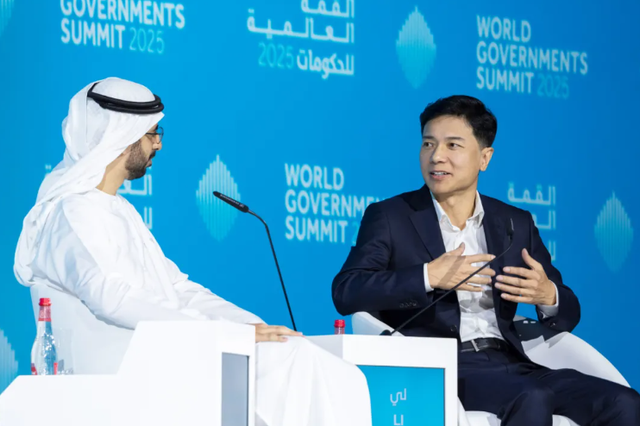
To understand the new dynamics of AI technology and industry, it's essential to combine insights from tech leaders with trends in the tech sector. On February 11, the World Governments Summit 2025 was held in Dubai, UAE. Baidu founder Robin Li, Google CEO Sundar Pichai, and Tesla & xAI founder Elon Musk all shared their latest views and predictions about the AI industry at the summit.
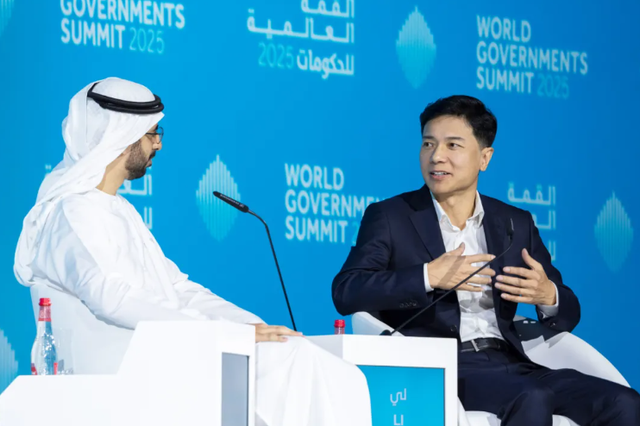
These tech leaders are in strong agreement: large models are entering a critical cost-reduction cycle. For example, Robin Li stated, “We live in an incredibly exciting era. In the past, when we talked about Moore’s Law, we said performance doubled every 18 months while costs halved; but today, when we talk about large language models, we can say inference costs drop by over 90% every 12 months.”
In line with this global consensus on falling large model costs, on February 13, the two largest language models from East and West—Ernie Bot and ChatGPT—both announced free access. It may be fair to say that understanding the trend and logic behind cost reduction in large models is key to forecasting the future trajectory of global AI.
So let’s start with this gathering of tech leaders in Dubai, and combine it with recent moves by AI companies like Baidu and OpenAI, to deeply examine the inevitability of large models entering a cost-reduction phase and the resulting industrial drivers.
Where will AI go in the coming period? The answer lies in four words: “the cost-reduction era.”

We must first establish this judgment: any innovation at the level of general-purpose technology inevitably goes through four stages—experimental phase, high-cost trial phase, cost-reduction phase, and popularization phase.
The best illustration of this pattern is household electricity. After inventors like Edison developed the light bulb, for a long time people believed home generators were necessary. However, the high cost and safety risks of home power generation made it unaffordable for most households. This stage saw real innovation, yet high costs limited application.
Then came high-voltage transmission and regional power grids. Households no longer needed individual power systems, and per-unit electricity costs dropped dramatically. Only then did household electricity and lighting truly become widespread. Today’s large language models are now precisely at such a “power grid” moment—a cost-reduction cycle.

At the World Governments Summit 2025, UAE Minister of AI Omar Sultan Al Olama engaged in a dialogue with Robin Li. During the conversation, Li remarked that looking back over the past few centuries, most innovations have been tied to cost reduction—not only in artificial intelligence, but even beyond the IT industry. “If you can reduce costs by a certain amount or percentage, it means your productivity has increased by the same margin. I believe this is almost the essence of innovation. And today, the pace of innovation is much faster than before.”
In the previous cycle, training and inference costs for large models have been rapidly declining. But this does not mean earlier high-cost innovations were meaningless. On the contrary, only because of massive investments in AI infrastructure could subsequent AI innovations have a solid foundation for experimentation and exploration. Likewise, only by discovering and applying Scaling Laws and training high-quality large models could further work focus on reducing costs and optimizing model architecture. Just as electric lights had to come first before power grids could follow—these two phases cannot replace each other.
Due to sustained global efforts in advancing large language models, mainstream AI enterprises now widely recognize the feasibility of cost reduction.

For instance, Google CEO Sundar Pichai said at the recently held Paris AI Action Summit that AI technology is advancing rapidly, with particularly notable reductions in cost. Over the past 18 months, the cost of processing tokens has dropped from $4 per million to 13 cents—a 97% decrease.
Just days earlier, OpenAI CEO Sam Altman posted on social media: “The cost of using AI at a given capability level drops roughly tenfold every 12 months, and lower prices lead to even more usage.”
This indicates that top-tier global AI companies like Baidu, Google, and OpenAI all see the realization of annual rapid cost declines in large models. As AI innovation becomes cheaper, foundational large models and AI-native applications will develop even faster. Just as one standout app could spark a trend during the internet era, we are now heading toward a blossoming era of diverse AI models and applications—an age where “small forces create miracles.”
This is an inevitable trend in large model development, pushing the AI market into a new phase—high-quality models becoming freely available.

The entry of large models into a cost-reduction cycle will bring many surprises—new models that impress, and mature models becoming freely accessible to all. Supported by falling costs, offering the most advanced and technically sophisticated large models for free is emerging as a new consensus in the AI world.
The clearest evidence supporting this shift occurred on February 13, when Ernie Bot and ChatGPT simultaneously announced free access.
With continuous iteration of the Ernie large model and ongoing cost reductions, the official Ernie Bot website announced it will become fully free starting 00:00 on April 1, allowing all PC and mobile app users to experience the latest Ernie series models, along with features such as ultra-long document processing, enhanced professional search, advanced AI art generation, and multilingual dialogue.

Meanwhile, Ernie Bot has also launched a deep search feature from today onward, equipping the large model with stronger reasoning, planning capabilities, and tool-calling abilities. It can provide expert-level responses, handle multi-scenario tasks, and support multimodal input and output.
Across the ocean, OpenAI revealed updates on GPT-4.5 and GPT-5, announcing that the free version of ChatGPT will now use GPT-5 for conversations under standard intelligence settings without limitation. Previously, OpenAI had already opened ChatGPT Search to everyone, requiring no registration.
Earlier still, Google announced open access to its latest Gemini 2.0 model, including three versions: Flash, Pro Experimental, and Flash-Lite.
Clearly, driven by the cost-reduction cycle of large models, democratization is becoming a shared choice among global AI companies. We will soon apply large models at lower costs and through more convenient means. Ubiquitous, low-barrier large model capabilities will, like the spread of the internet, unleash vast imagination for intelligent transformation across all domains.
Given this wave of AI democratization and the trend toward cost reduction, what new AI trends await enterprises, developers, and individuals? Baidu’s actions have already laid out a reference blueprint.

As large models enter the cost-reduction era, enterprises need to promptly adjust strategic directions to align with upcoming market demands and user expectations. What opportunities can we identify in this cost-reduction era? Baidu’s actions have already provided answers. In this phase dominated by cost reduction and democratization, three opportunities stand out:
1. Continuous AI infrastructure development.
Lower large model costs do not mean infrastructure investment should stop. On the contrary, reduced costs will expand the发展空间 for large models and attract larger user bases. Effective infrastructure development remains the cornerstone for ensuring sustained AI innovation and broad accessibility. Robin Li believes continued investment in chips, data centers, and cloud infrastructure is still needed to build better, smarter next-generation models. From the Kunlun chip to the PaddlePaddle deep learning framework, foundational large models, and Baidu AI Cloud, Baidu is making extensive, robust investments across the full-stack AI infrastructure.

2. Exploring AI-native applications.
Certainly, large language models themselves represent valuable application forms, but AI capabilities extend far beyond. Using large models as a foundation to explore AI-native application formats and functionalities is the true highlight of the next phase in AI. Users can look forward to a colorful array of AI-native applications. For enterprises and developers alike, leveraging large model capabilities at the application layer remains the most central opportunity.

In terms of AI-native applications, Baidu has already achieved significant results—for example, the Baidu app, Baidu Wenku, and the Ernie Agent platform have all demonstrated competitive advantages. Robin Li believes that even at current levels, large language models are already creating substantial value across various scenarios, and attention must remain focused on value creation at the application layer.
3. Building next-generation large models.
Continued decline in training and inference costs means it’s now possible to create even more powerful and effective large models. Next-generation large models serve as the vanguard driving continuous evolution in the AI industry—the central axis connecting AI infrastructure with AI applications.
Currently, Western AI giants like OpenAI have already unveiled plans for next-generation models. According to a CNBC report on February 12, Baidu plans to release its next-generation AI model, Ernie 5.0, in the second half of this year, featuring major enhancements in multimodal capabilities.
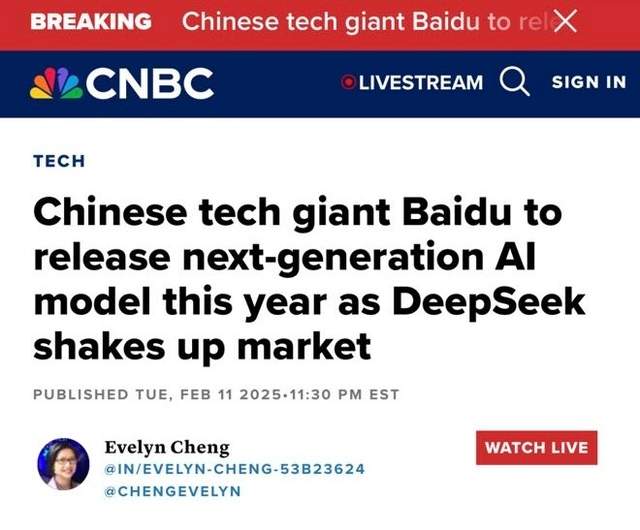
Ernie 5.0 meets external expectations for next-generation models in both strategic timing and technical upgrades. How can the upper limits of large model capabilities be突破ed during the cost-reduction cycle? That is the question Ernie 5.0 must answer.
Robin Li said, “Technological progress is extremely fast. Although we’re satisfied with what we’ve achieved so far, think about how different things will be in six months or two years.”
Under the rapid advancement of technology and infrastructure, the speed of AI development may exceed everyone’s expectations. Achieving better outcomes at lower costs. Leveraging a small lever to move a miracle of infinite possibility. This may be the beautiful foundation of the intelligent era.
Join TechFlow official community to stay tuned
Telegram:https://t.me/TechFlowDaily
X (Twitter):https://x.com/TechFlowPost
X (Twitter) EN:https://x.com/BlockFlow_News