








Wall Street's Battle for Tokenizing Securities: The Hidden Capital Struggle in the RWA Sector
TechFlow Selected TechFlow Selected
Wall Street's Battle for Tokenizing Securities: The Hidden Capital Struggle in the RWA Sector
If RWA succeeds, Ondo Chain could become a redistribution of power between old and new financial systems in the "Wall Street game."
 Navigating Web3 tides with focused insights
Author: YBB Capital Researcher Ac-Core
I. Introduction: Can RWA Become the Next Market Turning Point?
With the launch of spot Bitcoin ETFs, the crypto space is entering a new phase of development. Policy moves during the Trump administration laid the groundwork for this field, and now the entry of traditional financial giants such as BlackRock is further accelerating the growth of the RWA (real-world assets) sector. An increasing number of financial institutions are exploring how to tokenize and manage traditional assets like stocks and bonds on blockchain platforms—an emerging trend that is reshaping the financial landscape.
Recent initiatives by Ondo Finance, including Ondo Global Markets and Ondo Chain, signal that the RWA sector is gradually moving into the mainstream. This transformation has triggered a new round of competition on Wall Street, quietly changing the rules of the game in both crypto and traditional finance.
II. Differentiation and Commonality Among RWA Projects
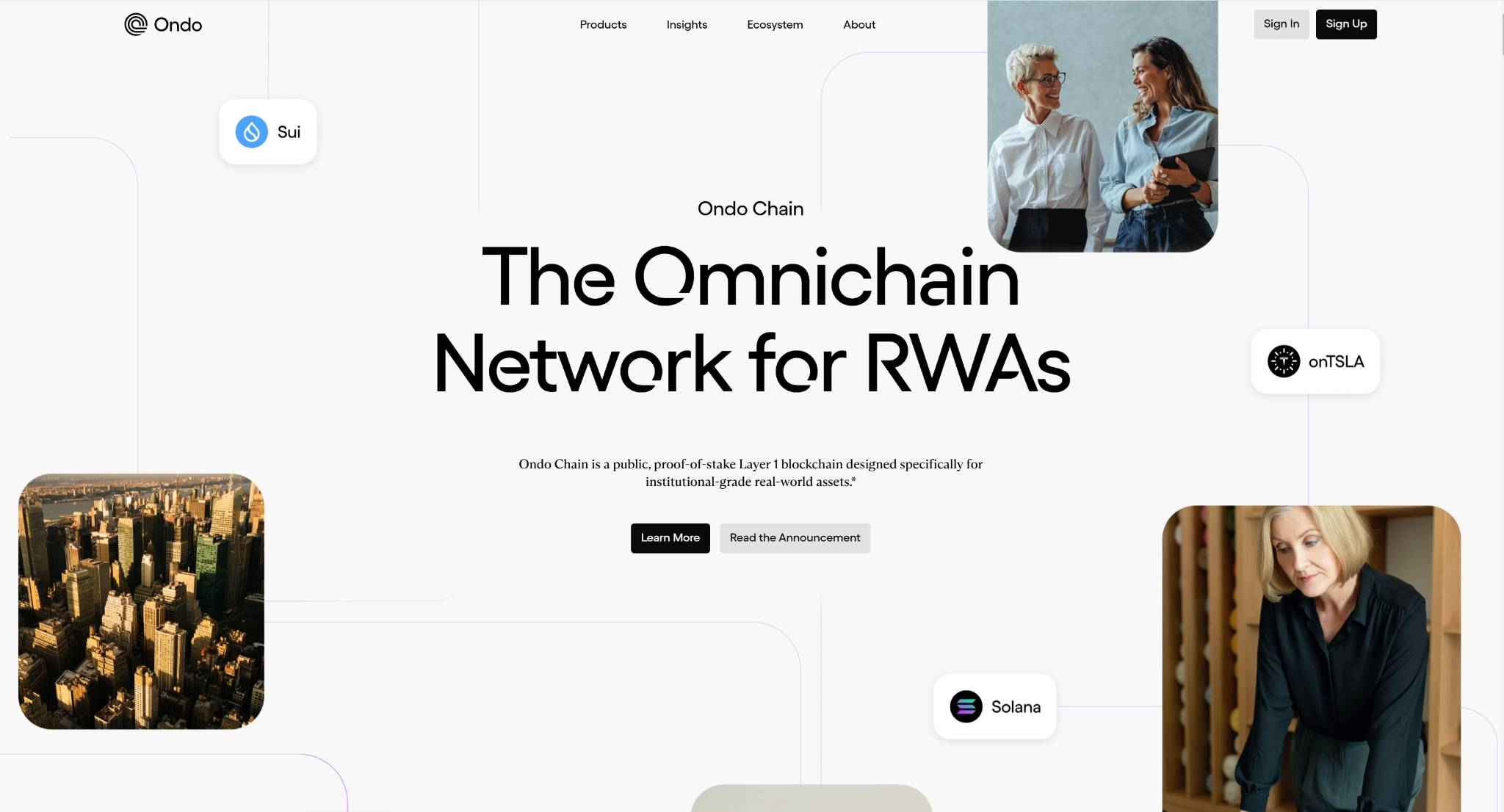
Image source: Ondo official website
2.1 Ondo Finance – A Representative Project Backed by BlackRock
Ondo Finance has been active recently—on February 5, it launched the Ondo Global Markets platform, offering blockchain access services for stocks, bonds, and ETFs. Shortly after, Ondo Finance announced its new Layer 1 public chain, Ondo Chain, aiming to build a stronger financial infrastructure to advance RWA tokenization.
Ondo Chain serves as the foundational architecture for Ondo Global Markets (Ondo GM), focusing on integrating RWA tokenization with blockchain technology. Ondo Chain enables global investors to gain blockchain-based access to U.S.-listed securities (such as stocks, bonds, and ETFs), breaking geographical barriers and offering 24/7 uninterrupted trading.
Ondo Chain introduces a model that embeds institutional-grade compliance into its public chain design, using permissioned validator nodes and native cross-chain protocols to address existing pain points in RWA onboarding. By using traditional financial assets as collateral to secure network safety and achieving interoperability with traditional clearing systems, Ondo Chain bridges liquidity between on-chain and off-chain ecosystems.
2.2 Competitive Advantages and Limitations of Ondo Finance Among Peers
These stem from its unique architectural design and strong institutional backing, reflecting the power and interest dynamics between blockchain and traditional finance.
● Competitive Advantages
Through partnerships with top-tier financial institutions like BlackRock, Ondo Finance has built a blockchain financial infrastructure capable of supporting large-scale RWA tokenization, balancing compliance with decentralization.
1. RWA Tokenization and Free Transfer: By pairing assets such as stocks, bonds, and ETFs 1:1 with tokens, investors outside the U.S. can freely transfer these tokenized assets and integrate them into DeFi for lending, yield generation, and other financial activities.
2. Combining Openness with Compliance: Ondo Chain blends the openness of public blockchains with the regulatory compliance of permissioned chains. Validators undergo approval to ensure compliance, while any developer or user can issue tokens and build applications on the chain, preserving innovation.
3. Institutional Participation and Ecosystem Development: Ondo Chain’s advisory team includes major financial institutions such as Franklin Templeton, Wellington Management, and WisdomTree, driving institutional adoption across TradFi and DeFi.
4. Oracle Mechanism and Data Security: Its built-in oracle system ensures accuracy and real-time updates of on-chain data, reducing manipulation risks and enhancing trust in critical data such as asset prices, interest rates, and market indices.
5. Cross-Chain Functionality and Security: The Ondo Bridge enables secure cross-chain transfers, supports decentralized validation networks (DVN), and facilitates institutional asset and liquidity management, accommodating large-scale transactions.
● Limitations
Heavy reliance on institutions limits participation from retail users and decentralized communities, resulting in high centralization where power remains concentrated among a few entities.
1. Over-Reliance on Institutions, Lack of Community Momentum
Ondo Finance's architecture heavily depends on participation from traditional financial institutions, whose endorsement underpins the credibility and liquidity of its tokenized assets. While this ensures quality and compliance, it also creates a core issue: the ecosystem is primarily designed for institutions, limiting retail involvement. Compared to fully decentralized RWA projects, Ondo resembles an extension of traditional finance, with most circulation and trading occurring among institutions, weakening the influence of retail investors and decentralized communities.
2. Power Distribution Under Centralized Control
Although Ondo Chain retains some openness, its validators are permissioned, meaning key control lies with a small group of institutions. This contrasts sharply with fully decentralized RWA projects, which emphasize open participation as network nodes. Ondo’s structure reflects traditional financial power dynamics, where most authority remains with a few large financial firms. Such concentration may lead to governance conflicts and resource allocation disputes, especially when token holders’ interests diverge from institutional priorities.
3. Innovation Speed Limited by Compliance and Traditional Institutions
Since compliance and institutional involvement are central pillars of Ondo Finance, innovation may be constrained. Introducing new financial products or technologies may require lengthy compliance reviews and institutional approvals, risking sluggish responses in the fast-moving crypto landscape. When competing against more agile DeFi projects, Ondo’s compliance-driven, institution-focused design could become a burden.
III. Real-World Barriers Facing RWA Projects
Despite blockchain providing a technical foundation for RWA onboarding, current public chains still struggle to meet traditional finance demands in areas like high-frequency trading and real-time settlement. Fragmentation and security issues in cross-chain ecosystems further complicate institutional deployment of RWA. RWA integration into DeFi faces multiple practical challenges:
First, trust and consistency between real-world assets and on-chain data remain core hurdles. The crux of RWA onboarding lies in ensuring alignment between physical-world assets and their digital representations. For example, after property tokenization, ownership records and valuation data on-chain must perfectly match legal documents and actual asset conditions. Two key issues arise: one is data authenticity—ensuring sources are trustworthy and tamper-proof; the other is real-time synchronization—guaranteeing on-chain information promptly reflects changes in real-world assets. Resolving these often requires trusted third parties or authoritative bodies (e.g., governments or certifiers), conflicting with blockchain’s decentralized ethos. Trust thus remains an unavoidable challenge in RWA onboarding.
Inadequate network security is another major concern. Blockchain security typically relies on economic incentives tied to native tokens, but RWAs generally have lower volatility than cryptocurrencies. During market downturns, this could undermine network security. Moreover, the complexity of RWAs demands higher security standards, which existing blockchain systems may not fully satisfy.
Compatibility between RWA and DeFi architectures remains unresolved. DeFi was originally designed for crypto-native assets, not traditional securities. Tokenizing RWAs involves complex financial operations (e.g., stock splits, dividend distributions) that current DeFi systems cannot efficiently manage. Crucially, oracle systems also fall short in handling the timeliness and security of large-scale traditional financial data.
Distributed cross-chain liquidity and security risks further complicate RWA onboarding. Cross-chain issuance fragments liquidity and increases asset management complexity. While bridge mechanisms offer solutions, they introduce new risks such as double-spending attacks and protocol vulnerabilities.
Institutional regulation and compliance represent the biggest non-technical barrier. Many regulated financial institutions cannot operate on public blockchains due to anonymity, lack of compliance frameworks, and divergent global regulations. KYC and anti-money laundering requirements add layers of complexity, potentially restricting capital inflows.
Liquidity constraints and limited institutional participation also hinder RWA growth. Currently, RWA market capitalization is concentrated in low-risk assets (e.g., government bonds and funds), while major asset classes like equities and real estate progress slowly in tokenization. RWA liquidity still depends on crypto-native protocols, indicating the market remains in early stages.
Finally, the clash between DeFi and traditional finance trust models must be addressed. DeFi builds trust through code and cryptography, whereas traditional finance relies on legal contracts and centralized institutions. This divergence makes traditional financial players cautious about blockchain adoption, particularly in custody and risk management.
While blockchain enables RWA onboarding, numerous challenges persist in practice—from data consistency and network security to compatibility, liquidity, compliance, alignment of technical and economic models, and trust mechanism conflicts. These issues must be progressively resolved to enable broad RWA adoption in DeFi.
IV. If RWA Succeeds, Ondo Chain Could Redistribute Power Between Old and New Financial Systems in the "Wall Street Game"
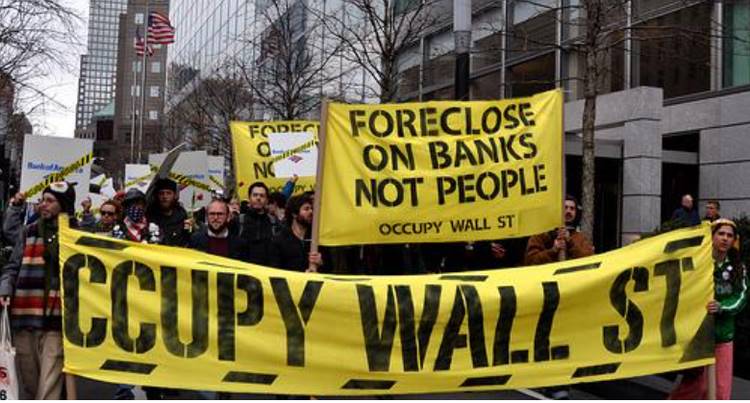
Image source: Occupy Wall Street
When analyzing the core Wall Street interests behind Ondo Chain, I believe we must look beyond blockchain and asset tokenization phenomena, focusing instead on financial logic and underlying drivers of power struggles. As previously noted, the greatest challenge for RWA isn't technological—it's achieving compliance, which requires recognition from powerful centralized organizations.
BlackRock, the world’s largest asset manager, having advanced Bitcoin ETFs, is now investing in RWA development. This move essentially represents an early bid to redistribute power between traditional finance and emerging blockchain-based decentralized technologies. This battle is not merely about technological change or financial innovation—it’s a contest over global financial rule-making, capital control, and future wealth distribution mechanisms.
Although blockchain offers hope for decentralization, faced with highly concentrated capital and power, Wall Street is attempting to bring this technological revolution under its control—using new forms of market manipulation and asset securitization to maintain dominance in the global financial system.
4.1 Rebalancing Power in the Global Financial System
Wall Street has long dominated the global financial system, controlling key nodes of capital flow, asset management, and financial services. Traditional institutions maintain global capital control by monopolizing financial infrastructure (banks, stock exchanges, clearing systems, etc.). However, the rise of blockchain technology disrupts this status quo:
Decentralized Finance (DeFi) undermines Wall Street’s long-standing control of traditional financial infrastructure through disintermediation. DeFi enables key functions like capital movement and asset management to operate on decentralized platforms—users can directly conduct asset management, lending, and trading on blockchains without banks or investment firms. This poses a significant threat to Wall Street, as such power shifts could erode its dominance over the global financial system.
4.2 Asset Tokenization: Who Controls the New Financial Infrastructure?
Platforms like Ondo Chain promote RWA tokenization to enhance liquidity, yet conceal a deeper struggle for control over next-generation financial infrastructure. Blockchain networks are candidates for the new global financial backbone—those who dominate this infrastructure will lead in linking real-world assets to blockchain.
Wall Street’s interest lies in controlling these decentralized networks. Rather than rejecting blockchain outright, they may use investments, acquisitions, or partnerships to take control of emerging blockchain platforms, recreating capital centralization. Despite blockchain’s decentralization goals, vast amounts of capital and liquidity tend to concentrate in the hands of a few large financial institutions or hedge funds. Ultimately, key resources on blockchain platforms—liquidity, protocol governance rights—may revert to a small group of players, making decentralized markets reliant on centralized forces.
4.3 Regulatory Arbitrage and Extralegal Power
On February 6, Cointelegraph reported that according to JPMorgan’s latest institutional trader e-trading survey, 29% of institutional traders are currently engaging or planning to engage in cryptocurrency trading this year—an increase of 7 percentage points from last year.
Arbitrage has long been a favored strategy among Wall Street elites. Faced with uncertain regulatory environments around blockchain’s decentralized nature, Wall Street institutions may exploit regulatory differences across jurisdictions—establishing operations in regions with lax oversight to circumvent stricter rules elsewhere.
For instance, certain RWA tokenizations on projects like Ondo Chain might bypass traditional securities or financial market regulations. By manipulating asset flows and capital structures across different regulatory regimes, Wall Street can strengthen control over emerging markets. It's possible that operating in such “gray zones” is one way Wall Street seeks higher returns via blockchain.
4.4 Market Liquidity and Price Manipulation: The Battle for Covert Dominance
Liquidity is central to market manipulation—enabling covert price control even in seemingly “decentralized” markets. While Ondo Chain provides global investors with new investment opportunities through RWA tokenization, its liquidity and trading depth still heavily depend on large capital injections. Liquidity control will remain a core weapon for Wall Street players. Even within decentralized blockchain environments, institutions with greater capital, advanced trading tools, and superior market insights can still steer market trends.
4.5 RWA Hedge Funds: Restructuring the Asset Securitization Game
Historically, Wall Street generated massive profits through asset securitization (e.g., subprime mortgage-backed securities). RWA tokenization on blockchain opens a new era of asset securitization. For example, Wall Street could bundle tokenized assets to launch novel financial products, attracting global investors. These products—based on RWAs such as real estate investment trust tokens or corporate bond tokens—would expand market offerings.
Derivatives markets could also expand via blockchain. Wall Street might design complex financial instruments (options, futures, swaps), repackaging and selling risks globally once again. The cycle of risk transfer and profit extraction will continue in the age of RWA tokenization.
V. The Evolution of the Crypto World – Industry Development Forced Into Overdrive
Taking Bitcoin-led crypto ETFs, Trump-related events, and future RWA as examples, each is accelerating industry development at varying degrees—directly increasing profitability challenges. These factors impact the crypto industry through complex market dynamics, regulatory pressures, and gradual infiltration of traditional finance.
5.1 Market Maturation Driven by ETFs
The introduction of ETFs marks growing acceptance of crypto assets by mainstream institutions and investors—but doesn’t necessarily benefit overall industry growth. Just as gold saw prolonged stagnation post-ETF, similar effects may occur:
Declining Market Liquidity and Volatility
ETFs signify crypto assets entering traditional financial markets. Institutional investors attracted by ETFs tend to adopt conservative strategies, and increased financial derivatives reduce crypto asset volatility. For traders relying on high volatility (e.g., retail traders and crypto hedge funds), this means fewer arbitrage and high-frequency trading opportunities, shrinking profit margins.
Concentrated Capital Flows
ETFs centralize capital flows in major assets like Bitcoin. This could leave mid- and small-cap crypto assets vulnerable to liquidity shortages and price declines, threatening the development prospects of smaller projects. As a result, emerging projects face reduced profitability, raising overall industry barriers.
Competition from Traditional Finance
ETFs mean crypto assets are being productized within traditional finance, increasing market transparency and competition. Crypto must now compete more intensely with established financial instruments like stocks, bonds, and commodities, diverting capital and investor attention.
5.2 Market Uncertainty from the Trump Effect
Actions by political figures like Trump affect the crypto market through policy decisions, regulatory stances, and international relations, adding uncertainty and complexity:
Increased Policy Uncertainty
Trump’s policy positions and governing style are often unpredictable, especially regarding economic and financial regulation. Potential regulatory actions (tightening or loosening controls on digital currencies) during his administration would directly impact market sentiment, increasing instability in the crypto market. This uncertainty exposes the industry to greater policy risks, undermining long-term profit stability.
Stricter Anti-Money Laundering and KYC Requirements
If politicians like Trump push for tougher AML and KYC regulations, exchanges and crypto projects will face higher compliance costs. This significantly raises operational expenses and squeezes profit margins—especially for crypto businesses lacking compliance experience.
The “TRUMP” Meme Coin Creates a “Siphoning Effect”
High volatility attracts speculative capital. The “TRUMP” coin benefits from natural marketing appeal, drawing massive capital into a single asset. Limited market liquidity and capital can be quickly siphoned by meme coins in the short term, creating a “capital concentration effect.” However, once prices drop, liquidity rarely disperses back evenly.
5.3 RWA Development Brings Penetration of Traditional Finance
The growth of RWA in crypto reflects a trend toward integration between crypto and traditional financial assets—but this convergence also increases profitability challenges:
Introduction of Traditional Finance Cost Structures and Competition
Once RWA projects go live at scale, traditional assets like bonds, equities, and real estate will compete directly with crypto assets in the same ecosystem. The maturity, cost efficiency, and lower risk profiles of traditional financial products will attract institutional investors, forcing crypto assets to compete with well-established alternatives.
Conflict Between Decentralization and Compliance
RWA onboarding involves complex regulatory requirements, especially concerning compliance and legal liability. Compared to today’s decentralized crypto assets, RWA adoption may force more crypto projects toward compliance, pushing those unable to meet regulations out of the market—and reducing profitable opportunities.
Capital Shifts Toward Low-Risk Assets
The tokenization of real-world assets—such as government and corporate bonds—will draw conservative investors into on-chain markets. As more capital flows into low-risk RWAs, high-risk, high-return crypto projects (like DeFi protocols or emerging tokens) may lose funding support. This migration toward safer assets will further compress profit margins in the crypto market.
VI. Conclusion: Is RWA a Narrative Bubble or a Market Transformation?
In my view, ETFs, the Trump effect, and the rise of RWA will collectively increase profitability challenges in the crypto industry through different channels and intensities. ETF-driven market maturation and institutionalization reduce volatility and high-profit opportunities; Trump’s policies may heighten market uncertainty and policy risks; and RWA introduces direct competition between crypto and traditional financial markets. Amid this increasingly complex evolution, the more “conventional” crypto assets become, the more likely the market is to hit bottlenecks—presenting harsher challenges ahead.
Therefore, whether RWA is a “narrative bubble” or a “market transformation” depends on the maturity of its technological foundation, market demand, and implementation pathways. Judging from early-stage progress and existing challenges, RWA does contain elements of a “narrative bubble.” Yet, given deep involvement from prominent institutions, RWA holds potential to become a new catalyst for change in the crypto market.
Join TechFlow official community to stay tuned
Telegram:https://t.me/TechFlowDaily
X (Twitter):https://x.com/TechFlowPost
X (Twitter) EN:https://x.com/BlockFlow_News
 @YBBCapital






