Three-minute overview Noon: On-chain intelligent yield stablecoin protocol
TechFlow Selected TechFlow Selected
Three-minute overview Noon: On-chain intelligent yield stablecoin protocol
Noon aims to create a stablecoin that combines value storage with yield generation, bringing financial empowerment and equitable participation opportunities to a broader user base.
 Navigating Web3 tides with focused insights
By ChandlerZ, Foresight News
In the highly volatile traditional cryptocurrency market environment, stablecoins offer users a relatively stable store of value due to their pegging mechanism with fiat currencies. However, simple stablecoin functionality alone can no longer meet the market's diversified demands for capital appreciation and yield generation. To address this, an increasing number of projects are now integrating yield-generating mechanisms into stablecoin products, aiming to deliver additional economic returns while maintaining price stability.
Amid this trend, Noon has emerged as a new player. Positioned as a next-generation stablecoin within the Web3 ecosystem that combines stability with yield generation, Noon focuses on intelligent capital allocation and fair governance models to reshape the value distribution mechanism of financial instruments. Its core stablecoin USN is pegged 1:1 to the U.S. dollar and introduces a staking derivative called sUSN. Users can mint USN by collateralizing USDT or USDC, while holding sUSN to capture protocol-generated yields. The project is currently live on Ethereum, Sophon, and ZKsync, with plans to expand to additional chains soon.
sUSN: The Core Vehicle for Yield-Bearing Assets
USN is the foundation of the Noon protocol—a stablecoin pegged 1:1 to the U.S. dollar. Users mint USN by depositing USDT or USDC. While USN itself does not directly generate yield, it serves as the base asset enabling subsequent yield generation. Through its minting and redemption mechanisms, USN maintains high liquidity, allowing users to freely trade in the market. During the public testing phase, USN holders can accumulate points that will indirectly entitle them to future allocations of the NOON governance token.
When users stake their USN into designated staking pools, they receive sUSN in return. This process effectively converts user assets into eligibility for yield generation. The platform’s built-in smart rebalancing system deploys the staked USN into a set of pre-defined low-risk, market-neutral strategies. As these strategies generate “native yield,” the platform automatically adds newly earned USN back into the staking pool, thereby increasing the underlying asset value represented by each unit of sUSN. This ensures that sUSN holders benefit from compounding returns generated by intelligent strategies without touching their principal, enabling steady asset growth.
A New Model for Intelligent Yield and Fair Distribution
Noon’s core innovation lies in its dynamic strategy engine, which intelligently allocates capital across multiple delta-neutral (market-neutral) strategies to balance risk and return. Initial strategy components include funding rate arbitrage and tokenized treasury investments. Funding rate arbitrage captures periodic funding fee income through hedging between spot and perpetual contracts, while tokenized treasury investments leverage low-risk, fixed-income government bond assets to provide baseline yield stability. The system automatically optimizes strategy weights based on real-time market data such as interest rate environments and funding levels, maximizing returns under varying market conditions. This system operates via multiple data monitoring and real-time feedback mechanisms, ensuring the entire asset allocation process remains both secure and efficient, delivering consistent yield experiences across market cycles.
From a technical architecture perspective, Noon has been deeply designed around security, liquidity, and strategic flexibility. Its dynamic rebalancing system continuously monitors strategy performance and market risk indicators, automatically switching to optimal strategy combinations to mitigate risks arising from single-strategy failure. Additionally, Noon has established an insurance fund accounting for 10% of generated yields, serving as a buffer against potential losses and prioritizing support for fast redemption features to ensure users’ liquidity needs are met. A decentralized governance framework involving node operators and validators enhances protocol transparency and resistance to manipulation.
In terms of yield distribution, Noon demonstrates strong user-centricity in both its distribution and governance models. Its yield distribution mechanism is transparent and equitable: 80% of strategy earnings go directly to sUSN holders, 10% are allocated to the insurance fund, excess profits go to staked governance token (sNOON) holders, and the remaining 10% cover protocol operating costs. The long-term goal is to reduce operational fees through economies of scale and return surpluses to users.
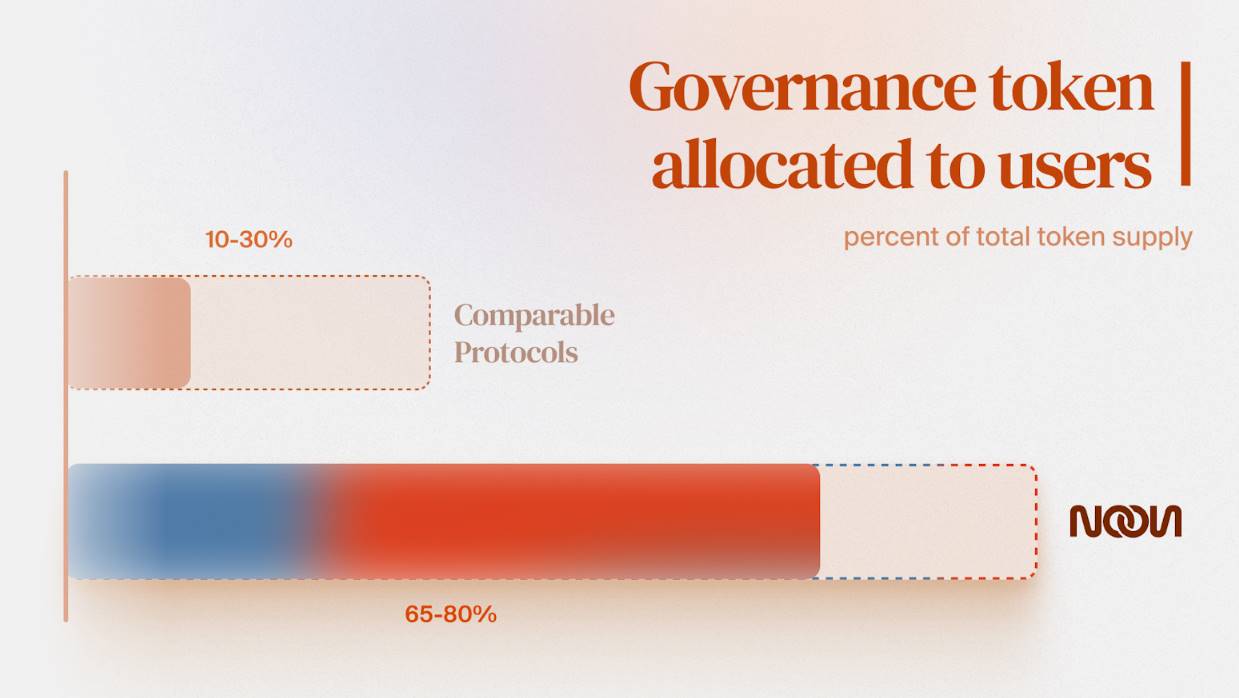
Regarding governance token (NOON) distribution, Noon adopts a strict anti-speculative design. 65% of tokens are distributed over a period exceeding eight years to long-term participants, ensuring deep alignment between governance rights and user interests. 15% are placed in a trust fund for ecosystem incentives and liquidity support, while 20% are allocated to the team with a seven-year lock-up (one-year vesting plus six-year linear release) to prevent short-term profit-taking. Furthermore, Noon explicitly rejects involvement from external capital sources such as VCs and angel investors, avoiding the risk of concentrated sell-offs of governance tokens and safeguarding maximum user benefit.
Noon targets a broad user base, including both low-risk and high-yield-seeking participants. For conservative users, sUSN offers stable yield capture without requiring active management. For more aggressive users, the liquidity of USN/sUSN supports leveraged operations, lending, and other complex DeFi yield scenarios. Moreover, the protocol’s reserve data is now updated in real time, ensuring transparency and verifiability. Noon emphasizes that it cannot alter or view data prior to its public release, thus preserving the integrity of the verification process.
On January 27, Noon officially launched its testnet to further validate the deployment strategies of USN and sUSN and to provide broader participation opportunities. The protocol plans to fully launch its governance token in Q2. Future long-term strategies include expanding the strategy library, integrating with major DeFi protocols, and driving continuous protocol optimization through community governance.
In summary, through technological innovation and institutional design, Noon has carved out a differentiated path in the stablecoin space. Its intelligent strategy engine and user-first distribution model aim to resolve existing pain points such as high yield volatility and centralized governance in current stablecoins. With proof-of-solvency in place, if Noon can effectively execute its strategic roadmap and expand ecosystem partnerships, it may become an indispensable “smart base currency” on-chain, advancing both financial inclusion and market efficiency. The project’s long-term success will depend on the sustainability of its strategies, community cohesion, and adaptive response to market risks.
Join TechFlow official community to stay tuned
Telegram:https://t.me/TechFlowDaily
X (Twitter):https://x.com/TechFlowPost
X (Twitter) EN:https://x.com/BlockFlow_News
 Foresight News