Huobi Growth Academy | Cryptocurrency Market Macro Research Report: Trump's Tariffs Trigger Market Turmoil, but Ultimately Benefit Bitcoin
TechFlow Selected TechFlow Selected
Huobi Growth Academy | Cryptocurrency Market Macro Research Report: Trump's Tariffs Trigger Market Turmoil, but Ultimately Benefit Bitcoin
An in-depth analysis of the impact of Trump's tariff policy on Bitcoin and the entire cryptocurrency market, and a discussion of Bitcoin's potential future trends.
 Navigating Web3 tides with focused insights
Executive Summary
Recently, former U.S. President Donald Trump reaffirmed his policy plan to impose high tariffs on Canada, Mexico, and China, triggering severe volatility in global financial markets. Affected by this, stock markets, foreign exchange markets, and cryptocurrency markets all experienced significant fluctuations, with Bitcoin (BTC) price briefly dropping below the $92,000 level. Although the short-term market has been impacted, in the long run, trade wars and high tariff policies may actually benefit decentralized assets such as Bitcoin.
This report will deeply analyze the impact of Trump's tariff policy on Bitcoin and the entire crypto market from multiple perspectives including macroeconomics, monetary policy, market structure, and investor sentiment, while exploring potential future trends for Bitcoin.
1. Overview of Trump's Tariff Policy
1.1 Background of Tariff Policy
1.1.1 The Return of Protectionism
Under globalization, international trade relations have become increasingly close. However, U.S. trade policy in recent years has gradually shifted toward protectionism, especially during Trump’s presidency (2017–2021). The Trump administration argued that the United States had long been at a “disadvantage” in international trade, citing several key reasons:
Widening trade deficit: The U.S. has maintained a high trade deficit with countries and regions such as China, Mexico, Japan, and the EU. Trump believed this deficit led to the loss of manufacturing jobs in the U.S.
Industrial hollowing-out: Over the past decades, U.S. manufacturing has been outsourced to Asia and other regions, resulting in a shrinking domestic manufacturing sector. The Trump administration aimed to reverse this trend by raising tariffs to encourage corporate repatriation.
Security concerns: Trump and his advisory team viewed China’s technological rise as a threat to the U.S., attempting to curb China’s industrial development through export restrictions and higher tariffs.
1.1.2 Context of the 2024 U.S. Presidential Election
In the 2024 U.S. presidential election, Trump once again emerged as the Republican nominee, strongly advocating the “America First” policy during his campaign, with core measures including:
Stricter trade sanctions against China: Promising to impose tariffs of at least 60% on all Chinese imports.
Re-evaluating trade agreements with Mexico and Canada: If elected, he may reassess the USMCA (United States-Mexico-Canada Agreement).
Imposing trade pressure on allies like Europe and Japan: Demanding they reduce their trade surplus with the U.S., or face high tariffs.
The introduction of these policies has increased global market uncertainty about future trade conditions, affecting capital flows and market sentiment worldwide.
1.2 Key Tariff Measures
The core of Trump’s trade policy is imposing high tariffs on major global economies, particularly targeting goods from China, the EU, Japan, and Mexico. Below are potential specific measures:
1.2.1 Imposing Over 60% Tariffs on Chinese Goods
Trump previously levied a series of tariffs on Chinese goods between 2018 and 2020. If re-elected, his proposed tariffs on Chinese imports would be even harsher.
Scope of affected goods: Includes electronics, automobiles, solar panels, industrial equipment, semiconductor manufacturing tools, and other key sectors.
Impact: Could increase U.S. import costs and exacerbate instability in global supply chains.
1.2.2 Adjustments to Tariff Policies Toward Europe, Japan, and Mexico
Europe: Trump may raise tariffs on German cars, French wine, and Italian fashion brands to reduce the U.S.-EU trade deficit.
Japan: May demand further market access from Japan, otherwise increasing tariffs on Japanese vehicles and auto parts.
Mexico: Trump previously threatened to impose additional tariffs on Mexican exports to the U.S. to force stronger border controls. A similar policy could be revived if he returns to office.
1.2.3 Domestic Manufacturing Support Policies
Tax incentives: Offering tax breaks to companies investing in U.S. manufacturing, encouraging them to relocate production bases back to America.
Preferential government procurement: Strengthening the “Buy American” policy, requiring government agencies to purchase more domestically produced goods.
Implementation of these measures could further strain the global trade environment, affect market stability, and indirectly drive up demand for decentralized assets such as Bitcoin.
2. Impact of Tariff Policy on Global Markets and Economy
2.1.1 Economic Shock of Trade Wars
Trump’s tariff policies may bring the following negative impacts:
Slower global economic growth: Higher tariffs increase corporate production costs, potentially reducing consumer spending and thus suppressing global economic growth. The International Monetary Fund (IMF) has warned that trade wars could reduce global GDP growth by 0.5%-1%.
Supply chain disruptions: Tariffs may force companies to restructure supply chains, increasing uncertainty. Companies like Apple and Tesla may need to find alternative suppliers, raising operational costs. Rising inflationary pressures: Tariff implementation leads to higher prices for imported goods, pushing inflation upward. The Federal Reserve may then adjust its monetary policy, affecting market liquidity.
2.1.2 Impact of Tariff Policy on the U.S. Economy
Although the Trump administration believes higher tariffs can boost U.S. economic growth, it may actually pose the following risks:
Rising consumer costs: Since many daily consumer goods rely on imports, tariff hikes could increase spending for American consumers.
The 2018–2019 tariff policies caused U.S. businesses and consumers to pay over $80 billion in additional costs.
Declining corporate profitability: Tariffs may squeeze profit margins, leading to layoffs or reduced investment. Industries such as manufacturing, retail, and agriculture could suffer major setbacks.
Federal Reserve monetary policy adjustments: If inflation continues to rise, the Fed may delay rate cuts or even hike rates further, affecting market liquidity. A high-interest-rate environment could pressure stock and bond markets, increasing market volatility.
2.1.3 Impact of Tariff Policy on Bitcoin and the Crypto Market
Despite short-term market shocks, trade wars could indirectly benefit Bitcoin in the long term for the following reasons:
Increased demand for safe-haven assets: Amid global economic uncertainty, capital may shift from traditional markets to decentralized assets like Bitcoin.
Expectations of dollar depreciation rising: If trade wars push the Fed toward accommodative monetary policy, the dollar may weaken, enhancing Bitcoin’s appeal.
Capital flight driving crypto market growth: Historically, Bitcoin demand rises whenever global markets face shocks.
2.2 Reactions in Traditional Financial Markets
Trump’s tariff policy has heightened market uncertainty, undermining investor confidence in the economic outlook and triggering a rise in risk-averse sentiment across global markets. From equities to precious metals, asset prices have been significantly affected.
2.2.1 Stock Market Decline: Growing Investor Concerns Over Economic Growth
After Trump announced plans to raise import tariffs, the three major U.S. stock indices—S&P 500, DJIA, and NASDAQ—all fell by 2%–4%. This decline was driven by several factors: rising corporate costs hurting profitability, declining consumer spending limiting demand, and growing risk-aversion pushing capital into safer assets.
When uncertainty increases, investors often exit the stock market and shift funds into safe-haven assets such as gold, the dollar, and U.S. Treasuries. Capital outflows from equities further pressure the market, creating a downward trend.
2.2.2 Stronger Dollar Index (DXY): Risk Aversion Boosts the Dollar
Despite the negative impact of Trump’s tariff policy on the global economy, the U.S. Dollar Index (DXY) strengthened in the short term. This was primarily due to market expectations that the Fed would not cut rates immediately, coupled with investors seeking the dollar as a safe-haven asset.
Impact of Fed monetary policy: Tariff policies may increase inflationary pressure, making the Fed reluctant to cut rates in the near term to prevent runaway inflation. Markets had expected rate cuts in the coming months, but the announcement of new tariffs changed this outlook, pushing the dollar higher.
Global capital flowing into dollar-denominated assets: As economic uncertainty grows, global investors tend to hold U.S. dollars or invest in U.S. Treasury bonds to hedge risk. During the 2018 U.S.-China trade war, the DXY surged past 100—a scenario that could repeat.
Pressure on risk assets like Bitcoin: A stronger dollar typically pressures risk assets priced in dollars, such as Bitcoin, as capital flows preferentially into dollar markets rather than crypto.
In the short term, a stronger dollar may lead to lower Bitcoin prices. But in the long term, growing concerns about the credibility of the dollar system could反而 boost Bitcoin’s value.
2.2.3 Rise in Precious Metals: Gold Breaks $2,800/Ounce
With risk-aversion rising, precious metal markets rallied, with gold prices breaking above $2,300 per ounce. This was mainly due to:
Safe-haven capital flowing into gold: As a globally recognized safe-haven asset, gold typically attracts capital during market turmoil.
Institutional investors and hedge funds may increase gold holdings during stock market turbulence to hedge risk.
Rising inflation expectations enhance gold’s appeal: Tariff policies may fuel inflation, strengthening gold’s role as a store of value.
Historical data shows that gold performs well in high-inflation environments. For example, during the stagflation of the 1970s, gold prices rose sharply.
2.3 Extreme Volatility in the Crypto Market
Compared to traditional financial markets, the crypto market experiences more extreme volatility, heavily influenced by investor sentiment, leveraged liquidations, and liquidity shocks.
2.3.1 Short-Term Bitcoin Drop: Safe-Haven or Risk Asset?
Although some investors view Bitcoin as “digital gold,” during this tariff shock, Bitcoin’s price plummeted temporarily, briefly falling below $92,000—a drop exceeding 10% from its peak.
In the short term, Bitcoin is still seen as a risk asset: With greater institutional participation, Bitcoin’s correlation with U.S. equities has increased. During market panic, investors often sell Bitcoin and move into dollars and gold.
In the long term, Bitcoin’s safe-haven attributes may strengthen: If doubts grow about the credibility of the dollar system, Bitcoin could regain its safe-haven status. For instance, during the 2019 U.S.-China trade war, Bitcoin surged and became a global capital refuge.
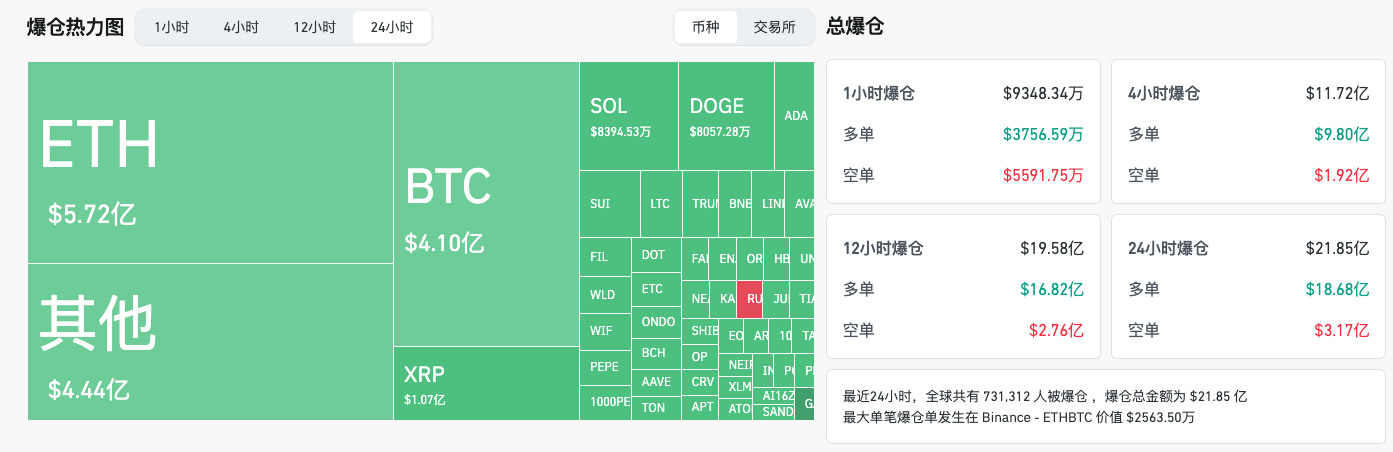
2.3.2 Leveraged Liquidations Intensify Selling Pressure
The crypto market’s high leverage means price movements are non-linear; when prices fall, highly leveraged long positions get forcibly liquidated, causing a “waterfall” decline.
Over $2 billion in total futures liquidations: Data shows that during Bitcoin’s plunge, the total liquidation across the crypto futures market reached $2 billion, with over 80% being long positions.
Exchanges’ Auto-Deleveraging (ADL) mechanisms further amplify market volatility.
Extreme market sentiment and panic selling: Dominated by retail traders, the crypto market sees emotional extremes, leading to panic-driven selloffs that deepen declines. The "Fear & Greed Index" shifted from "Greed" to "Fear" within 24 hours.
2.3.3 Altcoins Suffer Even Larger Declines
Compared to Bitcoin, altcoins performed worse, with average drops exceeding 15%.
Liquidity drying up, prices swinging wildly: Many altcoins have shallow trading depth. When selling pressure hits, insufficient buy-side orders cause rapid price collapses.
DeFi ecosystem under stress: Falling collateral values in DeFi systems triggered mass liquidations, worsening market panic.
3. How Trump’s Policies Could Long-Term Benefit Bitcoin
Although Trump’s tariff policies triggered short-term market volatility and even temporary declines in Bitcoin prices, in the long run, these policies could become catalysts for Bitcoin. The main reasons are: trade wars may weaken the dollar, capital flight could boost Bitcoin demand, and the global "de-dollarization" trend may accelerate—further solidifying Bitcoin’s role as a reserve asset. This section will detail how these factors could benefit Bitcoin over time.
3.1.1 Trade Wars Could Lead to Dollar Depreciation
Trump’s tariff and protectionist policies may undermine U.S. economic growth potential, ultimately weakening the dollar—under which Bitcoin typically performs well.
3.1.2 The Fed May Be Forced to Cut Rates, Leading to Dollar Weakness
If the U.S. economy suffers under trade wars, the Fed may be forced to adopt looser monetary policy, including rate cuts or restarting quantitative easing (QE). Uncertainty from trade wars could slow growth, forcing the Fed to cut rates to stimulate the economy. Rate cuts reduce dollar attractiveness, prompting capital outflows and dollar depreciation. A weaker dollar generally benefits Bitcoin.
As a scarce asset akin to “digital gold,” Bitcoin becomes more attractive when fiat currencies lose value.
For example, during the Fed’s large-scale QE in 2020, Bitcoin surged from $4,000 to $69,000.
3.1.3 Institutional Capital May Shift Toward Bitcoin
Institutional investors seek hedges against dollar depreciation: Institutions may reduce allocations to dollar-denominated assets (like U.S. Treasuries) and turn to tools like Bitcoin. In 2021, companies such as MicroStrategy, Tesla, and Square bought Bitcoin to hedge against dollar depreciation. Bitcoin as “digital gold”: Over recent years, Bitcoin’s safe-haven properties have strengthened, with its correlation to gold increasing.
As the dollar weakens, Bitcoin may become an increasingly popular hedging tool among investors.
3.2 Capital Flight Driving Bitcoin Demand
In times of rising uncertainty, capital tends to flow from traditional financial markets into decentralized assets like Bitcoin. Trump’s tariff policies may indirectly accelerate capital inflows into the Bitcoin market.
3.2.1 Trade Wars Increase Uncertainty, Prompting Capital to Seek Shelter
Rising uncertainty drives demand for safe-haven assets: Tariff policies trigger market turmoil, pushing many investors toward safe havens like gold and Bitcoin. During the 2019 U.S.-China trade war, Bitcoin rose amid global stock market volatility.
Decentralized assets gain appeal: In an environment of unpredictable government policies, decentralized assets like Bitcoin become more attractive due to their censorship resistance and global liquidity. Capital will no longer flow only into gold or dollars, but also partially into crypto assets.
3.2.2 Wealthy Americans May Shift Assets into Bitcoin
Wealthy individuals seek tax optimization and asset protection: If Trump’s tariff policies persist, worsening the U.S. economy or increasing tax burdens, the wealthy may look for asset safe havens. Bitcoin’s global mobility and decentralization make it an ideal wealth preservation tool.
The 2024 Bitcoin halving could boost capital inflows: In 2024, Bitcoin will undergo its next “halving event,” cutting miner rewards from 6.25 BTC to 3.125 BTC. Reduced supply may drive up prices. Combined with global economic uncertainty, wealthy investors may front-run Bitcoin exposure to hedge risk.
3.3 Accelerating De-Dollarization, Pushing Bitcoin as a Reserve Asset
Trump’s protectionist policies may accelerate global de-dollarization, prompting more countries to consider Bitcoin as a reserve asset.
3.3.1 Global De-Dollarization Is Accelerating
U.S. frequent use of financial sanctions drives de-dollarization: In recent years, the U.S. has frequently used the dollar system to impose financial sanctions on other nations (e.g., Russia and Iran).
To avoid limitations of the dollar settlement system, many countries are seeking alternatives—such as RMB settlement, digital currencies, and Bitcoin.
Trump’s policies may intensify de-dollarization: Trade wars could prompt China, the EU, Russia, and others to reduce reliance on the dollar, accelerating the de-dollarization process. In 2023, BRICS nations began researching a new trade settlement system to reduce dollar dependence.
3.3.2 Nations or Institutions May Consider Bitcoin as a Reserve Asset
Bitcoin’s chance of entering central bank reserves as “digital gold” increases: In recent years, some countries (e.g., El Salvador) have started including Bitcoin in national reserves. If global confidence in the dollar system declines, more countries may consider holding Bitcoin as part of their reserves to diversify risk.
Institutional asset allocation strategies may shift toward Bitcoin: Over the past five years, institutional interest in Bitcoin has surged, with giants like BlackRock and Fidelity launching Bitcoin-related products. During global economic turmoil, institutions may increase Bitcoin allocations.
4. Market Outlook: How Will Bitcoin React?
After Trump’s tariff policy triggers global market turmoil, Bitcoin’s price trajectory may go through short-term consolidation, medium-term rebound, and eventually long-term breakout to new highs. Throughout this process, the market will be influenced by macroeconomic conditions, Fed policy, institutional inflows, on-chain data, and other factors. This section analyzes key support/resistance levels, market sentiment, on-chain metrics, and potential market evolution paths.
4.1 Key Support and Resistance Levels: Critical Price Zones
Bitcoin has several key technical and psychological support and resistance levels, around which market movements often revolve.
4.1.1 Key Support Levels
$91,000 (short-term support): This is the initial support zone tested during downturns. If market sentiment recovers, it may form a short-term bottom. A break below $90,000 could trigger further panic and leveraged liquidations.
$85,000 (medium-term support): A stronger technical support level, likely where institutional capital enters.
If market reaction to Fed policy remains negative, BTC may retreat further to find support here.
$70,000 (extreme-case support): If trade war turmoil persists and risk aversion rises, this critical level may be tested. It would represent a major buying opportunity for long-term investors, likely attracting substantial bottom-fishing capital.
4.1.2 Key Resistance Levels
$105,000: A closely watched major level; a breakout could attract accelerated capital inflows. Institutions may test market liquidity here.
$110,000 (new all-time high): A key target BTC could hit during a bull run. A breakout may trigger FOMO (fear of missing out). If global capital rushes into Bitcoin, this level could become a new price discovery zone.
$150,000 (long-term potential resistance): If Bitcoin enters a supercycle driven by institutional capital, this could become the next target.
4.2 Potential Market Evolution Paths: Bitcoin’s Multi-Phase Cycle Analysis
Bitcoin’s price movement may unfold in three phases—short-term consolidation, medium-term rebound, and long-term breakout to new highs—each driven by different market sentiment, capital flows, and macro conditions.
4.2.1 Short-Term Consolidation (1–3 Months): Market Recovery Phase
Market Characteristics
Price Range: $80,000 – $100,000
Market Sentiment: Panic eases, caution prevails
Macro Drivers: Fed policy, market liquidity, institutional buying
Short-term Influencing Factors:
Market sentiment recovery, bottom-fishing capital enters: If $90,000 holds, panic may subside and capital may reposition. Rising stablecoin reserves on exchanges signal investor readiness to re-enter.
Fed policy as focal point: If the Fed delays rate cuts, markets may remain volatile, awaiting clearer signals. A dovish pivot could spark a rebound.
On-chain monitoring: Capital flows: Analysis of Bitcoin holder addresses: Reduced selling by long-term holders (LTH) indicates stabilization. Exchange outflows: Large BTC withdrawals from exchanges suggest restored confidence and long-term holding intentions.
4.2.2 Medium-Term Rebound (3–6 Months): Market Recovery and Uptrend
Market Characteristics
Price Range: $100,000 – $120,000
Market Sentiment: Cautiously optimistic, accelerating inflows
Macro Drivers: Institutional capital acceleration, clear Fed policy direction
Medium-term Influencing Factors
Fed turning dovish improves liquidity: If the Fed announces rate cuts or pauses hikes, improved liquidity could push Bitcoin into an uptrend. In 2020, massive Fed easing drove Bitcoin’s price up 1,600%—history may repeat.
Institutional accumulation drives price recovery: After the 2024 launch of spot Bitcoin ETFs, institutional demand for BTC may rise further. Similar to 2021, firms like Grayscale and MicroStrategy may continue accumulating BTC.
On-chain data supports bullish trend
Increase in BTC holder addresses: Growth in large BTC addresses (“whales”) signals institutional buying.
Declining exchange supply: Shrinking BTC liquidity on exchanges indicates strong buying pressure.
4.2.3 Long-Term Breakout to New Highs (6–12 Months): Bull Market Onset
Market Characteristics
Price Range: $120,000 – $150,000+
Market Sentiment: FOMO (fear of missing out),狂热 capital inflows
Macro Drivers: Global capital seeking safe haven, Bitcoin as global reserve asset
Long-term Influencing Factors
Prolonged trade wars drive capital into Bitcoin as safe haven: If trade conflicts persist, global risk-off capital may flow into BTC.
Post-2024 Bitcoin halving tightens supply-demand balance, pushing prices higher.
Bitcoin enters institutional asset allocation: Once Bitcoin’s market cap exceeds $2 trillion, more institutions may include it in portfolios. Like gold, Bitcoin could become part of sovereign wealth fund allocations.
Bitcoin ETF assets keep growing: Currently, spot Bitcoin ETFs are still in early stages. Future growth could attract more institutional capital. Accelerated ETF inflows may propel BTC into a new super bull cycle.
4.3 Conclusion: Short-Term Volatility, Long-Term Upside
Summary of Market Trajectory
Short Term (1–3 months): Market consolidation, key support at $90,000, awaiting Fed policy signals.
Medium Term (3–6 months): Gradual Bitcoin recovery toward $100,000, accelerating institutional inflows.
Long Term (6–12 months): If trade wars persist, BTC may break $120,000 and set new all-time highs.
While Trump’s tariff policy causes short-term market panic, in the long run, it may accelerate Bitcoin’s adoption as a global safe-haven asset.
5. Conclusion: Short-Term Volatility, Long-Term Optimism
Trump’s tariff policy has undoubtedly brought significant volatility to global markets, especially the cryptocurrency market, where Bitcoin’s short-term price performance is heavily influenced by market sentiment. Bitcoin experienced a sharp correction, with losses briefly exceeding 10%. However, from a broader perspective, ongoing changes in the global economy and the long-term implications of Trump’s policies may provide fundamental support for Bitcoin’s value, driving gradual price appreciation.
Although Trump’s tariff policy has caused short-term market turbulence and downward pressure on Bitcoin prices, Bitcoin’s core value remains unchanged in the long run. As global economic uncertainty grows and digital transformation in capital markets advances—especially the development of decentralized finance—demand for Bitcoin as a safe-haven asset will continue to rise, supporting its long-term value growth.
Investors should monitor global economic policies, market sentiment, and technological developments in the Bitcoin network, preparing for mid-to-long-term positioning. While the market may face continued volatility in the short term, Bitcoin’s attributes as a safe-haven asset and its potential as “digital gold” will cement its increasingly important role in the global economy. As the global economic landscape evolves, Bitcoin will remain a significant and不可忽视 asset within the world’s financial system.
Join TechFlow official community to stay tuned
Telegram:https://t.me/TechFlowDaily
X (Twitter):https://x.com/TechFlowPost
X (Twitter) EN:https://x.com/BlockFlow_News
 @HTXAcademy