









Foreseeable trade conflicts, unpredictable Web3 settlement
TechFlow Selected TechFlow Selected
Foreseeable trade conflicts, unpredictable Web3 settlement
Trump returns, eliminating ills, Ma's dog house, sweeping all directions.
 Navigating Web3 tides with focused insights
By: Zuo Yeye Waibo Mountain
Previously, we thought territorial expansion through maps was exclusive to small islands, but没想到 even global superpowers would follow this precedent; we thought the ETH L2 ecosystem was chaotic enough, but没想到 the world trade system has gradually fractured; we thought Web3 settlements were just fantasy, but没想到 stablecoins have become a new pillar.
On February 1, 2025, Trump began "fulfilling his promises" by imposing additional tariffs on imports from Mexico and Canada—25% extra on all goods except Canadian energy products.
Although Trump's style has always been maximal pressure, and these tariffs may not fully materialize, there's no turning back. The core economic idea of Trump 2.0 is to replace domestic taxes with tariffs, returning America to the idyllic era without the IRS.
Of course, Americans aren't naive enough to believe Trump’s rhetoric that tariff hikes can coexist with price stability. In a fully deindustrialized U.S., every product is imported. But from the halls of power down to ordinary citizens, everyone has entered a quasi-wartime state—temporary pain is deemed necessary to win the final victory.
Wartime Crypto Economy
After the launch of Tariff War 2.0, the crypto market was hit first. Bitcoin dropped to 97,000, and the entire market entered a downtrend, as fragile as ever—just like China's A-shares.
Theoretically, the crypto market is global. Even if one doesn’t support America’s global tariff war, massive capital should flow in as a safe haven—but only if crypto is truly a global market.
Unfortunately, DeepSeek’s emergence has shattered the myth that U.S. equities represent the global market. If you recall, it was the crypto industry that first recognized and embraced the technological advancement of DeepSeek V3 immediately after its technical report release on December 26, 2024—earlier than the general public.
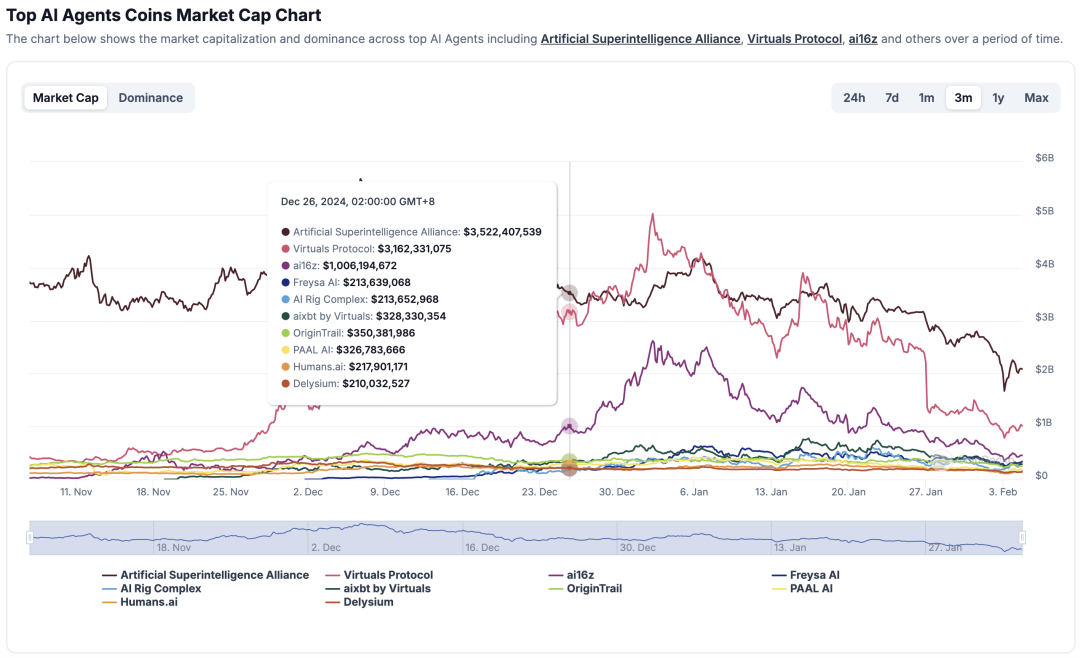
Caption: Overall trend of AI Agents. Image source: CoinGecko
AI Agents were still thriving at the time. The real crisis came when $TRUMP and DeepSeek R1 launched almost simultaneously. From January 17 to January 20, within just three days, the world faced two shocks: the president really did launch a cryptocurrency, and Chinese AI had temporarily overtaken the U.S.
To put it another way, the recent AI Agent narrative in crypto rested on two assumptions:
-
American AI dominates globally—AI Agents are first and foremost Pax Americana AI Agents, requiring OpenAI to maintain algorithmic leadership and irreplaceable Nvidia chips on the hardware side;
-
AI Agents generate no real profits nor attract genuine users; liquidity drained by $TRUMP won’t blindly return—it remains narrative economics, not PMF (product-market fit).
The timeline converges. We return to trade wars.
Facing the sharp decline of U.S. equity giants like Nvidia among the Magnificent 7, both the AI Agent sector and the chaos within Ethereum Foundation and Binance appear insignificant.
If Nvidia’s chips and Bitcoin’s price represent America’s Plan A and B for revival, then both are now under scrutiny. The only solution is restoring global confidence in U.S. capital markets.
Tariffs and trade wars are merely the first strike. More crucially, the U.S. needs stock market gains and interest rate cuts. Domestically, rate cuts are needed to stabilize the economy, but as a global financial power, the stock market must not falter—even allowed only to rise, never fall. Thus, rising U.S. equities become the sole option.
In conventional economic theory, these two goals are hard to reconcile. Yet magically, $TRUMP can bypass the existing fiscal-monetary system, while tariffs and trade wars create short-term government revenue. Add Musk’s sweeping layoffs, and whatever funds remain will inevitably be funneled into capital markets—unless someone actually builds factories in the U.S.
Under this framework, the short-term driver is ensuring tariffs work. Therefore, even if Canada secures concessions from Trump, his tariff war against the rest of the world will only escalate.
In the long term, the fiscal role of cryptocurrencies will become unavoidable: either the dollar—Federal Reserve system abandons its nominal independence and forms a closer political alliance with Trump, or the Trump administration continues using unconventional means to "direct" the dollar.
Undoubtedly, the driving force behind cryptocurrencies is no longer blockchain technology or decentralization ideals. After all, Vitalik himself admitted having ultimate control over the Ethereum Foundation. The true rulers of crypto are now real-world political forces—every major CEX must pick sides, USDT issuers and operators must align, and even every retail trader must make their choice.
Thus, the wartime state quietly became reality in 2025.
Two Worlds
Looking ahead to 2025’s main theme, the fragmentation of global trade has become real. Regionalization has effectively replaced the old globalization centered on the U.S. and institutionalized via the WTO. The only thing left intact is the dollar’s status as the global currency.
In fact, Trump has repeatedly warned BRICS nations not to challenge the dollar’s dominance. Yet everyone knows that if the U.S. withdraws from global trade, it makes little sense for non-trading nations to use its currency. But everyone also knows no country or bloc currently possesses a currency capable of challenging the dollar.
This deadlock is unprecedented.
Blockchain technology has made attempts—mBridge, involving the Bank for International Settlements (BIS), is one example, focusing on CBDC settlement. Central banks including China’s and UAE’s, along with enterprises from multiple countries and regions, have already experimented with it.
Yet BIS cannot bridge a divided world. It has withdrawn from mBridge—simply because too many BRICS nations are involved. Fearing Western accusations of helping Russia and others evade sanctions, BIS could only launch Project Agorá, with participants limited to South Korea, Japan, and the EU—clearly demarcating East and West.
Web3 projects continue advancing. The PayFi concept has entered a long-term development phase. Huma Finance aims to enable cross-border corporate settlements in the post-Ripple era—the tool, naturally and necessarily, being stablecoins. But the power of a single project remains limited. B2B becomes the dominant model, forever out of reach for ordinary individuals.
Web3 super individuals feel lost. In the era of explosive CEX growth, simply holding BTC, ETH, or even BNB was enough to outperform. But in this PVP era, super individuals face ultra-fast bots, predatory token launches, and unethical VC manipulation. The old world has finally faded away.
Last year, Web3 settlements based on stablecoins might have been the industry’s biggest trend. Now, it's hard to say. After the AI Agent flame died out, the entire industry slipped into a boring, drawn-out soap opera—complaining about trivial grievances. VCs lament their “meager” 6x returns; CEXs whine about the hardship of achieving 100 billion market cap for their platform tokens and 100 trillion in trading volume.
Conclusion
There is no true empathy in this world—humans cannot truly share each other’s feelings. But before the epic correction of U.S. equities arrives, let’s hope we each still have our own chance.
From any perspective, DeepSeek’s surprise move is merely a prelude to a long, grueling battle. Let us hope we’re all prepared before it begins.
Join TechFlow official community to stay tuned
Telegram:https://t.me/TechFlowDaily
X (Twitter):https://x.com/TechFlowPost
X (Twitter) EN:https://x.com/BlockFlow_News
 @zuoyeweb3









