Solana vs. Ethereum Ecosystem Comparison: Daily Active Users, Use Cases, Revenue, and Fees
TechFlow Selected TechFlow Selected
Solana vs. Ethereum Ecosystem Comparison: Daily Active Users, Use Cases, Revenue, and Fees
Ethereum may dominate institutional-grade complex financial scenarios, while Solana has greater advantages in pure consumer-grade scenarios.
 Navigating Web3 tides with focused insights
Author: E2M Research
Network Data Comparison
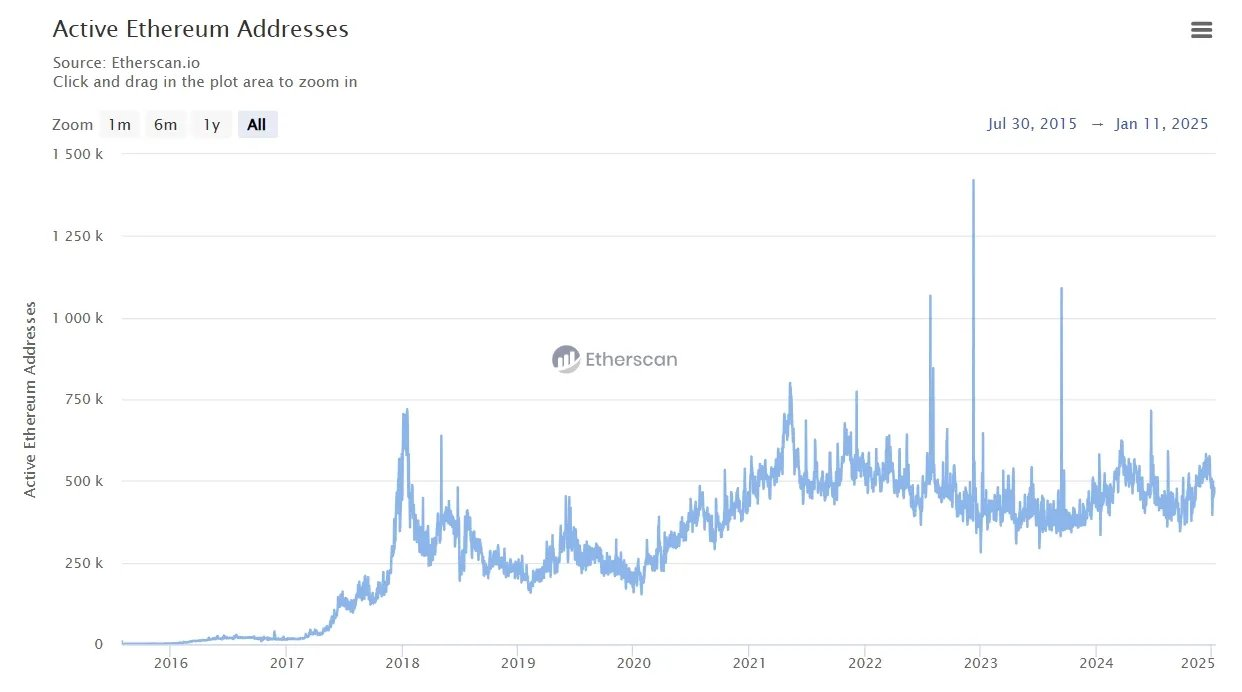
In terms of active user data, Ethereum's ecosystem sees its mainnet daily active users consistently maintained between 400,000 and 500,000.
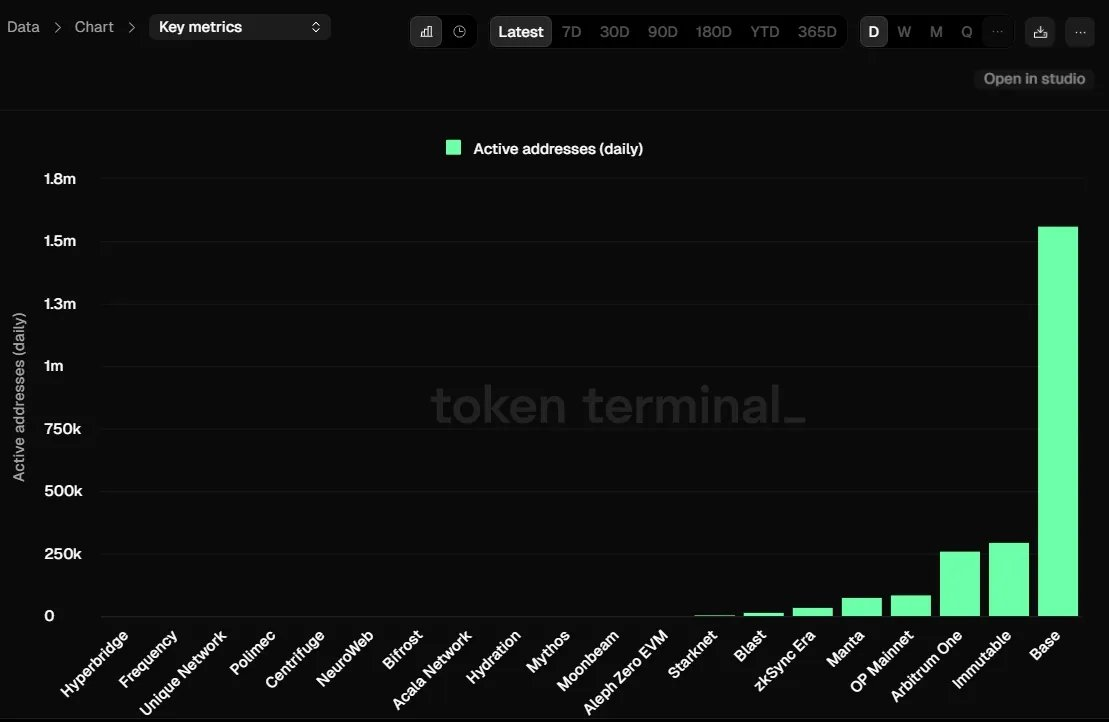
For Layer 2 networks, Base dominates with approximately 1.5 million daily active users. Immutable has around 300,000, Arbitrum about 260,000, and OP roughly 90,000. When combined with mainnet data, the total daily active users across the entire Ethereum ecosystem remain under 3 million.
Solana’s data has grown significantly since 2024, clearly finding its bowling lane and exhibiting S-shaped growth. It currently maintains around 5 million daily active users.
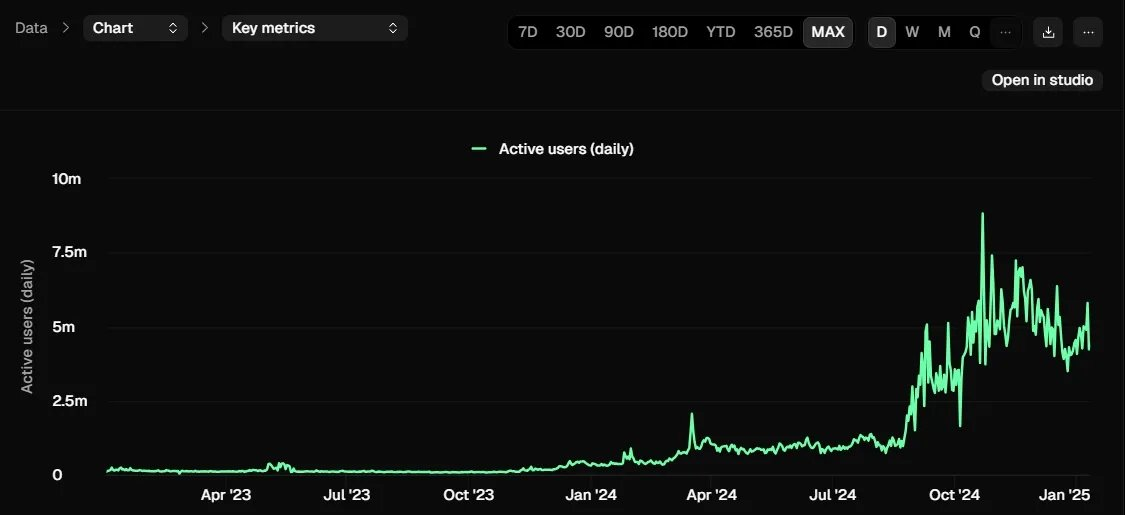
In terms of daily active users, Solana has already surpassed the entire Ethereum ecosystem—5 million versus 3 million.
This situation differs from the previous surge in BSC's data activity. The BSC boom still relied on Ethereum’s EVM architecture and was essentially influenced by Ethereum’s design, thus posing no major threat to Ethereum’s dominance. In contrast, Solana employs a completely different architecture—akin to a chimpanzee company—aiming to establish its own standards. If a large number of users migrate into the Solana ecosystem, it could drive projects to follow suit.
Recently, we’ve seen trends such as PENGU launching tokens on Solana, and DePIN projects and AI agents increasingly favoring Solana for asset issuance. This, in turn, boosts DEX trading volume. Refer to the following comparison of major DEX metrics:
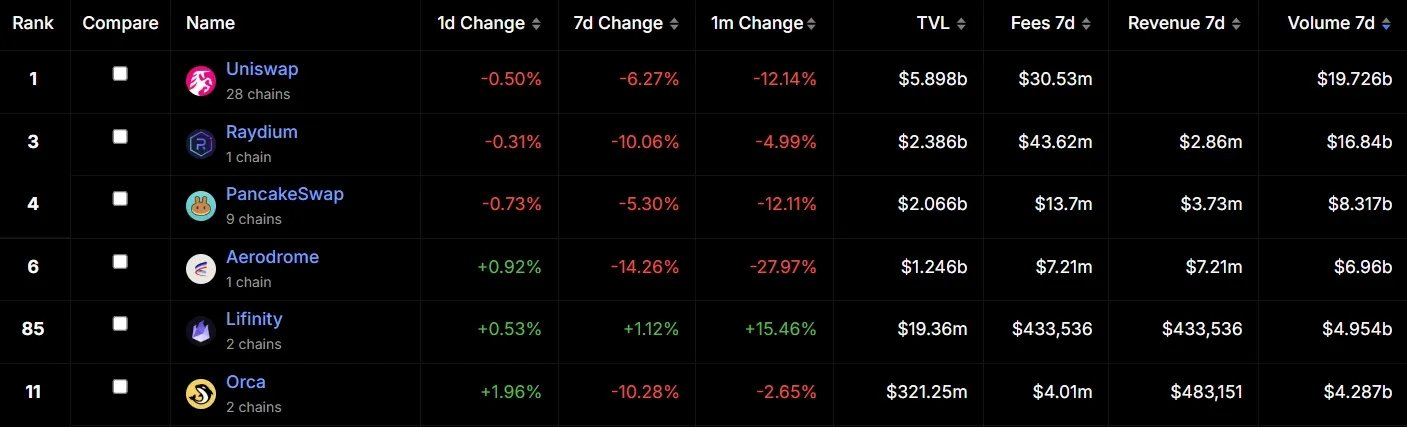
Different analytics platforms show slight variations in these figures, but they do not affect the overall analysis. Taking DefiLlama as an example, trading volumes on Ethereum and Solana ecosystems are now roughly equivalent.
In terms of fees, Solana holds an advantage, primarily because meme traders are less sensitive to high transaction costs.
Project Revenue Data
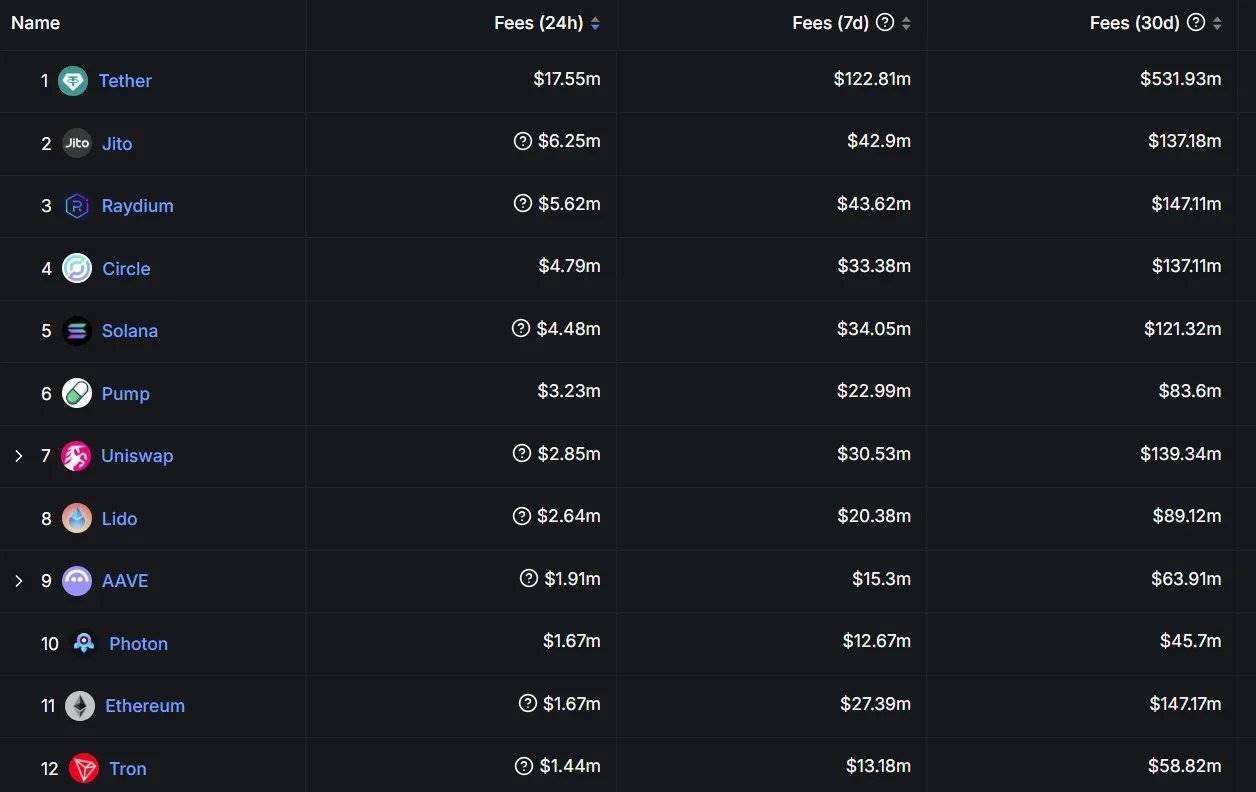
The following chart ranks recent 24-hour revenue generated by various projects. Aside from stablecoins Tether and Circle, most top performers belong to the Solana ecosystem. This serves as an expensive signal, reflecting strong user willingness to pay for products. Clearly, Solana-based projects are currently more popular.
Another notable point is that the blockchain protocols themselves do not generate the highest revenue. For instance, Solana, Ethereum, and Tron all earn less than leading applications built on their chains. This touches on the long-standing debate between "fat protocols" versus "fat applications." Currently, it appears that applications capture more value.
One possible reason is that each chain’s application landscape is largely monopolized by a few dominant players. As ecosystems grow larger and more diverse, this concentration may naturally diminish.
Fidelity Report
The Fidelity Digital Assets 2025 Outlook Report also compares Ethereum and Solana.
The report notes: The rollup-centric roadmap aims to scale Ethereum while preserving the usability of the Layer 1 blockchain. Although the Deneb-Cancun upgrade significantly reduced L1 fees, the team believes that even if blob market revenues may not immediately offset the decline in protocol income in the short term, this shift will generate positive network effects over time.
The relationship between Layer 2 and Ethereum is mutually beneficial—Layer 2 benefits from Ethereum by leveraging its security and decentralization while providing low-cost execution and further expanding ETH usage.
The chart below illustrates the trend in blob count and blob fees.
Blob fees are viewed as a long-term positive driver of Ethereum’s network effect, particularly helping Layer 2 solutions attract more users and increase interaction with ETH. This does not mean Ethereum has entirely given up on future cash flows. Developers suggest that the most likely endgame is for sustainable revenue streams to naturally emerge as network effects grow substantially.
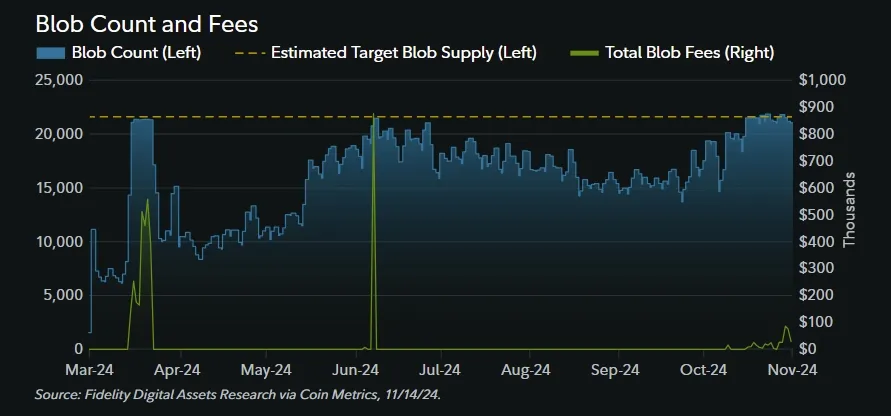
Ethereum core developers emphasize that low fees are key to driving Layer 2 user growth. More use-case-specific Layer 2 solutions are expected to emerge by 2025. While Solana may appear stronger in the short term, Ethereum’s foundational strength is likely more robust over the long haul.
Post-Deneb-Cancun upgrade, Ethereum’s token economics are projected to remain stable, with an estimated annual inflation rate of 0.22% in 2024. Ethereum’s scaling plan involves gradually increasing the number of blobs; combined with growing Layer 2 demand, this could eventually push total Ethereum fees above the annual ETH issuance rate.
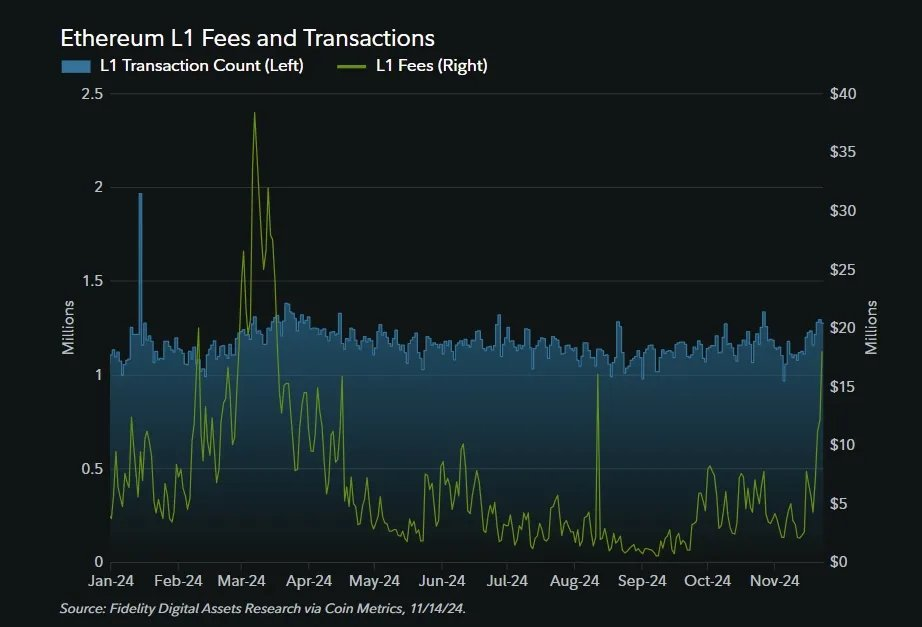
The next chart shows L1 fee and transaction volume trends. Data indicates that despite increased offloading of transactions to L2s, L1 transaction volume has not decreased compared to pre-upgrade levels—even though L1 transaction fees have dropped significantly. This suggests that even as Ethereum prioritizes L2 improvements, a substantial number of users still prefer conducting transactions directly on L1.
Reflections
The above discussion focuses on current conditions at around 5 million daily active users. But what happens when we consider 50 million or even 500 million daily active users—who is better positioned?
Given their differing characteristics, at a scale of 500 million daily active users, the two ecosystems might evolve into a state of “division of labor and cooperation”:
-
Solana is more likely to become the primary layer for consumer-grade applications, especially in high-frequency, low-value transaction scenarios such as gaming, social media, and payments.
-
Ethereum (and its L2 ecosystem) may dominate institutional services and complex financial applications involving high-value transactions.
Overall, Solana likely holds greater advantages in pure consumer-facing use cases, thanks to its Web2-like user experience and high-performance capabilities.
However, considering long-term ecosystem health and security, Ethereum’s modular architecture and mature infrastructure give it stronger sustainability in supporting mass adoption. The ideal development path may involve both ecosystems thriving in their respective domains, jointly advancing large-scale Web3 adoption. Of course, if the market grows 100x, ETH’s captured value would likely increase less than 100x, as much of the value would be captured by Layer 2s and higher-level applications.
Solana Founder's Perspective

Although Ethereum doesn’t have as many users as Solana, consider Apple smartphones—they hold a smaller market share yet capture the majority of profits. Is Ethereum in a similar position?
Currently, that isn't the case. As previously analyzed, Ethereum captures very little value from its Layer 2s, while applications built on-chain capture significant value. From a long-term perspective—say, in a 500-million-user market—Ethereum could dominate high-value transaction areas like institutional services and complex financial applications. This would resemble Apple’s business model: fewer but higher-value transactions generating disproportionate economic returns. As the Layer 2 ecosystem matures, Ethereum could further strengthen its competitiveness across multiple value tiers. Blockchain protocol revenue resembles paying for space or bytes rather than based on asset value, which inherently limits profitability. In contrast, upper-layer applications enjoy more flexible pricing models and thus capture more value. However, through Ethereum’s scaling approach, a thriving Layer 2 ecosystem in the future could potentially reverse the current low-value-capture issue.
Referencing the "Chimpanzee Company" analogy, Solana resembles a chimpanzee firm—one that must find its niche. Right now, that niche appears to be the meme issuance and trading market. The strategy then becomes waiting for the “gorilla” (i.e., incumbent leader) to make mistakes, or identifying new markets caught in a tornado phase, such as AI agents. Investment consideration should only arise when the chimpanzee company stands a real chance of becoming the new gorilla. (Even if Solana succeeds, the value may not necessarily accrue to SOL.) The meme coin market operates on non-proprietary architectures with low migration costs.
With advancements in wallet technology and multi-chain support, the meme market is no longer tightly coupled to any specific base-layer blockchain. Ethereum has firmly established itself in DeFi—that’s its bowling lane. DeFi has high migration costs, giving Ethereum a structural advantage. Stablecoin systems also face high switching costs, but their architecture isn’t tied to any particular blockchain. Bitcoin represents a high-switching-cost, non-proprietary architecture. This suggests that blockchain industry standards cannot simply copy the "Chimpanzee Game" framework. Consensus appears to be a more critical factor, carrying strong network effects.
Solana has become an undeniable part of the blockchain landscape. Nearly all mainstream cross-chain bridges and multi-chain wallets now prioritize both EVM and Solana chains. Blockchains are open systems—unlike closed internet app ecosystems—and value networks can interoperate freely.
Users aren’t confined to a single ecosystem—they can trade memes on Solana while doing DeFi on Ethereum. Full-chain wallets or chain abstraction layers may become the next battleground, as full-chain wallets sit closest to users. Features like private key management, user identity systems, and derived social relationship networks could form the moat for these wallets.
cm: In this cycle, SOL is a worthwhile bet—similar to Ethereum in the last cycle. SOL participation is essential for capturing value in this round’s meme market. Solana has not prioritized decentralization, effectively removing one constraint from the blockchain trilemma, giving it an edge. In the long run, both will have their own strongholds, but Ethereum’s irreplaceability is stronger. The next Solana may emerge, but the next Ethereum will be extremely hard to replicate.
dz: Bitcoin has no competition in the value reserve market. Ethereum provides permissionless global financial markets and serves as the foundational layer for L2s. Solana, for now, remains a meme casino with low irreversibility and low irreplaceability.
Join TechFlow official community to stay tuned
Telegram:https://t.me/TechFlowDaily
X (Twitter):https://x.com/TechFlowPost
X (Twitter) EN:https://x.com/BlockFlow_News
 @E2mResearch