All You Need to Know About Pippin, the Underrated AI Agent Framework That Recently Reached a $200 Million Market Cap
TechFlow Selected TechFlow Selected
All You Need to Know About Pippin, the Underrated AI Agent Framework That Recently Reached a $200 Million Market Cap
Pippin aims to help developers and creators leverage advanced AI technologies in a modular way.
 Navigating Web3 tides with focused insights
Author: JW (Peace and Serenity)
Translation: TechFlow

In the crypto space, especially within trending new domains, I’ve noticed a common phenomenon: after discovering a "good project" and witnessing its rapid rise, many people become overly focused and overlook other possibilities. While this may yield short-term gains, when external conditions shift, failure to adapt promptly can lead to serious issues.
I believe it's overly naive to assume that the current leader in a four-month-old emerging field will maintain dominance long-term—especially as superior developers and technologies continue to emerge.
Pippin Framework
Pippin is an AI agent framework developed by @yoheinakajima, designed to empower developers and creators to leverage advanced AI technologies in a modular way. With Pippin, users can build digital assistants capable of autonomously completing tasks, generating new plans, and seamlessly collaborating with external tools. As an open-source project, Pippin will be globally accessible in the coming weeks.
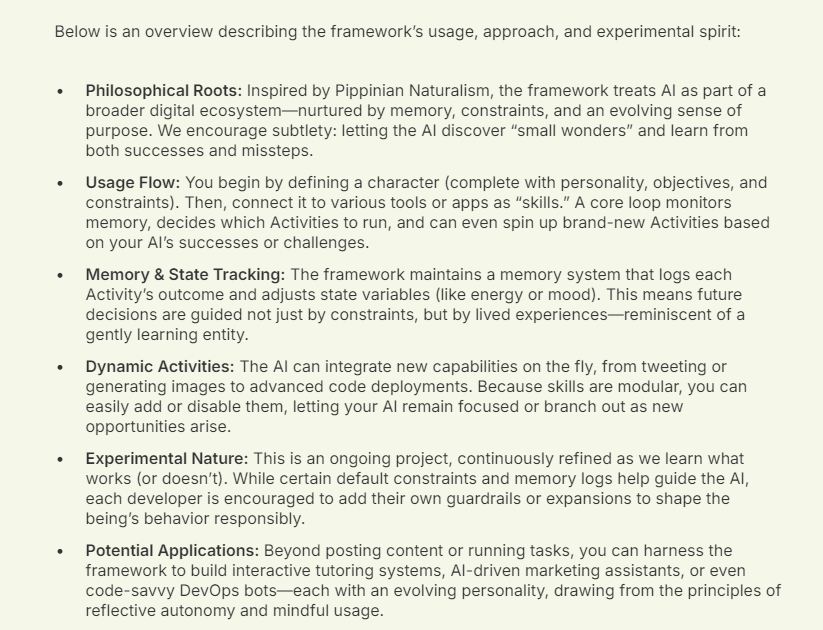
Below is an overview of the framework’s usage, design philosophy, and experimental spirit:
-
Philosophical Roots: Inspired by Pippinian naturalism, the framework treats AI as part of a broader digital ecosystem. It drives AI development through memory, constraints, and an evolving sense of purpose. We advocate for a nuanced design approach—enabling AI to independently discover “small miracles” in life and learn from both successes and failures.
-
Usage Flow: To use the framework, first define a role—including personality, goals, and constraints. Then connect the role to various tools or applications, known as "skills." The core loop monitors the agent’s memory state, determines which activities to execute, and can even generate entirely new activities based on the AI’s past successes or encountered challenges.
-
Memory & State Tracking: The framework includes a built-in memory system that logs outcomes of each activity and dynamically adjusts state variables (such as energy or mood). This means future decisions are influenced not only by constraints but also by “past experiences,” much like an intelligent agent that learns and adapts over time.
-
Dynamic Activities: The framework supports dynamic expansion of AI capabilities—from simple actions like posting tweets or generating images to complex ones such as advanced code deployment. Since skills are modular, developers can easily add or disable specific functions, allowing the AI to focus on certain tasks or expand its abilities when new opportunities arise.
-
Experimental Nature: This is an ongoing optimization project; the framework continuously improves as developers explore effective methods. While default constraints and memory logs are built in to guide behavior, developers can add their own safeguards or extensions to responsibly shape the AI’s behavioral patterns.
-
Potential Applications: The framework has broad potential applications. Beyond content publishing or task execution, it could power interactive teaching systems, AI-driven marketing assistants, or even DevOps bots with coding capabilities. These applications feature evolving personalities grounded in self-reflection and responsible-use principles, offering innovative solutions across industries.
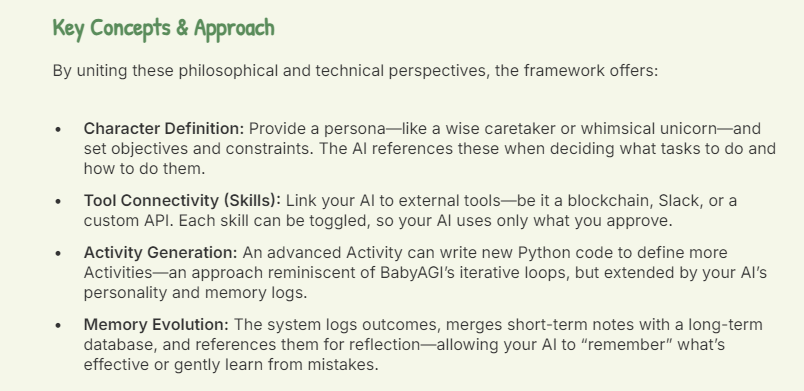
Core Concepts & Methods
By merging philosophical and technical perspectives, the framework provides developers with the following key features:
-
Role Definition: You can assign the AI a role—such as a wise guardian or a fantastical unicorn—and set corresponding goals and constraints. The AI then makes decisions about “what to do” and “how to do it” based on these personalized parameters.
-
Tool Integration (Skills): The framework allows connecting AI to external tools such as blockchain, Slack, or custom APIs. Each tool exists as a modular "skill," with flexible on/off control, ensuring the AI uses only authorized tools and remains task-focused and controllable.
-
Activity Generation: The AI can dynamically generate new Python code through high-level activities to define additional tasks. This approach draws from BabyAGI’s iterative loop mechanism but integrates the AI’s personal traits and memory logs, making generated activities more aligned with role settings and real-world needs.
-
Memory Evolution: A built-in memory system records results of every activity, combining short-term notes with a long-term database. The AI reflects on these memories to gradually optimize its behavior—not only remembering what works better but also learning gently from mistakes to inform future decisions.
You might now be wondering: "JW, how is this different from existing frameworks? Why is Pippin so special?"
Let me introduce you to its background.
BabyAGI (The Foundation of Pippin)
BabyAGI was @yoheinakajima's first open-sourced AI agent project. To date, it has garnered 20,000 stars on GitHub and been cited in over 70 academic papers. It remains one of the most influential agent frameworks ever created—an undisputed pioneer in the field.
In fact, many believe BabyAGI sparked the competitive wave in AI agent development.
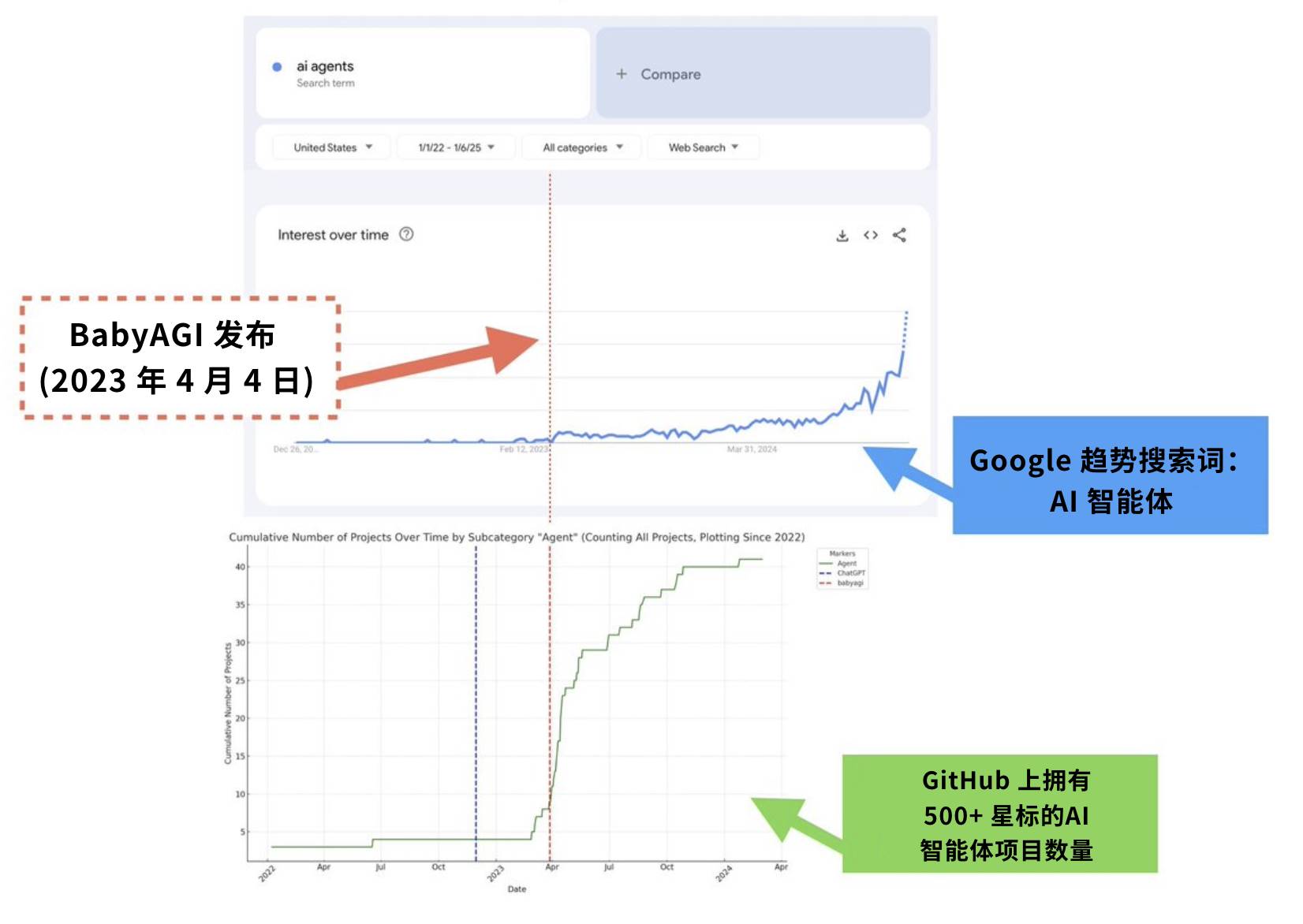
Original image by @JW100x, translated by TechFlow.
In short, BabyAGI is a landmark achievement in the AI agent industry, and Pippin represents its next evolution. Pippin transforms BabyAGI into a modular agent framework and will soon be open-sourced for global use. Pippin has the potential to become the world’s leading agent framework—yet it remains largely under-discussed (a clear case of “narrow vision”).
Q&A with Yohei
Recently, I had several fascinating conversations with @yoheinakajima. He allowed me to share some of our exchanges:
Yohei: “For the past two years, I’ve been exploring one idea—building an AI that can start a business autonomously. I’m not sure yet if current AI models are powerful enough to achieve this, but once I’m convinced they are, I’ll go all-in and build a commercial empire.”
JW: “Will the Pippin framework play a role in such a project?”
Yohei: “:) . I think the current framework can be applied to any domain—it all depends on the developer’s creativity.”
The potential of the Pippin framework is limitless. As AI agent technology advances, we may see it not only shine in the crypto space but also drive transformation across industries worldwide.
Problems with Existing Frameworks
Through discussions with several AI developers, I’ve learned that existing frameworks—particularly those based on TypeScript—pose significant challenges in practical development.
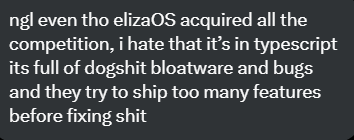
A developer closely working with Eliza (ai16z) noted: “To be honest, even though ElizaOS has acquired all its competitors, I really dislike its TypeScript-based architecture. The system is bloated and full of bugs, and they keep rushing out new features before fixing existing issues.”
It’s precisely due to these shortcomings that the market urgently needs more efficient and user-friendly frameworks—where Pippin excels. From BabyAGI’s open-source code alone, we can already glimpse the future potential of Pippin.
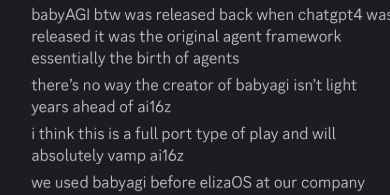
In fact: “BabyAGI launched alongside ChatGPT-4. It was the earliest agent framework and could be considered the origin of agent technology. Its creator is clearly far ahead of AI16z. I think ElizaOS development is essentially a complete framework port—and it’s almost certain to surpass AI16z entirely. Our company used BabyAGI internally before adopting ElizaOS.”
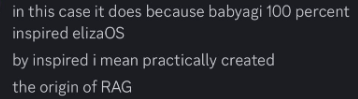
“In this context, that statement holds true because ElizaOS was directly inspired by BabyAGI. That 'inspiration' can nearly be interpreted as BabyAGI laying the foundational groundwork for RAG (Retrieval-Augmented Generation) technology.”
Many existing frameworks are not only inferior to BabyAGI (and thus Pippin), but were actually built upon BabyAGI’s inspiration. While ai16z offers unique value in some areas, its valuation vastly exceeds that of Pippin—which seems clearly unjustified.
"First-mover advantage" is indeed important, but when stronger technologies emerge, we must re-examine our biases—or risk missing out on real opportunities.
Don’t Overlook Yohei
Yohei is hailed as the “Godfather of AI,” with extensive experience and a proven track record as a pioneer in the field. He currently runs a venture capital fund, leveraging his own technologies to guide investment decisions. His primary focus today is the Pippin framework. He aims to build self-sustaining, profit-generating business models powered by Pippin—and he truly possesses the technical capability to make it happen.
P.S.: Yohei has even caught the attention of Jeff Bezos—an indication of his influence.
Join TechFlow official community to stay tuned
Telegram:https://t.me/TechFlowDaily
X (Twitter):https://x.com/TechFlowPost
X (Twitter) EN:https://x.com/BlockFlow_News
 @JW100x