









NFT sales rose in 2024—what will drive NFT growth in 2025?
TechFlow Selected TechFlow Selected
NFT sales rose in 2024—what will drive NFT growth in 2025?
Analysts expect the future market to fluctuate with cryptocurrency trends.
 Navigating Web3 tides with focused insights
Written by: Denis Omelchenko, Anna Akopian
Translated by: Tom, Mars Finance
As 2024 draws to a close, non-fungible token (NFT) sales in December surged to $877 million, making it the second-best month of the year.
Blockchain-based digital collectibles performed strongly in December, reaching $877 million in sales and ranking as the second-highest month of 2024. This growth capped off a turbulent year for the NFT market, which saw a notable recovery during the fourth quarter.
Data from CryptoSlam shows that total NFT sales in 2024 reached $8.83 billion—over $100 million more than in 2023. While the 1.1% increase may not seem substantial, it highlights the market's ability to rebound after months of declining volumes.
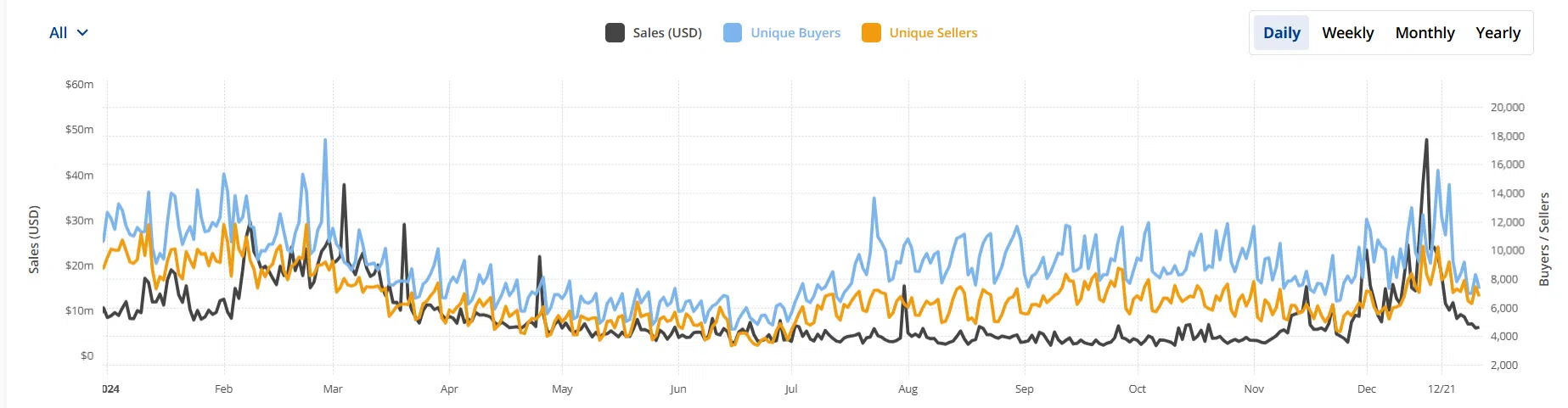
NFT Sales in 2024 | Source: CryptoSlam
Data indicates that December’s strong performance was partly driven by Ethereum-based collections such as Pudgy Penguins, Azuki, and Bored Ape Yacht Club. According to NFT Price Floor, Ethereum NFTs accounted for $488.4 million of total sales in December. Pudgy Penguins led the pack with over $285 million in trading volume, while other series like Lil Pudgys and Azuki added another $222 million combined.
In comments to crypto.news, Nicolás Lallement, co-founder of NFT Price Floor, said the NFT market was "very strong in Q1 2024 for both Ordinals (Bitcoin) and Solana NFTs," adding that "the repricing of Ethereum collections was long overdue."
"The trigger for this repricing has been the current trend of 'tokenizing NFTs.' Projects like Pudgy Penguins, Doodles, and Azuki have either launched or announced meme/L2 governance token plans, significantly boosting market interest and driving up valuations of blue-chip NFTs."
— Nicolás Lallement
Lallement emphasized that this repricing is "not just about airdrops," as many NFT holders "have shifted profits from speculative memecoin trading into long-term value investments, favoring high-quality collections." He noted this trend is especially pronounced on Ethereum, which hosts the most mature blue-chip series.
"Looking ahead to 2025, I expect this effect to gradually spread across the entire NFT ecosystem. It will likely start with airdrop-linked collections, then expand to Ethereum blue-chip PFP projects, generative art (e.g., Art Blocks), and eventually reach Solana and Bitcoin."
— Nicolás Lallement
The NFT market experienced a real rebound in the fourth quarter. After a difficult third quarter totaling just $1.12 billion, sales surged 96% in Q4 to $2.2 billion. November’s $562 million in sales laid the groundwork for December’s near-$1 billion performance.
Industry experts attribute this rally to growing confidence in the broader crypto market. For example, researchers at DappRadar pointed out that rising token prices may have fueled optimism and attracted new buyers. Sara Gherghelas, blockchain analyst at DappRadar, believes this divergence "could be attributed to renewed trading activity in premium collections (such as those from Yuga Labs) alongside increasing token prices."
"Improved liquidity and increased engagement with blue-chip collections are reinforcing collector and investor confidence, who now view NFTs not only as speculative assets but also as cultural goods."
— Sara Gherghelas, in a report
Still Far From Peak Levels
Despite the strong year-end performance, total NFT sales in 2024 remain far below peak market levels. In 2021, NFT sales hit $15.7 billion—nearly double this year’s figure. The following year, they soared even higher to $23.7 billion.
Lallement believes NFTs occupy a "unique positioning" as both high-risk speculative assets and status symbols. He explained that in the later stages of a bull market, participants who have realized gains often shift their focus from speculative investments toward status assets like digital art and collectibles.
"This behavior stems from the desire to display wealth and gain recognition within communities. For NFTs to return to the highs seen in 2021–2022, we’ll likely need Bitcoin to reach a significant price level (e.g., $150,000), and Ethereum to set new all-time highs (possibly multiples of previous peaks, around $10,000)."
— Nicolás Lallement
Once these milestones are achieved, Lallement anticipates a "capital rotation from fungible tokens into select NFT assets." He believes that when market participants begin allocating profits into high-value collections, it could once again drive valuation inflation. "Strong token performance can restore investor confidence, create a wealth effect, and reignite both speculative and cultural demand for NFTs—as both investments and status symbols," he concluded, noting that this dynamic may persist, causing the NFT market to continue cycling through booms and busts in line with broader crypto trends.
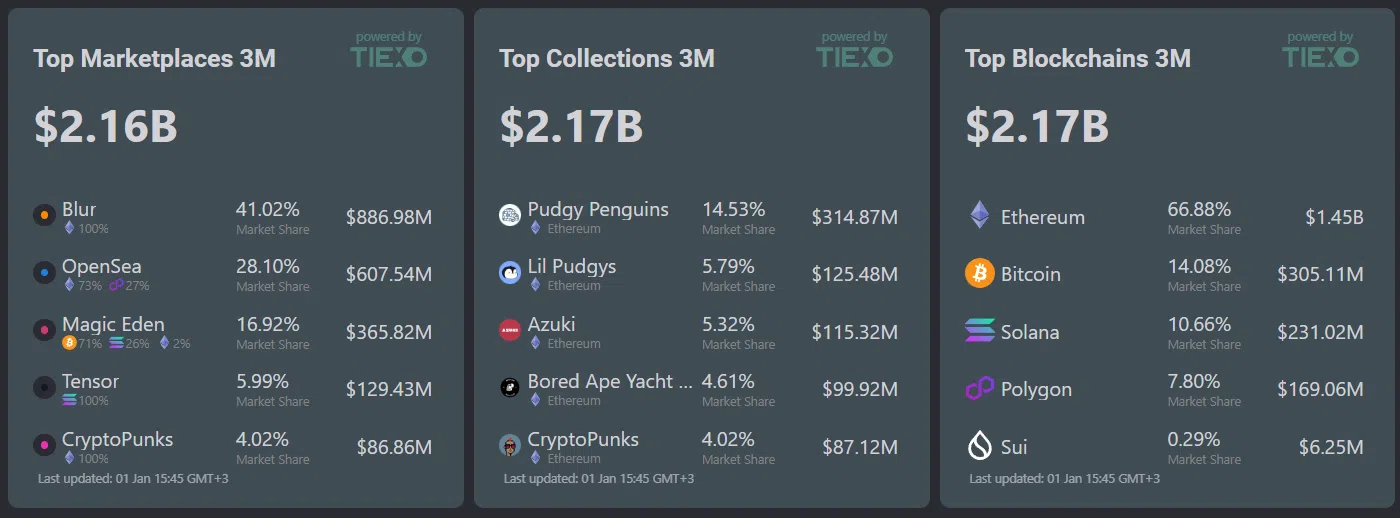
Q4 2024 NFT Activity | Source: Tiexo
According to data analytics platform Tiexo, Blur and OpenSea were the two dominant markets in Q4, collectively accounting for nearly 70% of all NFT sales. Blur led with $885 million in quarterly sales, followed by OpenSea at $607 million. Magic Eden, focused on Solana NFTs, recorded $365 million in sales.
The diversification of market activity suggests the NFT ecosystem continues to mature, with no single platform or blockchain maintaining complete dominance. While Ethereum still leads in historical cumulative NFT sales, Solana and Bitcoin are gradually gaining share.
The December surge raises questions about what comes next for NFTs. Will the momentum carry into 2025, or will it cool down? We may find out soon, as analysts predict Bitcoin’s rally could peak around mid-2025—potentially influencing the NFT market in turn.
Join TechFlow official community to stay tuned
Telegram:https://t.me/TechFlowDaily
X (Twitter):https://x.com/TechFlowPost
X (Twitter) EN:https://x.com/BlockFlow_News
 @itscrypto_news






