From AI Agents to AI L1: Virtuals, ai16z, and Zerebro Dancing Together
TechFlow Selected TechFlow Selected
From AI Agents to AI L1: Virtuals, ai16z, and Zerebro Dancing Together
Virtuals and ai16z, zerebro: The economic evolution from AI agents to AI L1.
 Navigating Web3 tides with focused insights
Author: KarenZ, Foresight News
AI agents are far more than just simple chatbots. Especially at the intersection of Crypto and AI, a new narrative—AI Layer 1 (short for AI L1)—is quietly emerging.
Here, "Layer 1" does not refer to public blockchains, but rather to the foundational layer of AI technology, encompassing the core tech stack and frameworks for AI agents, even including agent token launch platforms akin to pump․fun, capable of capturing significant value for their tokens.
ai16z: Launchpad for Eliza-based agents launching in Q1
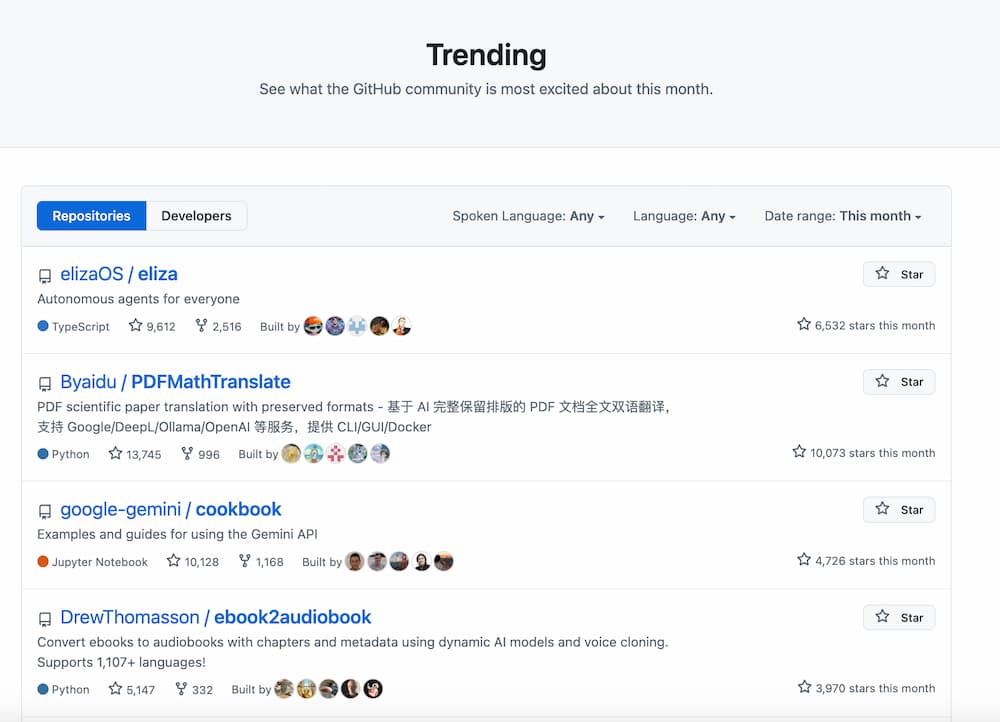
ai16z has become a leader in AI agents thanks to its outstanding Eliza agent framework. In the past month, Eliza performed exceptionally well on the GitHub Trending list, rising to the top with 6,532 new stars and accumulating a total of 9,600 stars.
However, despite ai16z’s significant technical success, there remains room for improvement in terms of value capture and accumulation within its token economy.
To address this, ai16z proposed a document titled “ai16z Token Economics” in December 2024, aiming to transform ai16z into an AI L1 blockchain by launching a Launchpad for Eliza-based agents, positioning ai16z as the base currency for agent-to-agent (A2A) transactions and the “App Store” for agent services, implementing node incentives, and establishing value capture and value accrual strategies. Through these measures, ai16z aims to build a more robust and comprehensive AI agent ecosystem.
The key points discussed in the proposal and within the Discord community include:
1. Launch a Launchpad for Eliza-based agent projects in Q1 2025;
2. Position ai16z as the base currency for agent-to-agent (A2A) transactions and the “App Store” for agent services, defining ai16z as an L1 blockchain for AI;
3. Node incentives;
4. Value capture mechanisms: charging launch fees; requiring holding of ai16z to receive allocations upon release; staking ai16z tokens (to gain early access, fee sharing, etc.); using ai16z as the token to purchase initial agent products; pairing agent tokens with ai16z in liquidity pools;
5. Value accumulation strategy: buyback and burn mechanism using Launchpad fees (though some community members support reinvesting in Eliza development instead of burning);
6. Provide liquidity mining incentives and lockups to stabilize LPs and encourage long-term liquidity provision;
7. When a new AI project launches its token on the platform, users can trade that token for SOL, generating small fees collected by the platform. The Launchpad may split these fees: half used to repurchase ai16z tokens from the market, and the other half paired with newly purchased ai16z tokens to create a special pool, providing additional liquidity for the new project’s token;
8. Implement a community curation process, allowing ai16z partners to review projects before launch to maintain quality and align with the ai16z brand—potentially involving staking and slashing;
9. Treasury diversification: including major L1 tokens, stablecoins, and select project tokens, to provide liquidity support and incentives for ai16z trading pairs, while avoiding selling agent tokens;
10. No increase in the total supply of ai16z tokens.
zerebro: Launching a consumer-focused AI agent Launchpad
Likewise, last month, zerebro co-founder Jeffy Yu announced they are building a consumer-oriented agent Launchpad called “Zentients,” which will also provide a value accumulation framework for the ZEREBRO token. Zentients aims to create a seamless UI/UX for launching and growing agents while returning value to the ZEREBRO token. Transaction fees will be used to build a treasury for special projects/distributions, enhance liquidity, or open new trading pairs.
Specific details (still being finalized) include:
1. Agents will require ZEREBRO as a creation fee and will launch according to a ZEREBRO bonding curve and fee structure;
2. Once an agent token reaches a certain valuation, it graduates;
3. Liquidity from the bonding curve will be deposited and locked into a DEX;
4. Afterwards, traders will use ZEREBRO to buy and sell within the liquidity pool.
Of course, zerebro envisions Zentients as a Web2- and Web3-compatible agent platform, supporting Web2 functionalities such as agent email assistants, coding agents, and financial modeling. zerebro is also exploring a standardized communication layer for agents—"Agent TCP"—and infrastructure for multi-agent intelligence. Jeffy Yu gave an example where one agent creates a tweet, another critiques it, and returns it with revisions for publication.
In addition, through partnerships with decentralized providers, zerebro is building infrastructure enabling users to rent GPUs directly on Zentients. This means users can host their agents directly, making Zentients not just a launchpad but also an agent hardware layer. Ultimately, agents themselves could take actions like renting GPUs for self-training and fine-tuning.
Notably, in December 2024, Zerebro also announced a collaboration with ai16z to advance the open-source framework ZerePy. The ai16z team will be among the first external contributors to help grow ZerePy, while the Zerebro team will contribute to the Eliza framework.
Virtuals: Platform mechanics drive a self-sustaining economic loop
It's worth noting that Virtuals Protocol, rooted in the Base ecosystem, is actually the pioneer in the AI L1 space. Since its VIRTUAL token launched on Binance futures markets on December 10, 2024, its price has nearly tripled, surpassing a $4 billion market cap.
Back in late November 2024, I summarized promising AI agent tokens under Virtuals in an article titled “aixbt Rises 170x in Two Weeks: A Look at Virtuals’ AI Agent Dark Horses.” Since then, most of the mentioned tokens have shown strong growth. For instance, GAME surged 12x, WAI (WAI Combinator) rose nearly 17x, aixbt and VADER both gained 4x, MUSIC achieved a 3x increase, and although LUNA’s rise was more moderate, it still delivered a solid 62% gain.
Virtuals Protocol is much more than just an AI agent platform—it is a vibrant, imaginative ecosystem. Powered by its intuitive, powerful low-code toolkit, users can easily create and manage AI agents and tokens.
The strong performance of the VIRTUAL token largely stems from Virtuals’ token and platform economics.
First, deploying an agent token requires a mandatory stake of 100 VIRTUAL tokens, which are used to establish the agent token’s liquidity pool. Deployers can also purchase a small amount of VIRTUAL to avoid sniper attacks.
Next, investors contribute VIRTUAL tokens. An agent must accumulate sufficient VIRTUAL within its bonding curve to “graduate” into full trading status, after which its liquidity pool is deployed on Uniswap.
Equally important, VIRTUAL serves as the base currency for all AI agent token trades within the platform, ensuring liquidity and utility. Before purchasing any agent token, users must first convert their USDC, ETH, or other assets into VIRTUAL.
On the agent economics front, AI agents within the Virtuals Protocol ecosystem charge a 1% transaction fee on all trades to cover execution costs. Additionally, agents pay per use when utilizing inference services, with fees paid directly in VIRTUAL tokens to the agent’s wallet. This ongoing demand mechanism turns agents into high-value, high-performance assets within the ecosystem. Revenues earned are used to directly repurchase and burn agent tokens on-chain, further strengthening their deflationary nature. The flourishing of AI agents within the ecosystem will undoubtedly feed back into the growth of Virtuals Protocol and the VIRTUAL token.
Data from Dune shows that since Virtuals launched its new platform on October 16, cumulative protocol revenue has exceeded $72 million—a strong testament to its strength and potential.
Summary
Virtuals’ platform economy indeed demonstrates remarkable sophistication and synergy. Through a series of tightly integrated design elements, it offers clear economic incentives for participants while creating a self-sustaining, continuously growing economic loop. This economic model not only lays a solid foundation for rapid platform expansion but also provides a powerful engine for innovation and development in AI agents.
Both ai16z and zerebro have the potential to achieve and even surpass Virtuals’ success in their respective domains, but this will depend on sound decisions and effective execution in tokenomics, community engagement, technological innovation, and market strategy.
In summary, AI L1 is increasingly attracting attention due to its unique technological appeal and economic value. Pioneering projects like Virtuals, ai16z, and zerebro are leading this transformative wave, laying stronger and more complete foundations for the AI agent ecosystem. These platforms are not merely launchpads for projects—they are fertile ground for token value appreciation.
Although many current AI agent frameworks face criticism regarding implementation details, in the Web3 world, whichever AI agent outperforms others holds the key to victory.
Join TechFlow official community to stay tuned
Telegram:https://t.me/TechFlowDaily
X (Twitter):https://x.com/TechFlowPost
X (Twitter) EN:https://x.com/BlockFlow_News
 Foresight News