Vitalik's Latest Article: One-Year Outlook on Decentralized Accelerationism and Artificial Intelligence
TechFlow Selected TechFlow Selected
Vitalik's Latest Article: One-Year Outlook on Decentralized Accelerationism and Artificial Intelligence
The core idea of d/acc is concise and clear: decentralized, democratic, and differentiated defensive acceleration.
 Navigating Web3 tides with focused insights
Author: Vitalik Buterin, Ethereum founder
Translation: Leek, Foresight News
Abstract: This article explores the concept of decentralized acceleration (d/acc), examining its applications in technological development and the challenges it faces—including AI safety and regulation, its relationship with cryptocurrency, and public goods funding. It emphasizes the importance of d/acc in building a safer and better world, while outlining both opportunities and obstacles for future progress. The author elaborates on the meaning of d/acc, analyzes different strategies for managing AI risks, discusses the role of cryptocurrency, investigates mechanisms for funding public goods, and concludes with an optimistic outlook: despite significant challenges, humanity still has the tools and ideas needed to build a superior future.
Introduction
Special thanks to volunteers Liraz Siri, Janine Leger, and Balvi for their feedback and review.
About a year ago, I wrote an article about technological optimism, expressing my overall enthusiasm for technology and the immense benefits it can bring, while also voicing caution regarding specific concerns—particularly superintelligent AI and the existential risks or irreversible loss of human agency that could arise if such technology is poorly constructed.
A central idea in that article was a philosophy of decentralized, democratic, and differential defensive acceleration: accelerating technological progress, but selectively focusing on technologies that enhance our defensive capabilities rather than offensive ones, and promoting the decentralization of power rather than concentrating it among a small elite who would decide right and wrong on behalf of everyone. Defense should resemble democratic Switzerland or historically quasi-anarchist Zomia, not the model of lords and castles from medieval feudalism.
In the year since then, these ideas have significantly evolved and matured. I shared them on the "80,000 Hours" platform (a career-focused organization), receiving many responses—mostly positive, though some critical as well.
The work itself has continued to advance with tangible results: we’ve seen progress in verifiable open-source vaccines; growing awareness of the value of healthy indoor air; “Community Notes” continuing to provide positive impact; prediction markets breaking through as information tools; zero-knowledge succinct non-interactive arguments of knowledge (ZK-SNARKs) being applied in government identity verification and social media (and securing Ethereum wallets via account abstraction); open-source imaging tools adopted in medicine and brain-computer interfaces (BCI), and more.
Last autumn marked the first major d/acc event: “d/acc Discovery Day” (d/aDDy) at Devcon, which brought together speakers from across the pillars of d/acc—biology, physics, cyberspace, information defense, and neurotechnology—for a full day of discussion. Those long dedicated to these fields are increasingly learning about each other’s work, and outsiders are becoming more aware of a broader vision: the values driving Ethereum and cryptocurrency can extend far beyond their origins into the wider world.
The Meaning and Scope of d/acc
Fast forward to 2042. You see news reports suggesting a new outbreak may be emerging in your city. Such alerts are now routine—people often overreact to every animal virus mutation, most of which never materialize into real crises. The last two potential outbreaks were caught early through wastewater monitoring and open-source analysis of social media, and successfully contained. But this time feels different: prediction markets show a 60% chance of at least 10,000 cases, raising concern.
Yesterday, the virus's genetic sequence was identified. A software update for your pocket-sized air tester is released immediately, enabling it to detect the new virus—either from a single breath or after 15 minutes of exposure in a room. Meanwhile, open-source instructions and code for producing a vaccine using equipment available at any modern medical facility are expected within weeks. Most people take no immediate action, relying instead on widely adopted air filtration and ventilation measures for protection.
Due to your immune condition, you’re more cautious. Your open-source, locally-run personal assistant AI—not only handles navigation, restaurant, and event recommendations, but also integrates real-time air quality and CO₂ data to recommend only the safest locations. These data come from thousands of participants and devices, with privacy protected via ZK-SNARKs and differential privacy, minimizing risks of leakage or misuse. (If you contribute data, other AIs verify whether these cryptographic tools actually work.)
Two months later, the outbreak mysteriously fades: around 60% of people followed basic protocols—wearing masks when air testers detected the virus, and isolating when tests came back positive. This alone reduced transmission rates, already low due to passive high-efficiency air filtration, below 1. A disease that simulations suggested could have been five times worse than the 2020 pandemic ends up having little impact.
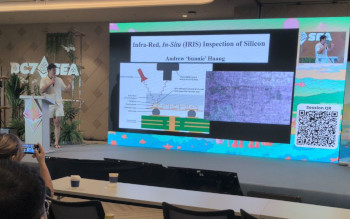

d/acc Day at Devcon
One highly positive outcome of the d/acc event at Devcon was how effectively the d/acc concept united people from diverse fields and sparked genuine interest in each other’s work.
Organizing a “diverse” event isn’t hard, but forging deep connections between people of different backgrounds and interests is challenging. I still remember being forced to sit through long operas in middle and high school, which I personally found dull. I knew I “should” appreciate them—otherwise I’d be seen as an uncultured computer nerd—but I couldn’t connect with them on a deeper level. In contrast, the atmosphere at d/acc Day felt different: people genuinely enjoyed learning about work across domains.
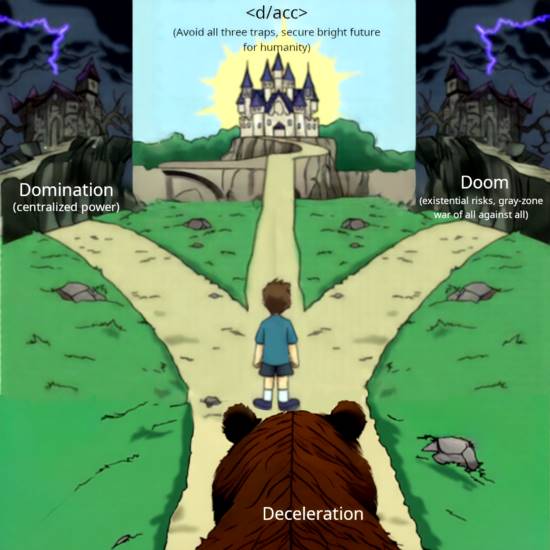
If we want to build a future brighter than one defined by domination, slowdown, or destruction, such broad coalition-building is essential. On this front, d/acc appears to be succeeding—and that alone makes the idea valuable.
The core idea of d/acc is simple: decentralized, democratic, and differential defensive acceleration. Build technologies that shift the offense-defense balance toward defense, without relying on giving more power to centralized authorities. These two aspects are deeply connected: decentralized, democratic, or free political structures thrive when defense is easy to implement, and struggle when it is difficult. In the latter case, the likely outcome is either chaotic war-of-all-against-all or a stable equilibrium where the strongest rules.
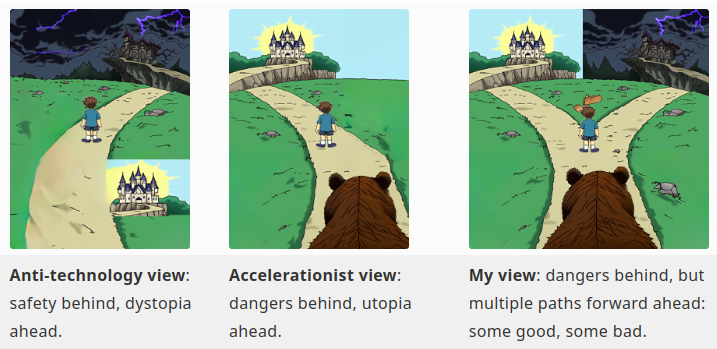
One way to understand the importance of simultaneously pursuing decentralization, defense, and acceleration is to contrast it with ideologies that abandon one of these three elements.
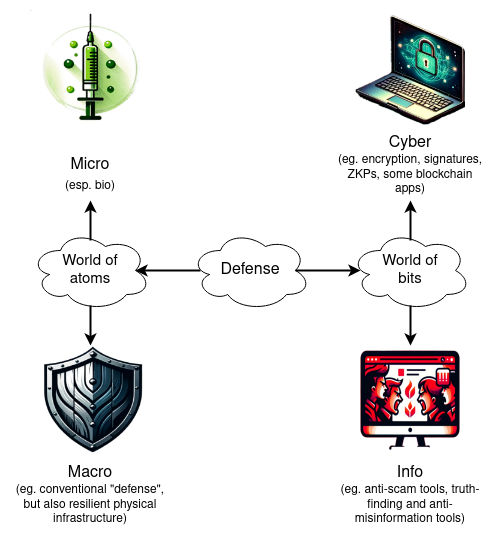
Chart from last year’s “My Techno-Optimism”
Decentralized acceleration, but ignoring “differential defense”
This is essentially being an effective accelerationist (e/acc) while also advocating decentralization. Many follow this path—some even call themselves d/acc, but productively describe their focus as “offensive.” Others express milder enthusiasm for “decentralized AI” and similar topics, yet in my view, they clearly underemphasize the defensive dimension.
To me, this approach might avoid the risk of a particular group imposing global dictatorship over humanity, but it fails to address a structural danger: in environments favoring offense, there remains constant risk of catastrophe—or someone positioning themselves as protector and permanently seizing control. Regarding AI, it also fails to adequately address the risk of humans collectively losing power relative to AI.
Differential defensive acceleration, but neglecting “decentralization and democracy”
Accepting centralized control for safety has always appealed to some, and readers are surely familiar with numerous examples and their drawbacks. Recently, some worry extreme centralization may be the only way to handle future powerful technologies—consider a hypothetical scenario: “Everyone wears a ‘freedom tag’—a successor to today’s limited wearable monitors, like ankle tags used in some countries as alternatives to prison… encrypted video and audio continuously uploaded and interpreted in real time by machines.” However, centralization comes in degrees. A relatively mild but still harmful form, often overlooked, appears in biotechnology—such as resistance to public oversight in food and vaccines, and closed-source norms that allow such resistance to go unchallenged.
The risks here are obvious: the center itself often becomes the source of risk. We saw this during the pandemic—gain-of-function research funded by major governments may have caused the outbreak; epistemic centralization led WHO to deny airborne transmission for years; mandatory social distancing and vaccine mandates triggered political backlash that may last decades. Similar dynamics are likely to recur with AI or other risky technologies. By contrast, decentralized approaches are better equipped to handle risks originating from centers of power.
Decentralized defense, but rejecting acceleration
In essence, this means trying to slow technological progress or induce economic decline.
This strategy faces dual challenges. First, technology and economic growth are overwhelmingly beneficial to humanity; delaying them incurs incalculable costs. Second, in a non-totalitarian world, stagnation is unstable: those who “cheat” most effectively—finding plausible ways to keep advancing—will gain advantage. Decelerationist strategies can work partially in specific contexts—e.g., European food being healthier than American food, or nuclear non-proliferation success so far—but they cannot work indefinitely.
With d/acc, we aim to:
-
Stand by principles in today’s increasingly tribal world—not just blindly building things, but building specific things that make the world safer and better.
-
Recognize that exponential technological progress will make the world extremely strange, and humanity’s footprint in the universe will inevitably grow. Our ability to protect vulnerable animals, plants, and people must keep pace—and the only way forward is forward.
-
Build technologies that actually protect us, rather than relying on assumptions like “good people (or good AI) in charge.” We achieve this by creating tools that are naturally more useful for building and protecting than for destroying.
Another way to think about d/acc is to return to a framework from the late 2000s European Pirate Party movement: empowerment.
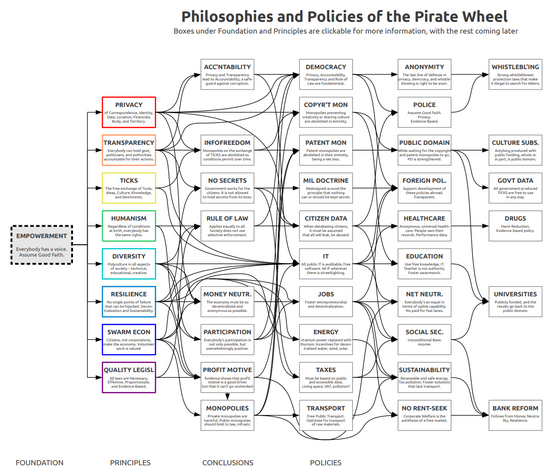
Our goal is to build a world that preserves human agency—achieving negative freedom (freedom from active interference by others, whether citizens, governments, or superintelligent robots, in shaping our own destinies) and positive freedom (ensuring access to the knowledge and resources needed to exercise that agency). This echoes a centuries-old classical liberal tradition—from Stewart Brand’s emphasis on “access to tools,” to John Stuart Mill’s view of education alongside liberty as key to human progress—and perhaps also Buckminster Fuller’s vision of globally participatory and widely distributed problem-solving. Given the technological landscape of the 21st century, d/acc can be seen as a pathway to achieving these enduring goals.
The Third Dimension: Co-Development of Survival and Flourishing
In last year’s article, d/acc focused especially on defensive technologies: physical, biological, cyber, and informational defense. Yet mere decentralized defense is insufficient to build a great world—we also need a forward-looking positive vision: what can humanity achieve once empowered with new decentralization and security?
Last year’s piece did include two elements of such a vision:
1. When addressing superintelligence, I outlined a path (not original to me) for achieving superintelligence without losing human agency:
-
Today: build AI as tools, not highly autonomous agents.
-
Future: use VR, myoelectric tech, and BCIs to create tighter feedback loops between AI and humans.
-
Long-term: evolve toward superintelligence as a tightly integrated fusion of machine and human.
2. In discussing information defense, I briefly mentioned progressive social technologies—beyond defensive tools that help communities maintain cohesion against attackers—such as Pol.is and prediction markets, which help communities make higher-quality collective judgments.
Yet at the time, these points felt disconnected from the core d/acc argument: “Here are ideas for building a more democratic, defense-friendly world at the foundational level, and incidentally, here are unrelated thoughts on how to achieve superintelligence.”
But I now believe there are crucial links between the “defensive” and “progressive” strands of d/acc. Let’s expand last year’s d/acc chart by adding this axis (now relabeled “Survival and Flourishing”) to see what emerges:
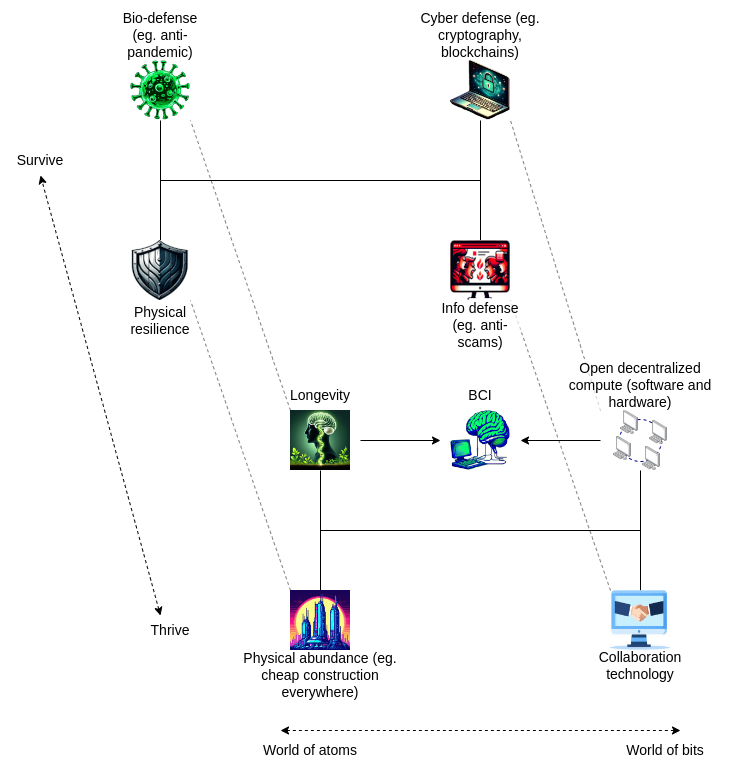
A consistent pattern emerges across domains: the sciences, ideas, and tools that help us “survive” in a given field are closely related to those that enable us to “flourish.” Examples include:
-
Recent anti-COVID research focuses on viral persistence in the body—a key mechanism behind long COVID. There are now signs that viral persistence may contribute to Alzheimer’s disease. If true, eliminating persistent viruses across tissue types could be key to defeating aging.
-
Low-cost, miniaturized imaging tools like those Openwater is developing hold strong potential not only for treating microclots, viral persistence, and cancer, but also for BCIs.
-
The philosophies behind social tools for highly adversarial environments (e.g., Community Notes) and cooperative settings (e.g., Pol.is) are strikingly similar.
-
Prediction markets are valuable in both highly cooperative and highly adversarial contexts.
-
Zero-knowledge proofs and similar technologies enable computation on private data, increasing datasets available for beneficial scientific research while enhancing privacy.
-
Solar and batteries are vital for the next wave of clean economic growth, and also excel in decentralization and physical resilience.
Beyond individual fields, important interdependencies exist across disciplines:
-
BCI is crucial for information defense and collaboration, enabling finer-grained communication of thoughts and intentions. BCI isn't just brain-to-machine—it can also be brain-to-machine-to-brain, aligning with pluralistic values.
-
Many biotechnologies depend on information sharing, but people will only share data if confident it won’t be misused—requiring privacy tech like ZK proofs, fully homomorphic encryption (FHE), and obfuscation.
-
Collaboration tools can coordinate funding across all other technological domains.
The Challenge: AI Safety, Tight Timelines, and Regulatory Dilemmas
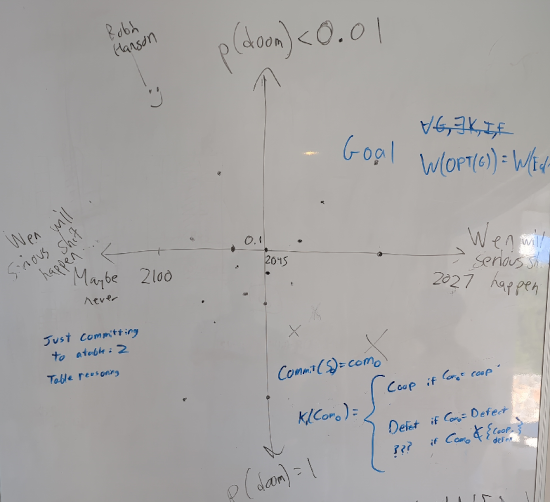
Different people have vastly different AI timelines
Chart from Zuzalu, Montenegro 2023
The most compelling criticism of my article last year came from the AI safety community. Their argument: “Sure, if we had fifty years to develop strong AI, we could focus on building all these beneficial technologies. But it looks like we might have only three years to reach AGI, and another three to superintelligence. So unless we want to risk extinction or irreversible lock-in, we can’t just accelerate beneficial tech—we must also slow down harmful tech, which means strong regulations that may anger powerful actors.” In last year’s article, beyond vaguely urging not to build risky forms of superintelligence, I offered no concrete “slow down harmful tech” strategy. So let’s directly address this: if we’re in the worst-case scenario—high AI risk and a timeline as short as five years—what regulations would I support?
Reasons for Caution Toward New Regulation
Last year, the main AI regulation proposal was California’s SB-1047. SB-1047 required developers of the most powerful models (those trained for over $100 million or fine-tuned for over $10 million) to conduct various safety tests before release, and imposed liability if developers weren’t sufficiently careful. Many critics called it “a threat to open source”; I disagreed, as the cost threshold meant it would only affect the largest models—Llama3 might not even qualify. Yet in hindsight, I see a deeper issue: like most regulations, it was overly adapted to current conditions. Focusing on training cost proved fragile as new tech emerged—DeepSeek v3, one of today’s most advanced models, cost only $6 million to train, and in newer models like o1, costs are shifting increasingly from training to inference.
Actors Most Likely to Cause AI Superintelligence Catastrophe
In reality, militaries are most likely to cause AI-driven superintelligence catastrophes. As we’ve seen over the past half-century in biosafety (and earlier), militaries are willing to undertake terrible actions—and are highly prone to error. Today, military AI use is rapidly expanding (e.g., in Ukraine, Gaza). Moreover, any government-passed safety regulation typically exempts its own military and closely affiliated companies by default.
Strategies
Nonetheless, these arguments don’t leave us helpless. Instead, we can use them as guidance to design rules that minimize such concerns.
Strategy 1: Liability
If someone’s actions cause legally actionable harm, they can be sued. This doesn’t solve risks from militaries and other “above the law” actors, but it’s a highly general method that avoids overfitting—hence favored by libertarian-leaning economists.
The main liability targets considered so far are:
-
Users: those who use AI.
-
Deployers: intermediaries providing AI services.
-
Developers: those who build AI.
Assigning liability to users seems best aligned with incentives. While the link between how a model is built and how it’s ultimately used is often unclear, users determine actual usage. Holding users liable creates strong pressure to use AI responsibly—in my view, focusing on building mechanical exoskeletons for human thought, not new self-sustaining intelligent entities. The former responds regularly to user intent and thus won’t cause disasters unless the user wants it. The latter poses the greatest risk of runaway behavior—the classic “AI gone rogue” scenario. Another benefit of placing liability closer to end-use is minimizing the risk that liability leads to harmful side effects (e.g., closed source, KYC and surveillance, secret corporate-state collusion restricting users, banks denying service to entire regions).
A classic objection to user-only liability: users might be ordinary individuals with little money, or even anonymous—so no one may be able to pay for catastrophic harm. This may be overstated: even if some users are too small to bear liability, typical AI customers aren’t, so developers still have incentive to build products that reassure users they won’t face high liability risks. Still, it’s a valid point needing resolution. We need to incentivize someone in the pipeline with sufficient resources to act cautiously—deployers and developers are natural candidates who still significantly influence model safety.
Deployer liability seems reasonable. A common concern is it won’t work for open-source models, but this seems manageable—especially since the most powerful models are likely closed-source anyway (if open-source, deployer liability may not help much, but won’t do much harm either). Similar concerns apply to developer liability (though for open-source models, fine-tuning to perform disallowed actions presents some barrier), and similar rebuttals hold. As a general principle, imposing a “tax” on control—saying “you can build something you can’t control, or something you can control, but if you choose the latter, 20% of that control must serve our purpose”—seems a reasonable legal stance.
An underexplored idea is assigning liability to other actors in the pipeline who are more likely to have resources. A highly d/acc-aligned idea: hold owners or operators of any device hijacked (e.g., via hacking) by AI during a catastrophic action liable. This would create broad incentives to make infrastructure (especially computing and bio systems) as secure as possible.
Strategy 2: Global “Soft Pause Button” on Industrial-Scale Hardware
If I were convinced we need something stronger than liability rules, this would be my choice. The goal is to temporarily reduce globally available computing power by ~90–99% for 1–2 years during critical periods, buying humanity more preparation time. Don’t underestimate the value of 1–2 years: one year of “wartime mode” can easily equal a century of normal work amid complacency. Methods for implementing such a pause are already being explored, including proposals requiring hardware registration and location verification.
A more sophisticated approach uses clever cryptography: industrial-scale (but not consumer-grade) AI hardware could include a trusted hardware chip that only allows operation upon receiving a weekly 3/3 signature from major international institutions (including at least one non-military-affiliated body). Signatures would be device-independent (we could even require zero-knowledge proofs published on a blockchain), making it all-or-nothing: no practical way to authorize one device without authorizing all others.
This seems to “hit the sweet spot” in balancing benefit and risk:
-
It’s a useful capability: if we detect near-superintelligent AI starting catastrophic actions, we’d want a slower transition.
-
Merely having the soft-pause capability causes little harm to developers before the critical moment arrives.
-
Focusing on industrial-scale hardware and targeting only 90–99% reduction avoids dystopian extremes—like spy chips in consumer laptops or forced shutdown switches, or coercing small nations against their will.
-
Focusing on hardware appears highly adaptable to tech change. Across AI generations, performance heavily depends on available compute, especially in early versions of new paradigms. Reducing available compute by 10–100x could easily tip the balance in a rapid fight between runaway superintelligent AI and humans trying to stop it.
-
The inherent hassle of weekly online check-ins strongly discourages extending this to consumer hardware.
-
Verification via random checks, and hardware-level implementation, makes exempting specific users difficult (unlike legal shutdowns, which lack this all-or-nothing property and are more prone to exemptions for militaries, etc.).
Hardware regulation is already under serious consideration, usually within export control frameworks—which inherently adopt a “we trust our side, not theirs” mentality. Leopold Ashenbrucker famously argued the U.S. should race for decisive advantage, then force China to sign a deal limiting their allowed devices. To me, this seems risky, combining flaws of multipolar competition and centralization. If we must limit people, it’s better to limit everyone equally and strive for genuine cooperation, rather than one side trying to dominate all.
The Role of d/acc Technologies in AI Risk
Both strategies (liability and hardware pause) have loopholes and are clearly temporary fixes: if something can be done on a supercomputer at time T, it’ll likely run on a laptop by T+5 years. So we need more sustainable ways to buy time. Many d/acc technologies are relevant here. Consider how AI might take over:
-
It hacks our computers → cyber defense
-
It creates super-plagues → bio defense
-
It convinces us (to trust it, or distrust each other) → information defense
As briefly noted, liability rules align naturally with d/acc—they can effectively incentivize global adoption of these defenses. Taiwan’s recent trials holding false advertisers liable exemplify using liability to promote information defense. We shouldn’t overuse liability everywhere—remember the benefits of ordinary freedom for enabling small players to innovate without fear of lawsuits—but where stronger safety incentives are needed, liability can be flexible and effective.
The Role of Cryptocurrency in d/acc
Many aspects of d/acc go far beyond typical blockchain themes: biosecurity, BCIs, collaborative discourse tools seem distant from usual crypto discussions. Yet I see important links between cryptocurrency and d/acc:
-
d/acc extends core crypto values—decentralization, censorship resistance, open global economy and society—into other technological domains.
-
Crypto users are natural early adopters, and value alignment makes the crypto community a natural early user base for d/acc tech. The community’s emphasis on action (both online and offline—events, pop-ups), and actual risk-taking (not just talk), makes it a uniquely attractive incubator and testbed for group-based d/acc technologies (e.g., most info and bio defense tools). Crypto people get things done together.
-
Many crypto technologies apply to d/acc areas: blockchains for stronger, decentralized financial, governance, and social media infrastructures; zero-knowledge proofs for privacy. Today, many largest prediction markets run on blockchains, growing increasingly complex, decentralized, and democratic.
-
Win-win collaborations exist with adjacent tech—formal verification, software/hardware security, adversarially robust governance—that are vital for crypto projects and key to d/acc goals. These make Ethereum, wallets, and DAOs more secure, and also strengthen civilizational defense—reducing vulnerability to cyberattacks, including those from superintelligent AI.
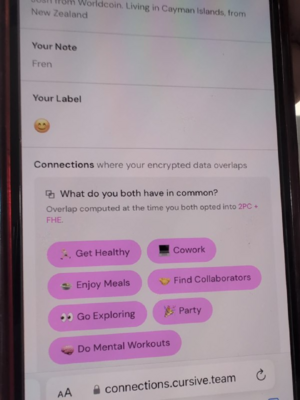
Cursive is an app using fully homomorphic encryption (FHE), allowing users to discover shared interests while preserving privacy. It’s used in Edge City, Chiang Mai—one of many Zuzalu offshoots.
d/acc and Public Goods Funding
I’ve long been interested in designing better mechanisms for funding public goods—projects valuable to large groups but lacking natural business models. My past work includes contributions to quadratic funding, retroactive public goods funding (retro PGF), and most recently, depth funding.
Many remain skeptical of public goods. This skepticism stems from two sources:
-
Historically, “public goods” have justified strong central planning and state intervention in society and economy.
-
A widespread perception that public goods funding lacks rigor, operating on social desirability bias—funding what sounds good, not what’s truly good—and favoring insiders skilled at social maneuvering.
These are important and valid criticisms. Yet I believe strong decentralized public goods funding is crucial to the d/acc vision, because a key d/acc goal—minimizing central control points—itself hinders traditional business models. Building successful businesses atop open source is possible—several Balvi grantees are doing so—but in some cases it’s so hard that vital projects need sustained additional support. Thus, we must tackle the hard challenge: figuring out how to fund public goods in ways that address both criticisms.
The solution to the first issue is basically credible neutrality and decentralization. Central planning is problematic because it gives power to elites who may abuse it, and because it often over-adapts to current conditions, becoming less effective over time. Quadratic funding and similar mechanisms aim to fund public goods as credibly neutral and architecturally/politically decentralized as possible.
The second issue is harder. A common critique of quadratic funding is that it quickly becomes a popularity contest, forcing project creators to spend excessive effort on promotion. Also, projects “in plain sight” (e.g., end-user apps) get funded, while behind-the-scenes projects (the classic “one person in Nebraska maintaining a dependency”) get nothing. Retroactive optimistic funding relies on fewer expert badge-holders; here, the popularity effect diminishes, but social closeness to badge-holders amplifies.
Depth funding is my latest attempt to solve this. It has two key innovations:
-
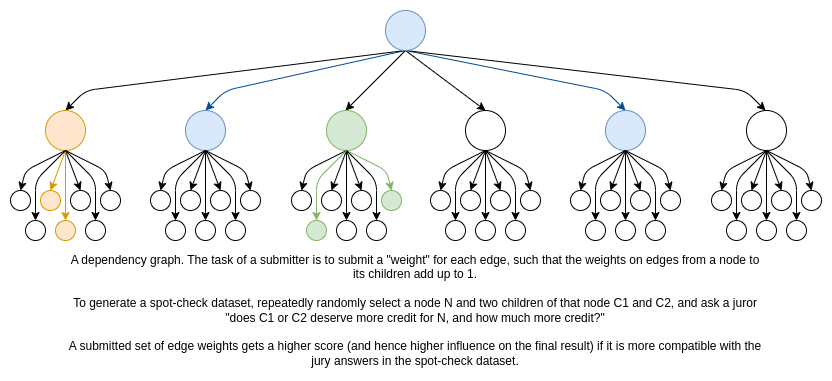
Dependency graph. Instead of asking jurors a global question (“What’s Project A’s value to humanity?”), we ask local questions (“Which of Project A or B contributes more to Outcome C? By how much?”). Humans are notoriously bad at global estimates: in one famous study, when asked how much they’d pay to save N birds, respondents gave roughly $80 for N=2,000, N=20,000, and N=200,000. Local questions are easier. Then, we assemble global answers via a “dependency graph”: for each project, which other projects contributed to its success, and by how much?
-
AI as refined human judgment. Each juror sees only a small random subset of all questions. An open competition allows anyone to submit AI models to fill in missing edges of the graph. The final answer is a weighted sum of models most compatible with jury responses. See code example here. This lets the mechanism scale massively while requiring jurors to submit only minimal “bits of information.” It reduces corruption risk and ensures high quality per bit—jurors can spend hours on each question instead of skimming hundreds. Using open AI competitions reduces bias from any single AI training process. An open AI market acts as engine, humans as steering wheel.
But depth funding is just the latest example; prior ideas existed, and more will emerge. allo.expert does excellent work cataloging them. The fundamental goal is to create a social tool that funds public goods with accuracy, fairness, and open access approaching market-level funding of private goods. It needn’t be perfect—markets themselves are far from perfect. But it should be effective enough that developers working on high-quality open-source projects benefiting everyone can continue doing so without unacceptable compromises.
Today, most leading d/acc projects—vaccines, BCIs, “edge BCIs” like wrist myoelectrics and eye tracking, anti-aging drugs, hardware—are proprietary. This undermines public trust, as we’ve seen across many of these fields. It also shifts focus toward competitive dynamics (“our team must win this key industry!”) rather than the larger race to ensure these technologies arrive fast enough to protect us in a world with superintelligent AI. For these reasons, strong public goods funding can powerfully promote openness and freedom. This is another way the crypto community can support d/acc: by seriously exploring and refining these funding mechanisms within its own context, preparing them for broader application in open science and technology.
The Future
The coming decades present major challenges. Recently, I’ve been reflecting on two:
-
A powerful wave of new technologies—especially strong AI—is arriving fast, with critical pitfalls to avoid. “Artificial superintelligence” may arrive in five years, or fifty. Either way, the default outcome isn’t clearly positive—as described in this and my previous article, multiple traps must be avoided.
-
The world is becoming less cooperative. Many actors who once seemed to act—at least occasionally—on noble principles (cosmopolitanism, liberty, shared humanity…) now more openly and aggressively pursue individual or tribal self-interest.
Yet each challenge carries a silver lining. First, we now possess powerful tools to complete our remaining tasks faster:
-
Current and near-term AI can aid development of other technologies and serve as a governance component (e.g., in depth funding or information finance). It’s also deeply linked to BCIs, which themselves promise further productivity gains.
-
Large-scale coordination is now possible at greater scale than ever. Internet and social media expand coordination range; global finance (including crypto) increases its power; information defense and collaboration tools improve its quality; and soon, BCIs in human-computer-human form may deepen it.
-
Formal verification, sandboxing (web browsers, Docker, Qubes, GrapheneOS, etc.), secure hardware modules, and other technologies are improving, enabling stronger cybersecurity.
-
Writing any kind of software is far easier than it was two years ago.
-
Recent foundational research on how viruses work—especially the simple insight that airborne transmission is key—clarifies paths to better bio-defense.
-
Biotech advances (e.g., CRISPR, improved bio-imaging) make diverse biotechnologies more accessible—whether for defense, longevity, super-wellbeing, exploring new biological hypotheses, or simply doing cool things.
-
Joint progress in computing and biotech enables synthetic biology tools for adapting, monitoring, and improving health. Cyber-defense tech like cryptography makes personalized applications more feasible.
Second, many cherished principles are no longer monopolized by narrow factions of old powers—they can be reclaimed by a broad coalition welcoming anyone worldwide. This may be the biggest benefit of recent global political “realignment,” worth actively leveraging. Cryptocurrency has already leveraged this brilliantly, gaining global appeal; d/acc can do the same.

Access to tools means we can adapt and improve our biology and environment, while the “defense” aspect of d/acc ensures we can do so without infringing on others’ freedom to do the same. Free pluralism allows great diversity in how we achieve this, while commitment to shared human goals ensures it happens.
We humans remain the brightest stars. The task ahead—building a brighter 21st century, protecting human survival, freedom, and agency as we journey toward the stars—is challenging. But I believe we are up to it.
Join TechFlow official community to stay tuned
Telegram:https://t.me/TechFlowDaily
X (Twitter):https://x.com/TechFlowPost
X (Twitter) EN:https://x.com/BlockFlow_News
 @VitalikButerin