AI Agent market cap far exceeds DeFi Summer levels—could it replicate DeFi's market trajectory?
TechFlow Selected TechFlow Selected
AI Agent market cap far exceeds DeFi Summer levels—could it replicate DeFi's market trajectory?
Compare the market development scales of crypto AI and DeFi, and discuss the similarities and differences in the development of these two fields.
 Navigating Web3 tides with focused insights
Author: Nancy, PANews
Each crypto cycle brings forth dominant narratives, and AI+ is undoubtedly one of the major themes of this bull market. In particular, the surge in AI Agents is capturing most of the liquidity on-chain, leading to growing discussions about whether crypto AI is entering a phase akin to the "DeFi Summer" cycle. This article by PANews will compare the market development scale of crypto AI and DeFi, while exploring their similarities and differences.
Market Cap Surpasses $48 Billion, Exceeding DeFi Summer—Can It Replicate DeFi’s Success?
According to CoinGecko data, as of January 2, the market capitalization of the crypto AI sector has reached $48.8 billion—surpassing the peak valuation seen during DeFi's "DeFi Summer." As reported by The Block, DeFi’s market cap hit a high of $6.04 billion during its explosive growth phase in 2020 and only crossed the $50 billion mark in mid-April 2021, by which time the market had already matured and diversified. This comparison indicates that crypto AI has already outpaced DeFi’s early developmental stage, demonstrating stronger appeal and greater growth potential.
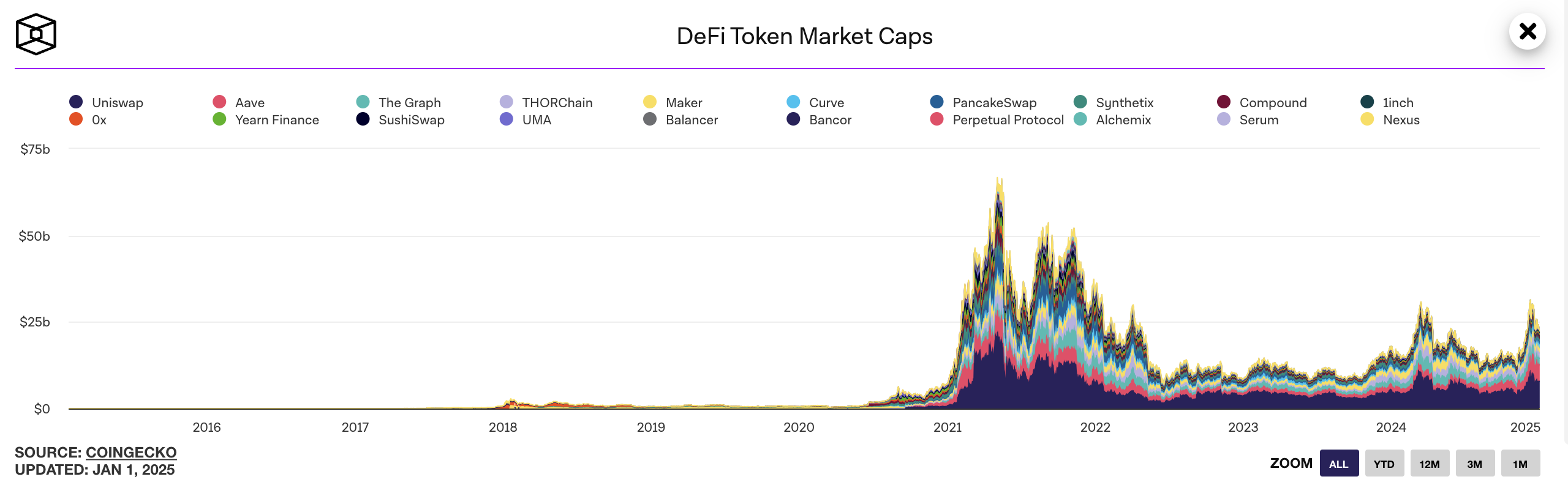
The AI Agent subsector, in particular, has experienced continuous breakout growth. According to CoinGecko, as of January 2, the market cap for AI Agents stood at $16.93 billion, accounting for 34.7% of the entire crypto AI sector—equivalent to the total market cap of all DeFi protocols in January 2021. Taking leading projects such as Virtuals Protocol ($5.02 billion) and ai16z ($2.7 billion), their combined market cap exceeds the total market cap of all DeFi protocols at the end of 2020, further highlighting the rapid rise of the AI space. For reference, top DeFi projects Uniswap and Aave reached peak circulating market caps of $22.05 billion and $6.58 billion, respectively, during the previous bull run.
In terms of capital inflow, just as DeFi attracted substantial venture capital after its rapid expansion, crypto AI is now entering a similar phase, with increasing amounts of funding flowing into AI-related projects. According to PANews' 2024 fundraising report, the DeFi sector raised $1.69 billion across 296 funding events in 2024. Meanwhile, AI-based projects, as an emerging category, have seen rapid growth this year, with nearly 100 disclosed funding rounds—about 15.2% of which secured tens of millions of dollars, totaling around $600 million in funding.
Despite these impressive figures, there remains debate over whether the development cycle of crypto AI can mirror that of DeFi. For instance, Messari’s latest report argues that AI Agents will peak in Q1 2025 and not recover afterward, citing three main reasons: (1) AI Agents have yet to demonstrate product-market fit sufficient to sustain speculation; (2) the success of alternative Layer-1 blockchains was built upon clear demand for blockspace during the DeFi boom, whereas AI Agents currently lack both demand and a defined user base; (3) the launch of AI Agents relies heavily on market speculation, but once investors realize they will remain mere novelties in the foreseeable future, the speculative cycle will collapse.
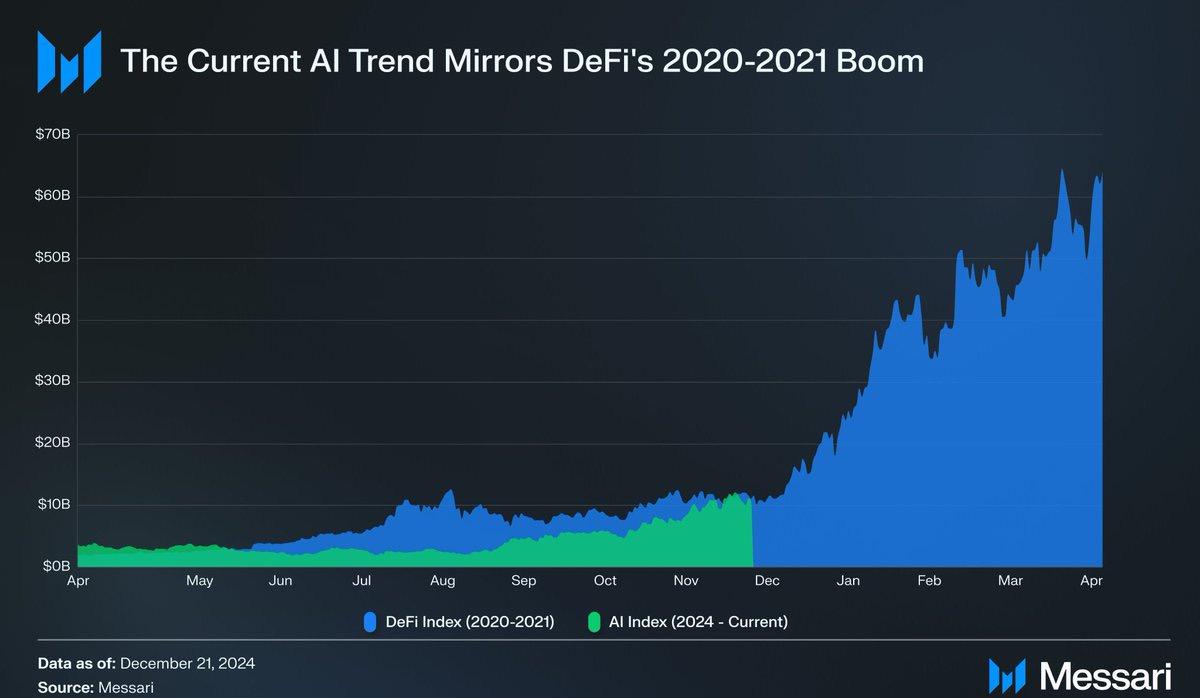
Conversely, some believe AI holds comparable developmental potential to DeFi. Crypto influencer @0xWizard, for example, stated that 2020 could be called the “Cambrian explosion of DeFi,” while 2025 may well become the “Cambrian explosion of AI Agents.” He predicts that various Ai+Crypto use cases will begin to take shape next year. Researcher Haotian believes the arrival of AI Agents resembles the DeFi Summer of 2020, potentially creating a massive new cycle of building and speculation—a kind of “bubble” narrative. Although the AI Agent ecosystem still lacks dedicated infrastructure, its potential for reshaping industry narratives far exceeds that of DeFi in scope.
Former Spartan Group member @0xJeff predicted that 2025 will be known as the era of Agentic systems, where agentic Layer-1 platforms could reach a $100 billion market cap—similar to the L1 valuation cycle of 2020–2021—and that DeFi, empowered by AI Agents, could surpass the previous cycle’s TVL high of $200 billion.
Regarding valuations for AI-themed meme coin projects, crypto KOL @Rui noted that in early meme markets, project valuations were closely tied to exchange listings—especially top-tier exchanges. However, with the rise of AI Agents and shifting market dynamics, the old exchange-centric valuation model no longer applies. Instead, market expectations now focus less on listing destinations and more on what kind of ecosystem a project can build. For projects with established ecosystems, valuation can be based on their share within that ecosystem; for standalone or “wild system” projects, the key threshold is whether they can break through a $100 million market cap—below which success depends more on virality, community support, and early funding.
Four Key Similarities: From Cultural Impact to Capital Efficiency
The convergence of technology and capital lies at the heart of crypto industry development. During the last bull market, DeFi reshaped the landscape of crypto finance through decentralized platforms and smart contracts. Today, crypto AI is transforming how the crypto market operates—through even more intelligent and automated mechanisms. Currently, both sectors share notable similarities in cultural influence, technological foundation, accessibility, and capital efficiency.
Meme Culture
As one of the core narratives of the previous crypto bull run, DeFi embodied a spirit of rebellion against traditional finance. While offering real financial utility, many DeFi projects used humorous and satirical naming conventions (e.g., food-themed tokens) to attract attention. Initially, the market often viewed DeFi more as a liquidity game than a serious financial tool. Yet, this irreverent culture—breaking away from the seriousness of traditional finance—unexpectedly sparked broader reflection and discussion, rapidly drawing in developers and users alike.
Similarly, the spread of crypto AI has been fueled by meme culture. The rise of AI Agents isn’t driven solely by technological innovation or practical value, but also by viral, playful memes that quickly capture sentiment and ignite interest and participation among on-chain users—including new entrants like off-chain developers and researchers who engage in a more relaxed and interactive way.
Technological Foundation
Ethereum’s flexibility—supported by smart contracts, token standards, and a robust developer ecosystem—provided a strong technical foundation for DeFi’s emergence. It enabled developers to innovate freely in financial product design, while its decentralized and open-source nature offered users a fair and transparent platform.
Likewise, the current wave of crypto AI gained momentum following breakthroughs in AI technology—particularly the advent of large language models like ChatGPT—which revealed the vast potential of integrating artificial intelligence with blockchain. Rapid advancements in AI model capabilities have also enabled smarter on-chain applications, including trading strategies, market forecasting, automated smart contracts, and data analytics—providing fresh perspectives and momentum for crypto innovation.
Accessibility
Compared to traditional finance, which requires complex procedures, bank accounts, and credit checks, DeFi offers permissionless, open, and transparent financial services via blockchain and smart contracts. Users need only a crypto wallet and minimal assets to freely participate in lending, trading, and liquidity provision—regardless of geography or economic background.
AI Agents offer a more intelligent and automated interface compared to traditional crypto tools, allowing users to get started without deep technical knowledge or professional trading experience. Leading AI Agent projects lower entry barriers through intuitive design, breaking down the historically high walls maintained by VCs and centralized exchanges (CEX). This opens up greater participation opportunities for retail investors and provides developers and builders with a lower-cost, more decentralized path for innovation.
Moreover, the fusion of AI Agents with meme culture reduces the cognitive barrier to understanding crypto AI—especially for non-technical users—and dismantles the perception of tech-heavy projects as inaccessible, making participation more diverse, casual, and entertaining.
Capital Efficiency
Capital efficiency has long been a central driver of DeFi. By leveraging smart contracts and automation, DeFi platforms significantly enhance capital utilization. Through high APYs and attractive returns, they draw in institutional and retail capital alike. Without intermediaries or traditional banking delays, funds move faster and generate higher yields—greatly improving overall market efficiency.
AI Agents leverage AI-driven automation to help users achieve more efficient capital operations in the crypto market. Unlike manual intervention, AI Agents can automatically execute trades, manage assets, and control risks based on real-time market data—helping users seize opportunities while avoiding emotional decisions and human errors, thereby greatly enhancing capital efficiency. Furthermore, on-chain execution mechanisms in AI Agent projects enable broader redistribution of benefits, allowing participants to access growth upside even with low initial investment.
Four Key Differences: From Technology-Driven Innovation to User Participation
While DeFi and crypto AI exhibit similar momentum and potential in advancing crypto innovation, they differ significantly across several critical dimensions. These differences are evident not only in technical complexity and breadth of application but also in market drivers and modes of user engagement.
Application Scope
DeFi primarily focuses on on-chain finance, with innovations centered on decentralized exchanges (DEXs), automated market makers (AMMs), and lending protocols. While these innovations disrupted traditional finance, their use cases are relatively narrow and well-defined. In contrast, crypto AI spans a much broader range of applications—including on-chain finance, AI-generated content (AIGC), NFTs, smart contract automation, and data analytics. Despite higher technical complexity due to cross-domain integration, this wider applicability allows crypto AI to address more diverse market needs and user demands. Future advances in large AI models are expected to drive even more cross-sector innovations.
Technology Drivers
DeFi’s innovation is rooted in blockchain and smart contracts, driven by decentralization, permissionless finance, and automated execution. Crypto AI, however, draws from a more complex and varied set of technological drivers—from algorithmic trading and risk management in finance to content generation, personalized recommendations, and advanced data analysis across multiple domains.
User Base
DeFi’s primary users are native crypto participants, typically individuals with strong financial literacy and on-chain experience. Crypto AI, on the other hand, extends beyond crypto natives to attract a wide array of non-technical users—including content creators, software developers, and academic researchers—giving it a distinct advantage in terms of adoption breadth and market reach.
Market Cap Drivers
DeFi project valuations are largely determined by metrics such as total value locked (TVL), exchange listings, and liquidity—directly tied to platform usage frequency and user engagement, resulting in relatively transparent and straightforward market dynamics. In contrast, the valuation logic for crypto AI projects is more complex and uncertain. Beyond technological depth and breadth, it must account for ecosystem influence and the feasibility of real-world applications. This means the sustainability of the crypto AI narrative hinges on the alignment between technological progress and actual user demand—carrying both higher risk and greater upside potential.
Join TechFlow official community to stay tuned
Telegram:https://t.me/TechFlowDaily
X (Twitter):https://x.com/TechFlowPost
X (Twitter) EN:https://x.com/BlockFlow_News
 PANews