The $20 Million Funding Behind Hyperbolic: How the Hottest Newcomer Will Reshape the AI Landscape?
TechFlow Selected TechFlow Selected
The $20 Million Funding Behind Hyperbolic: How the Hottest Newcomer Will Reshape the AI Landscape?
Hyperbolic is an open-source AI computing and inference service provider dedicated to enabling innovators worldwide—regardless of resources or geographic location—to access AI technology on an equal footing.
 Navigating Web3 tides with focused insights
Author: Jesse, Core Contributor of Biteye
Capital always chases future opportunities. The real money invested by venture capitalists in Europe and the United States often serves as a key indicator of a sector’s potential.
On one hand, Nvidia's stock continues to rise; on the other, global institutions are rushing to buy Bitcoin ETFs.
This clearly indicates that AI and Web3 are the hottest fields in recent years—and will be core forces reshaping the world order in the future, with far-reaching impacts.
However, in an increasingly AI-driven world, innovation and disruption remain controlled by a small elite.
The computing resources and infrastructure required to develop artificial intelligence have become the key that unlocks this door—but access to these resources is highly centralized, limited only to those with substantial capital or institutional backing.
Beyond this, high usage costs, lack of trustworthy verification for computational results, and privacy concerns further restrict the accessibility and fairness of AI.
The future of AI should not serve only the commercial interests of a few, but should—like Web3—become public wealth accessible and beneficial to all. This is a journey meant for everyone, not a private domain for a select few.
01 Introduction and Features
Hyperbolic is an open-source provider of AI computing and inference services, born from a vision to challenge the status quo, committed to enabling innovators worldwide—regardless of their resources or geographic location—to equally access AI technology.
Hyperbolic offers three core features:
1.1 GPU Marketplace: On-Demand Computing Power, Economical and Efficient
Hyperbolic’s GPU marketplace breaks away from traditional compute leasing models by aggregating idle GPU resources globally, offering developers on-demand computing power and helping them save up to 75% in costs. Powered by the Hyper-dOS decentralized operating system, developers can obtain the computing power they need in under a minute, dramatically lowering the barrier to innovation.
1.2 Inference Services: Low Cost, High Efficiency
Hyperbolic processes over one billion tokens daily, delivering cutting-edge open-source models at extremely low cost while supporting BF16 format, ensuring excellent performance in both efficiency and precision.
1.3 Proof of Sampling (PoSP): The Gold Standard in Verification
Hyperbolic’s proprietary Proof of Sampling protocol ensures outputs are reliable, economical, and privacy-preserving, making it the only Web3 real-time inference product capable of providing verifiable AI results.
02 Objectives
Hyperbolic has three main goals: 1. Provide decentralized heterogeneous computing 2. Ensure security and verifiability of decentralized AI 3. Protect privacy within decentralized AI.
2.1 Providing Decentralized Heterogeneous Computing
Hyperbolic aims to build a scalable system that aggregates global GPU computing power to optimize the performance of various types of GPUs. This vision seeks to overcome bottlenecks in compute resource allocation and deliver high-performance support to AI researchers and developers worldwide.
Hyperbolic first established its AI service layer, allowing developers to deploy and utilize global computing resources to run diverse AI services.
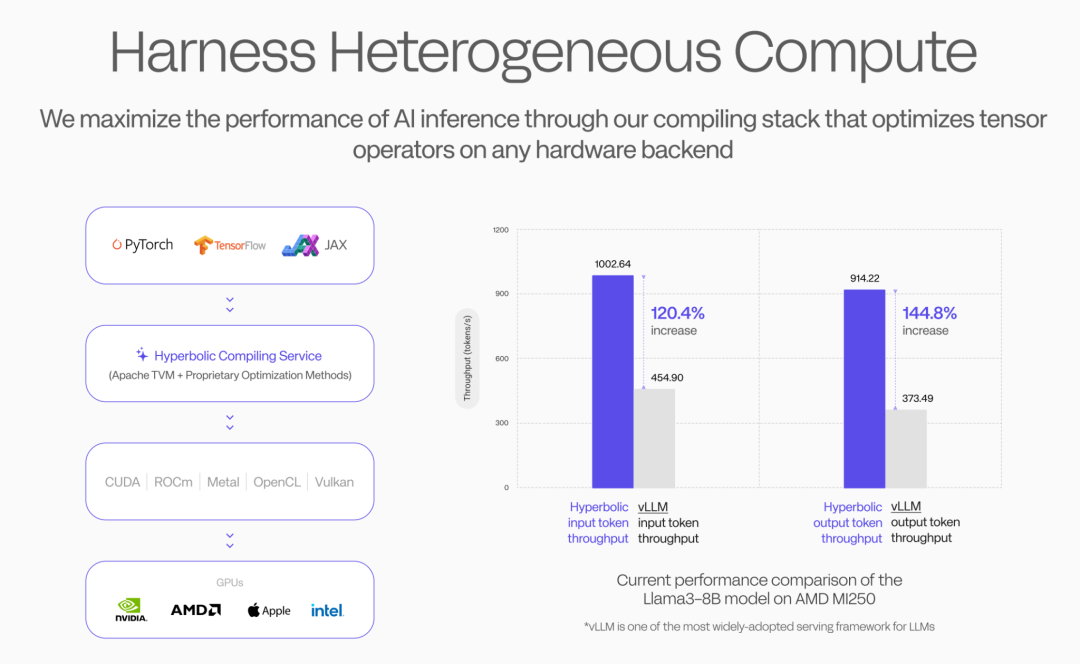
It can compile advanced machine learning frameworks—such as PyTorch, TensorFlow, and JAX—into low-level languages compatible with different hardware platforms (e.g., NVIDIA’s CUDA, AMD’s ROCm, Apple’s Metal).
In addition, Hyperbolic collaborates with AMD to enhance chip performance. Thanks to Hyperbolic’s optimizations, the Llama3-8B model achieved a 120.4% increase in input throughput and a 144.8% increase in output throughput on the AMD MI250 platform.
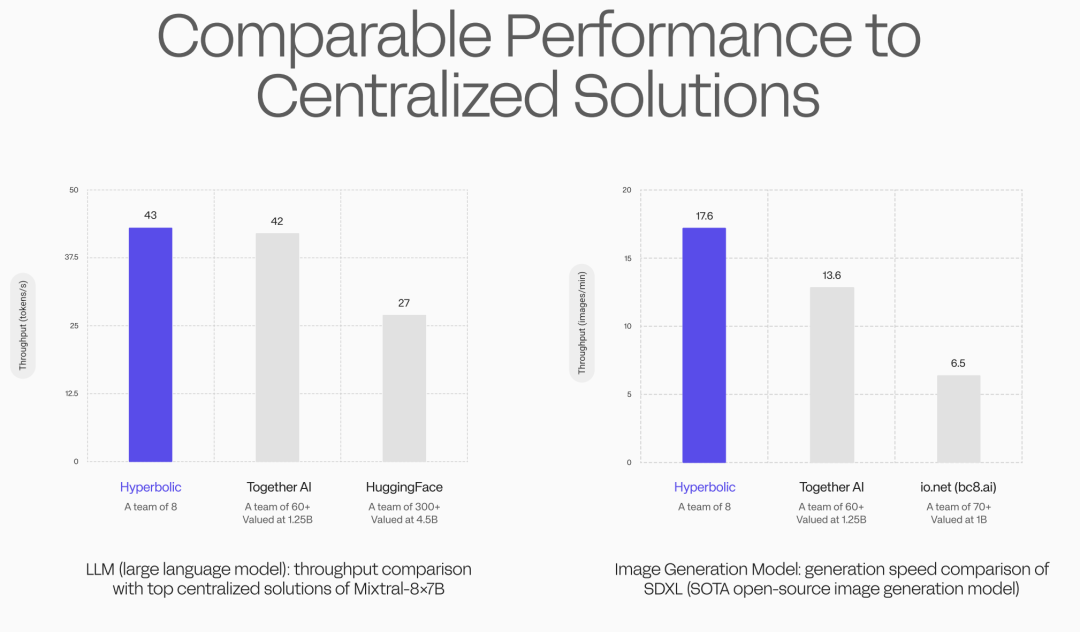
Hyperbolic’s solutions are not only favored by Web3 AI projects but also widely adopted by many Web2 AI developers.
Although Web2 developers often worry that decentralized solutions may compromise performance and reliability, Hyperbolic demonstrates outstanding performance in large language models and image generation.
Despite having a team much smaller than mainstream competitors, Hyperbolic achieves performance on par with—or even surpassing—these rivals, fully proving the superiority of its technical architecture.
This breakthrough dispels doubts about decentralized solutions and opens new possibilities for broader developer collaboration.
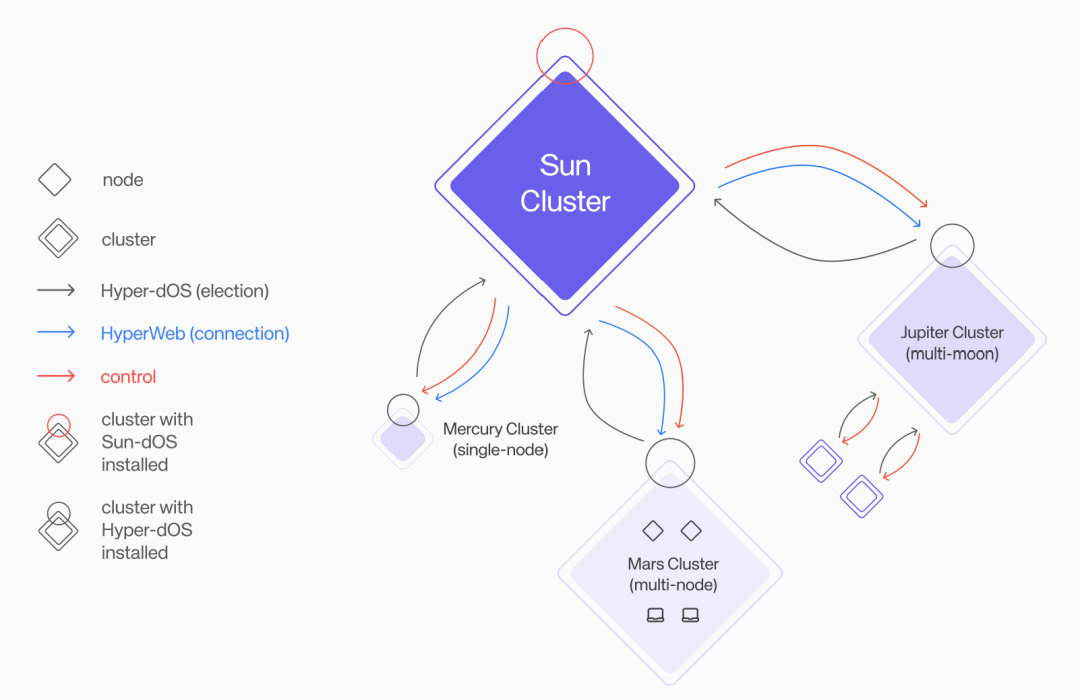
Hyperbolic’s advantage in decentralized computing stems from its unique system architecture—the Hyper-dOS, inspired by the solar system. This layered cluster model seamlessly integrates efficiency and stability.
The Sun Cluster acts as the central governance node, akin to the sun’s role in a planetary system, providing foundational services and support to ensure system stability and efficient operation.
Orbiting around it are multiple planet-scale clusters: Mercury Cluster (single-node), Mars Cluster (multi-node), and Jupiter Cluster (multi-satellite nodes). Each cluster varies in scale and governance characteristics, offering flexible adaptation to different needs.
Three Key System Features
-
Auto-scaling: Clusters automatically expand or contract based on computational demand, flexibly adapting to load fluctuations.
-
Self-healing: The system automatically detects issues and recovers from failures, ensuring continuous stable operation.
-
Customizability: Each cluster can be individually configured to meet specific requirements, providing highly flexible services.
This hierarchical architecture ensures high availability and scalability while balancing autonomy with overall coordination. Users need only own a machine or cluster, install Hyper-dOS, and can easily join the Hyperbolic network to access global computing resources and collaborate seamlessly.
2.2 Ensuring Security and Verifiability in Decentralized AI
A key challenge in decentralized networks is ensuring that results generated by random nodes are correct. Security and verifiability remain unresolved issues in deployed AI systems.
Current popular AI verification mechanisms include consensus/voting, optimistic mechanisms, and zero-knowledge proofs.
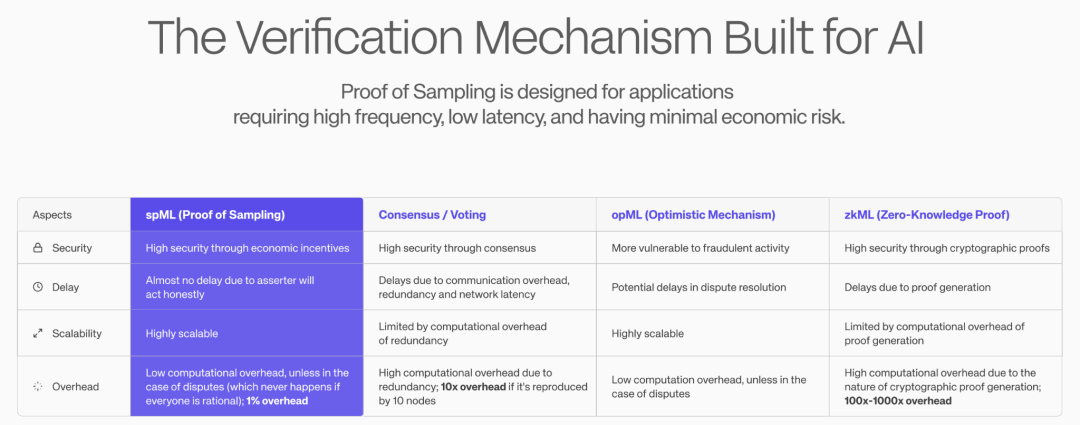
The consensus/voting mechanism requires multiple nodes to process the same request simultaneously, determining the answer via majority vote. However, this approach incurs very high costs—for example, processing one request across 10 nodes increases overhead tenfold.
The optimistic mechanism (OPML) allows a single node to generate a result, with a challenge window (typically 7 days) during which other nodes can dispute it. However, this method is impractical in real-time scenarios. For instance, if a user asks, “What are good places to visit in Singapore?” waiting seven days to verify the answer renders it meaningless.
Zero-knowledge proofs excel in privacy and verification but come with prohibitively high computational costs, making them difficult to implement practically in the near term.
To address these issues, Hyperbolic partnered with experts from UC Berkeley and Columbia University to introduce a novel verification mechanism based on Nash equilibrium called “Proof of Sampling” (PoSP). At its core, PoSP uses probabilistic sampling rather than full result validation.
Typically, one node generates the result, but the network randomly requests another node to recompute it with a certain probability. If results differ, an arbitration process is triggered, and dishonest nodes face significant economic penalties.
Mathematical modeling reveals threshold formulas for staking and rewards: as long as the audit probability exceeds this threshold, the system reaches a pure Nash equilibrium, incentivizing all nodes to act 100% honestly for self-interest.
This PoSP mechanism works not only for AI inference but also extends to AI training, fine-tuning, and even non-AI services such as L2 rollups and data availability.
Hyperbolic is collaborating with restaking protocols like EigenLayer and Karak to build a universal verifiable services layer (AVS), enabling other AVS providers to leverage this mechanism for enhanced security and reliability.
2.3 Protecting Privacy in Decentralized AI
In a decentralized AI network, ensuring both data privacy and model integrity remains a critical unsolved problem. When your data is distributed across nodes worldwide, security faces severe challenges.
Existing technologies such as Fully Homomorphic Encryption (FHE), Zero-Knowledge Proofs (ZKP), and Multi-Party Computation (MPC) can theoretically solve these issues but drastically reduce computation speed, failing to meet real-time inference demands.
Hyperbolic leverages Trusted Execution Environment (TEE) technology from NVIDIA’s latest Hopper and Blackwell GPUs, offering an efficient privacy protection solution.
TEE creates a “privacy vault” on the GPU: external parties cannot view the data inside, yet the GPU can still perform computations normally.
Remarkably, this privacy-preserving mechanism incurs only about 1% performance loss during inference.
Hyperbolic will integrate a confidential computing layer across its entire decentralized network, ensuring data and AI models remain secure throughout use and providing users with reliable privacy protection.
03 Hyperbolic Use Cases
AI Agents represent today’s hottest frontier. With Hyperbolic, AI Agents can achieve multiple innovative capabilities:
3.1 Support for Cryptocurrency Payments
AI Agents can make payments via cryptocurrency, enabling self-sustainability and independent operation.
3.2 Hosting Custom Models
Each AI Agent can have unique traits and skills, forming personalized services.
3.3 Self-Evolution Capability
Through continuous fine-tuning and learning, AI Agents can improve their capabilities according to user needs or environmental changes, becoming more efficient and intelligent over time.
3.4 Verifiable Reasoning
The reasoning process of AI Agents is transparent and verifiable, ensuring their independence from external control or malicious interference, thereby enhancing user trust.
3.5 Memory Functionality
Leveraging Retrieval-Augmented Generation (RAG), AI Agents can record and store interactions with users, forming long-term memory. This enables more personalized services, such as remembering user preferences.
3.6 Cross-Agent Communication
AI Agents can communicate and collaborate with each other, forming complex task-solving networks. For example, different agents can jointly complete multi-step projects.
3.7 Flexible API and Tool Integration
AI Agents can integrate and use various external APIs and tools, greatly expanding their functionality. For instance, calling weather APIs to plan trips or using financial tools to offer investment advice.
3.8 Autonomous Computing Power
They can possess their own computing devices and independently run tasks, reducing reliance on centralized servers and becoming more decentralized and autonomous.
3.9 Serving as Blockchain Validators
AI Agents can even participate in blockchain networks as validator nodes, enhancing network security and earning rewards through transaction validation, further achieving self-sufficiency.
Recently, Hyperbolic collaborated with Virtuals Protocol—the hottest AI launchpad on Base chain—providing strong technical support that significantly enhances AI Agents’ performance and self-development capabilities.
By directly connecting Virtuals Protocol’s agents to Hyperbolic’s infrastructure, each agent gains access to highly scalable computing resources, stable inference capabilities, and seamless dynamic interaction experiences via Hyperbolic APIs—maintaining consistent, high performance regardless of agent count or task complexity.
This partnership not only boosts AI Agents’ computing power but also improves their adaptability and intelligence across diverse applications.
For example, Hyperbolic’s infrastructure empowers smart NPCs (non-player characters) in games with persistent memory and personality development.
In the game *Legendary Quest*, NPCs powered by Virtuals Protocol’s advanced AI maintain consistent personalities based on player interactions, adjust behaviors from past experiences, and even continue evolving storylines when players are offline.
All of this is made possible by Hyperbolic’s scalable computing network, enabling NPCs to perform complex decision-making and personality evolution without impacting game performance.
This collaboration enables developers to transform AI concepts into practical solutions, driving innovation in gaming, virtual assistants, education, content creation, and beyond.
04 Competitive Comparison
4.1 Strategic Partnerships
Hyperbolic has earned the trust of leading AI companies including Hugging Face, Quora, Black Forest Labs, and Nous Research, as well as support from top universities such as Stanford, NYU, and UC Berkeley.
Developers can use Hyperbolic’s inference API to seamlessly create and share AI applications on Hugging Face Spaces, greatly simplifying deployment and distribution.
In addition, PhD students and postdoctoral researchers from Stanford, Cornell, and NYU receive up to 75% discounts on GPU rentals, significantly reducing computational costs.
Hyperbolic’s AI models, including base models, are now live on Quora’s Poe platform, enabling developers to easily create, deploy chatbots, and monetize directly through the platform.
4.2 Optimized Performance
Hyperbolic’s proprietary compiler ensures highly efficient GPU utilization, achieving performance comparable to—or exceeding—that of centralized systems.
4.3 Superior Model Quality
All models use BF16 precision, delivering superior accuracy and performance, outpacing competitors still relying on FP8.
4.4 Data Privacy and Security
Hyperbolic addresses AI verification security through its Proof of Sampling (PoSP) protocol, achieving minimal computational overhead—offering advantages over zkML, opML, and consensus-based alternatives. Additionally, Hyperbolic does not store any user data, further protecting privacy.
4.5 Mature Real-Time Products
Unlike many Web3 AI projects still in development or restricted access phases, Hyperbolic has already launched two production-ready products. Over 40,000 Web2 developers currently use its services.
4.6 Unified Compute and Inference
Hyperbolic is the only company offering both GPU computing and inference services on the same platform, successfully delivering a unified compute solution.
In summary, compared to Web2 AI companies with teams 10 to 30 times larger, Hyperbolic matches or exceeds their performance with a lean team while offering more cost-effective services through Web3 mechanisms.
In the Web3 AI space, Hyperbolic leads with cutting-edge technology and has gained the trust of Web2 developers. It bridges Web2 and Web3 AI with a fast, accessible connection, serving as a cornerstone for industry advancement.

05 Funding
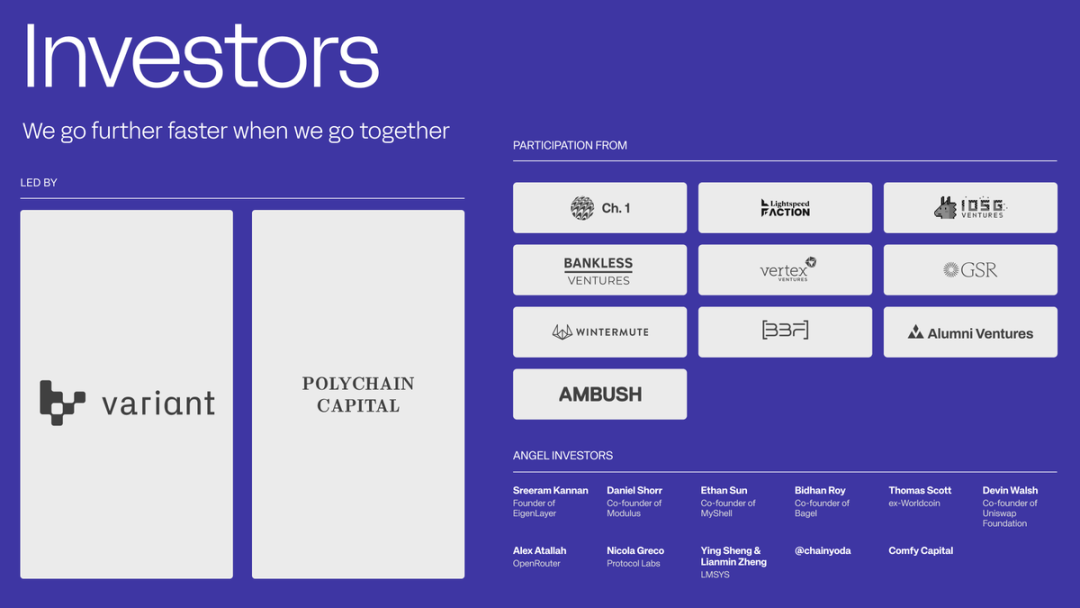
On December 10, Hyperbolic announced a $12 million strategic funding round led by Variant and Polychain Capital, bringing its total funding to $20 million.
This round attracted prominent investors including Chapter One, Lightspeed Faction, Bankless Ventures, IOSG, Vertex, GSR, Wintermute Ventures, Blockchain Builders Fund, Alumni Ventures, and Ambush.
Previously, Hyperbolic raised a $7 million seed round led by Polychain Capital and Lightspeed Faction, and earlier secured a $725,000 pre-seed round from Chapter One and Samsung Next.
The angel investor list for this round is also impressive, featuring Sreeram Kannan (EigenLayer), Devin Walsh (Uniswap Foundation), Ethan Sun (MyShell), Daniel Shorr (Modulus), Bidhan Roy (Bagel), Ying Sheng and Lianmin Zheng (LMSYS), Dillon Rolnick (Nous Research), Alex Atallah (OpenRouter), Chainyoda, Comfy Capital, Nicola Greco (Protocol Labs), Alex Atallah (OpenRouter), and Thomas Scott (former Worldcoin).
Jesse Walden, Partner at Variant, praised Hyperbolic: “Hyperbolic is the first company we’ve seen that truly solves the ‘cost of trust’ problem in decentralized GPU networks while maintaining high standards of performance, quality, and user experience.”
Hyperbolic leads in Web3 AI funding, a clear testament to the industry’s “smart money” recognizing its technical strength and product viability.
06 Team Background
Co-founder Jasper Zhang graduated from Peking University’s Mathematics Department and earned his PhD in Mathematics from UC Berkeley in just two years.
Prior to founding Hyperbolic, he worked as a quantitative researcher at Citadel Securities and served as a senior blockchain researcher at Avalanche.
Co-founder and part-time CTO Yuzhen Jin holds a PhD in Computer Science from the University of Washington and was previously Senior Engineering Manager at OctoAI before joining Hyperbolic.
Hyperbolic’s team members all come from top-tier academic institutions, with founders possessing solid technical foundations and several team members having prior collaboration experience at Avalanche.
The company’s advisory board consists of industry leaders.
Dr. Reynold Xin is co-founder and chief architect of Databricks, a major contributor to Apache Spark, and author of the most cited paper in SIGMOD history.
Prof. Raluca Ada Popa is Associate Professor at UC Berkeley, co-director of RISELab and SkyLab, and co-founder of Opaque Systems.
Prof. Ciamac C. Moallemi is a professor at Columbia Business School, research advisor at Paradigm, and director of the Briger Family Digital Finance Lab.
Prof. Yi Ma is Chair Professor and Head of Computer Science at the University of Hong Kong, Professor of Computer Science at UC Berkeley, and fellow of IEEE, ACM, and SIAM.
07 How to Get Involved
7.1 Enterprises
For companies burdened by expensive API calls and costly machine leasing, Hyperbolic offers competitive optimization solutions.
While ensuring stable service quality, Hyperbolic’s technical support helps enterprises reduce costs by up to 75%.
Additionally, to address inefficient resource utilization caused by long-term GPU leasing agreements, Hyperbolic introduces a resource redistribution mechanism, allowing customers to sublease idle equipment back to the platform. This model maximizes asset utilization and strikes an optimal balance between flexibility and cost control.
7.2 Researchers
For developers whose projects stall due to limited GPU resources, Hyperbolic provides abundant GPU options at a fraction of the price of traditional cloud providers like AWS. By offering high-cost-performance resources, Hyperbolic delivers the most competitive solution in the market, helping developers rapidly turn innovative ideas into reality.
7.3 Data Centers
Hyperbolic offers a platform for data centers whose existing investments have not met ROI expectations or who wish to break beyond traditional book-value constraints, enabling them to achieve higher returns.
7.4 Individuals
The potential of high-performance GPUs should not be limited to gaming. Through Hyperbolic, individuals can rent out their GPUs, transforming them into income-generating assets. Currently in whitelist phase—registration is available now.
In addition, Hyperbolic offers several large models for personal use, enabling text and image generation, voice-to-text reading, and more.
In the future, Hyperbolic plans to build AI agents on Base for user access—stay tuned.
Hyperbolic website:
app.hyperbolic.xyz?utm_source=x&utm_campaign=seriesA&utm_content=biteye
08 Conclusion
Hyperbolic sets a new benchmark for reliable, high-performance AI in Web3 by offering a GPU marketplace, inference services, and the gold-standard Proof of Sampling verification protocol—maximizing GPU performance, delivering higher-precision models, and providing secure, cost-effective solutions.
Hyperbolic transforms decentralized AI from concept to reality. With its multi-source computing strategy, competitive pricing, and deep understanding of both Web2 and Web3 customer needs, Hyperbolic occupies a unique position in the ecosystem.
Hyperbolic’s efforts toward democratizing and efficiently utilizing computing resources will drive innovation and sustained growth in the AI sector.
Join TechFlow official community to stay tuned
Telegram:https://t.me/TechFlowDaily
X (Twitter):https://x.com/TechFlowPost
X (Twitter) EN:https://x.com/BlockFlow_News
 @BiteyeCN