Tiger Research: South Korea's Martial Law Triggers Crypto Market Turmoil, $33.3 Billion Sell-Off and Local Projects Relocation
TechFlow Selected TechFlow Selected
Tiger Research: South Korea's Martial Law Triggers Crypto Market Turmoil, $33.3 Billion Sell-Off and Local Projects Relocation
Political instability prompts South Korean blockchain projects to move overseas.
 Navigating Web3 tides with focused insights
Author: Tiger Research Reports
Translation: TechFlow
Key Takeaways:
-
Market Turbulence: The declaration of martial law triggered massive sell-offs on South Korean cryptocurrency exchanges, totaling approximately $33.3 billion. Bitcoin prices dropped to $62,300, and local markets briefly recorded the highest trading volume globally.
-
Investor Exodus: Due to price volatility and system failures at domestic exchanges, South Korean investors are expected to shift toward overseas exchanges and DeFi platforms.
-
Industry Contraction: Political instability is prompting blockchain projects in South Korea to relocate abroad. Key legislation, such as the Virtual Asset User Protection Act, may be delayed as a result.
1. Introduction

Source: Yonhap News
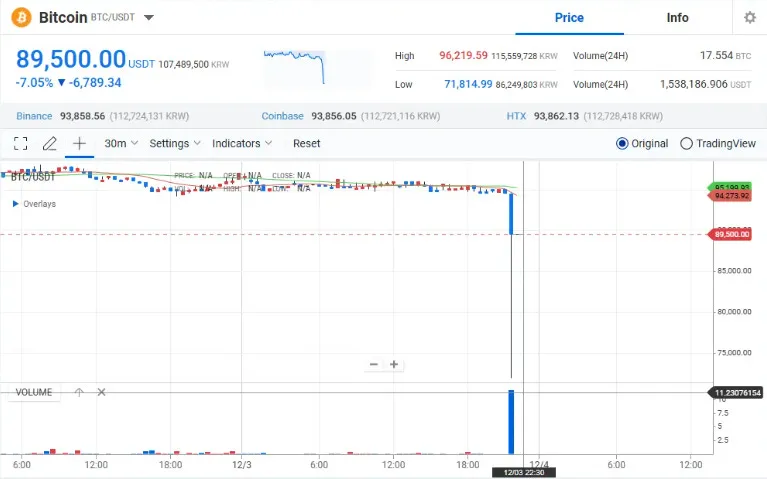
Last night, President Yoon Suk-yeol's sudden announcement and subsequent lifting of martial law shocked South Korea’s cryptocurrency market. Bitcoin prices on Upbit, South Korea’s largest exchange, fell to $62.3K. Upbit and Bithumb, the two major Korean exchanges, reported 24-hour trading volumes of $26.9 billion and $6.4 billion respectively—peaking at their highest levels this year. This reflected massive sell-offs by Korean investors following the martial law announcement. During this period, Korean exchanges briefly became the world’s most active markets, highlighting extreme market volatility.
2. Declining Trust in KRW Assets and Rising Demand for Cryptocurrencies

The martial law incident severely undermined confidence in KRW-denominated assets. With foreign capital exiting, stock and bond markets could become increasingly volatile. As a result, investors are gradually turning to decentralized assets such as cryptocurrencies.
Against the backdrop of rising geopolitical risks, investors are choosing cryptocurrencies to safeguard their wealth. Major cryptocurrencies like Bitcoin have drawn attention due to their independence from government control. In past crises—including the Hong Kong protests and the Russia-Ukraine war—cryptocurrencies were seen as safe-haven assets.
3. The Double-Edged Sword of Strict Regulation and Accelerated Shift of Exchanges Overseas
South Korean cryptocurrency exchanges maintain high security through strict travel rules and KYC regulations. The Act on Reporting and Use of Specified Financial Transaction Information has strengthened anti-money laundering (AML) measures and improved investor protection. These efforts have placed South Korea at the forefront of regulatory compliance.
Source: Upbit
However, the market crash revealed the double-edged nature of stringent regulation. Rigid rules sustain the "kimchi premium," widening price gaps with global markets and making rational investment decisions difficult for traders.
Sharp price fluctuations and system instability at local exchanges eroded investor trust. With overnight trading volume reaching $33.3 billion, servers at Upbit and Bithumb crashed. Unlike overseas exchanges, such instability makes domestic platforms appear unreliable.
These issues are expected to accelerate the migration of South Korean investors to overseas exchanges and DeFi platforms. Binance and Coinbase offer stable trading environments and diversified financial products, becoming ideal choices for Korean investors.
4. Accelerated Relocation of South Korean Blockchain Projects Abroad
Political instability has negatively impacted the investment environment for blockchain projects in South Korea. Many major projects have already relocated overseas—a trend expected to continue. Nexon’s blockchain division Nexpace has moved to Abu Dhabi; Klaytn and LINE Finschia’s Kaia Foundation have relocated to Singapore; and Wemade’s Wemix has shifted to Dubai. These companies have chosen jurisdictions more favorable to blockchain to avoid regulatory uncertainty and political risks in South Korea. More projects are expected to move to Singapore and the UAE, where regulations remain clear and stable.
The overseas migration of blockchain startups raises concerns about brain drain. This trend could weaken South Korea’s competitiveness in the blockchain sector. Amid rapid advancements in Web3 and blockchain technologies, talent outflows may have long-term negative impacts on South Korea’s technological edge. This exodus intensifies a sense of crisis within the industry.
In addition, impeachment proceedings could delay key legislative processes. Laws currently under discussion in the National Assembly, such as the Virtual Asset User Protection Act, may face postponements. Such delays could further hinder the institutionalization of South Korea’s cryptocurrency market.
5. Conclusion
The martial law incident exposed structural weaknesses in South Korea’s cryptocurrency market. Within a single night, $33.3 billion worth of trades vanished, and major exchange servers collapsed. Extreme price volatility emerged, with significant price disparities compared to global exchanges. These events highlighted political risks and the fragility of current trading systems under stress.
In the short term, market instability is expected to persist. However, with appropriate institutional improvements and system upgrades, this crisis could also become a turning point. Such efforts would help strengthen the stability of South Korea’s cryptocurrency ecosystem and promote its globalization. The future trajectory warrants close attention.
Disclaimer
This report is prepared based on materials we believe to be reliable. However, we make no express or implied warranties regarding the accuracy, completeness, or suitability of the information. We assume no liability for any losses arising from the use of this report or its contents. The conclusions and recommendations in this report are based on information available at the time of writing and may change without notice. All projections, estimates, forecasts, targets, opinions, and views expressed in this report are subject to change at any time and may differ from or contradict those of other individuals or organizations.
This document is for informational purposes only and should not be construed as legal, business, investment, or tax advice. Any reference to securities or digital assets is for illustrative purposes only and does not constitute investment advice or an offer to provide investment advisory services. This material is not intended for investors or potential investors.
Terms of Use
Tiger Research permits fair use of its reports. The principle of “fair use” broadly allows the use of specific content for public interest purposes, provided that the commercial value of the material is not impaired. If usage aligns with the purpose of fair use, the report may be used without prior permission. However, when citing Tiger Research reports, users must 1) clearly credit “Tiger Research” as the source, and 2) include the Tiger Research logo (black/white). Any reorganization and republication of the material requires separate negotiation. Unauthorized use of the report may lead to legal action.
Join TechFlow official community to stay tuned
Telegram:https://t.me/TechFlowDaily
X (Twitter):https://x.com/TechFlowPost
X (Twitter) EN:https://x.com/BlockFlow_News
 @tiger_research