Solana Summer's Overlooked Gem: Is Metaplex Undervalued Amid the Meme Craze?
TechFlow Selected TechFlow Selected
Solana Summer's Overlooked Gem: Is Metaplex Undervalued Amid the Meme Craze?
Metaplex is a foundational protocol serving all asset types within the Solana ecosystem and has directly benefited from the meme trend that began early this year and continues to the present.
 Navigating Web3 tides with focused insights
Author: Alex Xu
1. Introduction
If one were to name the Layer 1 blockchain that has seen the strongest business growth during this bull cycle, most would answer: Solana.
Solana has rapidly expanded its market share across key Layer 1 metrics such as active addresses and fee revenue:
Active Addresses: Solana’s share of monthly active addresses grew from 3.48% to 56.83%, a year-on-year increase of 1,533%;
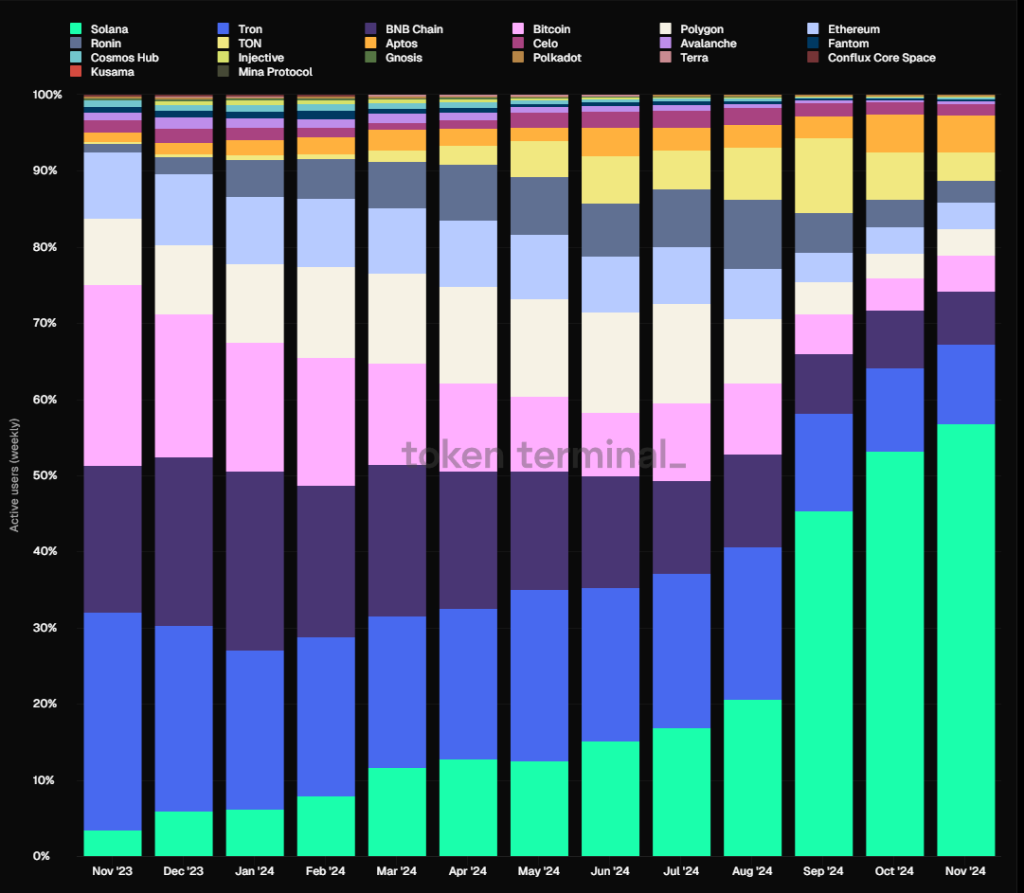
Market share of L1 monthly active addresses, data source: tokenterminal
Fees: Solana’s share of fee revenue rose from 0.62% to 28.92%, a year-on-year increase of 4,564%.
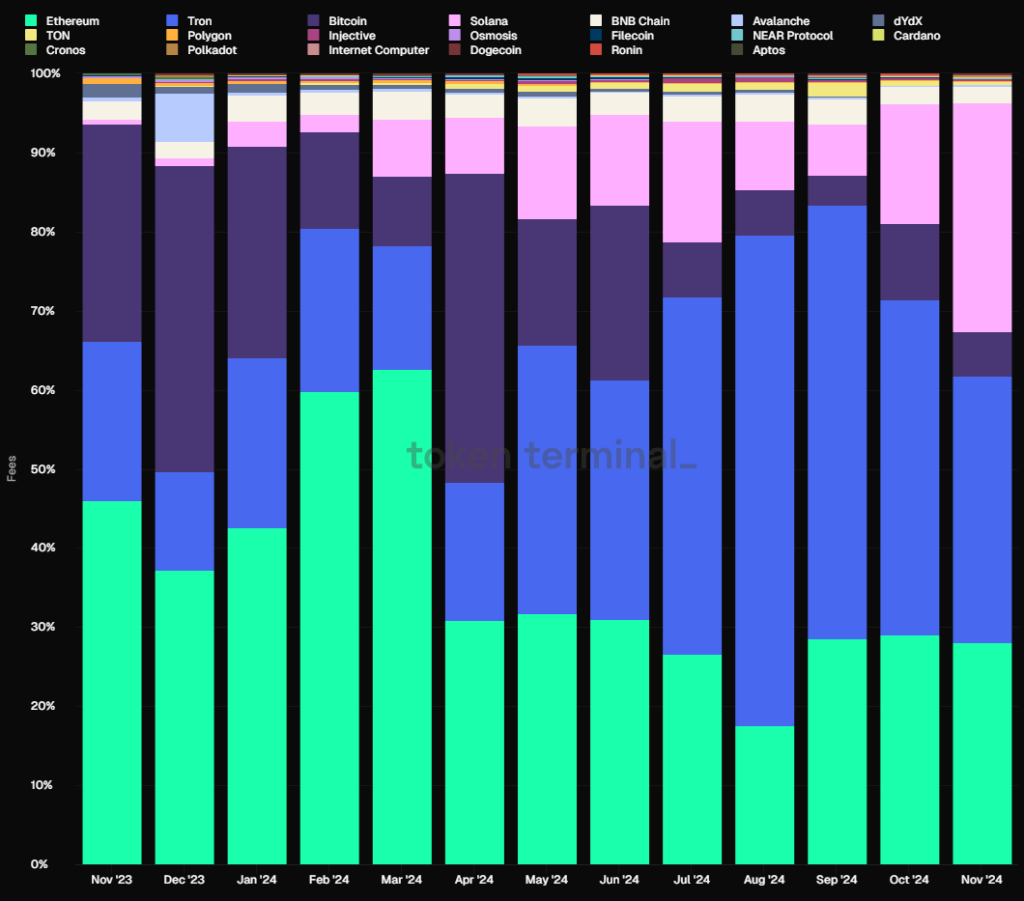
Market share of L1 monthly fee revenue, data source: tokenterminal
The Meme wave has been the primary driver behind the rapid growth in Solana’s core metrics this cycle. Besides Solana itself, projects like Raydium, a decentralized exchange (Dex), have also benefited significantly. The surge in Meme trading activity has generated massive transaction volume and protocol revenue for Raydium, which recently hit new all-time highs in price.
In this article, I will focus on another project benefiting from Solana’s explosive asset issuance: Metaplex.
This piece will explore and discuss the following four questions:
-
What is Metaplex’s business positioning and business model? Does it have a moat?
-
How are Metaplex’s business metrics performing? How well is the business developing?
-
What is the background and funding history of the Metaplex team? How should we evaluate the team?
-
What is Metaplex’s current valuation level? Is there a margin of safety?
This article reflects my current views at the time of publication, which may evolve over time. The opinions expressed are highly subjective and may contain factual inaccuracies, data errors, or flawed reasoning. Feedback and further discussion from peers and readers are welcome. However, this article does not constitute any investment advice.
Below is the main body of the article.
2. Metaplex’s Business Positioning and Business Model
Metaplex Protocol is a digital asset creation, sales, and management system built on Solana and other blockchains supporting SVM (Solana Virtual Machine). It provides developers, creators, and enterprises with tools and standards to build decentralized applications. Supported asset types include NFTs, FTs (fungible tokens), real-world assets (RWA), gaming assets, DePIN assets, and more.
Recently, Metaplex has expanded horizontally into other foundational services within the Solana ecosystem, such as data indexing (Index) and data availability (DA) services.
In the long term, Metaplex has the potential to become one of the most important multi-domain infrastructure projects in the Solana ecosystem.
2.1 Metaplex Product Suite
As an asset issuance, management, and standardization system, Metaplex serves both NFTs and fungible tokens. The products listed below form a comprehensive matrix serving Solana-based assets.
Core
Core is the next-generation NFT standard on the Solana blockchain. It adopts a "single-account design," significantly reducing minting costs and computational overhead. It also supports advanced plugins and enforces royalty payments.
Background: Solana's Account Model
To understand the advantages of the "single-account design," it's essential to first grasp Solana’s account model and traditional NFT storage methods.
On the Solana blockchain, all state storage—such as token balances and NFT metadata—is tied to specific accounts. Each account can store a limited amount of data and requires rent payments to maintain that data. Therefore, efficient management of on-chain accounts and data storage is a critical concern for Solana developers.
Traditional NFT Design
In traditional NFT designs, each NFT typically uses multiple accounts to store different types of information. For example, a typical NFT might involve the following accounts:
-
Main Account: Stores ownership information (e.g., who the current holder is).
-
Metadata Account: Stores NFT metadata (e.g., name, description, image link).
-
Royalty Account: Stores information related to creator royalties.
While this multi-account approach offers flexibility, it introduces several practical issues:
-
Complexity: Managing and interacting with multiple accounts increases complexity, especially when frequent queries or updates are needed.
-
Costs: Each account incurs rent to maintain its stored data; more accounts mean higher costs.
-
Performance: Operations involving multiple accounts consume more blockchain resources, impacting performance and transaction speed.
Advantages of “Single-Account Design”
Metaplex Core addresses these issues with its “single-account design,” consolidating all NFT-related information (ownership, metadata, royalties, etc.) into a single account. This simplifies account structure, reduces costs, improves interaction efficiency, and enhances NFT scalability. This design is particularly suitable for large-scale NFT projects—such as games and DePIN—on high-performance, low-cost blockchains like Solana.
Bubblegum
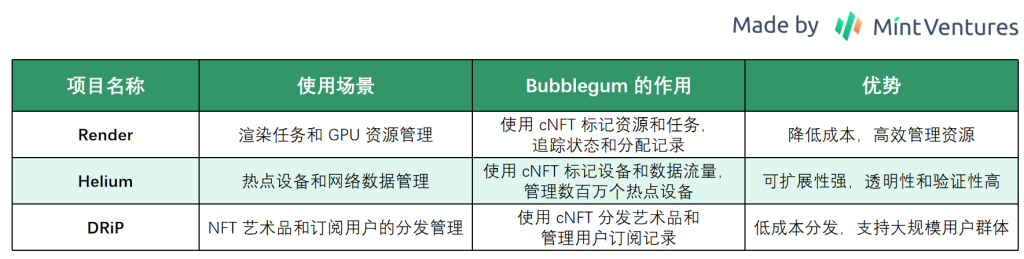
Bubblegum is Metaplex’s program for creating and managing compressed NFTs (cNFTs). Through compression technology, creators can mint vast quantities of NFTs at extremely low cost—minting 100 million NFTs costs only about 500 SOL (over 99% cheaper than traditional methods)—offering unprecedented scalability and flexibility. The introduction of Bubblegum made mass, low-cost NFT minting feasible, enabling DePIN projects like Render and Helium to migrate to Solana and paving the way for innovative platforms like DRiP. Below is a table showcasing how these three representative projects utilize Bubblegum.
Token Metadata
The Token Metadata program allows additional data to be attached to both fungible and non-fungible assets on Solana. While crucial for rich NFT experiences, Token Metadata is widely used by fungible token projects as well.
What many don’t realize is that Pump.fun, currently Solana’s largest Meme token launchpad, relies entirely on Metaplex’s metadata service. Today, the majority of demand for Token Metadata comes not from NFTs but from the massive number of Meme token launches.
For Meme projects, using the Token Metadata program offers clear benefits:
-
Standardization and compatibility: Tokens using Metaplex’s metadata service are more easily recognized by major wallets (e.g., Phantom, Solflare), correctly displayed on exchanges (with names, icons, and other info), and seamlessly integrated into other Solana applications.
-
On-chain storage and transparency: Metaplex stores token metadata on-chain, making information verifiable and tamper-proof.
-
Additional media content (images, text) enriches speculative narratives around Memes, transforming them from mere names and contract strings into cultural artifacts ripe for virality, remixing, and storytelling.

Constantly emerging new Meme tokens on pump.fun, source: pump.fun
As the Meme craze on Solana continues to intensify, over 90% of Metaplex’s protocol revenue now comes from fungible tokens (Memes). This reality starkly contrasts with the common perception of “Metaplex as an NFT infrastructure protocol,” indicating a significant gap in market understanding.
Candy Machine
Metaplex’s Candy Machine is the most widely used NFT minting and distribution program on Solana, enabling efficient, fair, and transparent NFT collection launches.
Other Products
Additional Metaplex services include:
MPL-Hybrid: A hybrid NFT storage and management solution combining on-chain and off-chain storage benefits, offering efficient and cost-effective storage—ideal for large files (e.g., high-resolution images) or dynamically updated NFTs.
Fusion: An NFT merging feature allowing users to combine multiple NFTs into a new one, enhancing user engagement and enabling new use cases in gaming, collectibles, and art.
Hydra: A scalable solution for large-scale NFT minting, tailored for projects requiring bulk minting (e.g., games, social platforms, loyalty programs).
……
Metaplex’s full list of existing products (asset-focused) is shown below:
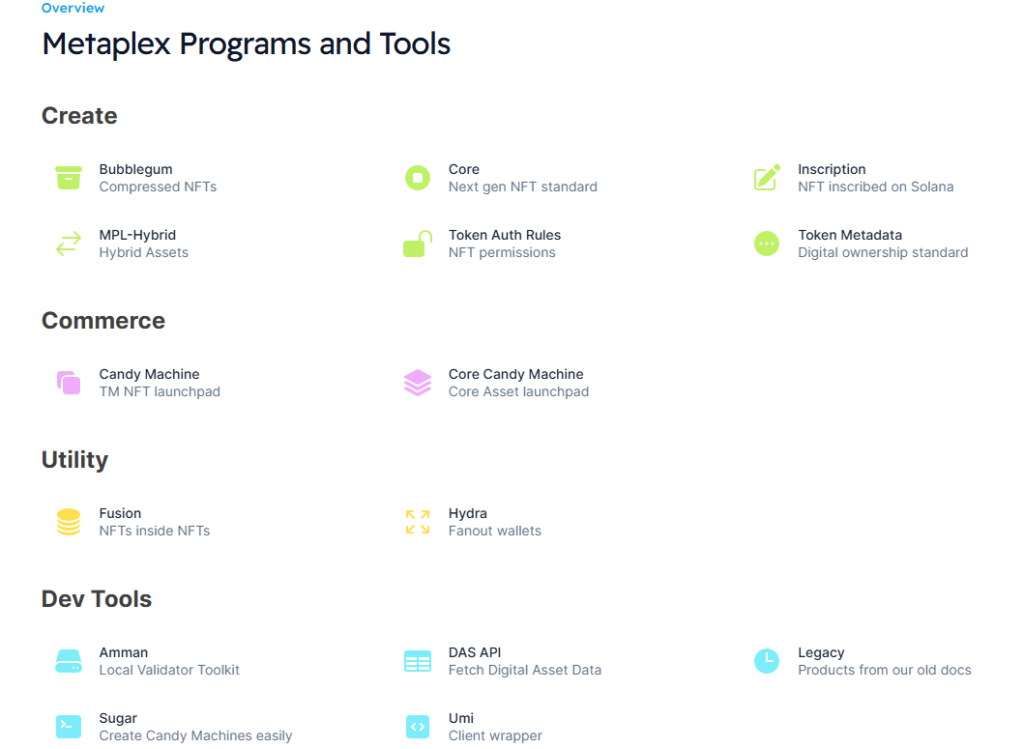
Source: Metaplex Developer Documentation
Aura
In September, the Metaplex Foundation announced Metaplex Aura—a decentralized indexing and data availability network for Solana and SVM-compatible chains (currently in testnet). By providing indexing and DA services, Aura enables Solana and other SVM-based blockchains to read asset data more efficiently and support batch operations at over 99% lower cost, as illustrated below:
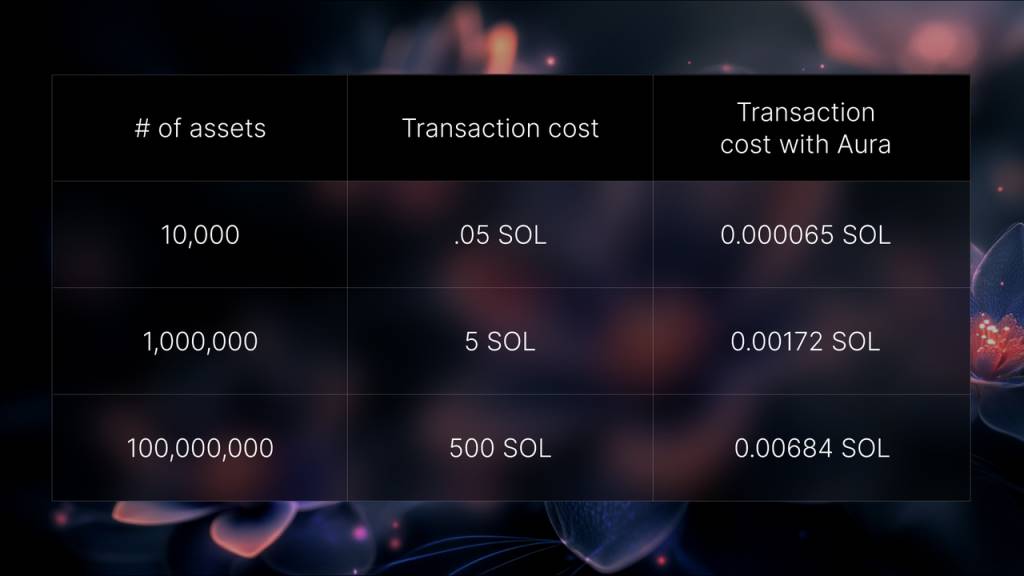
Cost comparison before and after adopting Aura for bulk asset operations, source: Metaplex official Twitter
At launch, Metaplex also revealed partnership agreements with several prominent Solana ecosystem projects, which are expected to become future users of Aura.
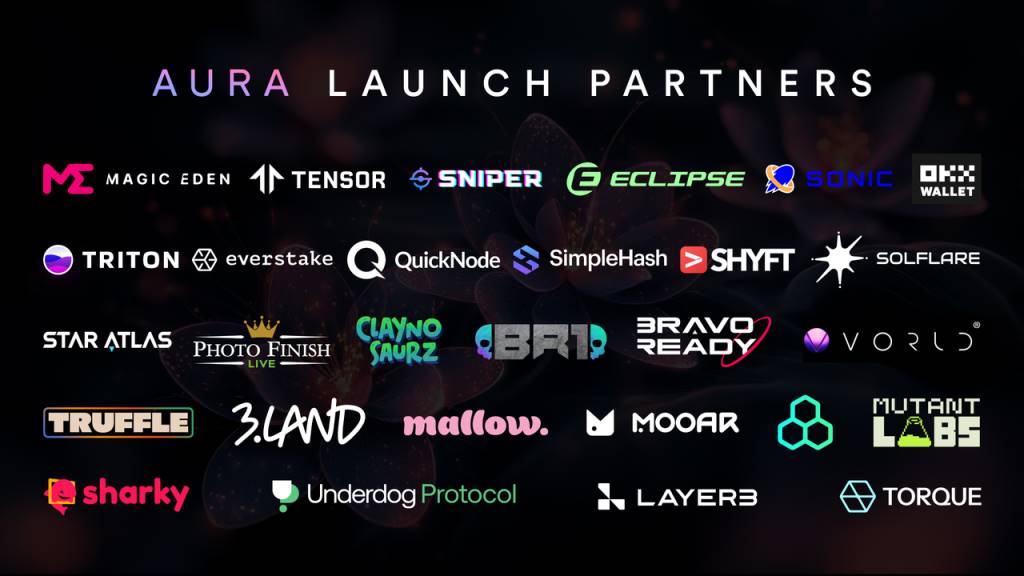
Source: Metaplex official Twitter
From asset services to data indexing and data availability, Metaplex is evolving into a full-stack infrastructure platform for the Solana ecosystem through horizontal expansion.
2.2 Metaplex’s Business Model
Metaplex’s business model is straightforward: charge fees for on-chain asset-related services. Some products in the suite are free, while others are paid.
Although Metaplex primarily partners with other projects on Solana—resembling a B2B model—its revenue largely comes from small projects or retail users leveraging larger B2B platforms. This includes teams launching various fungible tokens and individual users minting NFTs.
In my view, charging dispersed end-users is a better business model than relying solely on large B2B clients (like Pump.fun), because:
-
Smaller users or retail participants make more emotional decisions and are less price-sensitive. Since Metaplex’s fees represent a tiny fraction of their total spending, even modest per-user charges add up to substantial aggregate revenue when scaled across millions of users.
-
B2B platforms act as distribution channels, helping Metaplex reach a broader base of end-users without requiring additional marketing or channel development costs.
-
The user base is highly fragmented and lacks collective bargaining power, giving Metaplex strong pricing power and the ability to maintain or even increase profit margins over time.
Specifically, here are Metaplex’s service fees on Solana:
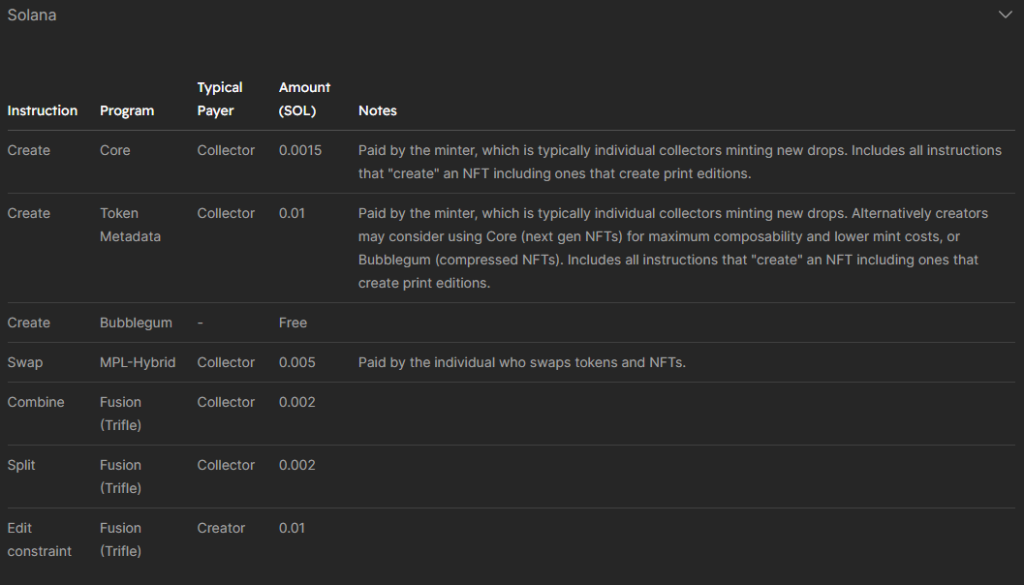
Source: Metaplex Developer Documentation
As shown, individual usage fees are minimal—for instance, minting an NFT costs just 0.0015 SOL; adding metadata to a Meme token costs only 0.01 SOL. These costs are negligible relative to users’ expected returns—essentially ignorable.
That said, the surge in fungible token (especially Meme) launches has boosted Metaplex’s revenue, but the sustainability of the Meme trend remains uncertain, posing risks to Metaplex’s long-term income stability. Even Solana experiences significant fluctuations in Meme activity: during the slowest week in September, new token listings on Dexs were only about one-third of the peak in May, while by mid-November, that number had surged tenfold.
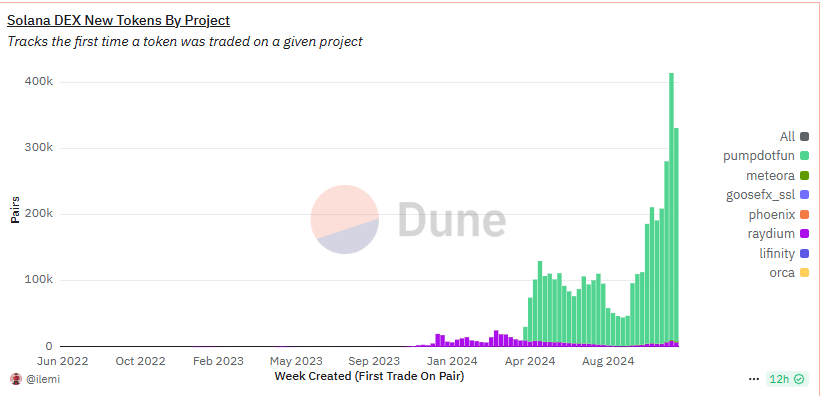
Weekly new token listings on Solana Dexs, source: Dune
2.3 Metaplex’s Moat
In business, a company’s moat can stem from various advantages: cost leadership via scale or geography, value accumulation through network effects, brand loyalty and pricing power, regulatory privileges, or patents.
Projects with strong moats deter competition—new entrants find it difficult or prohibitively expensive to catch up—resulting in fewer competitors. Financially, they exhibit stable or gradually rising profitability, with relatively low marketing and R&D expenses compared to revenue.
In Web3, truly defensible projects are rare—examples include Tether in stablecoins and Aave in centralized lending.
In my view, Metaplex possesses a strong moat, derived from “high switching costs” and “standard-setting.”
First, once developers and users deeply integrate Metaplex’s tools and protocols into their asset issuance and management workflows, migrating those assets to alternative systems entails significant technical, temporal, and economic costs.
Second, when Metaplex’s asset formats (for both NFTs and FTs) become the de facto standard across the Solana ecosystem—adopted by infrastructure and applications as the baseline for compatibility—new developers and projects are naturally inclined to choose Metaplex for maximum interoperability.
Thanks to this moat, Metaplex faces little direct competition within the Solana ecosystem, securing strong profitability—an aspect we’ll analyze next.
Beyond asset services, Metaplex’s upcoming indexing and data availability offerings (via Aura) could create a second growth vector. Given the high overlap between these new services and Metaplex’s existing customer base, adoption among current partners is likely to be smooth and rapid.
3. Metaplex Business Metrics: PMF Fully Validated, Core Data Shows Strong Growth
Metaplex’s core business revolves around asset-related services. Key metrics to track include active users, number of asset-issuance projects, and protocol revenue.
3.1 Monthly Active Users
Metaplex’s monthly active users refer to unique addresses that interact with the Metaplex protocol in a given month.
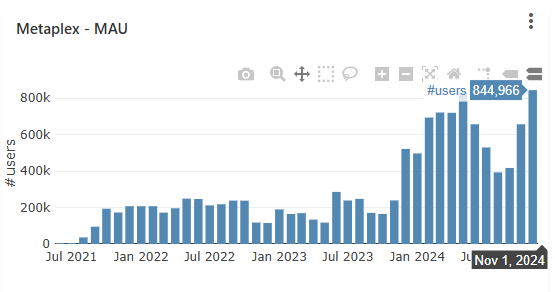
Metaplex monthly active addresses, data source: Metaplex Public Dashboard (same below)
As of the writing date (November 30, 2024), Metaplex reached a record high of 844,966 monthly active users, representing a 253% year-over-year increase.
3.2 Number of Assets Minted via Protocol
This metric tracks the number of distinct asset types created using Metaplex’s protocol.
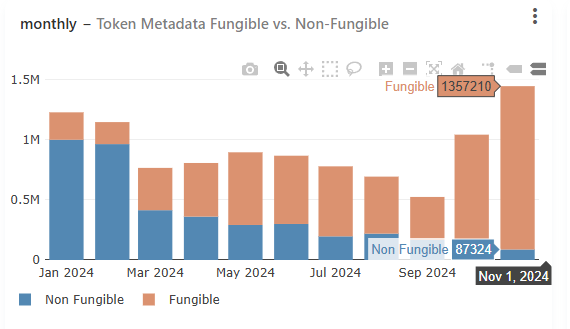
Monthly count of asset types minted via Metaplex
As of November 30, 2024, this metric also hit an all-time high, with over 1.44 million asset types minted in November alone.
More notably: 94% of these assets are fungible tokens, with only 6% being NFTs. In January of this year, the split was 18.6% FTs vs. 81.4% NFTs. This shift clearly indicates that Metaplex’s primary business has transitioned from NFT services to fungible token issuance—driven overwhelmingly by the Meme boom.
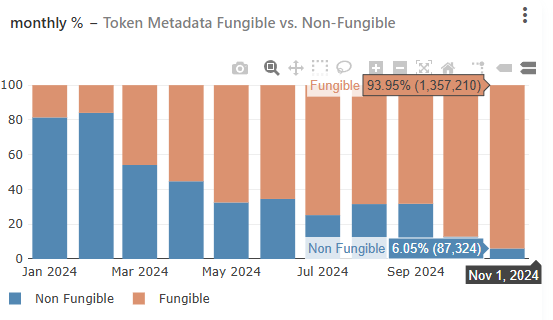
Breakdown of monthly asset types minted via Metaplex
3.3 Protocol Revenue
Protocol revenue refers to fees collected by Metaplex for its services.
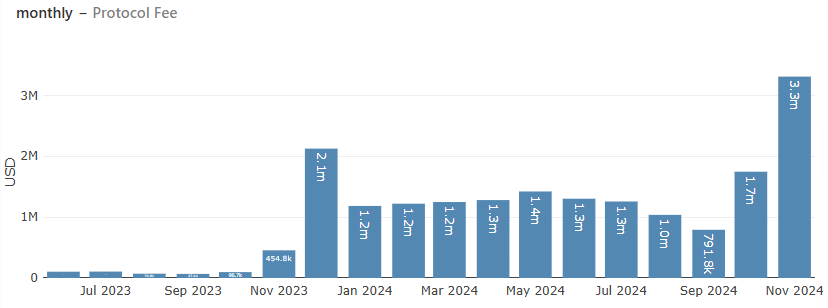
Metaplex monthly protocol revenue
As of November 30, 2024, Metaplex’s monthly protocol revenue reached $3.3 million, setting a new record.
It’s important to note that unlike many Web3 projects that rely on token subsidies to stimulate demand—spending protocol tokens to generate revenue—Metaplex’s income is organic. It has achieved true product-market fit (PMF) without artificial incentives.
From the data in this section, we observe:
-
As a foundational asset protocol, Metaplex directly benefits from Solana’s ecosystem growth, with its key metrics rising in tandem with Solana’s—especially revenue.
-
Metaplex benefits from both NFT and FT activity—not merely an “NFT infrastructure protocol.” If Solana sees renewed activity in other sectors—DePIN, gaming, RWA—the demand for Metaplex could expand further.
-
Metaplex’s demand is organic—revenue is generated without token subsidies.
Next, let’s examine the team behind Metaplex and the status of its native token.
4. The Metaplex Team: Ecosystem OG Close to Solana’s Inner Circle

Stephen Hess
Metaplex was founded by Stephen Hess, who also serves as Chairman of the Metaplex Foundation. He established Metaplex Studios in November 2021.
A graduate of Stanford’s Symbolic Systems program (focused on human-computer interaction), Hess was one of Solana’s earliest employees—joining just one year after Solana’s inception. Invited by co-founder Raj, he led Solana’s product division. During his tenure, he contributed to Solana Stake Pools, SPL governance, and Wormhole development. He was also part of the team behind the first version of Solana’s NFT standard, which later evolved into Metaplex.
In January 2022, shortly after Metaplex’s founding, the project secured a $46 million strategic investment from Multicoin, Jump, Alameda, and others. Based on the 10.2% allocation tied to that round, Metaplex’s post-money valuation was approximately $450 million—an exceptionally high early-stage valuation, even during a bull market.
Just before Metaplex’s first anniversary in November 2022, FTX collapsed due to massive financial fraud. Although Metaplex wasn’t financially exposed to FTX, Stephen Hess quickly announced layoffs on Twitter, preparing for the impending downturn in the Solana ecosystem. His foresight and disciplined cost management proved correct—unlike many Web3 teams that burned cash recklessly.
According to Metaplex’s current LinkedIn profile, the team remains lean at around a dozen members. Yet, judging from its monthly project reports, this compact team demonstrates strong execution and ambition, delivering rapid product iterations and new features consistently.
Metaplex monthly work report, source: official blog
Reviewing the founder’s background and project history, Metaplex aligns well with my criteria for an outstanding Web3 team:
-
Core team members possess relevant education, skills, and experience, with no history of misconduct.
-
Close ties to the core layer of the blockchain ecosystem, with open communication channels and broad community recognition.
-
Strong product intuition (few wrong turns), hardworking, and high delivery quality.
-
Cost-conscious, avoids reckless spending.
-
Secured backing from top-tier VCs, granting access to elite business networks.
Additionally, on September 9, 2024, The Block reported that知名 institutions including Pantera Capital and ParaFi Capital purchased large amounts of Metaplex (MPLX) tokens from Wave Digital Assets—tokens originally held by FTX—at a combined cost of roughly $0.20–$0.25 per token (subject to vesting terms).
5. MPLX: Token Utility and Valuation
5.1 Token Basics
Metaplex’s protocol token is MPLX, with a total supply of 1 billion.
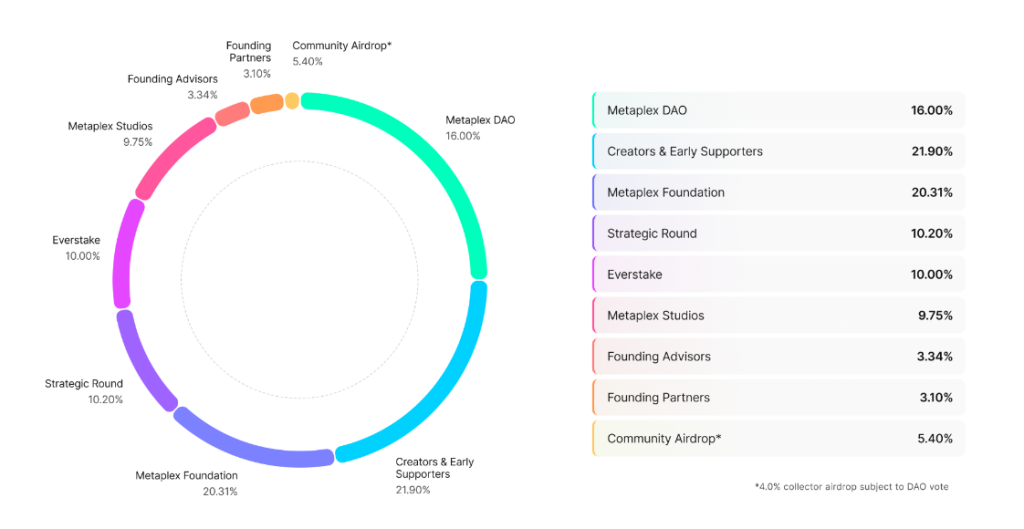
Source: Project Whitepaper
Detailed token allocation:
-
Creators & Early Supporters: 21.9% — 50% distributed via airdrop starting September 2022, remaining 50% released monthly over the following year;
-
Metaplex DAO: 16% — no lockup, distributed via DAO proposals;
-
Metaplex Foundation: 20.31% — no lockup;
-
Strategic Round: 10.2% — 50% unlocked one year after initial airdrop (September 2023), remaining 50% released monthly over the subsequent year;
-
Partner Everstake: 10% — locked for two years (until September 2024), linear release over one year post-unlock;
-
Metaplex Studios: 9.75% — locked for one year (until September 2023), linear release over two years post-unlock;
-
Community Airdrop: 5.4% — fully released immediately;
-
Founding Advisors: 3.34% — one-year lockup, linear release over one year, now fully unlocked;
-
Founding Partners: 3.1% — one-year lockup, linear release over one year, now fully unlocked.
Based on current circulating supply data, MPLX’s circulation rate is 75.6%. Most tokens are already in circulation, especially investor allocations, resulting in minimal unlock pressure.
The un-circulated portion mainly consists of tokens held by the Metaplex DAO, Metaplex Foundation, treasury reserves, and the remaining locked portions of Everstake and Metaplex Studios.
5.2 Token Utility
Currently, MPLX is primarily used for governance voting. Additionally, in March 2024, Metaplex announced plans to use 50% of protocol revenue (including accumulated historical revenue) to repurchase MPLX tokens. Repurchased tokens go into the treasury to fund ecosystem development.
Official buybacks began in June 2024, with 10,000 SOL spent monthly to repurchase MPLX—now sustained for five consecutive months.
Given the rapid rise in protocol revenue, next month Metaplex will increase its monthly buyback budget from 10,000 SOL to 12,000 SOL.
Beyond governance and buybacks, the next utility for MPLX will come from Aura. Once Aura launches, MPLX is expected to serve as staking collateral for Aura nodes, capturing yield generated by the network.
5.3 Protocol Valuation
To assess Metaplex’s valuation, I use comparative analysis. Since there are no direct competitors on Solana, I selected Raydium—an equally meme-driven, buyback-enabled Solana-native project—as a reference point.
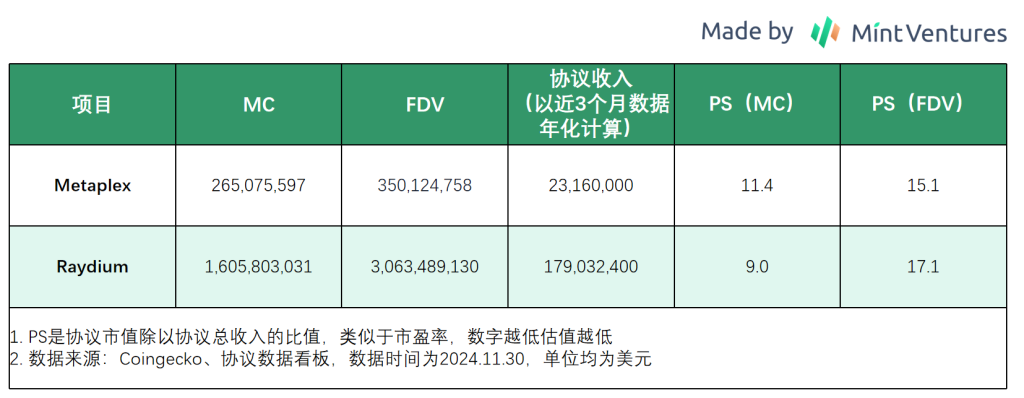
In terms of protocol revenue versus market cap, Metaplex appears slightly more expensive.
However, it must be emphasized that despite some similarities, these are fundamentally different projects in different sectors. Thus, this comparison offers only limited reference value.
5.4 Potential Catalysts and Risks
Overall, Metaplex’s strengths are clear:
-
Occupies an upstream position in the asset services stack, controls standard-setting, and directly benefits from Solana’s ecosystem growth.
-
Product-market fit is strongly validated; achieves positive cash flow without token subsidies and possesses a clear competitive moat.
-
Actively expanding into a second growth curve beyond its core offerings.
-
High-quality team with deep ecosystem connections, strong execution, and prudent cost management.
-
Token features a buyback mechanism; absolute market cap remains low (current market cap ~$260M+, FDV ~$350M+), making it relatively lightweight.
Potential upside drivers for Metaplex’s market cap include:
-
New active sectors emerge on Solana beyond Memes—such as DePIN, gaming, or RWA—expanding the asset issuance market.
-
Listing on major exchanges like Binance or Coinbase, unlocking liquidity premiums. Given the project’s fundamentals and low valuation, this seems highly justified—projects with real demand and positive cash flow are rare in today’s market.
-
Direct fee increases. Current fees are very low; Metaplex has room to raise prices. Even a 100% increase would still make costs negligible for users.
Of course, Metaplex also faces potential risks and challenges:
-
A cooling of Solana’s Meme frenzy could lead to a sharp drop in asset issuance and reduced revenue.
-
Revenue is currently one-time, based on the number of asset types created. Projects with fixed asset types cannot provide recurring revenue to Metaplex.
Conclusion
Contrary to the common investor perception of “Metaplex as an NFT infrastructure protocol,” it is actually a foundational protocol serving all asset types across the Solana ecosystem—and a direct beneficiary of the ongoing Meme boom since the beginning of the year.
If one remains bullish on the future of the Solana ecosystem, then Metaplex—occupying the upstream niche of “asset issuance and management”—deserves long-term attention.
Join TechFlow official community to stay tuned
Telegram:https://t.me/TechFlowDaily
X (Twitter):https://x.com/TechFlowPost
X (Twitter) EN:https://x.com/BlockFlow_News
 Mint Ventures