AI & Crypto: These Three Areas Are Worth Watching
TechFlow Selected TechFlow Selected
AI & Crypto: These Three Areas Are Worth Watching
Decentralized MLOps, distributed hardware, and blockchain-based traceability solutions are paving the way for a more decentralized and inclusive future for AI.
 Navigating Web3 tides with focused insights
Author: io.net
Translation: Alex Liu, Foresight News
Artificial intelligence has rapidly become one of the most centralized forces in the world. Developing and deploying AI requires massive resources—including substantial capital, advanced computing power, and highly specialized talent. Naturally, only the best-funded organizations can afford to invest in cutting-edge infrastructure and attract top-tier talent, leaving smaller companies struggling to keep up.
In traditional setups, MLOps (Machine Learning Operations) are controlled by large organizations that manage everything internally—from data collection to model training and deployment. This closed ecosystem monopolizes talent and resources, creating significant barriers for startups and small businesses.
One of the most exciting ways blockchain challenges this centralization is by enabling decentralized, permissionless AI models. By leveraging distributed communities to secure, validate, fine-tune, and verify every stage of LLM (Large Language Model) deployment, we can prevent a handful of players from dominating the AI landscape.
io.net is closely watching the intersection of artificial intelligence and blockchain, identifying three key areas that could reshape the industry.
Distributed MLOps
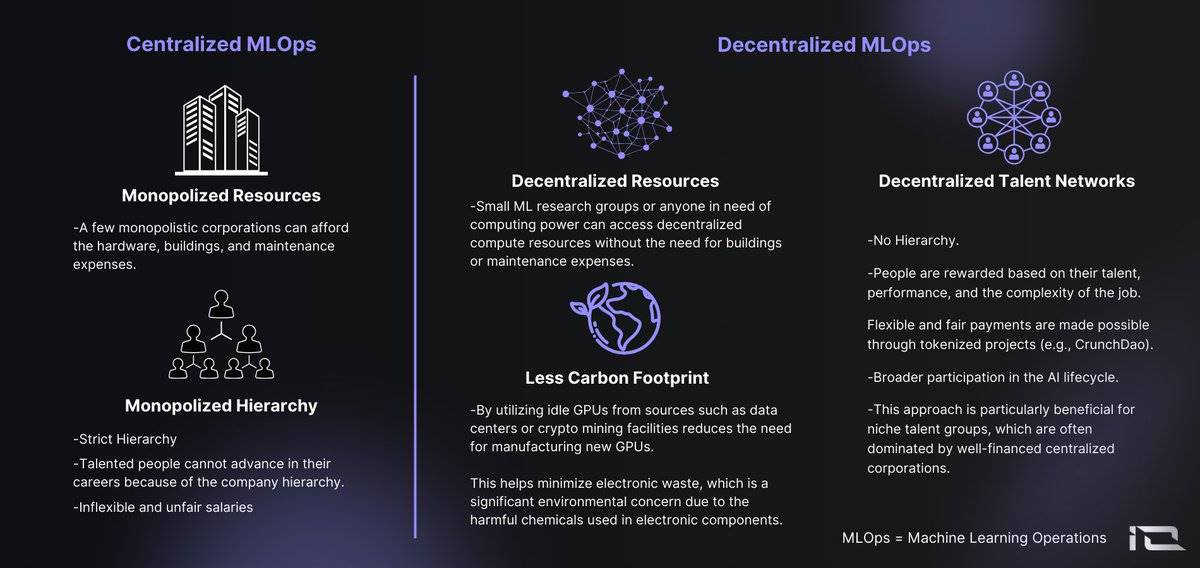
In traditional MLOps, big tech companies hold the advantage. They have the resources to monopolize talent and run operations entirely in-house. In contrast, decentralized MLOps uses blockchain and token incentives to create distributed networks, enabling broader participation across the entire AI development lifecycle.
From data labeling to model fine-tuning, decentralized networks can scale more efficiently and fairly. Talent pools can be dynamically adjusted based on demand and complexity, making this approach especially effective in specialized domains where talent is typically concentrated within well-funded firms.
Take CrunchDao as an example—they’ve built a decentralized platform similar to Kaggle, where AI talent competes to solve problems for trading firms. As specific datasets become more prevalent, companies will increasingly rely on these talent networks to provide “humans in the loop” for supervision, fine-tuning, and optimization. Another project, Codigo, is using a similar model to build a decentralized network of crypto developers who earn tokens for training and refining cryptocurrency-specific language models.
Distributed Hardware
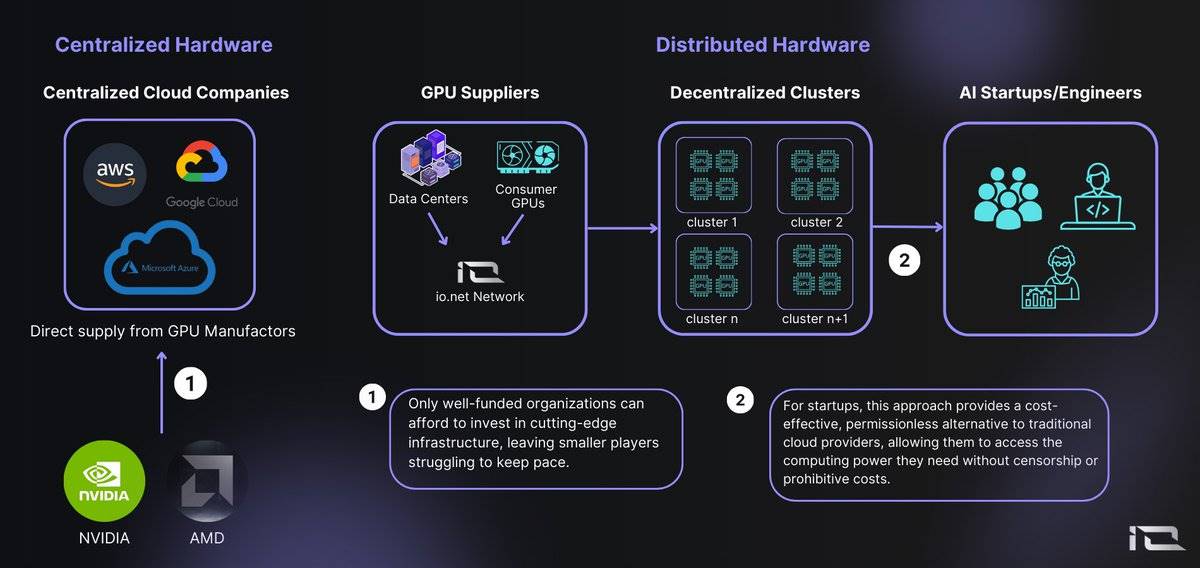
One of the biggest bottlenecks in today’s AI development is access to cutting-edge GPUs like Nvidia’s A100 and H100. These are essential for training large AI models, but their cost is prohibitively high for most startups. Meanwhile, companies like AWS are securing direct deals with Nvidia, further limiting access for smaller players.
This is where blockchain-based decentralized models like io.net come in. By allowing individuals to monetize idle GPUs—whether located in data centers, cryptocurrency mining facilities, or even gaming consoles—small companies can access the computing power they need at a fraction of the cost. It serves as a permissionless, cost-effective alternative to traditional cloud providers, without risks of censorship or exorbitant fees.
Distributed Provenance
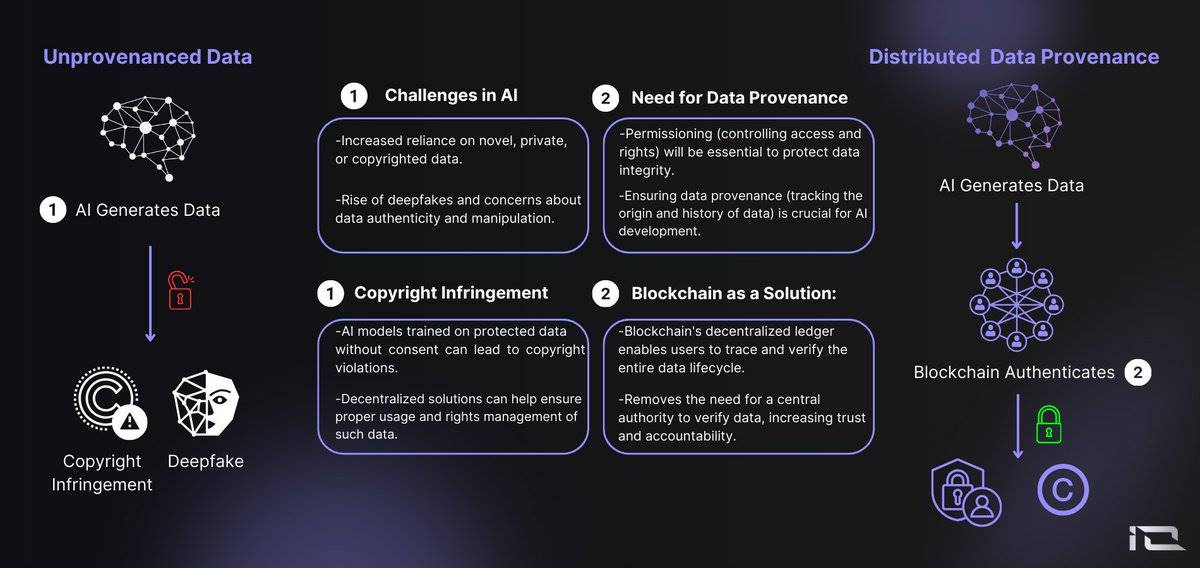
As Balaji Srinivasan put it, "AI is abundant digital goods; crypto is scarce digital assets; AI generates, crypto verifies." As AI models grow increasingly reliant on novel, private, or even copyrighted data—and as the threat of deepfakes rises—ensuring data provenance and proper licensing becomes ever more critical.
Copyright infringement is a serious concern when AI models are trained on protected data without proper consent. This is where decentralized provenance solutions shine. Using blockchain’s transparent, decentralized ledger, we can track and verify data throughout its entire lifecycle—from collection to deployment—without relying on centralized authorities. This adds a crucial layer of trust, accountability, and respect for data rights, which is vital for the future of AI.
Conclusion
The convergence of artificial intelligence and blockchain technology offers exciting new approaches to counteract centralization in AI development. Decentralized MLOps, distributed hardware, and blockchain-based provenance solutions all contribute to building a fairer, more scalable AI ecosystem. These models enable dynamic talent networks, unlock idle computing resources, and ensure data integrity—paving the way for a more decentralized and inclusive future for AI.
Join TechFlow official community to stay tuned
Telegram:https://t.me/TechFlowDaily
X (Twitter):https://x.com/TechFlowPost
X (Twitter) EN:https://x.com/BlockFlow_News
 @ionet