









Pantera Partner: What to Expect for the Crypto Market After the Election?
TechFlow Selected TechFlow Selected
Pantera Partner: What to Expect for the Crypto Market After the Election?
Bitcoin, Polymarket, and DeFi all have bright prospects.
 Navigating Web3 tides with focused insights
Author: Paul Veradittakit, Partner at Pantera Capital
Translation: Luffy, Foresight News
One week after the U.S. election, sentiment in the cryptocurrency market remains strong. Polymarket, Bitcoin, and the possibility of a more efficient and crypto-friendly government are all worth watching.
Polymarket
Polymarket is a prediction market built on the Polygon blockchain. Its adoption surged during the election period, with wagers reaching $3.2 billion—orders of magnitude higher than before the election. Compared to other prediction markets, Polymarket charges no fees, enables seamless trading, and is decentralized, meaning anyone can interact directly with its on-chain smart contracts via API (allowing creation of trading bots), and its front-end is accessible to users from any non-blacklisted region.
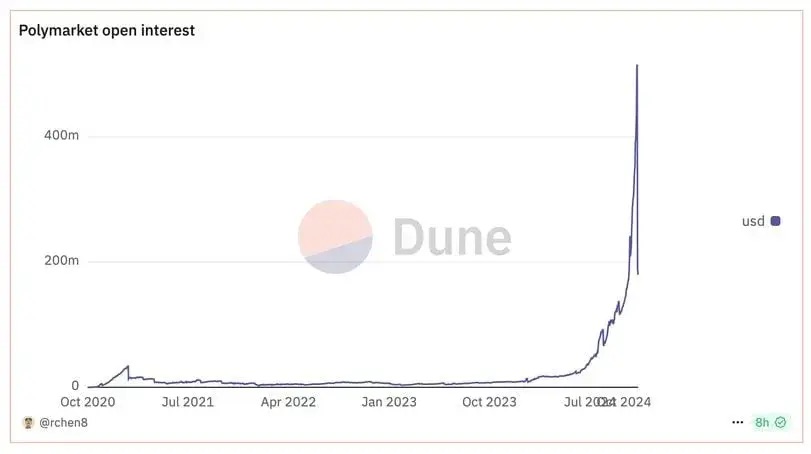
Betting volume on Polymarket
Although wagering volume has significantly declined post-election, mainstream users have already tried Polymarket and prefer it over other centralized applications. A notable trend after the election has been widespread discussion in mainstream media about Polymarket’s accuracy. Publications such as The Economist, The Wall Street Journal, and Forbes have referred to Polymarket as the largest prediction market and used it to analyze discrepancies between polls and voter sentiment before and after the election.
It is hoped that the enthusiasm for Polymarket will spill over into the broader crypto ecosystem, inspiring more crypto applications to emulate Polymarket's approach by pursuing better usability, abstraction, and marketing.
Bitcoin and Altcoins
Bitcoin reached an all-time high, surging to $77,000 immediately after the election and continuing upward toward $100,000. Altcoins indirectly linked to the election also saw significant gains, such as those on Solana. While Trump’s victory did not directly increase Bitcoin’s purchasing power, his public support was sufficient to drive token price increases.
Outlook
The positive momentum brought by the election itself may not last indefinitely. However, unified Republican control of both the House and Senate could lead to a more efficient government and the passage of more crypto-related legislation.
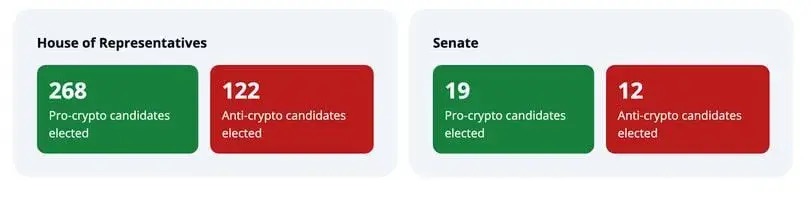
In both chambers, the number of pro-crypto representatives clearly exceeds those opposed (266 vs. 120 in the House, 18 vs. 12 in the Senate). A Trump administration supportive of crypto could ease regulatory pressure or push for favorable regulations. World Liberty Financial, a crypto project promoted by Trump, reportedly plans to operate as an instance of Aave—one of the largest DeFi protocols.
What does this mean for the future of crypto? First, lobbying efforts—such as those from Ripple and Coinbase—may intensify to steer crypto regulation in a favorable direction.
U.S. crypto regulation has long been seen as unclear; clear rules could fundamentally change how crypto companies view operating in the United States. Most of the largest crypto venture capital firms are still based in the U.S., so enabling funded crypto startups to operate domestically would strengthen the industry.
Top DeFi protocols like Compound and Uniswap are also showing renewed interest in previously "restricted" functionalities such as staking and fee conversion. Greater regulatory clarity around these features could spark a new wave of innovation in DeFi.
Overall, I am highly optimistic about the direction of the crypto industry following the election. A unified Congress may deliver unexpected good news for the fast-evolving crypto sector.
Join TechFlow official community to stay tuned
Telegram:https://t.me/TechFlowDaily
X (Twitter):https://x.com/TechFlowPost
X (Twitter) EN:https://x.com/BlockFlow_News
 Pantera Capital









