








Why does Vitalik insist on technical-philosophical thinking, publishing six blog posts in a row reviewing Ethereum's roadmap?
TechFlow Selected TechFlow Selected
Why does Vitalik insist on technical-philosophical thinking, publishing six blog posts in a row reviewing Ethereum's roadmap?
Transformative technologies will make the future brighter than it is today.
 Navigating Web3 tides with focused insights
Author: imToken

With the conclusion of Devcon7, the future direction of the Ethereum ecosystem has once again drawn widespread attention. This brings to mind a recent suggestion made by economists Tyler Cowen and Alex Tabarrok on their podcast: Vitalik Buterin, founder of Ethereum, should be considered a strong candidate for the Nobel Prize in Economics.
Tyler Cowen praised: "Vitalik Buterin built a platform and created an asset—his achievements could be seen as refuting Mises' regression theorem. While Ethereum builds upon Bitcoin by Satoshi Nakamoto, Vitalik Buterin's contributions undoubtedly reach Nobel-worthy heights."
Why Not a Bit More Philosophical Thinking?
At just 19 years old, Vitalik Buterin began working toward building new economic infrastructure for the internet. According to author Nathan Schneider in his book *Proof of Stake*, Buterin’s original passion was writing. After becoming curious about BTC at his father’s encouragement, in 2011 he posted on a forum asking whether anyone would pay him in BTC to write articles about Bitcoin.
To his surprise, people actually did. This allowed Buterin to continue writing, eventually co-founding *Bitcoin Magazine* and introducing Bitcoin—a then-niche phenomenon—to a broader audience.
From magazine writing to founding Ethereum, and now over a decade later, Vitalik Buterin has never stopped writing. He consistently shares his thoughts on blogs, forums, and social media, actively engaging with the community. Thanks to this ongoing dialogue, Ethereum has attracted a loyal following over the past ten years, and its development roadmap has gradually taken shape.
Looking ahead, if Ethereum’s vision is to be fully realized, Vitalik Buterin’s perspectives still need to gain wider understanding. Of course, these views may spark controversy—but debate and criticism are precisely what drive Ethereum toward a better future.
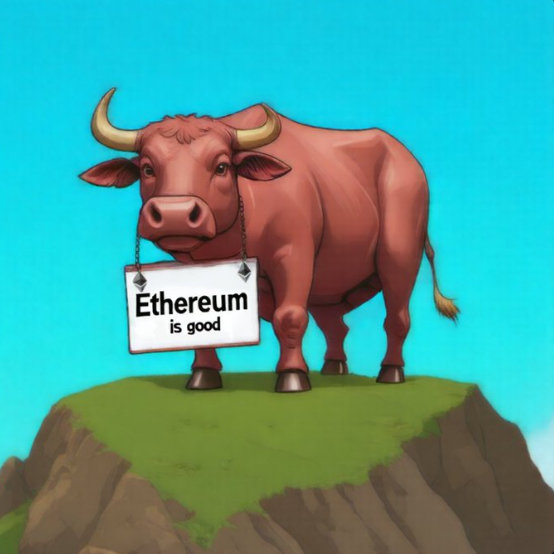
In the second half of 2024, amid the U.S. election cycle, discussions around crypto asset appreciation intensified, fueling many users’ dreams of getting rich quickly. Technical innovation seemed to fade from the spotlight. On August 21, 2024, Vitalik Buterin joked on X (formerly Twitter): “I’ve been told I need to ‘do less philosophy and more ETH price bullish posts.’” Below is such a bullish post—generated entirely by AI image tools Stable Diffusion 3 and GIMP.
This Is What Makes Ethereum Different
In an environment where everyone talks about getting rich overnight, Vitalik Buterin remains steadfast in promoting Ethereum’s technical and philosophical goals. Starting October 14, 2024, Buterin published six consecutive blog posts, deeply analyzing Ethereum’s future technological developments and solutions based on a retrospective of its roadmap:
The Merge: Published on October 14, 2024, this article explores areas for improvement after Ethereum's transition to PoS consensus. These improvements fall into two categories: technical optimizations (such as stability, performance, accessibility for small validators) and economic reforms (to mitigate centralization risks). The former belongs to “The Merge” domain; the latter falls under “The Scourge.”
Technical optimization goals include achieving single-slot finality—confirming and finalizing transactions faster while maintaining decentralization—improving feasibility for solo stakers, enhancing resistance against 51% attacks, and accelerating transaction confirmation times.
Read The Merge: https://vitalik.eth.limo/general/2024/10/14/futures1.html
The Surge: Published on October 17, 2024, this piece traces Ethereum’s scaling strategy evolution—from sharding to Layer 2 protocols, and finally converging into a Rollup-centric scaling solution that significantly increases data bandwidth. However, challenges remain: ensuring robustness of Layer 1, preserving decentralization, and maximizing interoperability across Layer 2s.
Read The Surge: https://vitalik.eth.limo/general/2024/10/17/futures2.html
The Scourge: Published on October 20, 2024, it discusses centralization and value extraction risks Ethereum faces post-PoS adoption, particularly concentrated in block building and staked assets. It also outlines progress since 2024, including dual-layer staking models and reduced issuance rates.
Read The Scourge: https://vitalik.eth.limo/general/2024/10/20/futures3.html
The Verge: Published on October 23, 2024, this article examines challenges and solutions for stateless validation on Ethereum, focusing on how technologies like Verkle Trees and STARKs can enhance blockchain efficiency and decentralization.
Read The Verge: https://vitalik.eth.limo/general/2024/10/23/futures4.html
The Purge: Published on October 26, 2024, it addresses Ethereum’s long-term challenge of reducing complexity and storage demands without compromising chain longevity. Decentralized applications must trust that their dependencies won’t break during upgrades—especially core Layer 1 protocols. Proposed solutions include removing unnecessary protocol features and implementing strategies like "historical data expiry" and "state data expiry" to reduce client storage burden.
Read The Purge: https://vitalik.eth.limo/general/2024/10/26/futures5.html
The Splurge: Published on October 29, 2024, this article revisits the concept of “Splurge” from Ethereum’s 2023 roadmap, aiming to bring the Ethereum Virtual Machine to a highly efficient and stable “final form.” Goals include implementing account abstraction so all users enjoy safer, more convenient accounts; optimizing fee market economics; improving scalability and reducing risks; and exploring advanced cryptography to enhance Ethereum’s long-term performance. Key steps include proposals like EIP-1559.
Read The Splurge: https://vitalik.eth.limo/general/2024/10/29/futures6.html
Perhaps this is exactly what sets Ethereum apart from other blockchain ecosystems—while others chase quick riches, Ethereum continues to focus on technology.
A vast developer community and strong appeal to developers form both the foundation of Ethereum’s creation and the cornerstone of its future growth. Compared to other chains, Ethereum offers more tooling and frameworks (like Truffle), supporting a wider variety of smart contracts and DApp development.
Moreover, Ethereum’s tools balance performance with depth—they were not built merely to serve high-performance trading applications. Over years of development, Ethereum’s proposed technical standards have become widely adopted across the crypto industry, including ERC-20 and ERC-721 token standards.
How to Forecast the Future More Accurately?
So, what kind of future does focusing on technology actually enable? In a blog post, Vitalik Buterin expressed nuanced feelings toward technological optimism—he leans positive, yet cautiously so. He believes truly transformative technologies will ultimately lead to a brighter future than today.
Buterin advocates that the best thing people can do is strive to keep the world roughly as it is today—just with a little less greed.
He also emphasizes that technology isn't only about scale—direction matters too. If certain types of technology develop well, they can reliably improve the world and thereby offset negative impacts from other technological paths.
In today’s world, some technological directions receive excessive emphasis, while others are underappreciated. This is precisely why humanity must consciously choose the directions we want to pursue. After all, the formula of “profit maximization” won’t automatically lead us to where we truly wish to go.
How can we see the future more clearly? On November 9, 2024, Vitalik Buterin revisited and expanded upon an innovative idea in a new blog post. He stated: the application feature within Ethereum that excites him most is “prediction markets.”
According to Buterin, prediction markets are actually highly valuable tools for society—not merely places for betting. At a higher level, prediction markets represent just one use case within a broader future category of applications, which holds potential to transform fields such as social media, science, journalism, and governance. This emerging field is called "Info Finance".
Join TechFlow official community to stay tuned
Telegram:https://t.me/TechFlowDaily
X (Twitter):https://x.com/TechFlowPost
X (Twitter) EN:https://x.com/BlockFlow_News
 @imTokenOfficial






