Bitcoin Surpasses $80,000: What's Driving the New High?
TechFlow Selected TechFlow Selected
Bitcoin Surpasses $80,000: What's Driving the New High?
I didn't expect the $80,000 to arrive so quickly.
 Navigating Web3 tides with focused insights
By: BlockBeats
Following Trump's victory in the U.S. presidential election, Toe Bautista, research analyst at GSR, noted that from an altcoin perspective, many projects have been waiting to observe both token issuance trends and the election outcome. He also believes that if macro conditions remain favorable, Bitcoin prices could rise further. "It’s easy to envision Bitcoin reaching $80,000—whether in Q1 next year or even by month-end."
After Trump’s election as U.S. President, everyone anticipated BTC would soon break $80,000—but no one expected this $80,000 level to arrive so quickly.
MicroStrategy Holdings
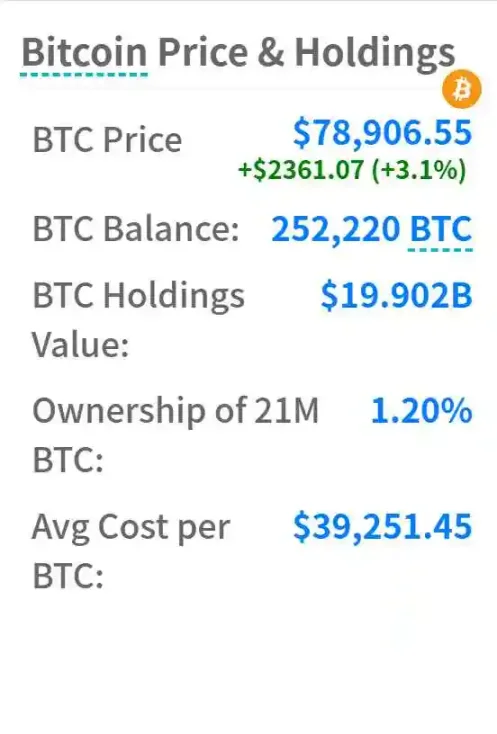
As a company heavily invested in BTC, MicroStrategy currently holds a total of 252,220 bitcoins, with an approximate total purchase cost of $9.9 billion, averaging around $39,266 per BTC. The current total value of its Bitcoin holdings stands at $20.177 billion.
ETF Inflows
Bitcoin ETFs attracted significant attention upon launch due to substantial inflows of new capital, pushing Bitcoin prices to new highs. However, net outflows soon followed, and market sentiment began to decline. Recently, however, BTC ETFs have seen sustained large-scale capital inflows.
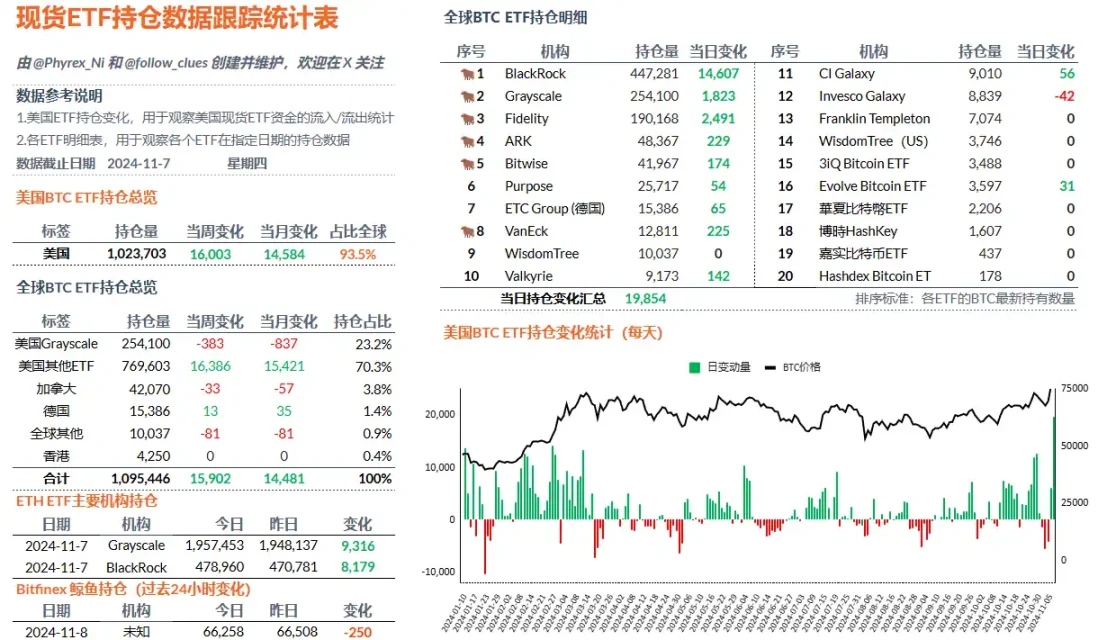
Daily net inflows have not only hit record highs but so has total holdings. The logic is clear: after Trump’s win, a “crypto golden age” may be imminent, with growing political support for cryptocurrency in the U.S. For traditional financial “big players,” allocating funds to crypto becomes more likely, and BTC ETFs offer the most convenient investment channel. For other U.S. stock investors, BTC ETFs will become highly attractive under Trump’s endorsement.
Interest Rate Cuts
The Federal Reserve cut rates by 50 basis points in September, significantly exceeding expectations, triggering an immediate surge in Bitcoin prices. At the November meeting, another 25-basis-point cut was confirmed—widely interpreted as bullish, especially since the previous bull market began with the March 2020 rate cut.
Historical Data for November
Beyond fundamentals, there's also a sense of ritual.
According to Coinglass data, Bitcoin delivered strong quarterly returns following the halvings in 2012, 2016, and 2020—97.7%, 58.17%, and 168.02% respectively. November returns were 5.42% in 2016 and 42.95% in 2020; this month’s performance remains promising.
Notably, Bitcoin posted a 7.35% gain in September this year—the best historical September performance ever. Historically, every time Bitcoin ended September in positive territory, it continued rising through year-end.
After dawn comes history.
Bitcoin Price Outlook: What Do Traders Say?
PlanB: BTC Could Reach $1 Million by End of 2025
PlanB, creator of Bitcoin’s Stock-to-Flow (S2F) model, is highly respected in the crypto industry for his unique model linking asset scarcity to price. His analysis focuses on Bitcoin’s long-term growth potential, particularly post-halving price movements. His latest prediction suggests that if Trump wins the upcoming presidential election, Bitcoin could experience an unprecedented price surge. PlanB outlines a monthly timeline projecting Bitcoin’s price trajectory under various market scenarios.
In earlier forecasts based on his S2F model, PlanB provided specific figures:
November: Trump wins the election, Bitcoin reaches $100,000. PlanB views Trump’s victory as a major turning point. He argues that a Trump administration would end the Biden/Harris government’s “war” on crypto, particularly countering regulatory pressures from figures like Gary Gensler and Elizabeth Warren, directly propelling Bitcoin to $100,000.
December: Massive ETF inflows drive Bitcoin to $150,000. PlanB believes Trump’s win will clear the path for Bitcoin ETF approvals, leading to massive capital inflows. ETF adoption signifies mainstream financial acceptance and investor confidence, pushing Bitcoin to $150,000.
January 2025: Crypto industry repatriates to the U.S., Bitcoin climbs to $200,000. With a more open crypto policy under Trump, many crypto firms and investors may return operations to the U.S. This shift, PlanB predicts, will create strong demand, pushing Bitcoin to $200,000.
February 2025: “Power Law” team takes profits, price retreats to $150,000. The February pullback represents a market correction. PlanB expects profit-taking after peak levels causes a temporary drop to $150,000. However, this adjustment will be brief and necessary, laying a more stable foundation for future gains.
March–May 2025: Global Bitcoin adoption drives price past $500,000. Starting in March, PlanB anticipates Bhutan, Argentina, and Dubai will adopt Bitcoin as legal tender. From April, the U.S. will initiate a strategic Bitcoin reserve under Trump’s leadership. By May, he expects other nations—especially non-EU countries—to join the trend, pushing Bitcoin toward $500,000.
June 2025: AI-driven arbitrage pushes price to $600,000. In June, PlanB hypothesizes that artificial intelligence begins autonomous arbitrage in the Bitcoin market. As AI participates in high-frequency trading, prices could be further driven upward, surpassing $600,000.
July–December 2025: FOMO fades, price hits $1 million. In the following months, PlanB believes FOMO sentiment cools, yet Bitcoin could still reach a new all-time high of $1 million by year-end. By then, Bitcoin will not only be a mainstream store of value but also an essential portfolio component for global investors.
2026–2027: Market correction and bear market. In 2026, PlanB forecasts Bitcoin will correct from $1 million to $500,000, entering a distribution phase. By 2027, the market will enter a bear cycle, with Bitcoin potentially falling to $200,000.
PlanB concludes that the core of this forecast lies in Bitcoin’s scarcity value. He emphasizes that scarcity will be the key driver of asset prices, just as with real estate and gold. PlanB believes that over the next 18 months, Bitcoin’s price could leap forward under the combined forces of the halving effect and growing demand, further cementing its status as “digital gold” among global investors.
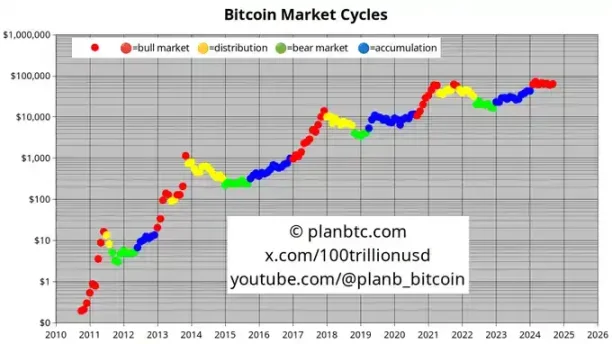
The crux of PlanB’s argument is Bitcoin’s scarcity premium. He notes that investors favor scarce assets, and today there are essentially three options: real estate (S2F 100, market cap $10 trillion), gold (S2F 60, market cap $20 trillion), or Bitcoin (S2F 120, market cap $1 trillion). Thus, Bitcoin’s superior scarcity will become the central force driving its price appreciation, mirroring other scarce assets.
PlanB also presents a counter-scenario: if Harris wins, he sees it as “the end of Western civilization” and accelerating the decline of the American empire. He expects increased regulatory pressure on crypto under Gensler and Warren, more suffocating actions, and possibly harsher tax policies such as unrealized capital gains taxes. Nevertheless, he stresses that Bitcoin does not depend on any single regulatory environment—its value will continue to be driven by global demand for scarcity.
Alex Krüger: Focus on Spot BTC on Election Night
Alex Krüger, Argentinian economist, trader, and advisor, believes the election result will directly impact Bitcoin’s price direction:
Trump wins: Year-end target of $90,000 for Bitcoin, with a 55% probability. Krüger expects Bitcoin to surge rapidly to $90,000 by year-end, as markets have already partially priced in the pro-crypto implications of a Trump victory. However, some undervaluation remains, and the market’s swift reaction will materialize shortly after results are confirmed.
The Giver: Mid-Term Decline After Election
The Giver is an anonymous seasoned investor with extensive experience in both buy-side and sell-side financial institutions, now focusing on special situations private equity. Offering a contrasting view to Krüger and PlanB, his approach is more conservative and short-term focused. He argues that election-driven Bitcoin rallies are largely temporary rather than indicative of long-term trends. His analysis emphasizes market liquidity and short-term event-driven dynamics, suggesting Bitcoin may face a correction post-election. His key points include:
The current rally is fueled by “non-sticky” event-driven buyers—short-term speculators hedging election risk, not participants in a broader market trend. These buyers are unlikely to hold Bitcoin long-term and may exit swiftly once the election concludes. Hence, this capital lacks “stickiness,” potentially creating selling pressure post-election.
Altcoins’ poor performance reflects Bitcoin concentration. Funds are flowing primarily into Bitcoin, not broadly into altcoins, resulting in weak altcoin performance. This indicates that inflows are driven by Bitcoin’s role as a hedge, not overall strength in the crypto market.
The Giver expects Bitcoin’s open interest and positions to grow increasingly crowded over the coming week, possibly reaching new highs. He warns that this “right-tail effect” might cause a short-term spike, but given limited market capacity in Q4 2024, it’s unlikely to sustain into next year. While this speculative momentum could push prices to a pre-election peak, the underlying liquidity isn’t robust enough to support prolonged gains.
Based on this outlook, The Giver recommends a relatively aggressive strategy: go long on Bitcoin and short major altcoins. Bitcoin may test $70,000 before the election, but regardless of who wins, a mid-term decline is likely afterward.
Markus: Hedge Strategy – Long BTC, Short SOL
Markus Thielen, a well-known analyst at Matrixport and 10X Research, gained widespread recognition in investment circles for his remarkably accurate prediction of Bitcoin reaching a $1 trillion market cap several months ago.
His latest analysis leverages 10X Research’s signal model, which boasts a 73% to 87% accuracy rate and typically delivers results within two weeks to nine months. He forecasts that if Bitcoin continues along its historical trend, it could rise 8% in the next two weeks, 13% in one month, 26% in two months, and 40% in three months. Based on this, Bitcoin could surpass $100,000 by January 27, 2025, and reach approximately $140,000 by April 29, 2025.
On election outcomes, Markus analyzed how different results might affect Bitcoin and other crypto assets. He predicts that under a Trump administration, Bitcoin could rise 5%, with Solana and Ethereum seeing similar gains. He believes Trump’s victory would foster a more crypto-friendly policy environment, fueling market optimism.
Under this scenario, Markus recommends a “long Bitcoin, short Solana” hedge strategy to manage election-related uncertainty. However, he cautions that contested or delayed results could increase market uncertainty and volatility.
If results are disputed or Harris wins—leading to a short-term dip in Bitcoin—Markus stresses that Bitcoin may still show strong resilience. He advises investors to watch for buying opportunities during any short-term weakness.
From derivatives and on-chain data, short-term holders have increased their Bitcoin holdings in October, while long-term holder balances have declined—a pattern often observed ahead of major price breakouts. Total open interest in Bitcoin options has surged to $22.5 billion in 2024, reflecting intense bullish sentiment. The 25 Delta skew sits at the lower end of its annual range (-8% to -10%), indicating strong call-side dominance.
Thielen also highlights MicroStrategy’s stock performance as a factor influencing Bitcoin’s price. Since October, MSTR shares have risen 33%, creating a “tail-wagging-the-dog” effect on Bitcoin. The subsequent covering of large short positions has further amplified bullish sentiment in the Bitcoin market.
Standard Chartered Analyst: Trump Win Could Send BTC to $125,000 by Year-End
According to a Cointelegraph report on October 25, Standard Chartered analyst Geoff Kendrick forecasts that if Trump wins the November election, Bitcoin could climb to $125,000 by year-end.
Kendrick’s model suggests Bitcoin may stabilize around $73,000 on election day (November 5). Under a Trump victory, he expects an immediate 4% jump, followed by a further 10% rise in the subsequent days, driven by rising market confidence and a more favorable regulatory outlook.
Meanwhile, brokerage Bernstein’s research report states that if Trump wins the November election, Bitcoin is expected to reach new highs later this year, with fourth-quarter prices potentially hitting $90,000. Conversely, a Harris victory could lead to expectations of tighter regulation, causing BTC to trade sideways between $30,000 and $40,000.
What we know for now is that BTC has already broken its all-time high. Technically speaking, there are no more “resistance levels”—BTC has not let down a single spot holder.
However, there are still about two months until Trump officially takes office. Will new narratives emerge during this “narrative vacuum” period to sustain the rally? And will Trump deliver on his campaign promises once in power? Only time will tell.
Join TechFlow official community to stay tuned
Telegram:https://t.me/TechFlowDaily
X (Twitter):https://x.com/TechFlowPost
X (Twitter) EN:https://x.com/BlockFlow_News
 BlockBeats