








BTCFi: An Innovative Journey to Unlock Bitcoin's Trillion-Dollar Market Cap
TechFlow Selected TechFlow Selected
BTCFi: An Innovative Journey to Unlock Bitcoin's Trillion-Dollar Market Cap
The development of BTCFi is inseparable from DeFi, and the further expansion of DeFi relies on blockchain scaling.
 Navigating Web3 tides with focused insights
Author: YBB Capital Researcher Ac-Core

TL;DR
The broader context of BTCFi is: 1. The narratives of Ethereum and the so-called "Ethereum killers" are gradually weakening, with infrastructure development nearing saturation. The industry as a whole lacks fresh narratives, left only with superficial coinage of terms. 2. Compared to other public chains, BTC has not established comprehensive resource monopolization;
BTC’s main scaling solutions include state channels, sidechains and rollups, UTXO + client-side validation, large blocks, and other asset protocols. However, all types of scaling solutions must jointly overcome technical hurdles related to achieving "canonical" validation;
The prerequisites for BTCFi development are cross-chain interoperability, Layer 2 scaling solutions, smart contract functionality, and infrastructure and developer tools that do not require one-click redundant construction;
The main challenges facing BTCFi are limitations of the Bitcoin protocol and liquidity issues, security and trust concerns around cross-chain bridges, difficulty in accurately capturing prices via oracles, and forging a unique development path for BTCFi.
I. BTCFi
1.1 What Is BTCFi?
Bitcoin was once the least active public chain—valued at hundreds of billions of dollars yet long in a “dormant” state. Fi stands for Finance. Thus, BTCFi aims to build a decentralized financial market within this trillion-dollar ecosystem, enabling BTC holders to directly use Bitcoin-native financial derivatives such as staking, lending, and market-making tools to generate yield. In essence, BTCFi introduces DeFi into Bitcoin's native ecosystem to unlock greater financial utility and value.
1.2 Background
2023 marked a pivotal year for the formal rise of the Bitcoin ecosystem. Token standards like BRC20 triggered significant wealth effects, fueling market FOMO. Looking at the current landscape, aside from inscriptions acting as a rickety engine, another reason behind Bitcoin’s resurgence is the fading narratives of Ethereum and its competitors, whose infrastructure development has largely plateaued. The industry now suffers from a lack of innovative storytelling, reduced to hollow buzzwords. The Bitcoin ecosystem has effectively replicated Ethereum’s developmental trajectory, but fundamentally still grapples with the same core challenge: how to scale blockspace without disrupting Bitcoin’s native consensus or requiring hard forks.
As of October 1, there have been 14 publicly disclosed funding rounds within the Bitcoin ecosystem, totaling over $71.1 million. The sole opportunity for BTCFi lies in the fact that, for both users and VCs, the Bitcoin ecosystem remains full of potential and has not yet experienced the comprehensive resource consolidation seen on other public chains. On the non-VC-funded asset side, numerous protocols have emerged, including BRC20, ORC20, ARC20, SRC20, and CAT20. From digital gold BTC to the controversial BTCFi, whether Bitcoin-based finance is a genuine proposition centers on two key debates: ensuring asset security and adopting effective scaling methods.
1.3 The Market’s First Catalyst: Index-Based Asset Protocols
Index assets can broadly be divided into non-UTXO-bound assets like BRC20 and UTXO-bound assets like ARC20. The ARC20 fungible token standard is based on the smallest unit of Bitcoin—the “satoshi”—with each token equivalent to 1 satoshi, guaranteeing a minimum token value of 1 sat. This standard leverages the Atomicals protocol on the Bitcoin blockchain, enabling colored coin technology within the Bitcoin ecosystem. It also allows these tokens to be split and combined just like regular bitcoins, paving the way for the promising future of the AVM (Atomicals Virtual Machine).
Other Asset Protocols
ORC20: An extension of Bitcoin’s Ordinals protocol, ORC20 is a token standard designed to create an ERC20-like experience on Bitcoin. The Ordinals protocol enables users to assign unique identifiers to individual sats on the Bitcoin network. ORC20 aims to allow issuance and trading of tokens directly on Bitcoin;
SRC20: Another Bitcoin-based token standard inspired by ORC20, but focused on simpler and more efficient mechanisms for token issuance and transfer. SRC20 seeks to reduce transaction fees and improve efficiency by simplifying token contract complexity, serving as a protocol for building tokens on the Bitcoin blockchain;
CAT20: A similar token standard primarily used for issuing custom assets (Custom Asset Token). Compared to ORC20 and SRC20, CAT20 focuses specifically on enabling individuals or enterprises to create customized tokens on the Bitcoin chain. It allows users to define parameters such as total supply and name, then circulate and manage digital assets on the Bitcoin network.
II. Layer 2 Scaling Solutions: Who Will Capture the Potential of BTCFi?
BTCFi cannot exist without DeFi, and DeFi’s expansion relies heavily on blockchain scalability. However, no unified or definitive path for blockchain scaling currently exists. Different approaches continue to spark debate over trade-offs between feasibility, decentralization, and security—all while facing a shared technical hurdle: compliance with Bitcoin’s “canonical” validation principles.
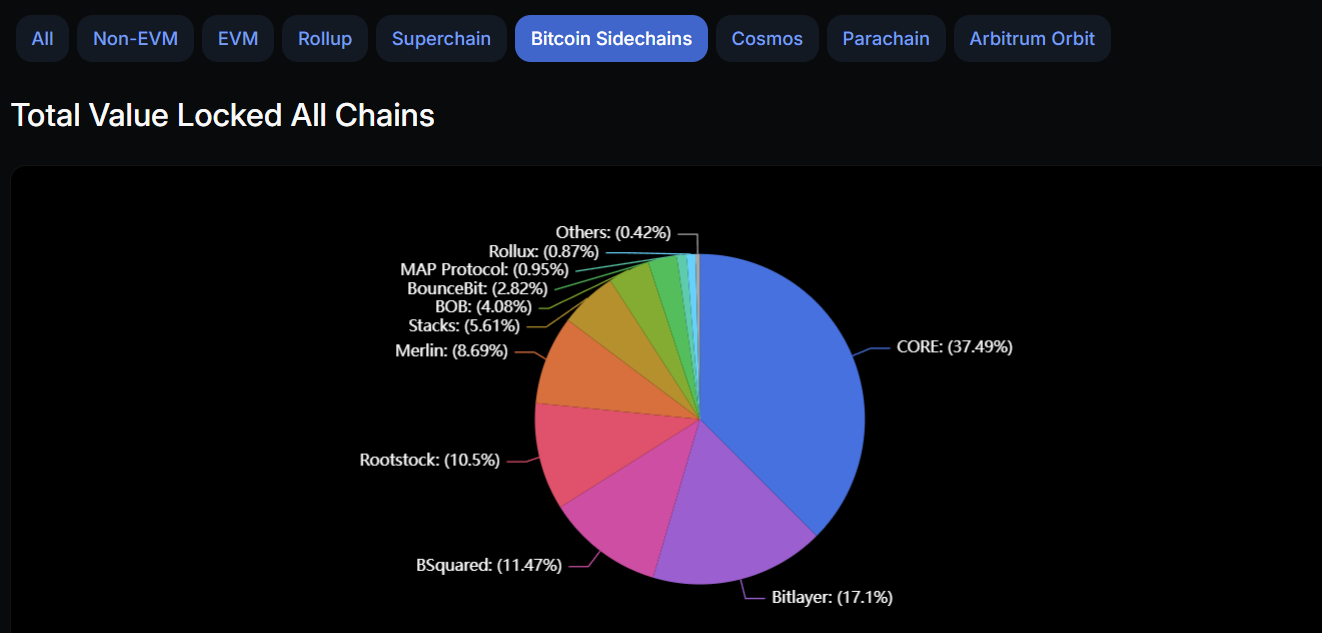
Source: DeFiLlama — Bitcoin Sidechains / Total Value Locked All Chains
Based on DeFiLlama data from November 5, 2024, we observe that among sidechain projects, CORE, Bitlayer, BSquared, and Rootsock currently dominate TVL, collectively accounting for 76.56%. When comparing BTCFi to similarly structured yield-generating ecosystems like ETHFi, we see emerging parallel characteristics:
BTCFi’s native-token Buff yield comes from: Babylon + LRT rewards + BTC layer expansion chain rewards + a basket of LRT yields on ETH chains (e.g., Pendle and Swell);
ETHFi’s native-token Buff yield comes from: POS staking interest + restaking rewards + LRT rewards + ETH layer expansion chain rewards.
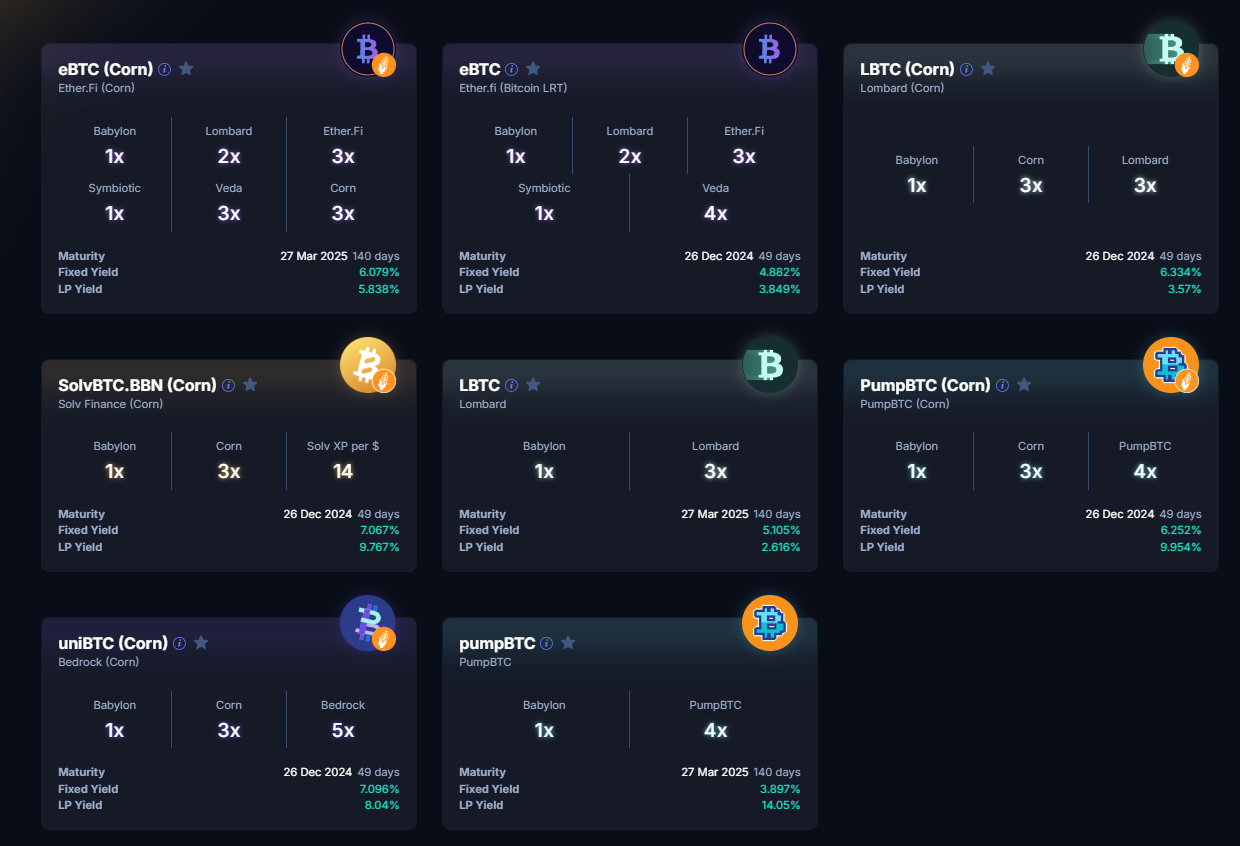
Source: Pendle / BTC Bonanza
2.1 State Channels
State channels are a scaling solution allowing multiple off-chain transactions between users, with only the opening and closing states submitted to the mainnet. In Bitcoin, examples include the Lightning Network and Ark. Users deposit BTC into a multisig address and conduct daily transactions through the channel, finalizing settlement via mainnet consensus to ensure security.
2.2 Sidechains and Rollups
From a market-driven perspective aiming for fast transactions, Turing completeness, and interoperability, sidechains and rollups are better suited for Bitcoin’s ecosystem growth. Both offer strong independence. Rollups aim to move complex operations off-chain to Layer 2, while the mainnet only verifies periodic proofs submitted by Layer 2, significantly increasing throughput. This mechanism ensures Layer 2 ledger security remains aligned with the mainnet. For sidechains, however, the mainnet cannot directly validate cross-chain activities. Instead, cross-chain bridges lock mainnet assets and mint corresponding representations on the sidechain. To enhance decentralization and security, additional validation mechanisms are often introduced. Currently, both sidechains and rollups demonstrate solid performance in unlocking liquidity.
2.3 UTXO + Client-Side Validation
In terms of natively aligning with Bitcoin and maximizing security, UTXO-based solutions stand out as more “canonical.” UTXO + client-side validation is an off-chain approach leveraging Bitcoin’s unique characteristics to improve transaction efficiency and privacy while preserving Bitcoin’s security model. Since Bitcoin natively uses the UTXO (Unspent Transaction Output) model rather than an account-based one, client-side validation shifts transaction verification from the blockchain’s consensus layer to off-chain clients responsible for validating their own transactions. Specifically, users verify the validity of transfer claims locally, ensuring secure and efficient transactions. This reduces blockchain load and enhances privacy, as each client stores only data relevant to itself.
The RGB protocol exemplifies this concept, originating from Peter Todd’s 2016 proposals of “one-time seals” and “client-side validation.” RGB uses Bitcoin’s UTXOs as “seals,” binding off-chain asset state changes to Bitcoin’s UTXOs, thus enabling secure off-chain state transitions without double-spending. In doing so, RGB inherits Bitcoin’s robust security guarantees.
Despite clear advantages in efficiency and privacy, this approach has drawbacks. Clients storing only user-specific data leads to data silos, hindering the development of applications like DeFi. While UTXO + client-side validation achieves efficient and private off-chain transaction verification by inheriting Bitcoin’s security, it still faces significant room for improvement in data transparency, usability, and developer tooling maturity.
2.4 Large Blocks via Consensus Changes
Altering the existing consensus implies changing Bitcoin itself, which introduces fundamental challenges around consensus dynamics and ecosystem development. We mention it here only for completeness.
BCH (Bitcoin Cash) resulted from a hard fork at block 478558 (August 1, 2017), driven by Bitcoin’s scalability debate. Bitcoin Cash increased its block size to 8MB, while Bitcoin simultaneously decided to increase its block size from 1MB to 2MB over six months. The proposal was first championed by Chinese mining company Bitmain. Other forked tokens include BSV.
III. BTCFi Requires Better Liquidity Unlocking

Source: pixabay.com
As stated earlier, Bitcoin’s trillion-dollar market cap remains largely dormant compared to Ethereum, unable to generate yield through borrowing or lending. Storage options are limited to secure hardware wallets or trusted centralized exchanges. How can BTCFi gradually mobilize this massive capital through on-chain financialization?
3.1 Prerequisites for Development
1. Cross-Chain Interoperability
Unlike Ethereum and other smart contract platforms, Bitcoin’s architecture lacks native smart contract capabilities. BTCFi’s primary task is to develop trusted cross-chain bridges, enabling Bitcoin to participate in DeFi applications on other chains. These bridges allow Bitcoin to be “mapped” onto other blockchains, retaining its value while gaining new functionalities;
2. Layer 2 Scaling Solutions
Bitcoin’s Layer 2 solutions face greater difficulty balancing the decentralization-trilemma compared to Ethereum’s. Most inevitably sacrifice some degree of decentralization. Yet, more centralized models often generate stronger wealth effects in the short term. Project teams may need to prioritize creating compelling economic incentives to offset lower decentralization as a primary consideration;
3. Smart Contract Functionality
To support DeFi applications, Bitcoin needs some form of smart contract capability. While native smart contracts don’t exist on Bitcoin today, developers are exploring second-layer solutions (e.g., RSK, AVM, BitVM) or sidechains to bring smart contract functionality to Bitcoin. This would enable direct support for lending, liquidity provision, derivatives, and other DeFi primitives;
4. Robust Developer Tools and Infrastructure
Developers require mature tools and infrastructure to build and deploy BTCFi applications. However, the Bitcoin ecosystem appears to reject redundant, one-click chain deployment models.
3.2 Key Challenges
1. Limits of the Bitcoin Protocol
Bitcoin was designed primarily as a secure and reliable store of value, lacking the flexibility of Ethereum or other blockchains purpose-built for DeFi. Without native smart contracts, developing BTCFi applications requires overcoming inherent protocol constraints, often involving complex technical innovations;
2. Liquidity Constraints
Even when Bitcoin is bridged to Ethereum and other smart-contract-enabled chains, its liquidity in DeFi remains far below that of native tokens like ETH. Current liquidity shortages could limit BTCFi’s adoption and scalability;
3. Security and Trust Risks in Cross-Chain Bridges
Cross-chain bridges are critical to BTCFi’s development, yet they carry significant security risks. Recent years have seen frequent bridge exploits resulting in massive fund losses. Ensuring bridge security—against centralization risks or technical failures—remains a major challenge for BTCFi;
4. Oracles Struggle with Accurate Price Feeds
Due to architectural constraints, oracle services cannot be deployed on Bitcoin as easily as Chainlink on Ethereum. This makes deploying oracle systems within BTCFi more complex, potentially requiring Layer 2 or sidechain solutions. Given reliance on cross-chain bridges and price synchronization challenges, BTCFi may increasingly depend on mapping Bitcoin to other chains to achieve cross-chain price alignment. Overall, BTCFi faces greater technical and security challenges than Ethereum in ensuring oracle accuracy;
5. Can BTCFi Forge Its Own Path, Rather Than Imitating Ethereum?
Bitcoin was designed with security prioritized over functionality, and in BTCFi design, market acceptance will always favor security over features. Bitcoin’s global adoption centers on value storage and payments, suggesting BTCFi might focus on financial products tied to those functions. The PayFi concept applies not only to Solana but even more so to Bitcoin.
References:
Join TechFlow official community to stay tuned
Telegram:https://t.me/TechFlowDaily
X (Twitter):https://x.com/TechFlowPost
X (Twitter) EN:https://x.com/BlockFlow_News
 @YBBCapital


