Bitcoin's Fort Knox moment
TechFlow Selected TechFlow Selected
Bitcoin's Fort Knox moment
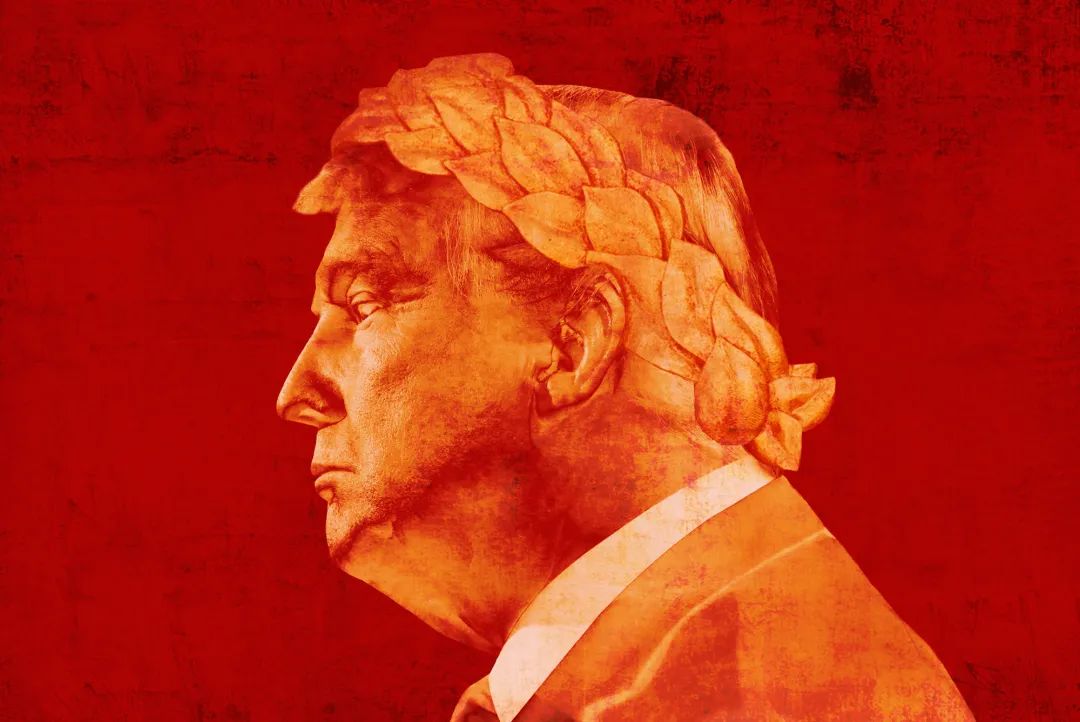
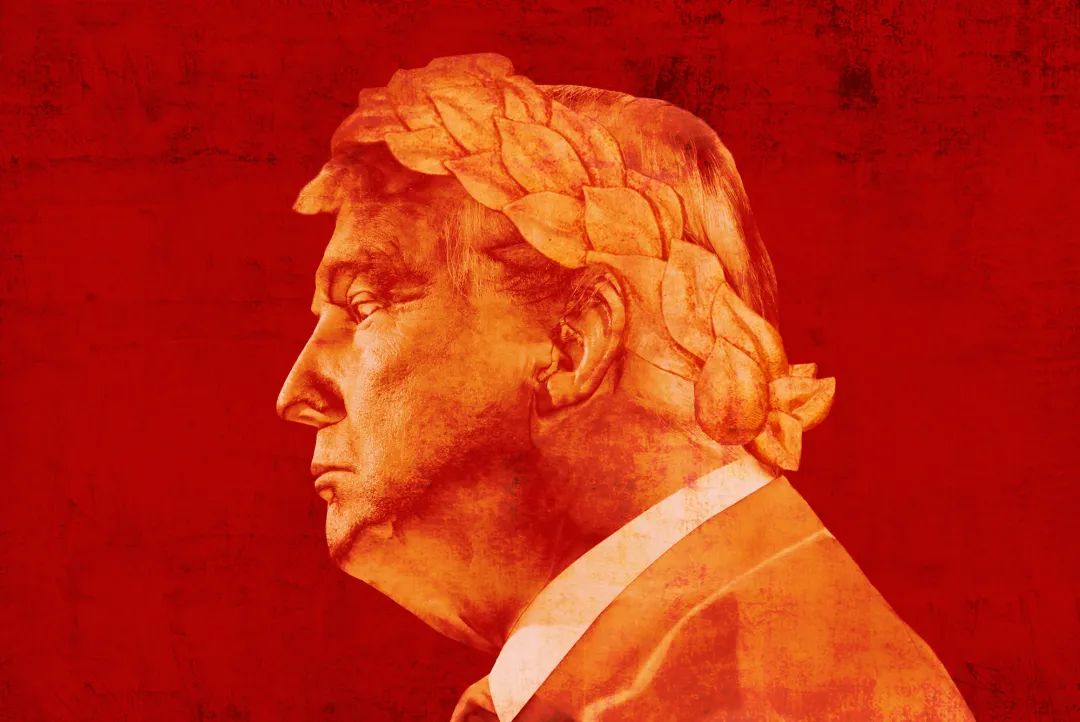
After today, Trump will become the most powerful president since Franklin D. Roosevelt.
 Navigating Web3 tides with focused insights
Author: Zuo Ye
I've been so focused on the U.S. election recently that I haven't had the mental space to update. Now that the outcome is clear, here comes a comprehensive piece.
From today onward, Trump will become the most powerful president since Franklin D. Roosevelt. It was during FDR's presidency that Fort Knox became America’s strategic gold reserve, and now Trump has declared his intention to make Bitcoin part of America’s federal reserves.
In this U.S. election, Trump won the popular vote over Harris. As long as electors remain loyal to their voters' will, he has already secured more than half of the 538 electoral votes. Unless something unexpected happens, on January 6, 2025, President Trump can return to the White House he remains fiercely loyal to.
Moreover, Republicans have already captured 51 seats in the Senate, while the House of Representatives is expected to reach near parity between the two parties. Even if Republicans fail to gain full control, the gap between both sides will be within single digits. Crucially, thanks to Trump’s multiple Supreme Court appointments during his first term, the current conservative-to-liberal justice ratio stands at a stable 6:3—something even surpassing FDR, who never fully controlled the Court.

The last time someone achieved non-consecutive presidential victories was 132 years ago under Grover Cleveland. As of November 5, Wikipedia pages will need editing—Trump has now secured his place as the second president in history to accomplish this feat.
Looking back at Rome’s development, the Republican Party has effectively become Trump’s party. With full control of all three branches for the first time, Trump holds a power base unprecedented among modern U.S. presidents. The last time such consolidation occurred, FDR laid the foundation for the dollar-gold alliance, which lasted until the collapse of Bretton Woods. Could Bitcoin now initiate its own historic transformation?
The Institutionalization of Web3 Begins
In major Eastern powers, “the system” implies stability. But to figures like Trump and Musk in Western nations, "System" and "Deep State" represent decaying interest groups—forces that must be dismantled. That’s why Musk personally stepped into politics, aiming to lead the Department of Government Efficiency (D.O.G.E.), introducing new energy and disruption beyond existing political correction mechanisms.
This isn’t a novel idea. The creation of the FBI, the IRS, and later the CIA—all emerged when established systems could no longer sustain themselves. Believing cryptocurrency or Bitcoin alone will transform America would be naive. What matters is understanding how the dollar and gold were “Americanized,” i.e., institutionalized—how rebellious new forces are absorbed into the existing order of governance.
The End of Free Dollars
Dollar issuance went through roughly three phases: from the Continental currency during the Revolutionary War to the founding of the Federal Reserve in 1913; the gold standard era (1879–1944); and the fiat currency age beginning in the 1970s.
During the American Revolution, the Continental Army began issuing dollars—essentially war bonds. If you bet on the Continental Army winning, hoarding dollars made sense. Later, during the Civil War, the federal government issued massive amounts of “greenbacks,” operating under the same logic—strongly resembling war bonds. Meanwhile, the Confederacy issued cotton-backed bonds. Ultimately, industrialized northern dollars defeated plantation-based southern cotton.
Then came the Bretton Woods system aligned with WWII, where the dollar was pegged to gold and other currencies tied to the dollar—a de facto gold standard. But when Nixon ended gold convertibility, the system officially collapsed.
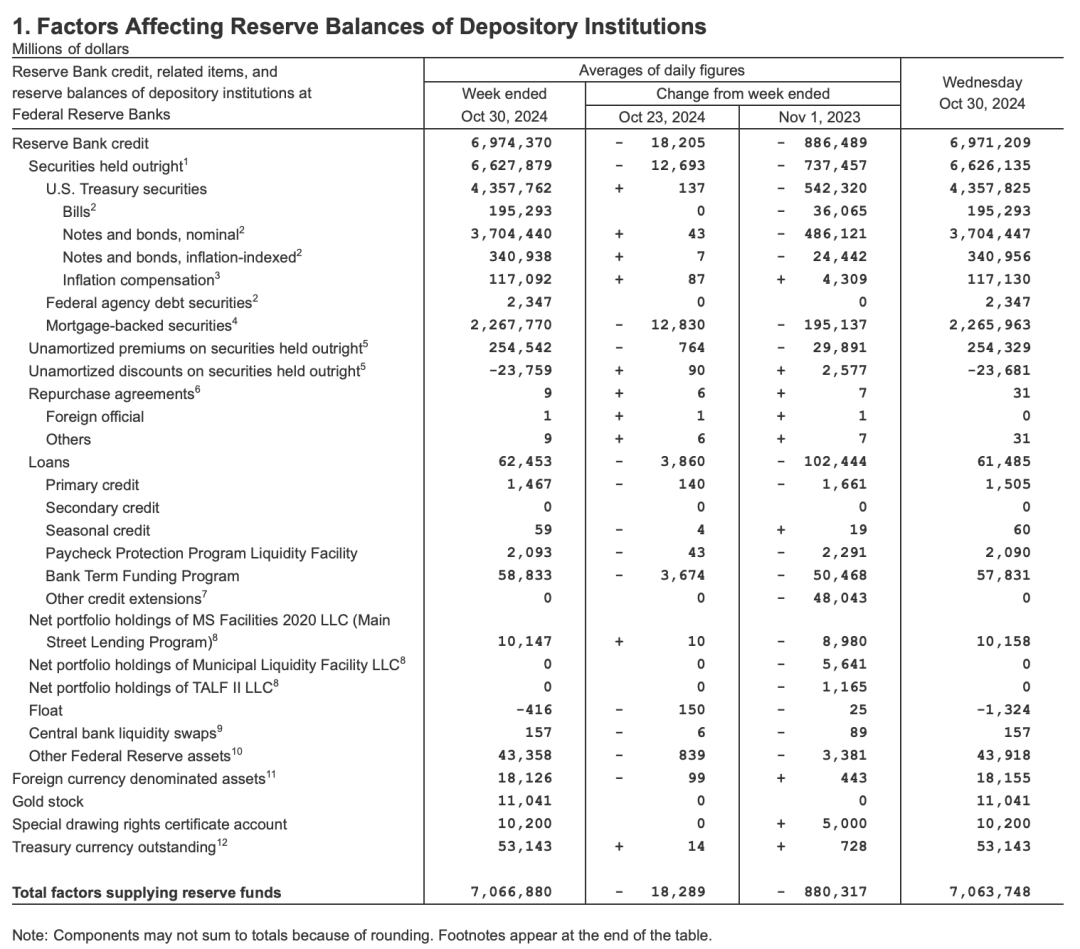
These are the familiar chapters of dollar history. Today, the dollar functions essentially as a redemption voucher for U.S. Treasury debt: the Treasury issues bonds, the Fed purchases them and uses them as reserve backing for dollar issuance. Mechanisms like Luna-UST are merely clumsy imitations.
Between the 1820s and the greenback era of the Civil War lay the Free Banking Era—an age mirroring today’s crypto boom. Thousands of banks independently issued banknotes, essentially promissory notes redeemable on demand. Even with identical face values, these notes often weren’t interchangeable across banks. At its peak, there were over 70,000 different forms of “dollars” circulating.
To some extent, this monetary chaos contributed to the outbreak of the Civil War.
Such fragmented issuance cannot persist indefinitely—just as today’s regulatory approach to crypto suggests. Without oversight, even gold could fluctuate wildly in price, sending the economy into perpetual Brownian motion.
Hence, the National Banking Act of 1863 established national banks and the Office of the Comptroller of the Currency (OCC). Notably, the U.S. government did not ban private banks from issuing notes; instead, it introduced targeted supervision and review—much like how the SEC regulates whether specific cryptocurrencies qualify as securities, without necessarily banning their issuance. The essence of American governance lies embedded in its history.
From then on, the U.S. government increasingly intervened in the dollar system. After J.P. Morgan played savior during the 1907 financial crisis, he gained enough leverage to co-design the next phase. In 1913, the Federal Reserve Act passed—the birth of the Fed—and free dollars were definitively extinguished.
After Bitcoin Comes Ashore
Zhang Hua got into Peking University, Li Ping entered a technical school, I work as a sales clerk at a department store—we all have bright futures ahead.
There are only two kinds of cryptocurrencies in the world: Bitcoin and everything else. In Trump’s view, the dollar needs a new anchor, and Bitcoin may serve better than U.S. Treasuries—perhaps not replacing gold, but standing alongside it as a foundational asset. The sole problem? Bitcoin’s market cap cannot currently absorb tens of trillions in liquidity. If each Bitcoin reaches $1 million, it might simply reflect dollar depreciation rather than Bitcoin appreciation.
Let’s do a simple math exercise: The current U.S. national debt stands at $35 trillion, with about 19.1 million Bitcoins in circulation. A basic division shows that to resolve the debt crisis, each Bitcoin would need to reach $1,832,460—meaning today’s ~$75,000 is just an appetizer, with another 24x growth required.
A more rational scenario isn’t making Bitcoin a direct reserve like gold, but using it to cover interest payments on the national debt. Annual interest is currently around $1 trillion—roughly half the total crypto market cap, or nearly equal to Bitcoin’s entire market value. However, this still requires the U.S. government to control or dominate most Bitcoin holdings. Regardless of feasibility, an illiquid asset holds little practical value.
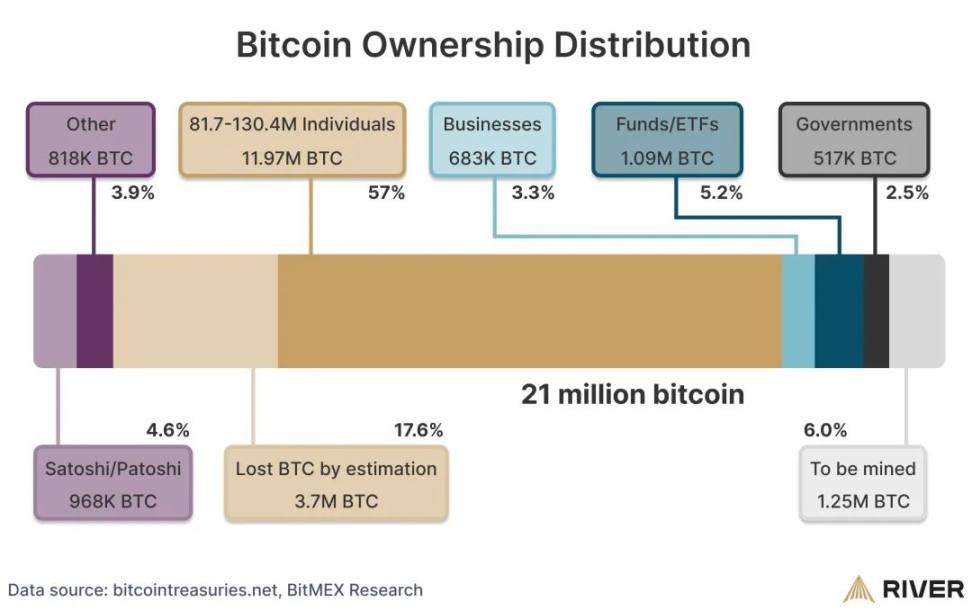
Caption: Bitcoin Distribution Chart
Source: River Capital
The U.S. government currently holds about 1% of all Bitcoin. But similar to J.P. Morgan’s influence over the Fed, most major BTC ETFs are backed by American capital. Adding their ~5.2% share, plus Satoshi Nakamoto’s passively locked ~4.6%, the U.S. government theoretically has the capacity to influence or control around 10% of Bitcoin’s price—already qualifying as a super whale.
Before 2034, approximately $10 trillion in U.S. debt interest will accrue. Considering Trump’s potential four-year term, if Bitcoin truly becomes part of dollar reserves, only about $5 trillion in interest needs addressing. This would require each Bitcoin to reach roughly $261,780—about three times the current price. Achievable? Yes—if one adopts the attitude of “after me, the deluge.”
And with it, the entire Web3 ecosystem could enter an American era. The last internet boom gave rise to Silicon Valley—what will emerge this time remains to be seen.
Join TechFlow official community to stay tuned
Telegram:https://t.me/TechFlowDaily
X (Twitter):https://x.com/TechFlowPost
X (Twitter) EN:https://x.com/BlockFlow_News
 @zuoyeweb3