








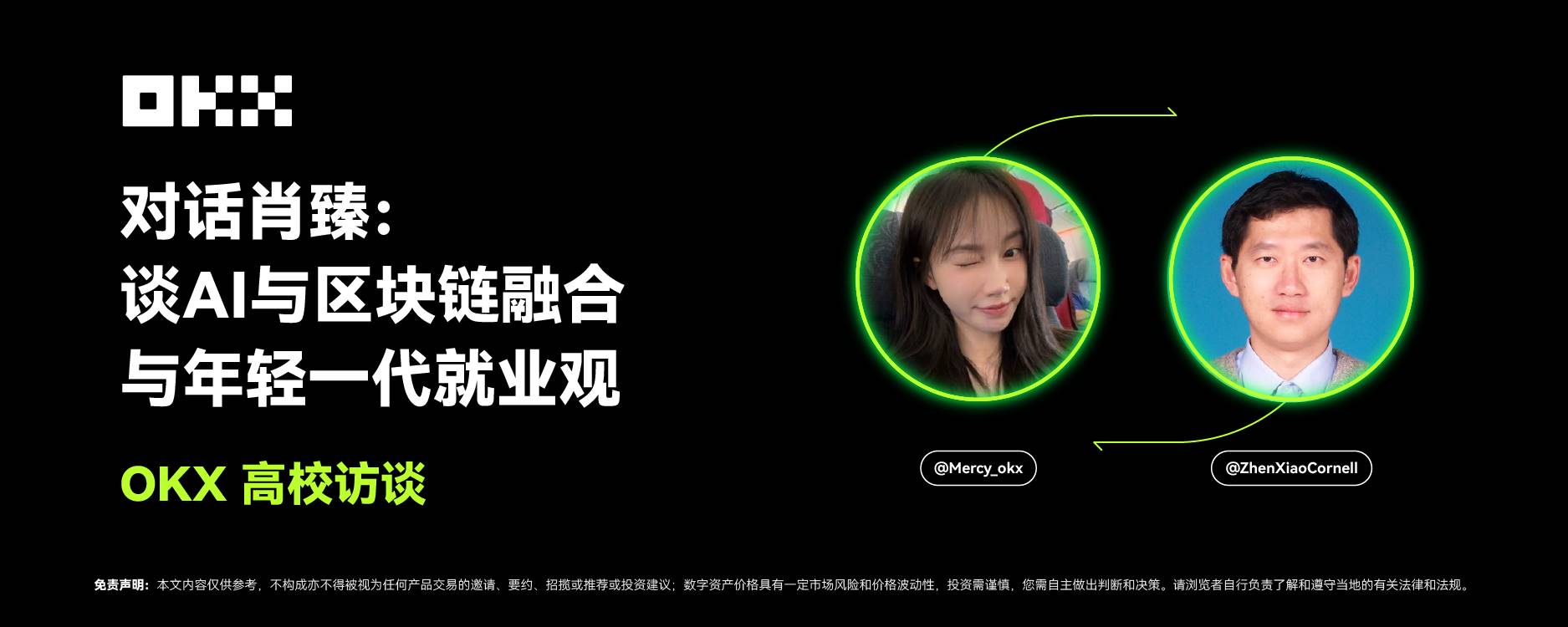
OKX University Interview | Xiao Zhen: On the Integration of AI and Blockchain, and the Employment Outlook of the Younger Generation
TechFlow Selected TechFlow Selected
OKX University Interview | Xiao Zhen: On the Integration of AI and Blockchain, and the Employment Outlook of the Younger Generation
The OKX University Interview Series aims to uncover industry insights from individuals at universities around the world, providing reference for those starting up or seeking employment in Web3.
 Navigating Web3 tides with focused insights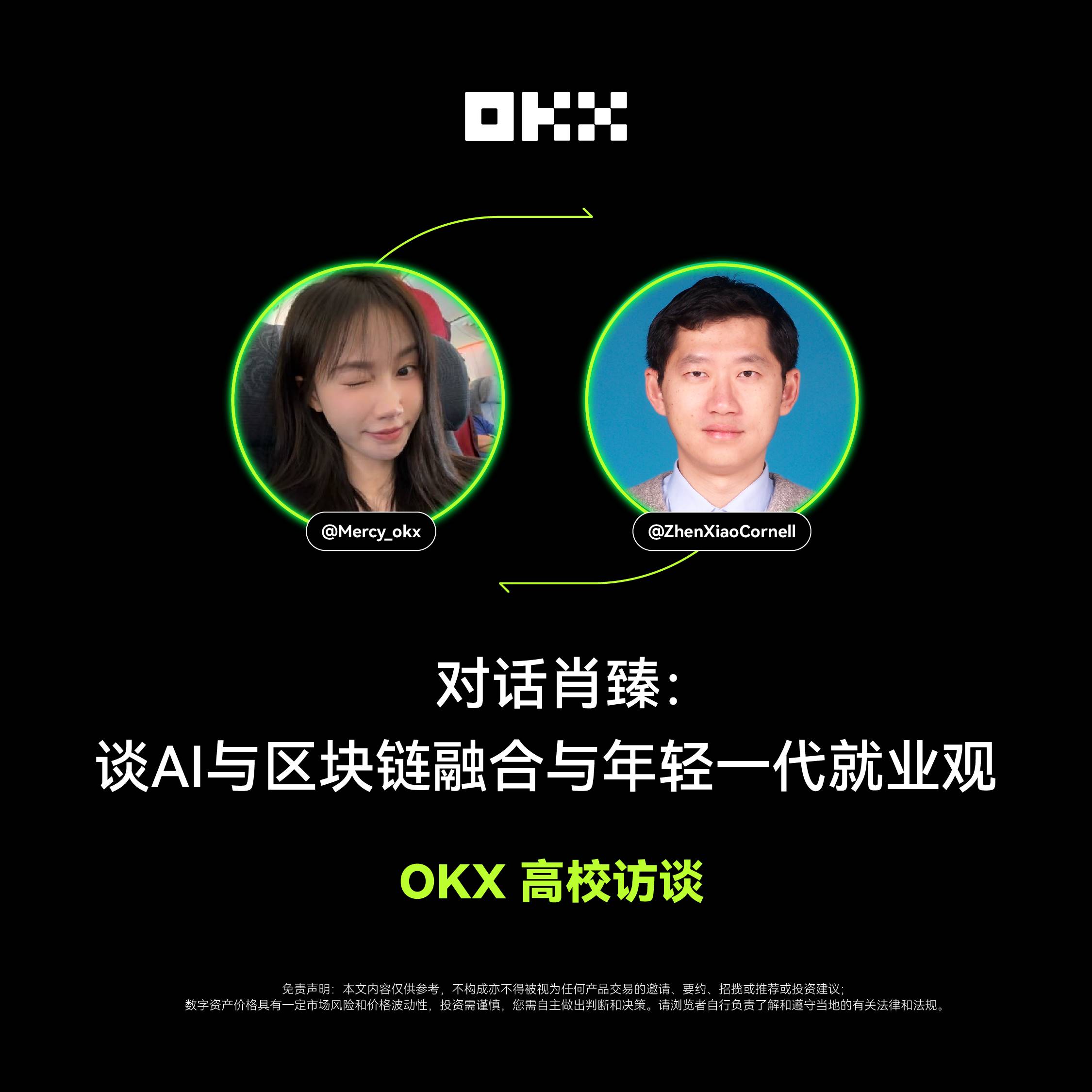
Dr. Xiao Zhen graduated from Cornell University in the United States. After graduation, he worked as a researcher at AT&T Labs (formerly Bell Labs) and IBM T.J. Watson Research Center, where he received the "Excellence in Research Award" during his tenure at AT&T. In 2008, Dr. Xiao returned to Peking University under the "Hundred Talents Program" to serve as a researcher and doctoral supervisor. His public lecture series on blockchain technology and applications has garnered over 1.4 million views on Bilibili.
The OKX University Interviews series aims to explore perspectives on Web3 industry development through dialogues with academics and provide guidance for students entering Web3-related careers or entrepreneurship. This episode features Professor Xiao Zhen as our guest speaker—his insights may offer valuable inspiration.
OKX University Interviews is a special column produced by OKX and hosted by Mercy (@Mercy_okx), an official community ambassador of OKX. The series highlights global academic viewpoints on the industry, offering practical references for those pursuing careers or startups in Web3.
1. You conducted in-depth research into foundational blockchain technologies such as Ethereum around 2018. Over the past few years, the Web3 and blockchain industries have gone through multiple developmental phases. What significant changes do you see in terms of technological evolution, industry ecosystem, and talent?
Our research group's traditional focus lies in distributed systems, with prior work mainly centered on optimizing network layers and consensus protocols. In recent years, blockchain performance has improved significantly, giving rise to various Layer 2 solutions. Technologies like Optimistic Rollup and ZK Rollup greatly enhance network efficiency by executing most transactions off the main chain while maintaining a high degree of decentralization and security. Of course, there are debates regarding the level of decentralization achieved by some Layer 2 solutions. A landmark event in recent years was Ethereum’s upgrade, particularly its transition from PoW to PoS, which drastically reduced energy consumption—aligning well with today’s global emphasis on green and sustainable development.
From an industry ecosystem perspective, DeFi, Metaverse, and NFTs have all experienced explosive growth. Peking University has even established a dedicated Metaverse Technology Institute, where I serve as deputy director, focusing on integrating AI with blockchain technologies. Beyond mainstream blockchain applications, emerging projects like Theta Network have brought important innovations to the blockchain ecosystem. Theta Network is a blockchain project focused on decentralized video streaming that leverages blockchain and cryptographic economic models to address bandwidth bottlenecks, high costs, and centralization issues inherent in traditional video delivery. Unlike conventional platforms such as YouTube or Twitch, Theta Network utilizes users’ idle bandwidth and computing resources globally for decentralized content distribution, thereby reducing CDN costs.
From a talent development standpoint, many traditional software developers and Web 2.0 engineers have transitioned into Web3, bringing rich engineering experience that has driven professionalization and diversification in blockchain application development.
2. In your teaching, you interact with students from diverse backgrounds. How would you compare today’s youth understanding of blockchain technology to that of several years ago?
A few years ago, blockchain-knowledgeable students were still a niche group. It wasn't until the 2017 cryptocurrency bull run that broader interest in Bitcoin and blockchain emerged. At Peking University, I teach two courses: Blockchain Technology and Applications and Introduction to Metaverse Technology. Most students enrolling in my classes come from science and engineering backgrounds, showing strong interest in technical aspects such as blockchain principles, consensus mechanisms, and Web3 application development. Course assignments include implementing cryptographic operations and consensus protocols using Go language, as well as smart contract programming with Solidity.
Meanwhile, students from humanities disciplines tend to focus more on blockchain applications, financial attributes, and societal impacts—such as decentralized governance, privacy protection, and digital sovereignty—topics that carry transformative social implications. The interdisciplinary integration and community-driven practices surrounding blockchain also foster openness and collaboration among students, indicating deeper future applications across various domains. With the recent surge in AI, I’ve incorporated topics like chatbots and AIGC into my curriculum, along with discussions on legal and ethical concerns. One feature of my lectures is linking theory with real-world practice—I dedicate part of the course to explaining crypto scams to help students avoid being deceived in the future.
Overall, young people today exhibit a more diversified understanding of blockchain and Web3. However, it remains a relatively niche field; student enrollment is still lower compared to courses in AI or algorithms.
3. What opportunities and challenges do you see for students seeking entrepreneurship or employment in blockchain or Web3 fields?
The blockchain and Web3 sectors are currently undergoing rapid development, with more opportunities available overseas than in China. Proficiency in programming languages such as Solidity and Go is fundamental for entering blockchain development, alongside familiarity with tools like Remix and Truffle, and mastery of testing and deploying smart contracts. Due to policy constraints, domestic efforts in China are primarily concentrated on consortium chains. My research group collaborates with leading Chinese consortium chains such as ChainMaker, SparkLink, and AntChain. To improve system throughput and user experience on consortium chains, we conducted an in-depth analysis of existing consensus algorithms. Our findings revealed that traditional approaches optimizing only the consensus protocol overlook the impact of data dissemination on overall throughput, shifting the performance bottleneck from the consensus layer to the network layer.
To address this, we proposed a novel data flow framework composed of Predis and Multizone. This allows consensus nodes to leverage their idle bandwidth for parallel pre-distribution of block content, enabling confirmation of more transactions within a single consensus round. Additionally, compression based on block construction rules helps reduce transmission latency. The Multizone strategy further divides the network into multiple zones, combining multicast trees with erasure coding to minimize bandwidth peaks and propagation delays during data distribution. Our collaborative成果 with AntChain has been successfully applied in business scenarios at Ant Group, demonstrating significant improvements and earning recognition as an “Outstanding Applied Project” under the CCF-Ant Research Fund.
Students should also seek opportunities to gain hands-on experience with public chain projects abroad. Our collaboration with Theta Blockchain provides students with deep insights into core technologies of public chains—including operational principles, consensus mechanisms, and transmission protocols—and serves as solid preparation for future international careers or entrepreneurial ventures. A key distinction between public and consortium chains lies in incentive mechanisms; designing effective tokenomic models requires a thorough grasp of cryptoeconomics. Successful blockchain projects often demand interdisciplinary expertise—combining computer science, finance, law—and require strong product thinking to meet diverse market needs and deliver innovative user-centric applications. One crucial point: regardless of location, anyone working in blockchain must strictly comply with local laws and regulations. Products with financial characteristics face strict oversight in many jurisdictions. Avoid getting caught up in speculation or chasing short-term profits; instead, focus on building impactful, meaningful projects.
4. What key factors should students prioritize when choosing Web3-related entrepreneurship or employment paths?
I believe the first consideration should be whether the target market is domestic or international. There are major differences between mainland China and overseas environments for Web3 entrepreneurship and employment. Mainland China maintains strict regulation over cryptocurrencies and blockchain, explicitly banning cryptocurrency trading. Therefore, Web3 startups within China cannot rely on token issuance or ICOs for fundraising or revenue generation. Products such as DeFi and NFTs are also heavily regulated—for example, NFTs in China are not allowed to have secondary markets. This makes fundraising more difficult, as venture capital firms remain cautious about investing in Web3 startups. China supports non-financial blockchain applications—a model known as “separating tokens from chains.” Domestic blockchain companies mostly focus on consortium chains and lead globally in areas such as supply chain finance, food traceability, judicial evidence storage, and data security. While China has a large pool of high-quality internet and Web 2.0 talent, the number of Web 3.0 companies is relatively small, mostly oriented toward technical development and底层protocol research. As a result, job opportunities in blockchain remain limited, with many domestic blockchain firms relying on government-funded projects for primary revenue.
In contrast, certain countries overseas—such as Singapore—adopt relatively relaxed regulatory policies toward Web3, offering transparent and stable legal frameworks that allow startups to operate within predictable compliance boundaries at lower cost, facilitating faster progress in fundraising and market expansion. Notably, U.S. regulations have become increasingly stringent, making token offerings like ICOs far less accessible than they were six years ago. Nonetheless, Silicon Valley maintains a vibrant funding environment, supported by mature venture capital networks and incubators that show strong acceptance of Web3. Many VC firms are actively investing in the space, allowing startups to secure funding relatively easily.
5. Web3 and artificial intelligence (AI) are two dominant technological trends today. How do you view their convergence and synergies?
An excellent question! My research group is actively engaged in both blockchain and AI domains. Over the past few years, our joint research with Theta Labs in the U.S. has led to a series of papers presented at top academic conferences, applying AI techniques to blockchain and distributed systems. For instance, our early 2024 paper on blockchain sharding used deep reinforcement learning to significantly reduce cross-shard transaction ratios while maintaining load balance, dramatically improving blockchain system performance. We've also co-developed a set of AIGC demos with Theta Labs, such as "sketch to 3D," which converts hand-drawn sketches into high-quality 3D models within seconds—holding great potential in film, gaming, and precision manufacturing. Moreover, we innovatively proposed a method to enhance the robustness of computer vision models, which holds significant value for building metaverse and virtual reality systems.
In summary, the integration of Web3 and artificial intelligence (AI) holds immense promise. Web3 aims to build a decentralized internet ecosystem, empowering users with greater ownership and control over their data, while AI enhances Web3 applications through intelligent data processing and analytics, enabling more precise interactions and experiences. The two fields can complement each other in data handling, decentralized services, and privacy protection, unlocking new functionalities and application possibilities. Through smart contracts and blockchain technology, developers can create decentralized AI model markets, making model training and usage more transparent and traceable. Trained AI models can be distributed across decentralized networks, eliminating reliance on centralized platforms and fostering fair competition. Web3’s decentralized data storage and privacy-preserving capabilities help overcome AI’s vulnerabilities in data security. By leveraging decentralized storage, users retain control over how their data is stored and used, enabling AI algorithms to access training data without compromising privacy.
Risk Warning and Disclaimer
This article is for informational purposes only. The views expressed herein are solely those of the author and do not reflect the positions of OKX. This article does not constitute (i) investment advice or recommendations; (ii) an offer or solicitation to buy, sell, or hold digital assets; or (iii) financial, accounting, legal, or tax advice. We make no guarantees regarding the accuracy, completeness, or usefulness of the information provided. Holding digital assets—including stablecoins and NFTs—carries high risk and values may fluctuate significantly. You should carefully consider whether trading or holding digital assets is suitable for you based on your financial situation. For specific advice related to your circumstances, please consult your legal/tax/investment professionals. You are responsible for understanding and complying with applicable local laws and regulations.
Join TechFlow official community to stay tuned
Telegram:https://t.me/TechFlowDaily
X (Twitter):https://x.com/TechFlowPost
X (Twitter) EN:https://x.com/BlockFlow_News
 OKX
OKX






