The ETH/BTC exchange rate has been steadily declining, and perhaps the most important thing has been overlooked
TechFlow Selected TechFlow Selected
The ETH/BTC exchange rate has been steadily declining, and perhaps the most important thing has been overlooked
The regret of this market cycle.
 Navigating Web3 tides with focused insights
Author: Mu Mu
Since this market cycle began, Bitcoin has surged ahead, making Ethereum and some older "value projects" appear increasingly weak. The ETH/BTC ratio has hit rock bottom, becoming the single greatest source of frustration for seasoned crypto enthusiasts. They've survived both bull and bear markets, yet remain deeply unsettled by Ethereum's persistent underperformance—community dissatisfaction with ETH may have reached its peak.

Meme images criticizing Ethereum are now widespread across the crypto community.
Has Ethereum Lost Its Original Vision?
While ETH and BTC follow different paths with little direct conflict, most who held ETH throughout the bear market did so with the expectation that ETH would outperform BTC—i.e., that the ETH/BTC ratio would rise. Based on pre-bear market history, ETH typically did outperform BTC.
Similar to how many in the Ethereum community hope ETH will surpass BTC, Ethereum’s original vision—or differentiated strategy—was to take a path the Bitcoin community either avoided or deemed unviable: a blockchain-based smart contract application platform, actively exploring scalability solutions to enhance functionality and performance beyond just being “digital gold.”
Like other early “altcoin” projects aiming to improve upon Bitcoin, Ethereum sought a differentiated path—or even aimed to become a more successful version of Bitcoin.

Screenshot from Ethereum Foundation's earlier official website
Early crypto users may recall the grand-looking background image on the Ethereum Foundation’s website shown above, which clearly displayed the slogan: “A Platform for Blockchain Applications”—the most accurate positioning of Ethereum at the time, with an image resembling a skyscraper rising from the ground, perhaps symbolizing blockchain expansion and construction.
Now, some believe Ethereum has strayed from its original vision—especially since the shift to Proof-of-Stake (PoS). Due to stagnant price performance, critics blame the PoS transition for Ethereum’s weakness, arguing that moving from Proof-of-Work (PoW) to PoS was a massive mistake. However, the move to PoS was always part of Ethereum’s original roadmap—not a last-minute pivot—and was a deliberate choice driven by the needs of a smart contract platform requiring scalability and enhanced account model capabilities.

Recently, a prominent Bitcoin maximalist shared an inflation chart post-merge on social media, showing Ethereum’s inflation rapidly increasing over the past six months, attempting to illustrate the failure of the merge. But the rebuttal came quickly: Ethereum community members published the full picture, including a comparison with Bitcoin’s annual inflation rate (defined as the ratio of newly issued supply to circulating supply), making the reality much clearer.
Many once mocked Ethereum for having no hard cap on issuance, worried it would lead to infinite inflation. However, the current reality is that through the PoS merge and EIP-1559, Ethereum not only maintains security but also keeps inflation under control—far below Bitcoin’s current inflation rate and significantly lower than other well-known PoS public chains.
Ethereum firmly holds the second-largest position in crypto and has become the benchmark against which new public chains differentiate themselves—many projects now aim to become a “better Ethereum.” In essence, Ethereum’s core roadmap has remained consistent, with only technical refinements along the way, and its original vision has largely been realized.
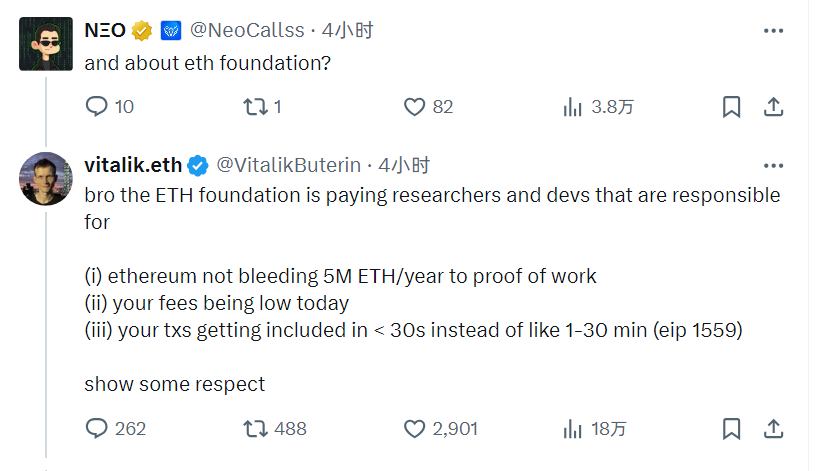
Recently, Vitalik responded on social media to concerns about the Ethereum Foundation selling off holdings, attaching nine points related to ETH fundamentals.
Vitalik said:
The Ethereum Foundation is funding researchers and developers working on:
(1) Saving 5 million ETH annually that would otherwise be lost to Proof-of-Work (PoW)
(2) Keeping your transaction fees low
(3) Getting your transactions confirmed in <30 seconds instead of 1–30 minutes (via EIP-1559)
(4) zk technology enabling privacy-preserving use of ETH
(5) Account abstraction allowing ordinary users to securely use ETH without seed phrases or centralized points of failure like SBF
(6) Local ETH events around the world, many of which rarely mention the Foundation
(7) Zero downtime due to DoS attacks or consensus failures since 2016
(8) Various security initiatives (internal development and grants) preventing significant fund losses
(9) Libraries within the codebases you use (wallets, DeFi apps…)
From another perspective, Ethereum exists and commands a market cap of over $300 billion not solely because of gas fee capture, but primarily due to its role in expanding and innovating within the crypto space, continuously absorbing value overflowed from Bitcoin. This explains why during previous bull markets (2018, 2021), the ETH/BTC ratio rose significantly—one of the key underlying reasons for Ethereum’s long-term outperformance.
In this current market cycle, despite strong fundamentals, I’ve noticed that many focus only on issues like fragmented on-chain liquidity in Ethereum’s ecosystem and competition from new L1s, while overlooking the most important factor: Ethereum’s role in absorbing Bitcoin’s value overflow.
Bitcoin’s Unresolved Challenges—An Opportunity for Ethereum?
Bitcoin is undoubtedly a “god-tier” design, but no system is perfect. Projects trying to do everything often end up overly complex and vulnerable, struggling to break through. Satoshi left behind unresolved challenges or regrets for future generations to address. One such issue is the tension between decreasing issuance and sustainable ecosystem development.
In simple terms, as Bitcoin approaches its capped supply through halvings, shrinking inflation boosts scarcity and supports price appreciation—but this same deflationary pressure reduces miner income under PoW, potentially undermining miner incentives, network security, and long-term stability.
The Bitcoin community proposes a solution: grow the Bitcoin ecosystem. When block rewards diminish after future halvings, a thriving ecosystem could compensate miners via transaction fees, sustaining their incentive to secure the network. This idea itself borrows directly from Ethereum’s approach to blockchain scalability. However, high prices, expensive fees, and low mainnet efficiency pose serious sustainability hurdles for Bitcoin’s ecosystem growth.
Bitcoin’s challenges remain front and center. The only apparent solution—keep the price going up—eventually hits limits. When capital pushes Bitcoin toward these bottlenecks, value inevitably spills over into other blockchains. Currently, the only large-cap project capable of absorbing most of Bitcoin’s spilled value is Ethereum—and no other.
Bitcoin L2 and Ethereum L2 Are Now On the Same Boat
Today, Bitcoin’s ecosystem is booming, with many teams introducing scaling solutions—especially Layer2 architectures inspired by Ethereum. In fact, Ethereum’s pioneering work in Layer2 has paved the way for Bitcoin’s own L2 scaling efforts. Some even say Ethereum is Bitcoin’s largest testnet.
Nonetheless, Bitcoin L2 still faces key challenges, such as difficulty inheriting Bitcoin’s security and slow settlement times due to Bitcoin’s inherent block timing. As a result, idle BTC looking to participate in DeFi still tends to bridge to Ethereum for greater reliability and security.
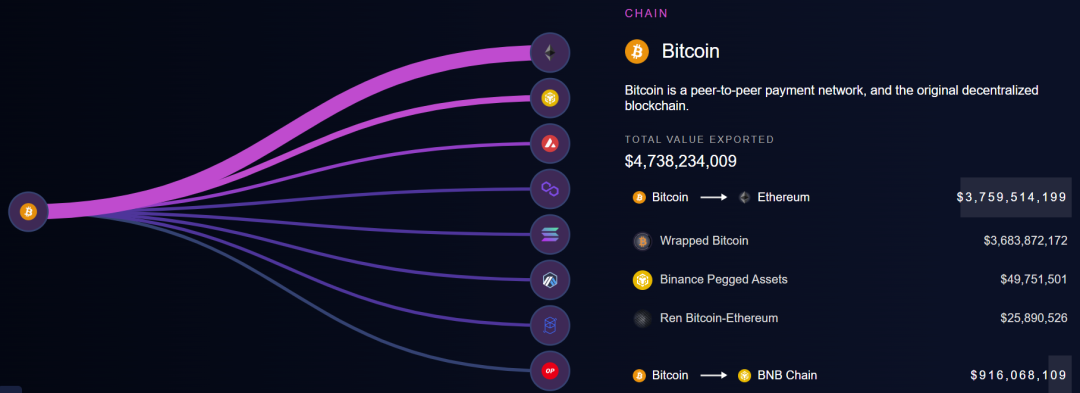
Source: CryptoFlows
Data from CryptoFlows shows that Bitcoin has transferred approximately $3.8 billion in assets to Ethereum, primarily via stablecoin bridges—and this doesn’t even include Layer2 transfers. The vast majority of cross-chain BTC flows go directly to Ethereum’s mainnet, demonstrating strong market confidence in Ethereum. As BitcoinFi continues to evolve, Ethereum’s share of incoming value is poised to grow further.
Look at it differently: In an era of multi-chain interoperability and chain abstraction where Web3 applications achieve mass adoption, seamless connectivity across the broader crypto ecosystem means Ethereum is effectively becoming Bitcoin’s largest sidechain—or a broad-sense Layer2. The best DeFi protocols on Ethereum are already helping activate dormant Bitcoin capital.
Whether through shared scaling solutions or cross-chain capital flows, Bitcoin and Ethereum appear increasingly intertwined in their future trajectories.
Conclusion
As things stand, Ethereum hasn't abandoned its original vision—it has delivered on what it set out to achieve. What’s changed are the holders, whose attention has wandered amid short-term temptations. Amid macro liquidity droughts, shrinking narratives make chasing memes understandable (when times are tough, people gather at the village gate gambling for luck). But the upcoming global rate-cutting cycle will gradually release liquidity, potentially shifting the landscape. Don’t forget: adoption of crypto assets and the real-world impact of Web3 applications will ultimately return to center stage.
As the top two crypto assets, Bitcoin and Ethereum are increasingly interdependent—not adversaries, not black-and-white. The crypto community, regardless of allegiance, should stop internal infighting and self-sabotage, and instead unite toward the common goal of driving mass adoption for the next-generation internet. Hopefully, Ethereum won’t disappoint us moving forward.
Join TechFlow official community to stay tuned
Telegram:https://t.me/TechFlowDaily
X (Twitter):https://x.com/TechFlowPost
X (Twitter) EN:https://x.com/BlockFlow_News
 白话区块链
白话区块链