What is The Surge: The Next Phase of the Ethereum 2.0 Upgrade?
TechFlow Selected TechFlow Selected
What is The Surge: The Next Phase of the Ethereum 2.0 Upgrade?
Ethereum's The Surge upgrade will significantly enhance scalability—enabling over 100,000 transactions per second—through Layer 2 rollups and improvements in data availability, while maintaining decentralization and security.
 Navigating Web3 tides with focused insights
Author: Kucoin
Translation: Baihua Blockchain
Explore Ethereum's next major upgrade—The Surge—focused on achieving over 100,000 transactions per second (TPS) through Layer 2 rollup solutions and enhanced data availability. Dive into how this phase boosts scalability, reduces gas fees, and maintains decentralization, laying a secure and efficient foundation for the future of blockchain.
Ethereum continues to evolve, with its next significant milestone being The Surge. This phase aims to enhance scalability without compromising decentralization or security. As part of Ethereum’s long-term vision, The Surge will scale network throughput across Layer 1 and Layer 2 to exceed 100,000 TPS. This article explains in detail the next steps in Ethereum’s journey toward becoming the most scalable and efficient blockchain.
1. What is The Surge?
The Surge refers to Ethereum’s shift toward improved scalability, primarily achieved through Layer 2 (L2) solutions and rollups. Coined by Ethereum founder Vitalik Buterin as part of the Ethereum roadmap, this concept aims to make the network faster and more efficient. Its primary goal is to process more transactions while preserving decentralization, security, and interoperability.
Currently, Ethereum handles approximately 15 to 30 transactions per second at the base layer. While sufficient for many applications, during peak times this leads to network congestion and elevated gas fees. The Surge is designed to resolve these bottlenecks and expand Ethereum’s capacity to serve global-scale applications.
1) Key Features of The Surge
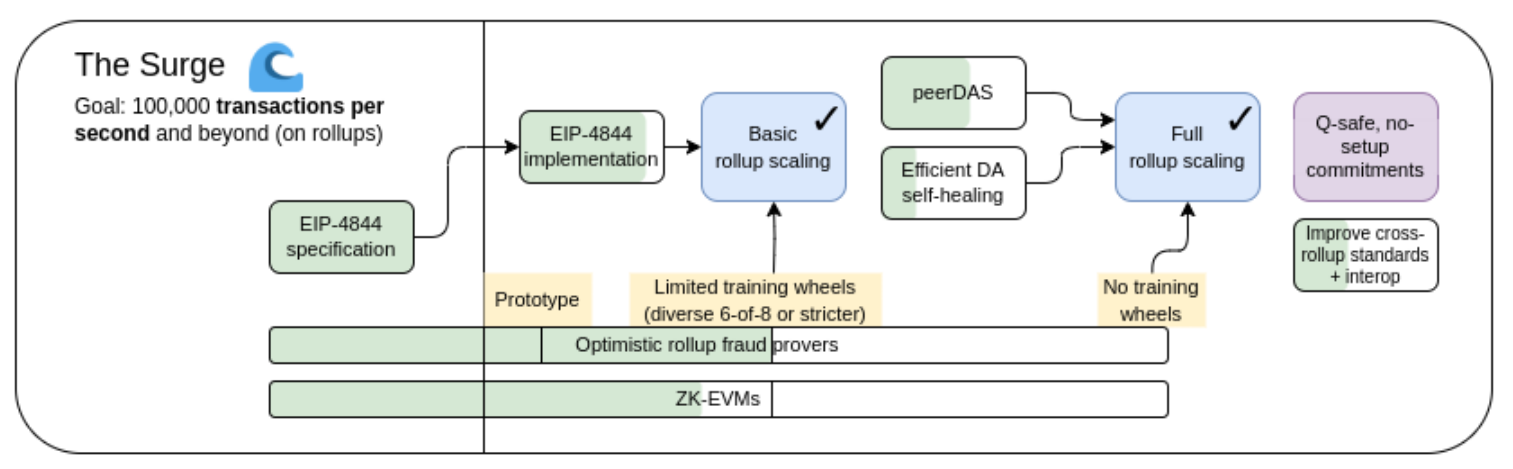
The Surge Roadmap | Source: Vitalik Buterin
-
100,000+ TPS across L1 and L2 networks: By leveraging Layer 2 rollup solutions, Ethereum aims to process over 100,000 transactions per second. Rollups bundle multiple transactions off-chain and submit summaries to the Ethereum blockchain, increasing throughput and reducing gas costs.
-
Decentralization and Security: The Surge ensures Ethereum remains decentralized, allowing users to run nodes with minimal hardware requirements. Advanced cryptographic proofs like SNARKs further strengthen Ethereum’s trustless architecture.
-
Improved Data Availability via Data Availability Sampling (DAS): DAS enables nodes to verify information without downloading all data, improving efficiency and supporting the scaling of Layer 2 solutions.
2) Ethereum’s Path to 100,000 Transactions Per Second
Currently, Ethereum’s Layer 1 processes around 15–30 TPS. However, with rollups and DAS, the network is projected to surpass 100,000 TPS. Vitalik Buterin emphasizes that Ethereum should be viewed as a unified ecosystem rather than a collection of isolated blockchains.
This means cross-L2 interoperability will improve, leading to a smoother user experience. The Ethereum roadmap focuses on building a network where moving assets between layers feels as seamless as sending ETH between wallets.
2. The Surge Timeline
The Surge consists of multiple phases focused on continuous upgrades to both Layer 1 and Layer 2. Below is the anticipated timeline based on recent updates and the official roadmap:
Q1 2024 – Dencun Upgrade (Launch of Proto-Danksharding)
Introduction of Proto-Danksharding (EIP-4844), enhancing data availability through data "blobs." This lays the groundwork for further rollup scaling. Ethereum’s Layer 2 solutions begin leveraging improved data availability for faster, cheaper transactions.
2024–2025 – Rollup Scaling and Maturity of Proof Systems
Rollups such as Arbitrum, Optimism, and zkSync will undergo updates to increase scalability. New cryptographic proofs (e.g., SNARKs) will enhance the trustlessness of rollups. Data Availability Sampling (DAS) systems like PeerDAS and 2D DAS will be expanded to support higher transaction throughput.
Late 2025 – Gas Price Optimization and L1 Enhancements
Introduction of EOF (Ethereum Object Format) to improve smart contract execution efficiency. Potential adoption of multi-dimensional gas pricing, differentiating costs for computation, data, and storage. Possible integration of rollup solutions directly into the Ethereum protocol.
2026 and Beyond – Full Rollout of Danksharding
Transition from Proto-Danksharding to full Danksharding, which will shard Ethereum into multiple parallel units, significantly boosting scalability. Ethereum aims to achieve full 100,000 TPS capability across its L1 and L2 ecosystems.
Post-2026 – Ongoing Monitoring and Upgrades
Implementation of advanced consensus mechanisms, including post-quantum cryptography, to ensure long-term network security. Continued optimization and integration of cross-L2 interoperability to enhance user experience.
This timeline reflects Ethereum’s phased approach, ensuring stability and smooth adoption throughout the transition. Each step of The Surge builds upon the previous one, ultimately aiming to create a blockchain capable of supporting global-scale applications while maintaining decentralization and security.
3. Key Components Likely Impacted by The Surge
Below are key elements within the Ethereum 2.0 roadmap expected to be affected during The Surge upgrade:
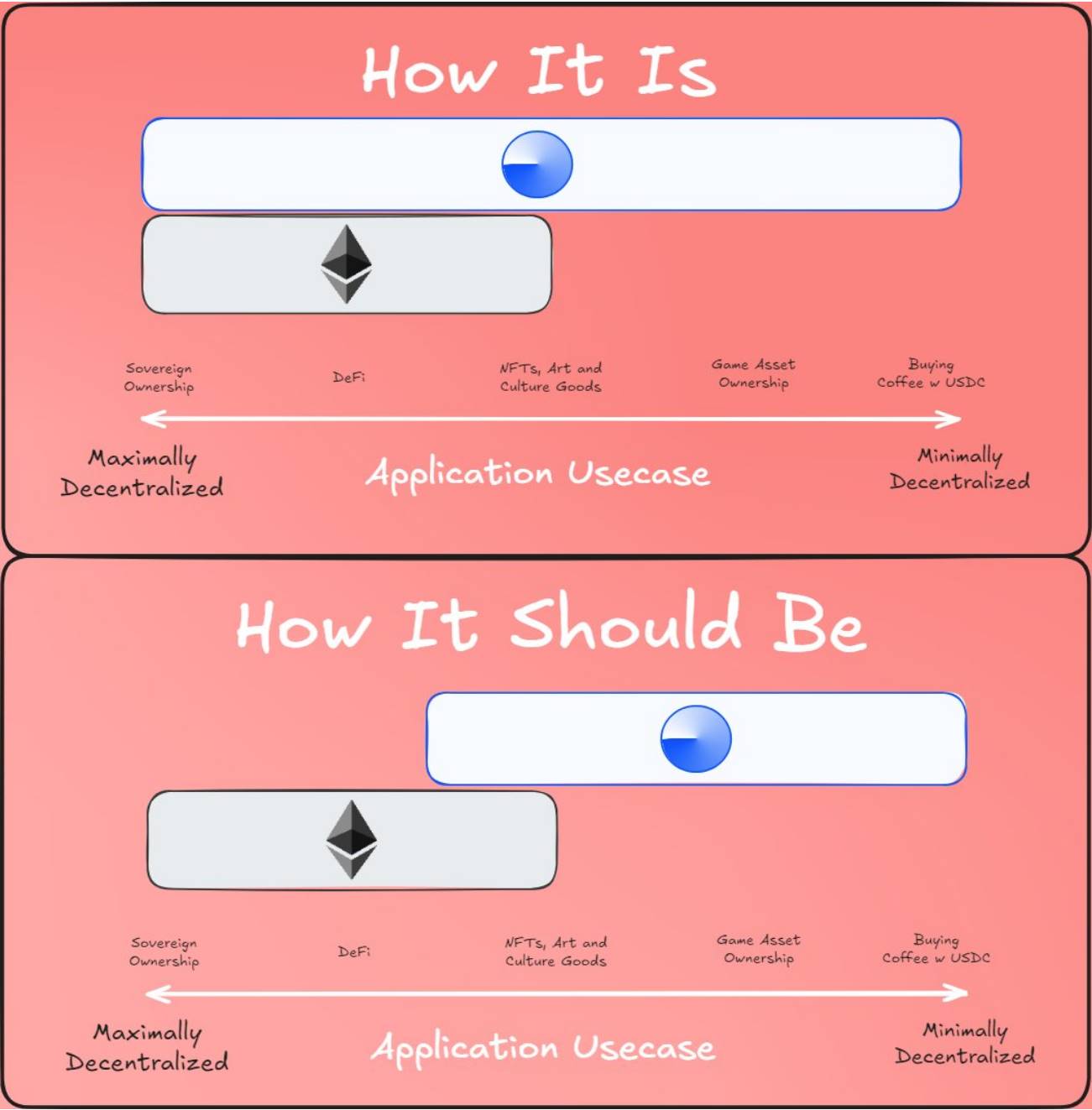
Proposed “Division of Labor” Between L1 and L2 | Source: Vitalik Buterin
1) Layer 2 Rollups: The Core of The Surge
Layer 2 rollups are essential tools for making Ethereum faster and more cost-effective. They batch multiple transactions off-chain (outside the Ethereum mainnet) and submit transaction summaries to the Ethereum blockchain. This reduces load on the mainnet, enabling faster and lower-cost transactions.
There are two main types of rollups:
-
OP-Rollups: Assume all transactions are valid unless challenged within a dispute window. This avoids immediate verification of every transaction, resulting in faster processing.
-
ZK-Rollups: Use advanced mathematics—zero-knowledge proofs—to instantly confirm transaction validity, offering immediate and secure validation.
The impact of rollups is already evident. According to L2Beat, total value locked (TVL) in Ethereum’s Layer 2 networks grew by 216% over the past year, exceeding $38 billion. As more users and projects adopt rollups, Ethereum becomes increasingly scalable and accessible, setting the stage for The Surge.
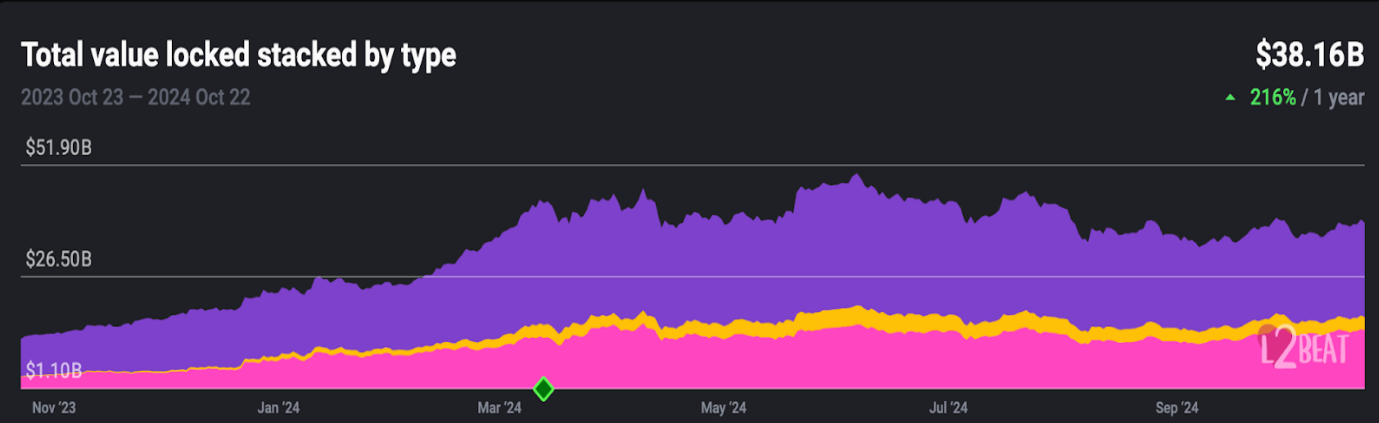
Ethereum Layer 2 TVL | Source: L2Beat
2) Data Availability Sampling (DAS)
Data Availability Sampling (DAS) is a method that helps Ethereum handle large volumes of data more efficiently. In a decentralized network like Ethereum, each node must confirm the availability of all transaction data. However, requiring every node to store all data is impractical. DAS solves this by allowing nodes to verify data without downloading or storing the entire dataset.
DAS comes in two main forms:
-
PeerDAS: Uses a peer-to-peer network to distribute verification work. Each node checks only a small portion of data, collectively confirming the full dataset. This ensures efficient validation without demanding high storage.
-
2D DAS: An improved version of PeerDAS that enhances verification efficiency. It verifies not just individual data chunks but also how they combine, enabling greater scalability and security while preserving decentralization.
With DAS, rollups can process more transactions without burdening the Ethereum network. This keeps the system fast, affordable, and decentralized, aligning with Ethereum’s goal of scaling without sacrificing security.
Plasma and Data Compression Solutions
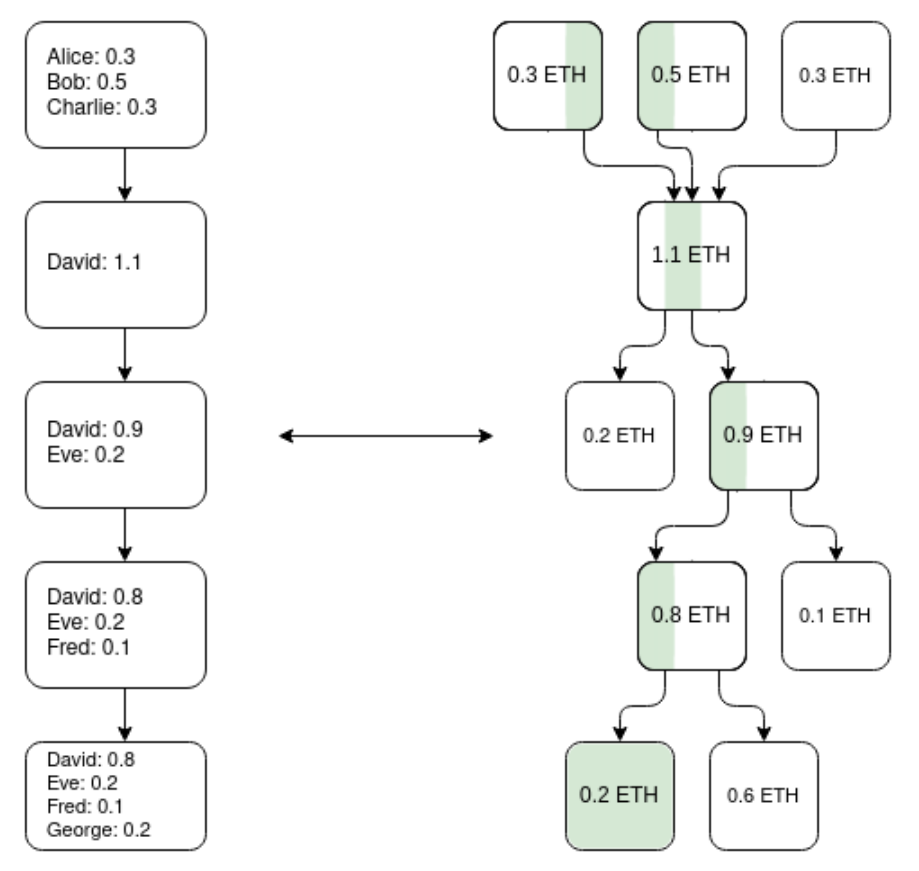
A method for constructing an EVM Plasma chain (not the only approach) involves using ZK-SNARKs to build a parallel UTXO tree reflecting balance changes generated by the EVM, defining a unique mapping of "the same coin" at different points in time. Based on this, a Plasma scheme can be constructed. Source: Vitalik Buterin
Besides rollups, Plasma and data compression technologies also contribute to Ethereum’s efficient scaling. Here’s how they work:
-
Plasma: Processes transactions off-chain, meaning outside the Ethereum mainnet. Instead of submitting every transaction to the blockchain, Plasma submits only summaries. This reduces on-chain data volume, increasing speed and lowering costs. Think of it as consolidating many small tasks into a single report, saving time and resources.
-
Data Compression: Reduces the size of transaction data. For example, Ethereum could switch from standard signatures to BLS signatures, which allow multiple signatures to be aggregated into one. This saves space on-chain and improves transaction efficiency, especially in high-volume systems like Layer 2 networks.
3) Collaboration Between Plasma and Rollups
One way to build a Plasma system is using ZK-SNARKs—a cryptographic technique—to track token movements over time. This creates a "parallel ledger" recording the flow of each token. By submitting only essential summary data to the main chain, Plasma ensures efficiency without compromising accuracy or security.
Together, Plasma and data compression further enhance the effectiveness of rollups. These solutions help Ethereum reduce gas fees, process more transactions, and support large-scale applications—all while preserving decentralization.
4. Layer 1 Improvements in The Surge
While rollups handle most off-chain transactions, Ethereum’s main blockchain (Layer 1) still requires upgrades to accommodate the growing ecosystem. These improvements will ensure the base layer remains scalable, efficient, and accessible. Key upcoming L1 enhancements include:
1) Increased Gas Limit: The gas limit determines how much data a single block can process. Raising the gas limit allows Ethereum to include more transactions per block, reducing wait times and easing congestion. However, excessive increases pose risks—higher node operation costs could reduce participation, threatening decentralization. Ethereum aims for a balanced approach: handling more transactions while keeping the network open and decentralized.
2) EVM Bytecode Improvements: The Ethereum Virtual Machine (EVM) executes smart contracts. Ethereum will introduce a new bytecode format called EOF (Ethereum Object Format) to boost execution efficiency. This update will reduce gas costs, lowering expenses for developers and users interacting with contracts.
3) Multi-Dimensional Gas Pricing: Ethereum will implement multi-dimensional gas pricing, categorizing fees by resource type—computation, data, or storage. This ensures users pay fairly based on actual usage, optimizing cost structures and improving user experience.
4) Native Rollups on Ethereum: Native rollups refer to rollup functionality built directly into the Ethereum protocol. This would enable multiple parallel instances of the EVM to run natively on Ethereum. Native rollups enhance transaction processing without overloading the network—like a train station with multiple tracks, each handling trains independently, making the whole system faster and more efficient.
These L1 improvements ensure that even as rollups absorb most transaction load, Ethereum remains scalable and efficient. Together, they help Ethereum grow as a secure, decentralized platform supporting complex applications and millions of users.
5. Impact of The Surge on Users and Developers
The Surge promises to make Ethereum more efficient and affordable, benefiting both everyday users and developers. While some technical aspects are complex, here’s a simplified view of how these changes affect you:
1) Lower Gas Fees: One of the most noticeable improvements will be reduced gas costs, especially on Layer 2 networks like Arbitrum and Optimism. These networks already offer cheaper transactions, with current ETH transfers costing about $0.24 to $0.78. After The Surge, fees may drop further, making ETH transfers and dApp interactions more affordable. Lower gas fees mean users can transact more frequently without worrying about high costs during congestion.
2) Improved dApp Performance: Developers benefit from faster transaction speeds, enabling them to build more complex and feature-rich dApps. Whether developing DeFi platforms, blockchain games, or NFT marketplaces, the enhanced scalability from The Surge will make operations smoother. Reduced latency improves user satisfaction and encourages innovation across sectors like DeFi and gaming.
3) Stronger Interoperability: The ability for different networks to work together will improve. Moving tokens and assets between Layer 2 networks and the Ethereum mainnet will become seamless. Users won’t need to rely on complex cross-chain bridges. Instead, Ethereum will feel like a unified ecosystem, where interacting with dApps or transferring funds across layers is as simple as using a single network.
These improvements make Ethereum more user- and developer-friendly, fostering an ecosystem where both ordinary users and builders can thrive. Whether sending transactions, building apps, or exploring new projects, The Surge will bring faster, cheaper, and more convenient blockchain services to the Ethereum community.
6. Security Considerations
As Ethereum scales, maintaining security becomes more complex. With widespread rollup adoption, ensuring their trustlessness and robustness is critical. Rollups rely on cryptographic proofs to validate transactions, and these proofs must remain secure against potential vulnerabilities.
Vitalik Buterin has also highlighted long-term risks from quantum computing. Ethereum developers are already exploring post-quantum cryptography to safeguard the network’s future security.
7. The Future After The Surge
After The Surge, Ethereum will continue advancing toward full Danksharding. This phase will introduce complete data sharding, further boosting scalability. Other upcoming upgrades include:
-
The Splurge: Focuses on additional improvements such as better gas pricing and transaction formats.
-
The Verge: Aims to improve consensus efficiency through stateless clients.
-
The Purge: Optimizes the network by removing unnecessary data and enhancing node performance.
Ethereum’s long-term vision is to build a blockchain capable of supporting millions of global users without sacrificing security or decentralization.
Learn more about Danksharding—the full sharding upgrade for Ethereum.
8. Conclusion
The Surge marks a pivotal step in Ethereum’s evolution into a global decentralized platform. By focusing on rollups, data availability, and Layer 1 enhancements, Ethereum aims to achieve over 100,000 TPS while preserving decentralization and security.
As these upgrades roll out, users will enjoy faster transactions and lower fees, while developers gain the tools to build more innovative dApps. However, rapid scalability brings risks. Potential challenges include vulnerabilities in Layer 2 solutions, temporary network disruptions, and fluctuating gas fees during the transition. Developers and users must stay informed and adapt as Ethereum continues to evolve.
With The Surge, Ethereum lays the foundation for a scalable, efficient, and secure blockchain future. Yet, like any major upgrade, careful monitoring and continuous adjustments will be crucial for long-term success. This is only the beginning of Ethereum’s ambitious development journey.
Join TechFlow official community to stay tuned
Telegram:https://t.me/TechFlowDaily
X (Twitter):https://x.com/TechFlowPost
X (Twitter) EN:https://x.com/BlockFlow_News
 @kucoincom