








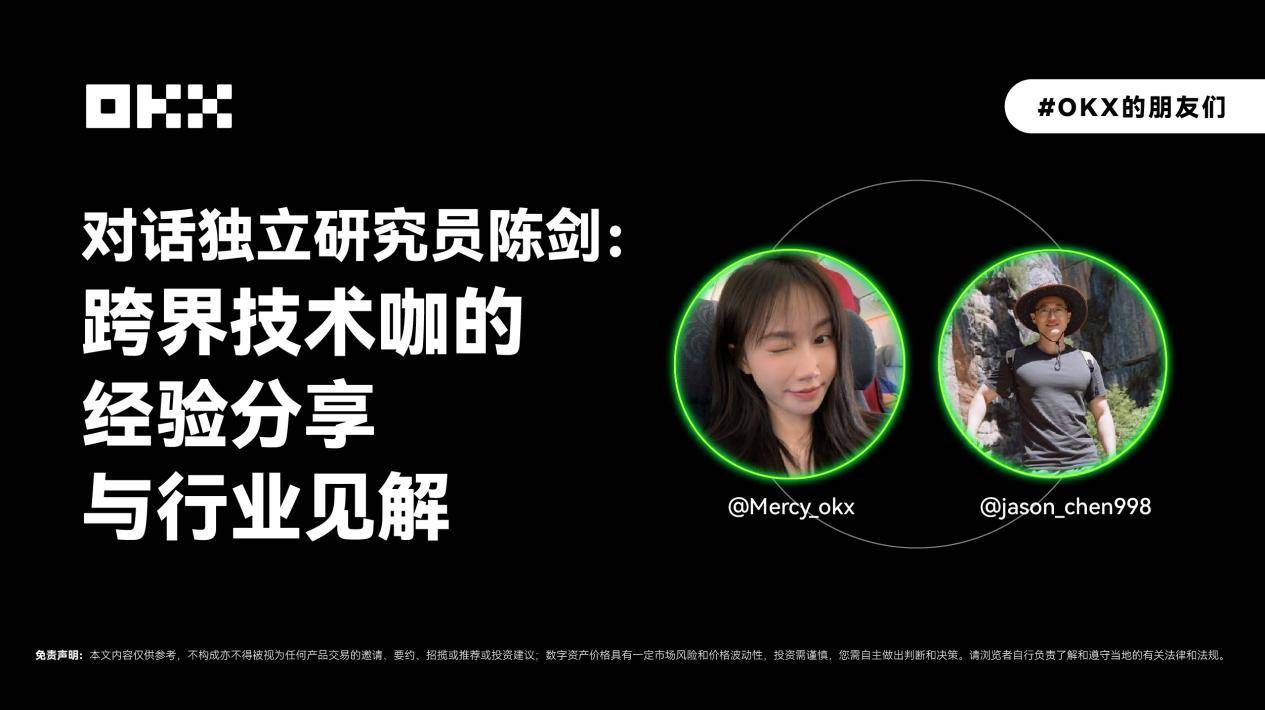
OKX Friends Episode 02 | Conversation with Independent Researcher Chen Jian: Insights and Experience from a Cross-Domain Tech Expert
TechFlow Selected TechFlow Selected
OKX Friends Episode 02 | Conversation with Independent Researcher Chen Jian: Insights and Experience from a Cross-Domain Tech Expert
The "Friends of OKX" series aims to provide novice users with insights and references by exploring the professional journeys, industry perspectives, and lessons learned from KOLs with diverse backgrounds.
 Navigating Web3 tides with focused insights
Guest Message: As a practitioner, I'm definitely bullish on Web3 in the long term. It's also rare to find another industry like Web3 that offers such significant opportunities with low entry barriers for ordinary people. OKX's investment in and leadership position within Web3 wallets demonstrates the responsibility and vision expected from a leading exchange. Personally, I find Web3 wallets extremely smooth and user-friendly—I've almost completely stopped using other swap tools.
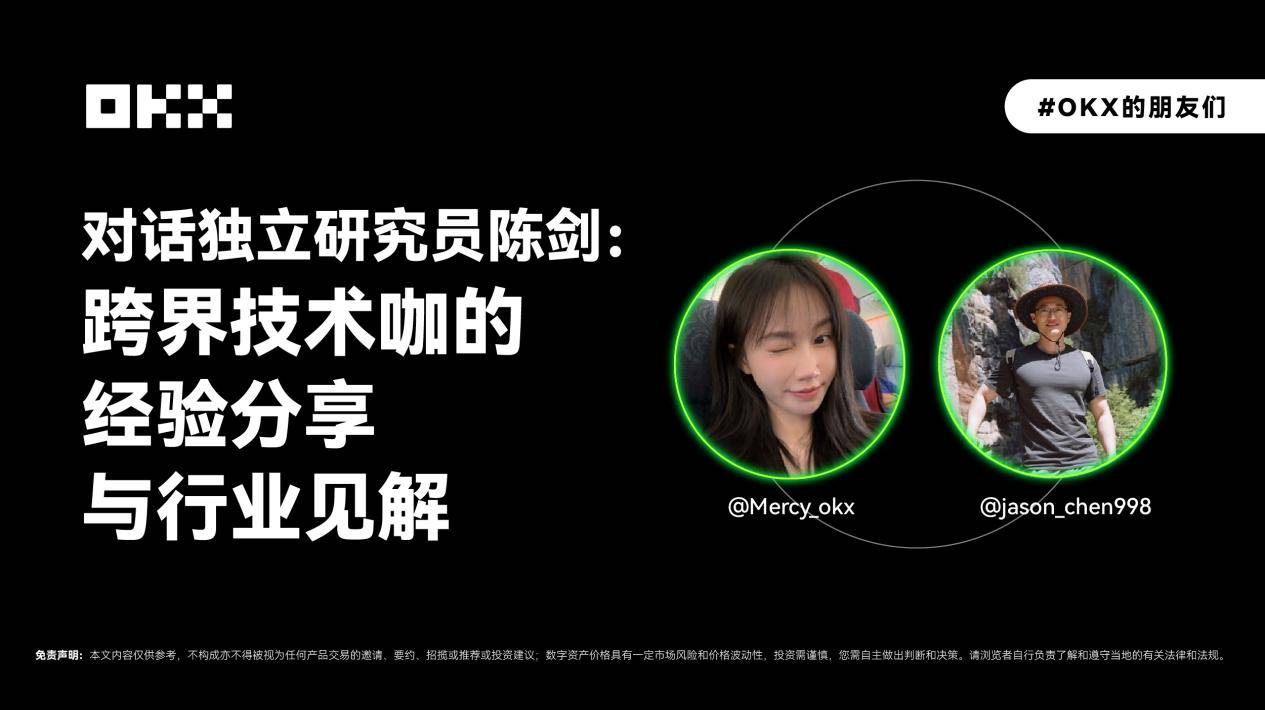
Chen Jian is an independent researcher who frequently shares insights and research about the industry and projects on Twitter. Beyond this, he personally supports early-stage projects as an advisor and investor. He first encountered blockchain technology while pursuing his graduate studies in 2017. After graduation, he joined Alibaba and re-engaged deeply with blockchain through collaboration with AntChain. Later, he participated in Sequoia Capital’s “Sequoia Scholar” program. Finding limited growth opportunities in both internet and traditional finance sectors, he ultimately decided to fully commit to the crypto industry.
Currently, Chen Jian focuses primarily on researching the industry and individual projects, sharing extensively on Twitter. In parallel, he engages in cryptocurrency trading and leverages his technical background along with experience from internet and financial fields to move upstream—interacting with early-stage projects and institutions as an advisor and early investor to help drive project development.
Given his rich experience and broad representativeness among user communities, OKX has specially invited him to be a featured guest in the "Friends of OKX" series, hoping his transition journey and deep understanding of the current state of the industry can provide valuable guidance for Web2 tech talents considering a move into Web3.
The "Friends of OKX" series is a special feature produced by OKX, hosted by official community ambassador Mercy (@Mercy_okx), aiming to offer learning references for new users by exploring the career stories, industry insights, and lessons learned from KOLs of diverse backgrounds.
1. Sharing Cross-Over Experience from Web2 to Web3
Mercy: As someone with prior experience at major tech companies and renowned funds, what natural advantages do you think technical professionals have in the crypto space? Do you have any advice or tips for developers looking to transition into Web3?
Chen Jian:
Although Web2 experience has little direct application in Web3, there are still considerable overlaps in skills and working methodologies. For example, if you previously worked on user growth or operations at an internet company, those strategies remain applicable in Web3 projects. We’ve seen several well-known projects in the Ton ecosystem founded by individuals who previously led user growth teams at large internet firms.
However, the situation differs for product managers. If you were a PM in a Web2 company, I’d suggest completely discarding your past product frameworks because Web3 product logic is fundamentally different.
From a technical standpoint, the crypto industry remains largely driven by early-stage technological narratives. Developers can enjoy substantial technical dividends here, which manifest in several ways:
1. Although the effect has weakened, during the last bull market, simply writing scripts for arbitrage allowed many people to earn significant profits.
2. You can become a technical contributor. Take for instance 0xAA’s @WTFAcademy_ academy, which received funding from multiple prominent public chains. This initiative serves both as public education to onboard more participants into blockchain and has achieved strong commercial success.
3. Developers are the most scarce resource in this industry since they bring activity on-chain and create ecosystem opportunities for projects. As a result, every project is competing fiercely to attract developer talent.
4. You can participate in on-chain activities, build small projects, or even become a bounty hunter in hackathons. While this behavior may be controversial, it represents a mutually beneficial arrangement between developers, projects, and ecosystems.
Even if you don’t write code directly, having a solid grasp of the technical architecture and being able to read code enables you to conduct project research and make informed judgments. These assessments can guide decisions in secondary market trading, primary market investments, or contributions to projects.
In summary, if you're currently a developer, entering the right way will still lead to generous returns in this industry.
Mercy: Given the current state of industry development, which tracks should beginner developers in crypto and Web3 focus on to accelerate their growth?
Chen Jian:
My advice for new developers is:
First, you must find an organization. Join a developer community or participate in a few hackathons. Even helping out with minor tasks is important. Engage practically through this group and get involved in real development work—it’s crucial. Avoid working in isolation.
Second, consider platforms like 0xAA’s WTF Academy. It brings together many developers where you can contribute code on GitHub. Even just taking courses, collecting badges, and joining the developer community is an effective path forward.
Overall, joining communities and gaining hands-on experience is the most effective route for growth.
Mercy: What was your impression of the recent Token2049 event in Singapore?
Chen Jian:
My overall feeling about this year’s Token2049 is that compared to last year, I didn’t see any clearly emerging new sectors or trends. Last September marked the transition between bear and bull markets, when many novel developments were visible. For example, I wrote a short article then predicting the rise of the Ton ecosystem. But this year, after much reflection, it seems most projects are either already mature or stuck in a stalemate—no clear new momentum is emerging.
From an industry-wide perspective, I sense widespread anxiety. Whether in primary or secondary markets, few seem to have made money this year. VCs may appear profitable on paper, but these gains haven’t been realized. Secondary market traders are mostly trapped in losses, and project teams are anxious too. Projects already listed are waiting to cash out before continuing development, while those that missed the golden listing window in March are scrambling to launch their tokens by year-end.
The root cause of this anxiety lies in insufficient market liquidity—there’s simply not enough capital to absorb supply. Not only are project teams and VCs stressed, but marketing agencies serving them are equally anxious. I observe that businesses genuinely capable of solving liquidity issues for projects or VCs are still making good profits. Everyone else is generally struggling and losing money.
As for hotspots, nothing particularly stands out this year. The Ethereum ecosystem is underwhelming; Layer 2 solutions have caused fatigue. Solana’s ecosystem is lively, but nothing truly innovative has emerged. We’re debating what might drive Solana’s third growth curve—some talk about DePIN concepts, but nothing groundbreaking.
Regarding the Ton ecosystem, I’m personally starting to support some projects now. Although I predicted its traffic红利 (traffic dividend) last year, my actual involvement was limited. My view is shifting lately—after engaging with certain projects, I notice improvements in the quality of Ton’s user traffic. Despite still having many bots and spam accounts, Ton at least offers a domain where real users interact and operate, unlike today’s flood of infrastructure-only projects.
Overall, I feel most sectors are currently in a relatively stagnant phase, all searching for their second or third growth curves.
2. Views on Popular Ecosystems Like Ethereum, Solana, and TON
Mercy: As an independent researcher, how do you view the development trends in the crypto industry over the next one to two years?
Chen Jian:
First, I must emphasize that as industry practitioners, we must maintain optimism toward crypto. If you believe the industry is doomed, you should exit immediately. This isn’t just professional attitude—it’s essential for long-term survival in this field.
Rationally speaking, I expect next year’s market conditions to improve. With global monetary easing and interest rate cuts underway, aside from U.S. stocks, crypto appears to be one of the better investment options. However, in practical terms, the current market environment feels quite frustrating.
Two things are especially concerning right now: First, Bitcoin remains above $60,000 while altcoins have dropped below previous bear market levels. Any fluctuation in Bitcoin could trigger even greater pressure on altcoins. Second, the market still appears dominated by external capital flows—we watch ETF inflows and outflows daily.
From a primary market perspective, I see current projects falling into two categories. The first are “so-so” projects—teams, sectors, valuations neither top-tier nor grassroots. These projects are struggling now. I advise them to prioritize revenue generation—whether via gas fees, node sales, or other means. Focus on driving real user interaction with the product. Don’t rush to launch a token—sometimes staying alive without issuing a token is better than dying quickly after issuance.
The second category includes projects with unique advantages—those occupying key positions in a sector, or backed by exceptional teams and top-tier VCs. If optimistic about next year’s market, launching their assets at a “midway” or “base camp” stage could be wise. But caution is needed: if your project can’t list on major exchanges and lacks institutional backing, listing on smaller exchanges may result in poor performance.
I’d also warn retail investors about two types of projects: first, those with no revenue model whatsoever—they’ll likely rely solely on selling tokens to recoup costs. Second, projects that have already made substantial profits before token issuance. They may seem financially strong and reputable, but there’s no guarantee they’ll use profits to support the token price.
Overall, I believe the crypto industry still holds vast potential over the next 1–2 years. But operationally, traders need to make choices based on personal risk tolerance and market judgment.
Mercy: Vitalik recently tweeted that next year he’ll only focus on Layer 2 projects that have reached a certain stage. How do you interpret the meaning behind this statement?
Chen Jian:
Vitalik’s comment carries two main implications. First, he divides Layer 2 projects into three stages, with the highest being fully decentralized Layer 2s—including decentralized sequencers. This aligns with Ethereum’s technical roadmap and philosophy. Vitalik aims to steer more Layer 2 projects toward this direction.
We know that besides token issuance, the main way Layer 2s generate income is through transaction fees, typically captured by the project’s own nodes. Given the massive incentives involved, pushing for decentralization is difficult. Yet, without decentralization, Layer 2s diverge from Ethereum’s long-term vision. Hence, Vitalik uses such statements to encourage decentralization.
However, I believe achieving this goal will be challenging for two reasons:
1. Powerful interest groups resist change. Top Layer 2s like Base, Arbitrum, and Optimism earn substantial gas revenues. For Base, which doesn’t issue a token, forgoing gas fee income would essentially mean operating as a charity.
2. Concerns about Ethereum’s ecosystem outlook. Though I mainly engage with Ethereum, I must admit this cycle’s performance has been disappointing. Many analyses highlight existing problems.
Nonetheless, I still believe long-term, Ethereum remains the most decentralized and ideologically consistent ecosystem. The Ethereum Foundation’s mission and roadmap consistently emphasize openness and decentralization. Therefore, I see Ethereum as a fertile ground for future innovation.
For the Layer 2 track: if you’re building consumer-facing apps with large user bases, launching your own Layer 2 or app chain is a smart choice. This allows monetization via token issuance and ongoing revenue from gas fees.
But I’ve lost interest in platform-level Layer 2 projects. I’ve even started declining collaborations or participation with such initiatives.
Mercy: Solana, Ton, Base, and others continue to attract attention. From your perspective, what opportunities exist within these ecosystems?
Chen Jian:
I’ll address each separately, starting with the widely discussed Ton ecosystem.
I believe Ton deserves continued attention. Its first phase—massive artificial interactions purely for incentives—may be ending. But recently I’ve encountered projects enabling genuine user engagement, showing promising new directions. These combine creativity with real social features and assetization capabilities. I believe Ton’s second growth curve could emerge from such projects.
Next, Base ecosystem. Base’s core issue is that despite high volume, top projects remain native Ethereum ones like Curve, Aave, and Uniswap. This resembles migration of old projects rather than emergence of new ones. Logically, Base shouldn’t thrive—it hasn’t issued a token nor signaled intent to. Yet it achieves remarkable volume and TVL, which is abnormal. Likely, powerful forces or “cartels” are driving it. If you can integrate into Base’s ecosystem, opportunities may arise. But jumping in solely due to high volume risks misjudgment.
Finally, Solana ecosystem. While I mainly operate in Ethereum, I’m open to Solana’s secondary market trades. Back in September last year, when SOL was $18, I published analysis explaining why I bought in. But from a primary market angle, entry opportunities in Solana may now be scarce. Most new projects emerging recently have founders with prior Solana ties—indicating a closed-loop ecosystem. External entrepreneurs or investors face high barriers to entry.
In summary, each ecosystem presents unique opportunities and risks. As founders or investors, the key is choosing the right ecosystem based on your strengths and judgment, staying vigilant, managing risks, and knowing when to exit.
3. Thoughts on OKX’s Product Experience and Suggestions
Mercy: The Web3 industry continues to anticipate its next big breakout. From your perspective as an independent researcher, what role do you see OKX playing in this process?
Chen Jian:
Let me clarify—I’m not saying this just because it’s an OKX event. I genuinely believe OKX is a solid exchange. Interacting with OKX employees, I deeply sense their passion, rooted in the belief that they’re making meaningful contributions to the industry.
A prime example is the OKX Web3 Wallet. Since adopting it, I rarely use other DEXs or swap tools when buying projects on-chain. The user experience is exceptionally smooth. Several friends work on the OKX Web3 Wallet team and respond promptly to user feedback.
From what I know, OKX has invested heavily in refining this wallet product. Notably, it currently operates non-profitably—the team doesn’t charge extra fees on user interactions. Such determination and vision are admirable. Moreover, OKX Wallet is now providing technical solutions to other exchanges, marking OKX as a leader in the transformation from “exchange to wallet” and “Web2 to Web3.”
Of course, regarding the exchange itself, we hope OKX continues strengthening core offerings like trading depth, new token listings, and mining campaigns. But in terms of product strength, OKX is undoubtedly highly competitive.
On attracting new users, I see two layers: enabling users to hold on-chain assets, and encouraging interaction and trading on the exchange. OKX has opportunities in both areas. Particularly in scenario-based applications—if projects emerge similar to STEPN that simultaneously drive user acquisition and trading volume—OKX’s prior investments and product foundation will be well-positioned to capture such traffic.
Overall, exchanges shouldn’t focus solely on trading. They should invest in forward-looking, preparatory work—even public goods that may seem unprofitable. OKX excels in this regard.
Mercy: Do you have any suggestions for OKX’s future tech development or product experience?
Chen Jian:
OKX’s products, especially the Web3 Wallet, are already excellent with very smooth user experience.
For the exchange side, I hope OKX further strengthens trading depth, new token listings, and mining activities to enhance competitiveness in core functions.
Beyond that, I suggest OKX consider expanding into payments. Launching a Visa-like card allowing users to spend funds directly from their exchange accounts in daily life would greatly increase user stickiness. This would transform OKX from merely a trading tool into a practical payment solution integrated into everyday life.
Overall, if OKX enables users to spend exchange-held funds directly in daily transactions—not just treating it as a market-tracking tool—that would be a highly anticipated evolution.
Risk Warning and Disclaimer
This article is for informational purposes only. The views expressed are those of the author and do not necessarily reflect the positions of OKX. This article does not constitute (i) investment advice or recommendation; (ii) an offer or solicitation to buy, sell, or hold digital assets; or (iii) financial, accounting, legal, or tax advice. We do not guarantee the accuracy, completeness, or usefulness of the information provided. Holding digital assets (including stablecoins and NFTs) involves high risk and may experience significant volatility. You should carefully consider whether trading or holding digital assets is suitable for you based on your financial situation. Please consult your legal/tax/investment professionals regarding your specific circumstances. You are solely responsible for understanding and complying with applicable local laws and regulations.
Join TechFlow official community to stay tuned
Telegram:https://t.me/TechFlowDaily
X (Twitter):https://x.com/TechFlowPost
X (Twitter) EN:https://x.com/BlockFlow_News
 OKX
OKX






