Deep Analysis of 62 Airdrops in 2024: 88% of Tokens Have Dropped in Price, Most Collapsing Within 15 Days
TechFlow Selected TechFlow Selected
Deep Analysis of 62 Airdrops in 2024: 88% of Tokens Have Dropped in Price, Most Collapsing Within 15 Days
The success of an airdrop depends not only on the distribution size, but also on FDV, liquidity, community engagement, and narrative.
 Navigating Web3 tides with focused insights
Author: Keyrock, crypto market maker
Translation: Felix, PANews
Retaining and acquiring crypto users is no easy task. Free token airdrops aim to encourage long-term user engagement, yet often result in rapid sell-offs. While some airdrop cases have successfully driven protocol adoption, the majority have failed. This report explores the performance and influencing factors of airdrops in 2024.
Key Takeaways:
Prices are difficult to sustain—most airdropped tokens collapse within 15 days. In 2024, 88% of airdropped tokens saw significant declines within months, despite initial price surges.
Larger airdrops perform better. Tokens allocating over 10% of total supply show stronger community retention and price performance, while those below 5% are typically dumped immediately after launch.
Inflated fully diluted valuations (FDV) are most damaging. High FDVs stifle growth and liquidity, leading to sharp post-airdrop price drops.
Liquidity is critical. Many tokens collapse under selling pressure due to insufficient liquidity to support high FDVs. Deep liquidity is essential for price stability after an airdrop.
A tough year. Cryptocurrency struggled in 2024, with most airdrops hit hardest. The few successful cases shared strategies: thoughtful distribution, strong liquidity, and realistic FDVs.
Airdrops: A Double-Edged Sword in Token Distribution
Since 2017, airdrops have been a popular strategy for distributing tokens and generating early hype. However, by 2024, oversaturation has made it difficult for many projects to "take off." While airdrops still generate initial excitement, most lead to substantial short-term selling pressure, low community retention, and high protocol mortality. Nevertheless, a few standout projects have successfully reversed this trend, showing that when executed properly, airdrops can still yield meaningful long-term success.
This report aims to uncover the state of airdrops in 2024 by analyzing 62 airdrops across six blockchains, comparing their performance across several dimensions: price, user adoption, and long-term sustainability. While each protocol has unique variables, the aggregate data clearly illustrates how effective these airdrops were at achieving their intended goals.
Overall Performance
When examining the overall performance of 2024 airdrops, most performed poorly upon release. While a few tokens achieved impressive early returns, the majority faced downward pressure as markets reevaluated their value. This pattern reflects a broader issue within the airdrop model: many users may be motivated solely by rewards rather than long-term protocol engagement.
All airdrops face one key question: does the protocol have staying power? After initial reward distribution, will users continue to see value in the platform, or was their participation purely transactional? This analysis, based on data across multiple timeframes, reveals a crucial insight: for most airdropped tokens, momentum fades rapidly within the first two weeks.
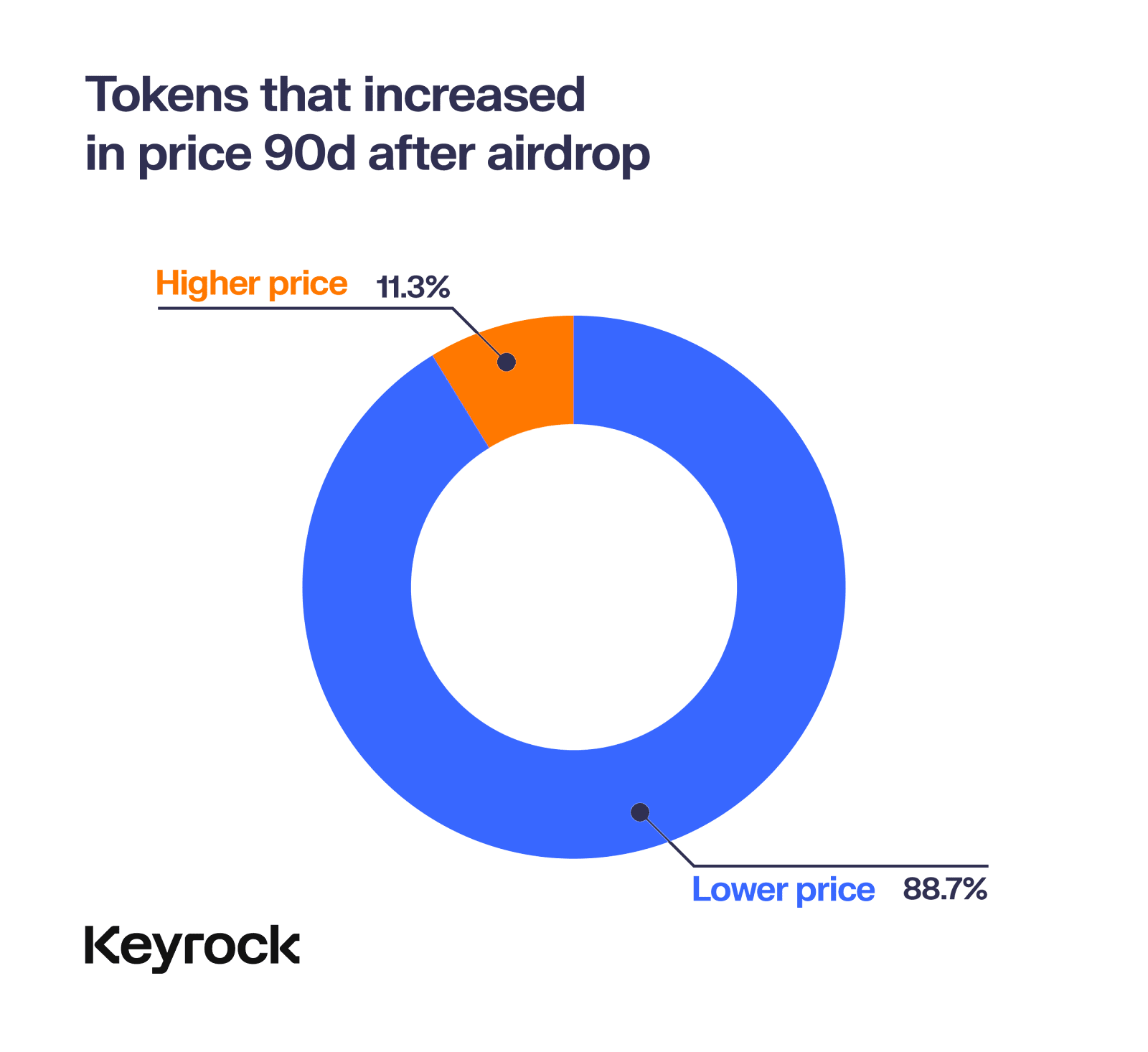
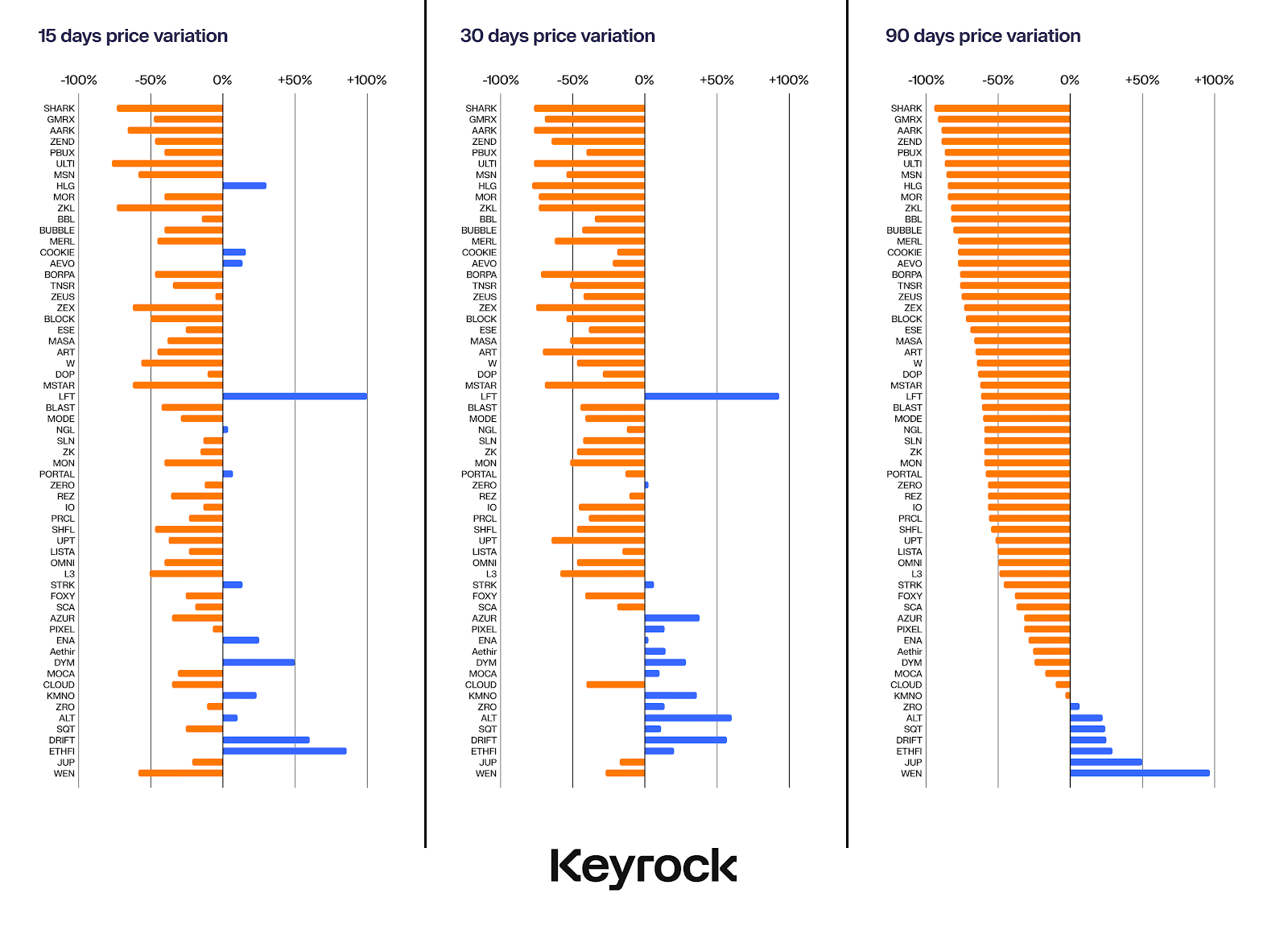
Observing price movements at 15, 30, and 90 days shows that most price action occurs in the first few days after the airdrop. Three months later, very few tokens achieve positive outcomes, with only a handful reversing this trend. That said, broader context matters—the entire crypto market performed weakly during this period, further complicating the picture.
Performance by Chain
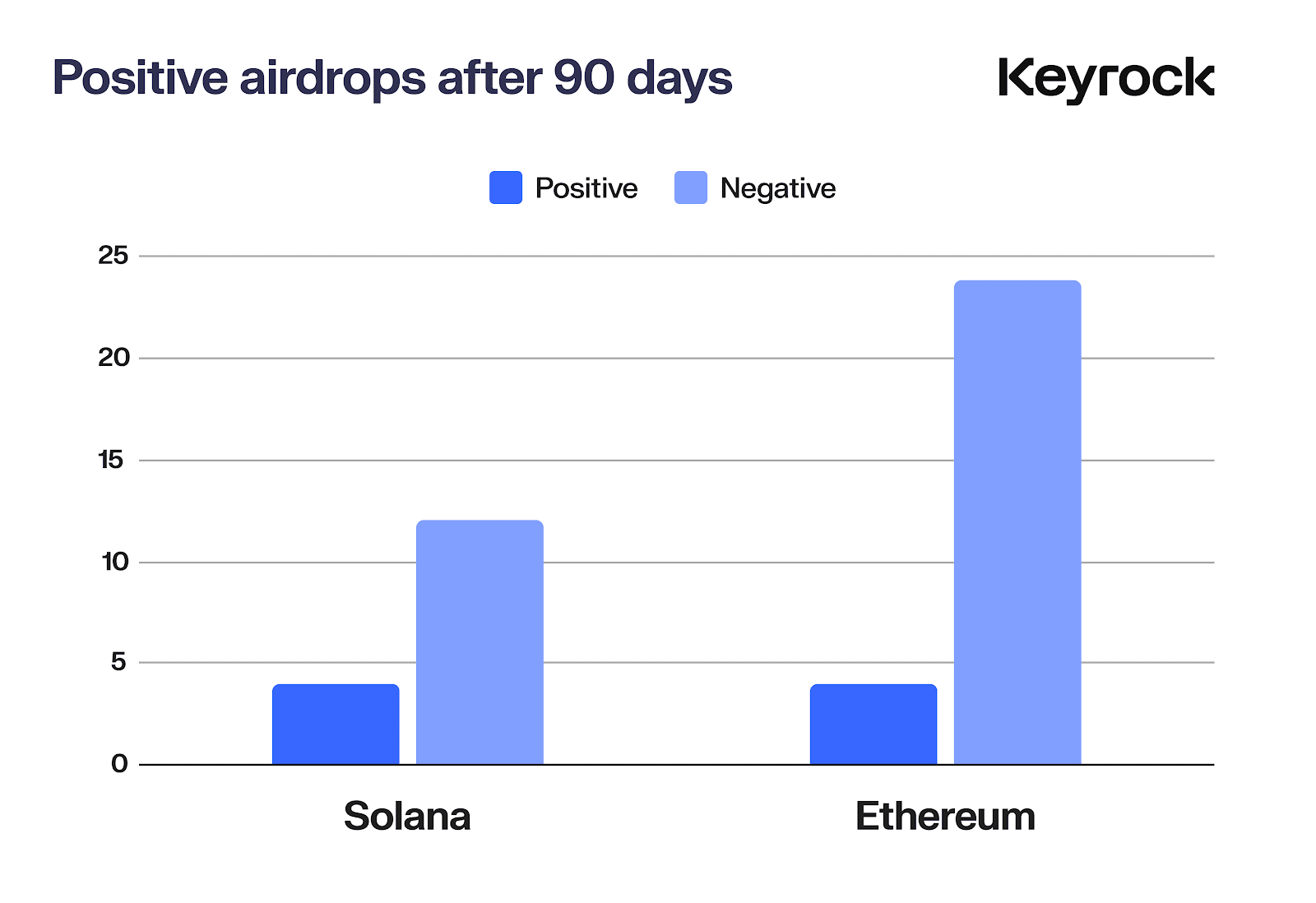
While overall performance was poor, not all chains fared equally. Among the 62 airdrops analyzed, only eight delivered positive returns after 90 days: four on Ethereum, four on Solana. None succeeded on BNB, Starknet, Arbitrum, Merlin, Blast, Mode, or ZkSync. Solana had a 25% success rate, Ethereum 14.8%.
Solana’s strong airdrop performance is unsurprising—it has become a hub for retail users over the past two years and a real challenger to Ethereum's dominance. Moreover, since many of the other analyzed chains are L2s competing directly with one another, it's no surprise that only the base chains retained some winners.
Although Telegram’s Ton network isn't included here, it's worth noting that it has seen numerous successful airdrops as user enthusiasm and adoption grow.
Relative Performance
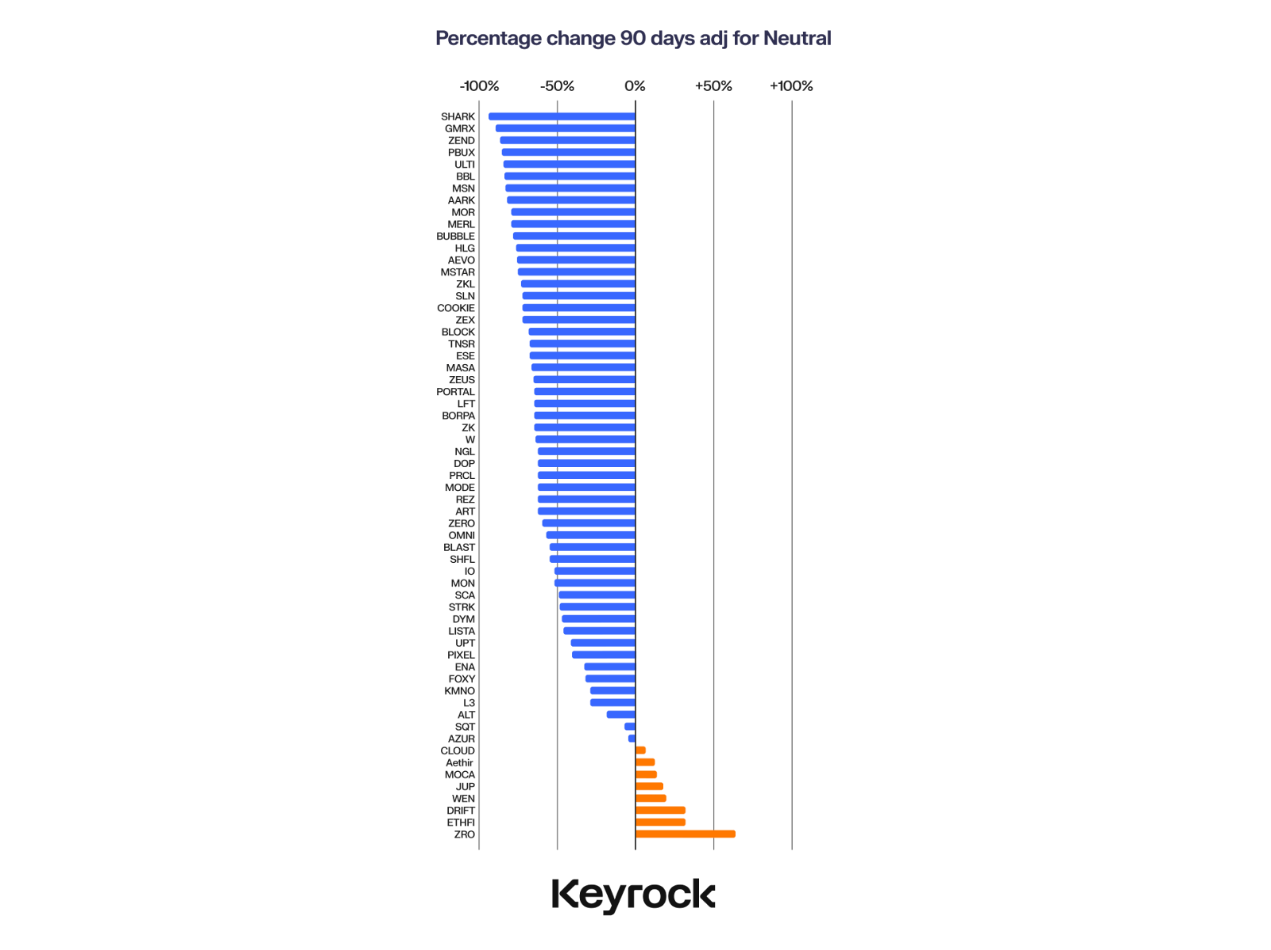
That said, what happens if we attempt to isolate larger chains from their airdrops? Would the data change if we account for movements in native tokens? When comparing airdrop prices against their respective ecosystem performances—such as Polygon airdrops versus MATIC price changes, or Solana airdrops versus SOL—results remain bleak.
Even though the market declined after peaking in 2023, the drop wasn't sufficient to offset the poor performance of airdropped tokens compared to system or major altcoins. These sell-offs, while tied to broader narratives, reflect widespread market concern about short-term speculation. When even “mature” assets are falling, the last thing people want is untested or “new” offerings.
Overall, Solana and ETH dropped no more than ~15–20% in their worst 90-day periods, underscoring that airdropped tokens are far more volatile and tied more to macro-narratives than intrinsic price behavior.
Performance by Distribution Size
Another key factor affecting airdrop outcomes is the proportion of total token supply distributed. How much a protocol allocates significantly impacts price performance. This raises critical questions: does generosity pay off? Is conservatism safer? Does giving users more tokens lead to better prices, or does releasing too many too quickly increase risk?
To analyze further, airdrops were categorized into three groups:
-
Small airdrop: < 5% of total supply
-
Medium airdrop: > 5% and ≤10%
-
Large airdrop: > 10%
Their performance was then observed across three timeframes (15, 30, and 90 days).
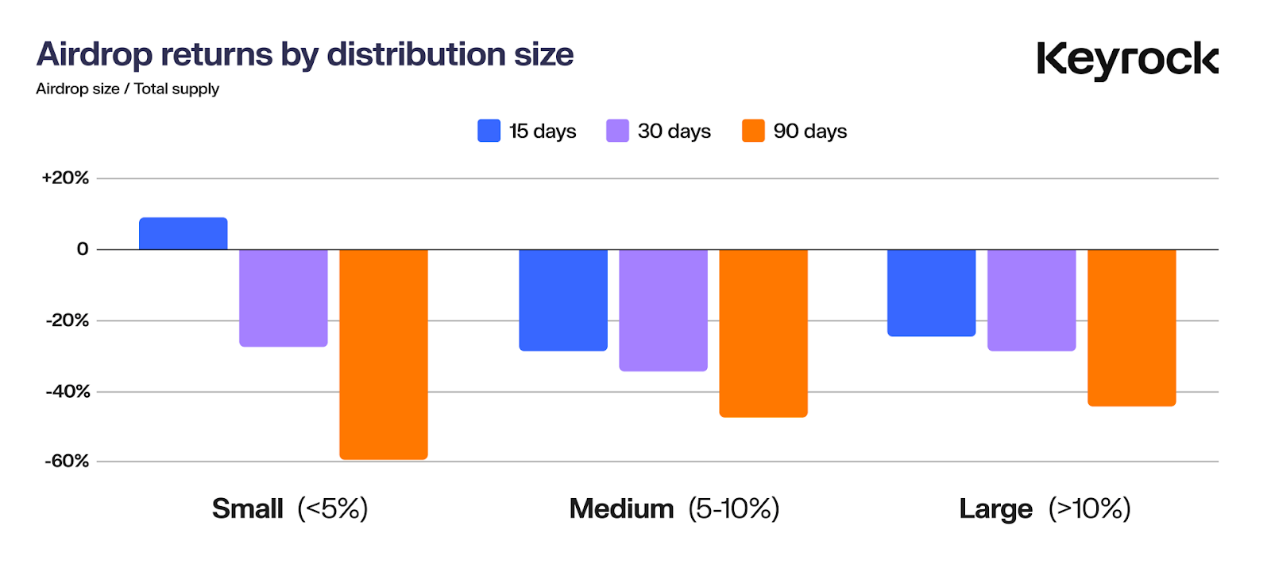
In the short term (15 days), small airdrops (<5%) often perform well, likely due to lower immediate selling pressure from limited supply. However, this initial success tends to be fleeting, with small airdrops seeing steep declines within three months. This may stem from multiple causes: low supply initially suppresses selling, but as narratives shift or insiders begin dumping, the wider community follows.
Medium-sized airdrops (5–10%) perform slightly better, balancing supply distribution and user retention. Yet large airdrops (>10%) deliver the best results over longer periods. While larger distributions may carry higher short-term selling risks, they appear to foster stronger community ownership. By distributing more tokens, protocols empower users with greater skin in the game, leading to improved price stability and long-term performance.
The data ultimately suggests that generosity pays off. Protocols conducting generous airdrops tend to cultivate more invested communities, yielding better outcomes over time.
Distribution Dynamics
Impact of Token Distribution
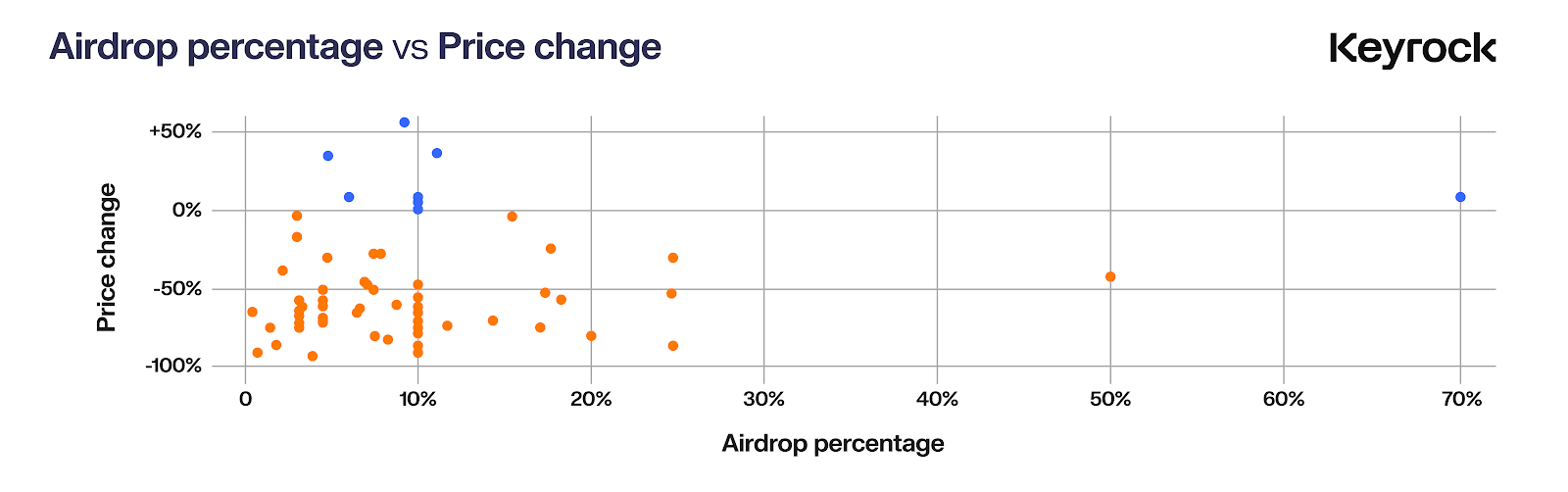
Airdrop size directly affects price performance. Smaller airdrops reduce initial selling pressure but often suffer massive dumps within months. Conversely, larger distributions do cause more early volatility but lead to stronger long-term results, indicating that generous allocation increases investor loyalty and willingness to support the token.
Link Between Distribution and Market Sentiment
While community sentiment is intangible, it's a crucial factor in airdrop success. Larger token allocations are often perceived as fairer, fostering a stronger sense of ownership and engagement. This creates a positive feedback loop: users feel more invested, are less likely to sell, and contribute to long-term stability. In contrast, smaller allocations may feel safer initially but often lead to fleeting excitement followed by rapid dumping.
Though difficult to quantify sentiment across all 62 airdrops, it remains a powerful indicator of lasting appeal. Signs of strong sentiment include active, engaged communities on platforms like Discord, meaningful discussions on social media, and genuine product interest. Additionally, product novelty and innovation often help sustain positive momentum by attracting loyal users rather than speculative airdrop farmers.
FDV Effect
A key area of concern is whether a token’s fully diluted valuation (FDV) at launch significantly impacts its post-airdrop performance. FDV is calculated by multiplying the current token price by the total token supply, including circulating, locked, vesting, or future tokens.
In crypto, it's common to see projects with FDVs disproportionately high relative to their actual utility or impact at launch. This raises a critical question: are tokens punished for launching with excessively high FDVs, or does FDV impact vary by project?
The dataset spans projects launching with FDVs as low as $5.9 million to as high as $19 billion—over a 3,000x difference among the 62 airdrop samples.
Plotting this data reveals a clear trend: the higher the launch FDV, the greater the likelihood of a sharp price decline, regardless of project type, hype level, or community sentiment.
Two main factors are at play. First is basic market psychology: investors are drawn to perceived upward mobility. Lower-FDV tokens offer room to grow and the psychological comfort of “early entry,” promising future gains. High-FDV projects, however, struggle to maintain momentum due to limited upside potential.
Economists have long discussed the concept of “room to run.” As Robert Shiller noted, when investors perceive returns as capped, “irrational exuberance” quickly fades. In crypto, when a token’s FDV signals limited growth potential, such exuberance vanishes just as fast.
The second factor is more technical: liquidity. Higher-FDV tokens often lack the liquidity needed to support their valuations. When large amounts of tokens are distributed to the community, even a small number of users cashing out can create massive selling pressure—with no buyers on the other side.
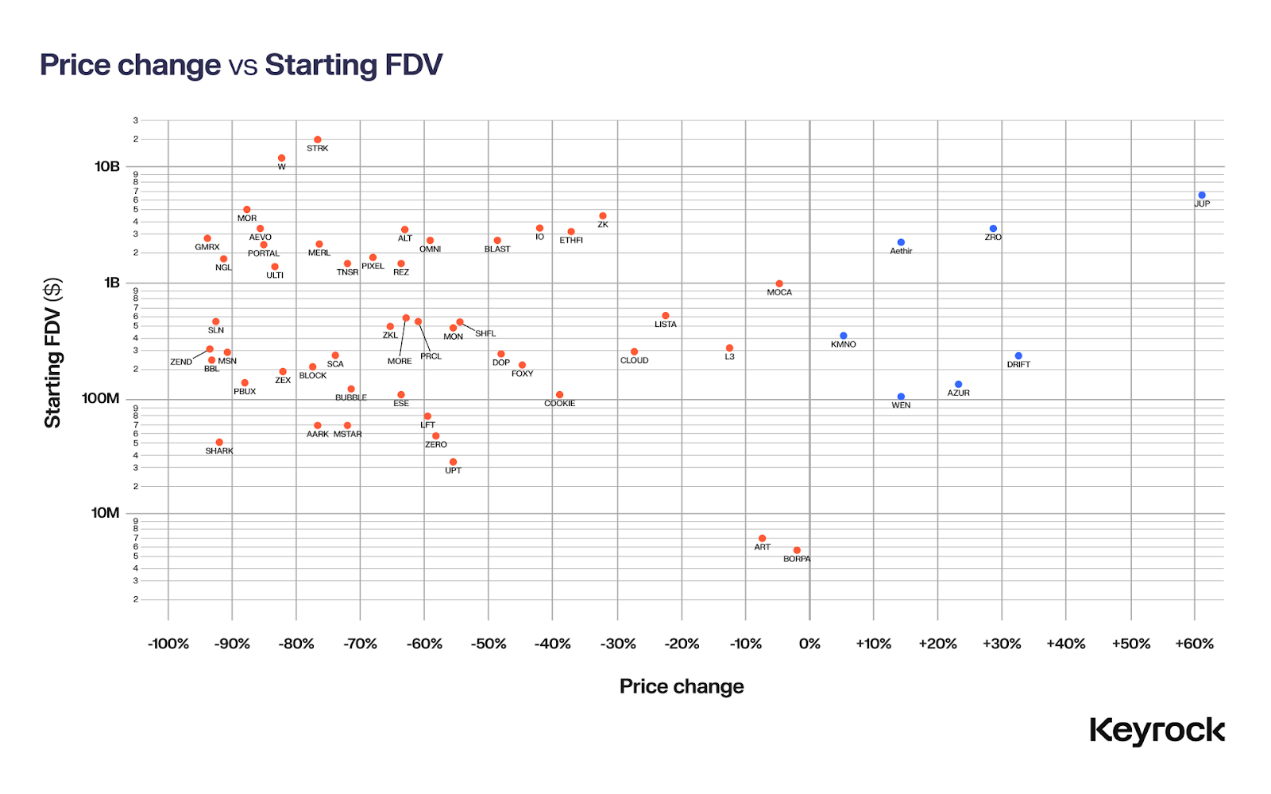
Take JUP, which launched with a $6.9 billion FDV, supported by a series of liquidity pools and market makers—estimated at $22 million on day one. This gave JUP a liquidity-to-market-cap ratio of just 0.03%. While low compared to WEN (2%), it was relatively high for its tier.
Compare this to Wormhole, which had a $13 billion FDV. To match the same 0.03% liquidity ratio, Wormhole would need $39 million in liquidity across venues. Yet even including all available pools (official, unofficial, and CEX liquidity), estimates reach only around $6 million. With 17% of tokens allocated to users, unsustainable valuation seemed inevitable. Since launch, token W has fallen 83%.
Without sufficient liquidity, prices become highly sensitive to selling pressure. The psychological demand for growth potential and the actual liquidity required to support large FDVs explain why high-FDV tokens struggle to maintain value.
Data confirms this: lower-FDV tokens suffer far less price erosion than those launching with inflated valuations, which experience the steepest losses in the months following their airdrop.
Case Studies
DRIFT
Drift, a decentralized futures trading platform, has operated on Solana for nearly three years. Drift’s journey has been marked by both triumphs and challenges, surviving multiple hacks and exploits. Yet each setback forged a stronger protocol, evolving into a platform whose value extends far beyond airdrop farming.
When Drift’s airdrop finally arrived, it was warmly received—especially by its long-standing user base. The team strategically allocated 12% of the total token supply to the airdrop—a relatively high share—and introduced a clever reward system that activated every six hours after the initial distribution.
Drift’s modest $56 million market cap surprised many, especially compared to other vAMMs (virtual automated market makers) with fewer users and shorter histories but higher valuations. Drift’s true potential was quickly recognized, reaching a $163 million valuation—up 2.9x post-launch.
Drift’s success stemmed from fair and thoughtful distribution. By rewarding long-term loyal users, Drift effectively filtered out Sybils, cultivated a more authentic community, and avoided pitfalls that often plague such events.
What Made Drift Different?
Long history and solid foundation
-
Drift’s extensive track record enabled it to reward an existing, loyal user base.
-
With a high-quality, battle-tested product, the team could easily identify and reward genuine power users.
Generous, phased distribution
-
Allocating 12% of total supply (a substantial portion for an airdrop) signaled Drift’s commitment to its community.
-
A phased rollout helped minimize selling pressure and maintain post-launch value stability.
-
Crucially, the airdrop rewarded actual usage, not just inflated points-farming metrics.
Realistic valuation
-
Drift’s conservative launch valuation avoided the trap of excessive hype, keeping expectations grounded.
-
Sufficient liquidity was seeded in initial pools, ensuring smooth market operations.
-
A low FDV not only set Drift apart but also sparked broader discussion about overvalued competitors.
ZEND
ZkLend (ZEND) is now in severe decline, with its value down 95% and daily trading volume struggling to exceed $400,000. This is a stark contrast for a project once valued at $300 million. Adding to this unusual situation, ZkLend’s TVL is now more than double its FDV—an uncommon and unhealthy scenario in crypto.
So how did a project that shone brightly amid the Starknet (a zk-rollup solution aimed at scaling Ethereum) hype end up in such precarious condition?
Riding the Starknet Wave—but Missing the Opportunity
ZkLend’s concept wasn’t particularly groundbreaking—it aimed to be a lending platform for various assets, leveraging Starknet’s narrative. The protocol capitalized on Starknet’s momentum, positioning itself as a key player in a cross-chain liquidity ecosystem.
-
Created a farming network where users earned rewards across different protocols
-
Attracted liquidity and users through incentives and cross-chain activity
However, in execution, the platform attracted mercenary users focused solely on short-term rewards, with no commitment to the protocol’s long-term health. Instead of nurturing a sustainable ecosystem, ZkLend found itself dependent on reward hunters, resulting in fleeting engagement and low retention.
Counterproductive Airdrop
ZkLend’s airdrop strategy worsened its problems. With no significant product or brand recognition before the airdrop, token distribution attracted speculators rather than genuine users. This critical misstep led to (inadequate participant vetting):
-
A flood of airdrop farmers eager to cash out immediately.
-
No loyalty or real engagement from participants—no long-term commitment.
-
Rapid token devaluation as speculators dumped immediately.
Rather than gaining attention and building loyalty, the airdrop created a brief speculative frenzy that quickly vanished.
ZkLend’s case serves as a warning: while hype and airdrops can attract users, they alone cannot create value, utility, or a sustainable community.
Key lessons:
-
Hype alone is not enough: real value requires more than buzz around a trending narrative.
-
Unvetted airdrops may trigger speculation and destroy value.
-
High valuations for new products carry significant risk, especially without proven use cases.
Conclusion
If the goal is maximizing returns, selling on day one is usually the best move—85% of airdropped tokens see sharp price drops within months. Solana stood out in 2024 airdrop performance, but even after adjusting for market conditions, overall results weren’t great. Projects like WEN and JUP became successful airdrop examples, showing that strategic approaches can still yield strong returns.
Contrary to popular belief, larger airdrops don’t always trigger sell-offs. Tokens with 70%+ airdrop allocations achieved positive returns, highlighting that FDV management matters more. High FDV is a serious mistake, limiting growth potential. More critically, it creates liquidity issues: inflated FDVs require massive liquidity to sustain, which is often unavailable. Without sufficient liquidity, airdropped tokens are vulnerable to severe price crashes, as there’s not enough capital to absorb selling pressure. Projects launching with realistic FDVs and robust liquidity plans are better equipped to weather post-airdrop volatility.
Liquidity is crucial. High FDVs place immense strain on liquidity. Under illiquid conditions, mass sell-offs depress prices—especially in airdrops, where recipients quickly dump tokens. By maintaining manageable FDVs and prioritizing liquidity, projects can achieve better stability and long-term growth potential.
In the end, airdrop success depends not just on distribution size—FDV, liquidity, community engagement, and narrative all matter. Projects like WEN and JUP struck the right balance, building lasting value, while others with bloated FDVs and shallow liquidity failed to sustain momentum.
In fast-moving markets, many investors make quick decisions. Selling on day one is often the safest choice, but for those focused on long-term fundamentals, there are always a few “gems” worth holding.
Join TechFlow official community to stay tuned
Telegram:https://t.me/TechFlowDaily
X (Twitter):https://x.com/TechFlowPost
X (Twitter) EN:https://x.com/BlockFlow_News
 @KeyrockTrading