








Token price doubles, TVL rebounds: Re-examining Aave, the veteran blue-chip protocol leading the recovery
TechFlow Selected TechFlow Selected
Token price doubles, TVL rebounds: Re-examining Aave, the veteran blue-chip protocol leading the recovery
Exploring the Uptrend Logic and Future Outlook for AAVE
 Navigating Web3 tides with focused insights
Author: Green Light Capital
Translation: Azuma, Odaily Planet Daily
Editor's note: The leading lending protocol Aave (AAVE) has recently defied the broader sector’s weakness, achieving a remarkable doubling in price—from around $80 on August 5 to over $170 today—while many established DeFi tokens remain stagnant.
As the Federal Reserve officially enters a rate-cutting cycle, discussions about the return of the "alt season," particularly the resurgence of DeFi, are gaining momentum—and Aave appears to have already begun its recovery. In the following article, Green Light Capital provides a comprehensive re-evaluation of Aave’s current fundamentals, offering investors insight into the logic behind AAVE’s recent rally and its future trajectory.
Below is the full text by Green Light Capital, translated by Odaily Planet Daily.
Why could AAVE dominate this bull cycle?
DeFi may initially seem daunting, often regarded as the most complex segment within the crypto industry. Compared to flashy new projects with innovative value propositions, it can also appear less exciting.
Yet the reality is quite the opposite. Despite waning interest in DeFi following the collapses of Terra Luna and Celsius, a subset of protocols now presents some of the most compelling investment opportunities in the space.
In this piece, we’ll analyze Aave to explore this thesis further, aiming to equip you with all essential information before making any investment decisions.
Aave Overview (Skip if Familiar)
Aave originated in 2017 (formerly ETHLend) and quickly rose to become a leading project in DeFi. As a lending platform, Aave offers a trustless, transparent, and secure alternative to traditional financial services.
“How does it work?”
For 80% of Aave users, the protocol serves primarily as a liquidity provision tool. Users connect their wallets, deposit ETH, stablecoins, or other crypto assets, and earn yield on these deposits. Most users stop here—their returns come entirely from borrowers who pay interest for borrowing assets. After deducting a fee known as the “reserve factor,” the interest is redistributed to depositors, while the reserve factor itself goes to the Aave DAO.
To borrow assets on Aave, users must provide collateral. Typically, borrowers deposit assets like BTC, WBTC, or ETH—or ETH-related assets such as stETH or WETH—and borrow stablecoins. This strategy is popular when users expect BTC or ETH prices to rise, allowing them to repay loans at lower effective costs. However, if collateral value drops sharply due to unexpected market events and no longer covers the debt, liquidation occurs. Liquidators step in to repay the borrower’s debt in exchange for a portion of the collateral as reward. This mechanism protects the entire protocol and ensures the safety of liquidity providers’ assets.
To account for potential shortfalls during liquidations, Aave maintains a “Safety Module” backed by $500 million worth of AAVE tokens. Users voluntarily stake their AAVE or provide AAVE-ETH liquidity, acting as a second line of defense during black swan events. In return, they receive incentives for securing the protocol.
Key Catalysts for AAVE
In this section, we examine key catalysts that could propel AAVE ahead of other altcoins in the current cycle.
Catalyst One: Paradigm Shift — Stakers to Share Protocol Revenue
On July 25, 2024, Marc Zeller (Aave Integration Lead) proposed an initiative called the “AAVEnomics Update,” introducing a “Buy and Distribute” program. This plan aims to use excess protocol revenue to directly reward participants in the DAO—a significant shift in AAVE’s tokenomics that enhances its appeal by offering tangible financial benefits to holders.
Readers interested in this potentially transformative governance proposal can learn more here: https://x.com/GL_Capital_/status/1836746881797394641
Catalyst Two: Partnership with BlackRock
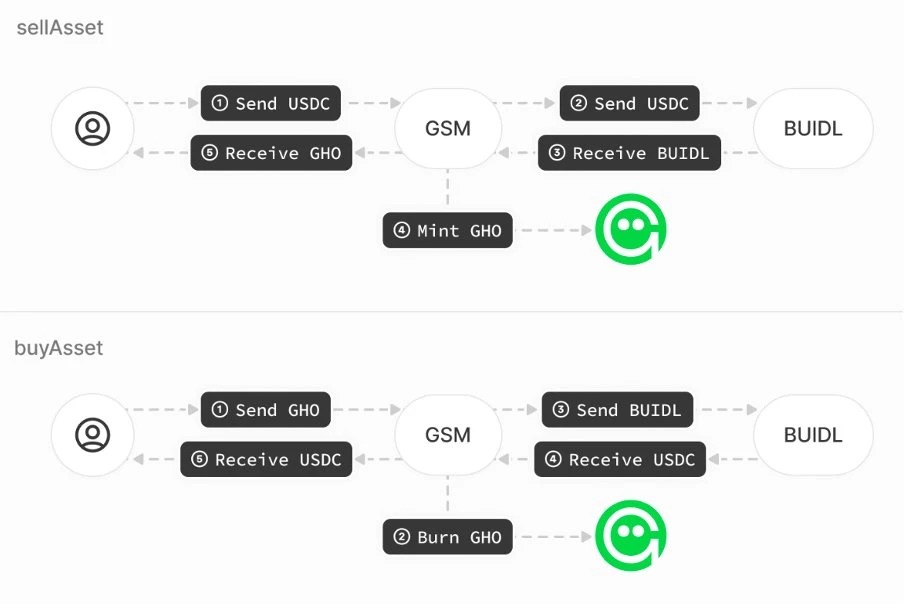
Aave has proposed integrating BlackRock’s tokenized fund BUIDL into its GHO Stablecoin Module (GSM).
The plan leverages idle USDC to mint BUIDL—managed by BlackRock and backed by real-world assets such as U.S. Treasuries and cash—improving capital efficiency. This integration not only strengthens GHO’s reserve management but also boosts liquidity across the Aave ecosystem. BUIDL generates daily dividends, providing participants with stable yields and diversifying Aave’s revenue streams through RWA exposure.
Additionally, the integration includes a $100 million USDC redemption fund supported by Circle, enabling seamless GHO-USDC conversions. This allows Aave to better respond to market demand fluctuations and maintain GHO’s stability as a stablecoin.
By partnering with global financial giant BlackRock, Aave enhances its credibility and positions itself as a pioneer bridging traditional finance and DeFi, opening doors for future institutional collaborations.
This partnership also plays a critical role in achieving key milestones required for Aave’s revenue distribution proposal:
-
GHO supply must reach 175 million: By using idle USDC to mint BUIDL, increased yield drives higher demand for GHO, increasing the likelihood of surpassing 175 million in circulating supply.
-
Ability to absorb large GHO sales with minimal slippage: The USDC redemption fund ensures large GHO sell-offs (e.g., $10 million swaps) can be executed with minimal slippage (1% price impact), preserving GHO’s stability.
Catalyst Three: Expansion to Solana
For months, Aave has hinted at expanding to Solana.
Marc Zeller stated his role involves maximizing profits for Aave DAO, requiring flexibility and exploration of various revenue-generating strategies. Aave’s view of Solana has evolved since the FTX collapse. As a data-driven platform, Aave will only proceed with migration if projected revenue on Solana exceeds the cost of code modifications and security audits.
Currently, potential earnings on Solana aren’t sufficient to justify migration—but Marc notes conditions are improving, making Solana increasingly attractive. Aave is closely monitoring its progress.
Aave believes expansion to Solana would be straightforward, and given its influence, it could quickly establish leadership on the network.
Catalyst Four: Market Leadership & Brand Credibility
In recent years, events like the FTX and Terra Luna collapses, repeated DeFi hacks, and persistent wallet thefts have made DeFi users and the broader crypto community increasingly risk-averse.
As a result, trusting decentralized DeFi protocols with asset management has become more challenging. In this environment, brand reputation plays a crucial role in earning investor trust—this is where Aave holds its greatest advantage, and why we believe newer protocols will struggle to surpass it in the coming years. Since 2017, Aave has been a cornerstone of the DeFi ecosystem. While it has experienced minor security incidents, these were typically linked to external smart contracts or liquidity pools—not direct attacks on its core protocol. Aave has proactively addressed security concerns through multiple audits and an ongoing bug bounty program.
Consequently, Aave is considered one of the safest DeFi platforms, attracting primarily whale users seeking attractive yields while lending their funds. These whales prioritize security and are unlikely to move their assets to newer, less proven protocols solely for marginally higher returns. As institutional participation in DeFi grows, Aave is well-positioned to maintain its leadership.
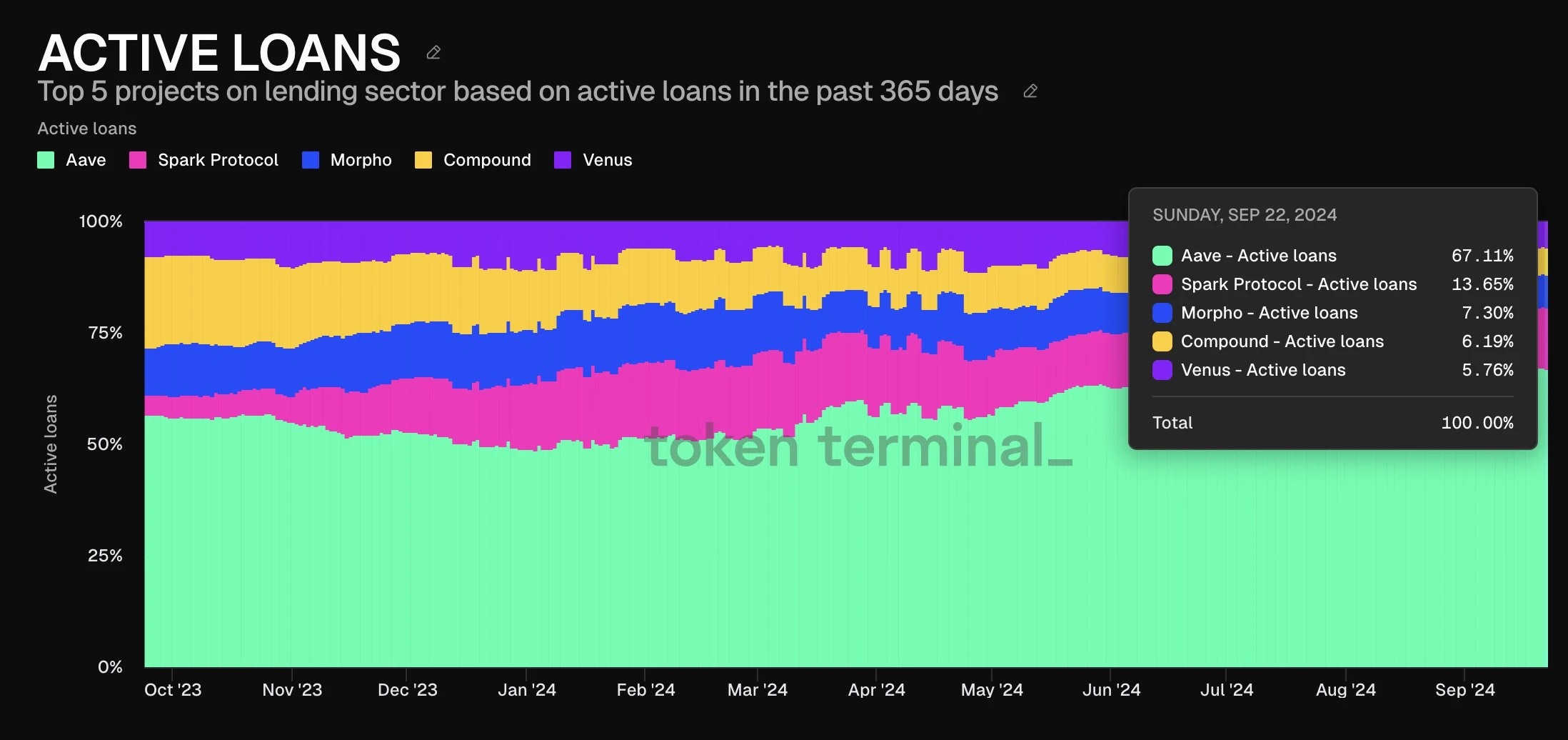
With 67% market share in the lending sector, Aave is expected to strengthen its dominance in the years ahead, solidifying its position as the market leader.
Market Outlook Analysis
As you know, borrowing on Aave requires posting collateral. Therefore, we’ve looked to traditional finance for comparable lending models to highlight DeFi’s vast growth potential in the coming years.
In our analysis, margin loans most closely resemble Aave’s model, as they allow stock market investors to borrow against existing assets to purchase additional securities.
On Aave, borrowers are typically individuals bullish on the crypto market. They post BTC, ETH, or similar assets as collateral and borrow stablecoins to buy more crypto. If the market rises, their borrowing cost becomes relatively smaller, enabling profitable trades. Conversely, if the market falls, they face margin calls and potential liquidation risks—similar to those faced by margin loan users in traditional finance.
A closer look at active loans in DeFi reveals clear signs of recovery, with the sector poised to rebound toward its all-time high (ATH) of ~$20 billion in outstanding loans last seen in 2021. Currently, there are $11 billion in active crypto loans, with $7.4 billion originating from Aave—further underscoring its market dominance. Yet compared to the $800 billion in margin loans currently in traditional finance (an 80x difference), it’s evident that crypto lending still has enormous room for growth in the coming years.
Valuation Comparison
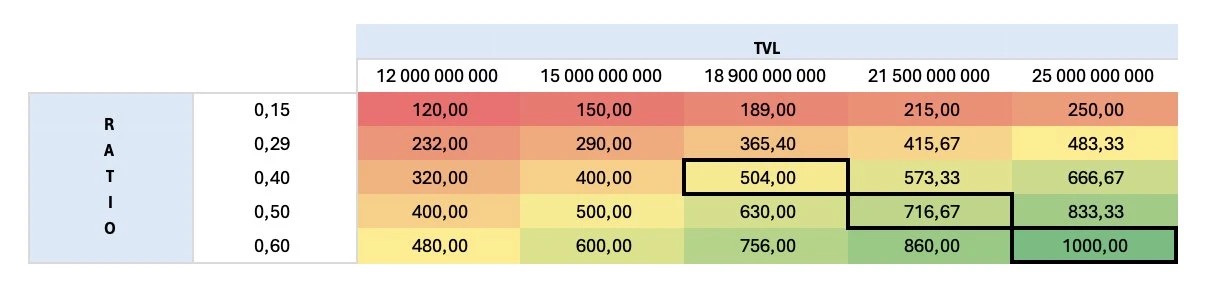
The best way to assess whether an asset is overvalued or undervalued is to compare it with peers using key metrics like Market Cap / TVL ratio. We conducted this analysis weeks ago and found that AAVE is clearly undervalued.
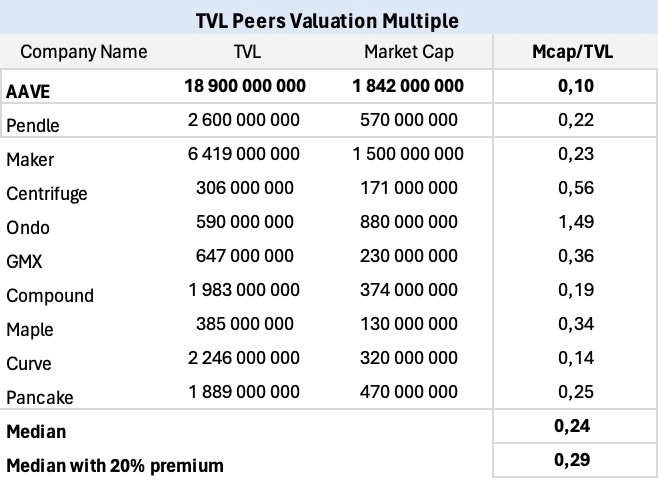
In this post (https://x.com/GL_Capital_/status/1834180379583877447), you can also find our price and market cap projections for the next 12 months.
Tokenomics Model
The Aave token was first launched during the ETHLend era under the name LEND. In 2020, Aave executed a token swap that significantly reduced the maximum supply.
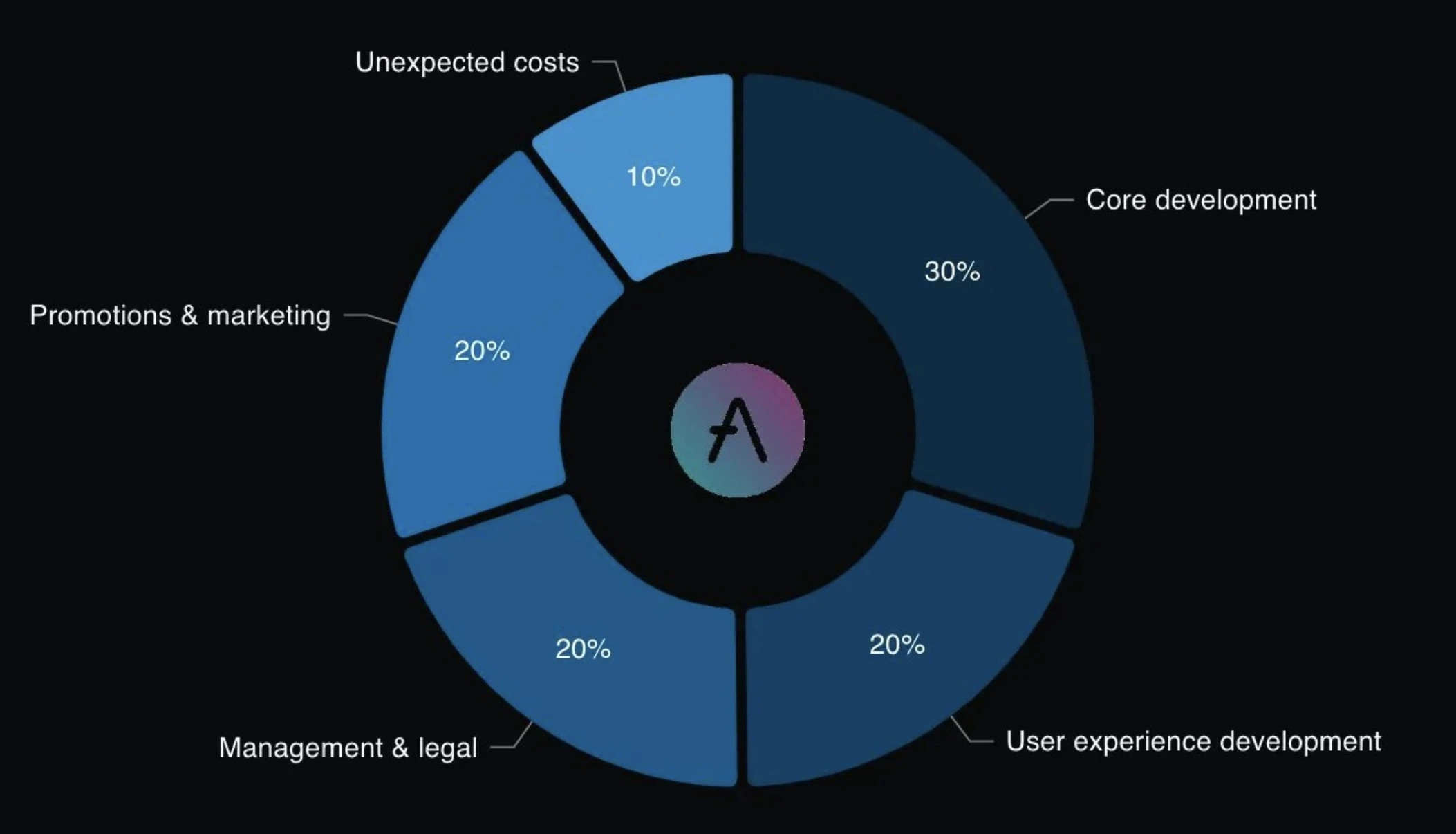
Under this swap, holders could exchange 100 LEND tokens for 1 AAVE token, reducing total supply from 1.3 billion LEND to 13 million AAVE. Additionally, the team allocated 3 million extra tokens to the Aave ecosystem reserve to support protocol development.
The migration from LEND to AAVE marked the introduction of internal governance mechanisms, enabling the community to submit Aave Improvement Proposals (AIPs) and participate in the project’s evolution. Governance thus became a core utility of the AAVE token.
The initial allocation structure of the AAVE token is shown below.
Funding and Unlock Status
In 2017, the Aave team conducted an initial coin offering (ICO), raising $16.2 million from investors at $0.0184 per LEND token (equivalent to $1.84 per AAVE). To date, early investors have achieved a 78x return, peaking at 360x during AAVE’s all-time high (ATH). However, given this was seven years ago, it’s unlikely many original investors still hold their tokens.
During the 2020 token swap, Aave also completed several funding rounds by selling treasury-held AAVE tokens, raising $32 million. Unfortunately, specific details such as unlock schedules remain undisclosed. It’s likely most VCs sold their holdings during the 2021 bull run, so the risk of large-scale institutional dumping is low.
In terms of unlocks, AAVE’s current circulating supply stands at 14.9 million, representing the vast majority of the 16 million total supply. Approximately 1 million tokens remain in the treasury, reserved for staking rewards in the Safety Module and liquidity incentives. With nearly all tokens already in circulation, there will be no significant future unlocks, minimizing the risk of value dilution.
This is an optimal token structure—almost all tokens are already circulating.
Token Utility
Currently, AAVE token utility is relatively limited, falling into two main categories. First is governance: AAVE holders can vote on or propose new Aave Improvement Proposals (AIPs), influencing risk parameters, incentives, product upgrades, and protocol changes. Second is staking: AAVE holders can allocate tokens to the Safety Module. During black swan events, staked tokens may be slashed to cover remaining debts and protect liquidity providers. In return, stakers receive rewards for securing the protocol.
With the proposed revenue distribution update, AAVE’s utility will evolve. The current Safety Module will transition into a “Legacy Safety Module,” meaning the existing model—where staked AAVE can be slashed during extreme scenarios to cover deficits—will give way to a more efficient and user-friendly system.
Under the new model, AAVE staking will be decoupled from protocol security responsibilities. Holders can still stake for income rewards, but these rewards will be directly tied to protocol revenue rather than protocol risk. This eliminates the possibility of losses due to security incidents, making staking far more attractive to token holders.
Technical Analysis
From a technical standpoint, AAVE’s outlook over the coming months appears highly promising, especially given its strong recent performance relative to BTC and ETH.
Analyzing the AAVE/ETH pair, we observe a significant shift in the weekly trend. AAVE has successfully formed new highs, signaling a potential trend reversal and suggesting the bear-market downtrend may be over. In our view, AAVE’s bottom against ETH has likely been established.
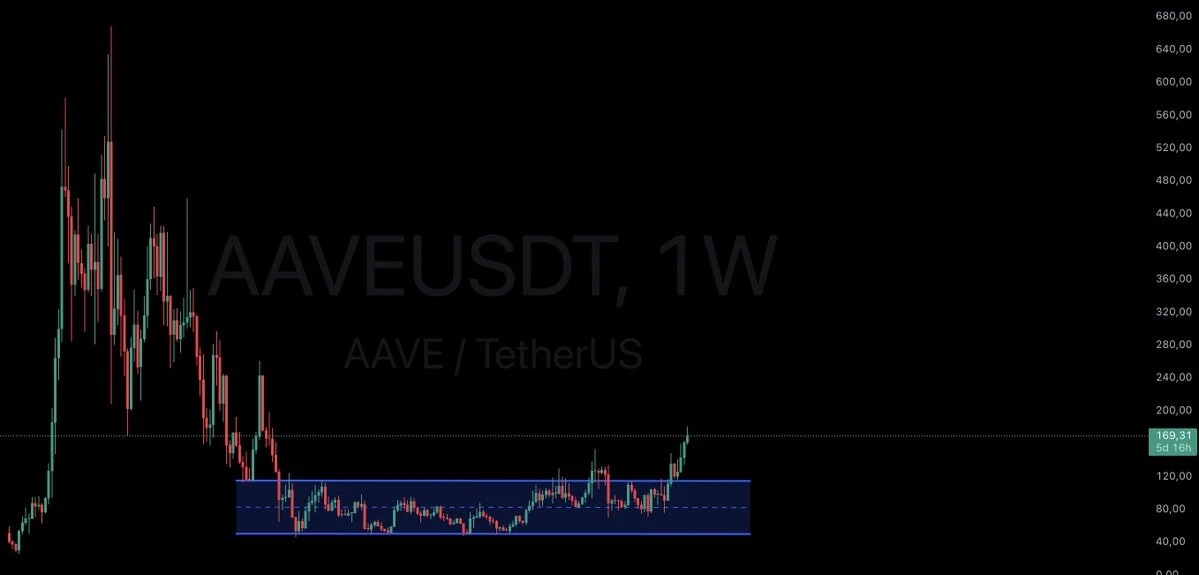
When analyzing AAVE independently, we see the token has finally broken out of its weekly consolidation range that began in May 2022. The token appears to be regaining strength and drawing renewed investor interest, particularly after the announcement of distributing excess revenue to token holders.
After such a prolonged accumulation phase, we expect AAVE to undergo rapid repricing, followed by a strong upward trajectory.
Investment Summary
Based on our analysis, AAVE stands out as a clear opportunity in the current bull market. The new revenue distribution plan fundamentally transforms AAVE’s value capture mechanism, directly aligning token holder interests with Aave protocol revenues.
The DeFi lending market remains small but is poised for substantial growth in the coming years, especially as more institutional players enter. With its strong brand credibility and market leadership, Aave is well-positioned to absorb this new capital and expand into emerging markets (such as Solana).
Furthermore, comparing Market Cap / TVL ratios shows that despite AAVE’s recent surge, it remains undervalued.
AAVE has recently broken out of a year-long trading range. Given its current undervaluation, we expect the market to rapidly reprice it soon.
Join TechFlow official community to stay tuned
Telegram:https://t.me/TechFlowDaily
X (Twitter):https://x.com/TechFlowPost
X (Twitter) EN:https://x.com/BlockFlow_News






