A once-in-a-lifetime opportunity for outsized Bitcoin returns
TechFlow Selected TechFlow Selected
A once-in-a-lifetime opportunity for outsized Bitcoin returns
A detailed explanation of the well-backed FBTC and participation opportunities.
 Navigating Web3 tides with focused insights
Author: LouisWang, Core Contributor at Biteye
Editor: Crush, Core Contributor at Biteye
01 Background and Demand
Bitcoin, as the cornerstone of the cryptocurrency industry, has surpassed a market capitalization of one trillion U.S. dollars. However, its functionality remains largely confined to value storage, with its financial application potential far from fully realized. The primary challenge lies in the fact that Bitcoin assets are restricted within their native network and cannot effectively participate in the thriving DeFi ecosystems on networks like Ethereum.
This dilemma highlights two critical challenges: first, how to enable BTC holders on the Bitcoin network to securely access yield opportunities and facilitate the flow of BTC into EVM-compatible networks; second, how to allow investors accustomed to EVM environments to benefit from yield opportunities on the Bitcoin network—such as participating in Babylon’s native BTC staking protocol—without directly interacting with the Bitcoin network.
WBTC (Wrapped Bitcoin), the main bridge enabling Bitcoin's entry into DeFi, is a 1:1 ERC20 token backed by Bitcoin custodied by BitGo. With a market cap of approximately $8.7 billion, it accounts for less than 1% of Bitcoin’s total market cap, underscoring the vast untapped liquidity potential within the Bitcoin ecosystem.
However, WBTC has recently faced controversy: concerns arose following BitGo’s transfer of control, prompting MakerDAO to reduce WBTC collateral limits and SparkLend to suspend WBTC lending altogether.
This incident has served as a catalyst for the growth of alternative BTCFi assets. FBTC, incubated by Ignition and developed with core contributions from Mantle and Antalpha Prime, maintains a 1:1 peg with Bitcoin while enabling bridging to any supported chain, achieving seamless integration with various DeFi protocols. FBTC aims to introduce highly liquid and composable BTC assets, expanding Bitcoin’s utility beyond mere value storage and enabling deep participation in diverse yield-generating strategies.
In doing so, FBTC not only opens new revenue streams for BTC holders but also provides users on other chains with a gateway to the BTC ecosystem, positioning itself as a key bridge connecting Bitcoin and the broader DeFi world.
02 How FBTC Works
To understand FBTC’s protocol design, we can apply first-principles thinking: FBTC fundamentally solves the problem of enabling BTC to flow between Bitcoin and other blockchains—a technical challenge similar to those faced by cross-chain bridges.
The core issues can be distilled into three aspects: secure deposits on the source chain, reliable minting on the destination chain, and effective communication between the two chains. To address these foundational challenges, FBTC employs a Mint & Burn model, constructing a secure and reliable system architecture.
The FBTC workflow consists primarily of three components: minting, burning, and cross-chain operations:
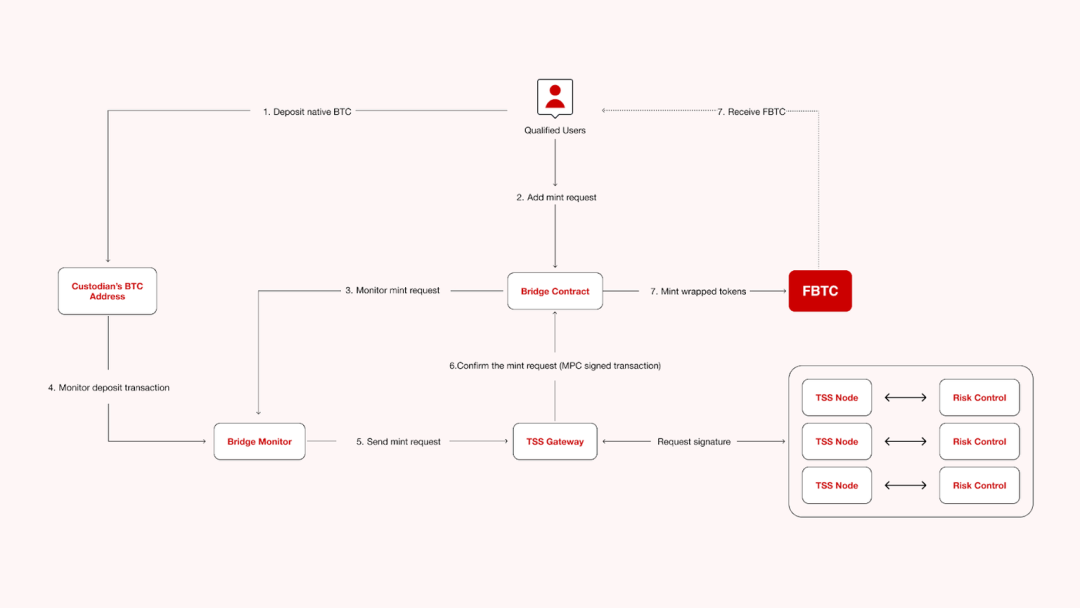
1. Minting Process:
Eligible users deposit BTC into a designated Bitcoin network deposit address and submit a minting request to the bridge contract on the target chain. The Bridge Monitor continuously tracks these minting requests and deposit events.
Upon receiving a request, the monitor forwards it to the TSS (Threshold Signature Scheme) gateway to request a signature authorization for minting FBTC. Multiple TSS nodes then jointly generate a cryptographic signature using MPC (Multi-Party Computation) algorithms.
Only when all conditions are satisfied will the system mint an equivalent amount of FBTC 1:1 on the target chain.
https://docs.fbtc.com/system-components/architecture
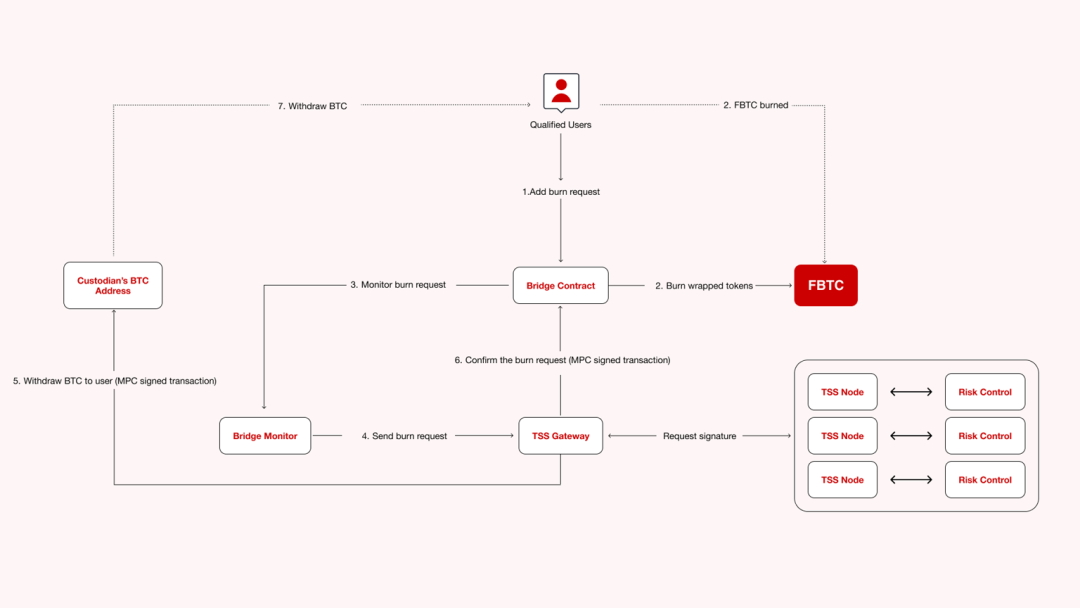
2. Burning Process:
When users wish to redeem their staked BTC assets, they may choose to burn (i.e., destroy) FBTC. This process mirrors the minting flow but in reverse. The system verifies the user’s request, ensures FBTC is properly destroyed, and then releases the corresponding amount of BTC back to the user-specified address.
https://docs.fbtc.com/system-components/architecture
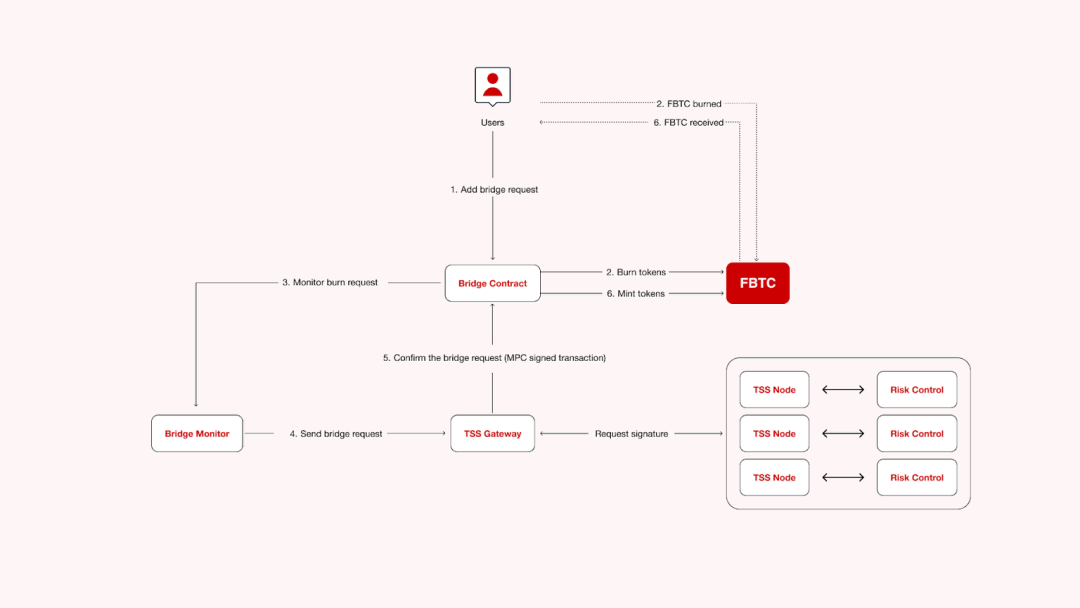
3. Cross-Chain Operations:
If a user wishes to transfer FBTC from one supported blockchain to another, they initiate a cross-chain request on the source chain.
The bridge contract first burns the FBTC on the source chain. Then, the minting process on the new chain proceeds similarly to the standard minting flow: the bridge monitor detects the cross-chain request and forwards it to the TSS gateway. After multiple TSS nodes co-sign the transaction, the system mints an equivalent amount of FBTC on the new chain, completing the cross-chain transfer.
https://docs.fbtc.com/system-components/architecture
03 Core Components of the FBTC Protocol
The FBTC protocol can be abstracted into three main components: custody addresses on the Bitcoin chain, smart contracts on the target chain, and off-chain service modules. Together, these form the core architecture of FBTC, ensuring security, efficiency, and reliability across the entire system.
The Bitcoin chain custody address serves as the foundation of the protocol. Users receive unique BTC deposit addresses; once BTC is deposited, the minting process is triggered, generating an equivalent amount of FBTC. Deposit addresses are managed using Multi-Party Computation (MPC) and multi-signature technology to prevent single-entity control and enhance security. During withdrawals, users burn FBTC via a unique withdrawal address to redeem BTC, with the entire process secured through multi-signature verification.
The smart contracts on the target chain act as the core execution layer, comprising the FBTC bridge contract, minting contract, and token contract. Each contract has clearly defined responsibilities, ensuring efficient system operation. FBTC also includes a Security Committee to respond to emergencies, enhancing overall system stability.
The off-chain service module supports critical functions. The Bridge Monitor validates transaction legitimacy, the TSS Gateway coordinates the signing process, and distributed TSS nodes ensure decentralization and security through threshold signatures. Each node runs an independent risk control module, serving as the final line of defense by rigorously validating all transaction requests.
Through this multi-layered, modular design, FBTC enables seamless connectivity between Bitcoin and the DeFi ecosystem while maintaining strong security. Each component plays a vital role in ensuring the safe and efficient operation of FBTC assets, making FBTC a crucial bridge between Bitcoin and DeFi.
04 Unique Advantages of FBTC
As a Bitcoin-derived asset, FBTC offers three key advantages: omnichain liquidity, enhanced security, and innovative yield-generation mechanisms.
Omnichain Liquidity
FBTC achieves true omnichain interoperability, allowing users to mint, burn, or transfer FBTC across any supported blockchain. This enables FBTC to freely circulate within the ecosystems of all supported chains.
Omnichain liquidity allows FBTC to deeply integrate with BTCFi protocols across chains, maximizing the composability of Bitcoin assets and significantly expanding the scope of DeFi participation for BTC holders. Currently, most major restaking projects have already integrated FBTC.
Enhanced Security
FBTC uses a unified system architecture for minting, burning, and cross-chain operations, ensuring operational consistency and security while reducing system complexity. Its security framework relies on core technologies including Multi-Party Computation (MPC), Multi-Signature (Multi-Sig), distributed TSS (Threshold Signature Scheme) nodes, and strict risk control modules. This multi-layered security design provides users with a reliable asset management platform, effectively safeguarding assets and ensuring operational transparency.
Locked FBTC (FBTC1)
FBTC1, an innovative asset built on FBTC, offers users additional financial avenues. By minting Locked FBTC, users release native BTC to designated custodians, providing extra liquidity for CeFi/DeFi strategies while gaining access to diversified yield opportunities.
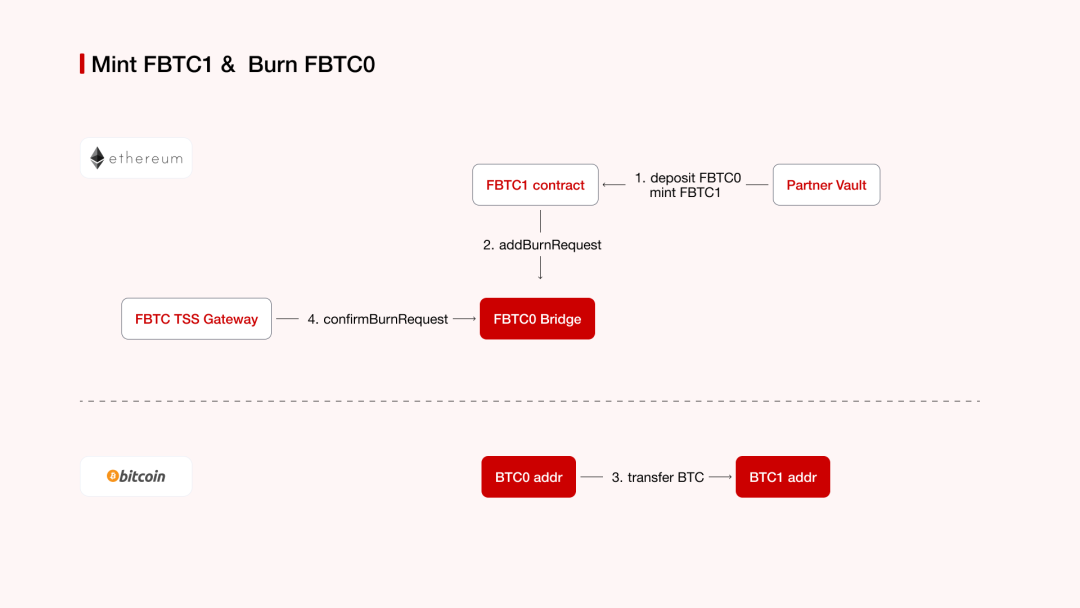
https://docs.fbtc.com/ecosystem/locked-fbtc-token/locked-fbtc-protocols-information
In the FBTC1 workflow, FBTC0 (standard FBTC) holders transfer their assets to partner vaults. Partners periodically deposit FBTC0 into the FBTC1 contract, triggering the minting of FBTC1 and the burning of FBTC0. Correspondingly, BTC is transferred from BTC0 addresses to dedicated BTC1 yield strategy addresses.
Current integrated partners include Avalon, Bedrock, Solv Protocol, and PumpBTC.
05 Current Status and Adoption of FBTC
Since its launch, FBTC has demonstrated remarkable growth momentum within just two months. Currently, the total minted FBTC has reached 2,664 BTC, natively issued across three major chains—ETH, Mantle, and BSC—with total value locked (TVL) exceeding $150 million, reflecting strong market demand and confidence in this innovative asset.
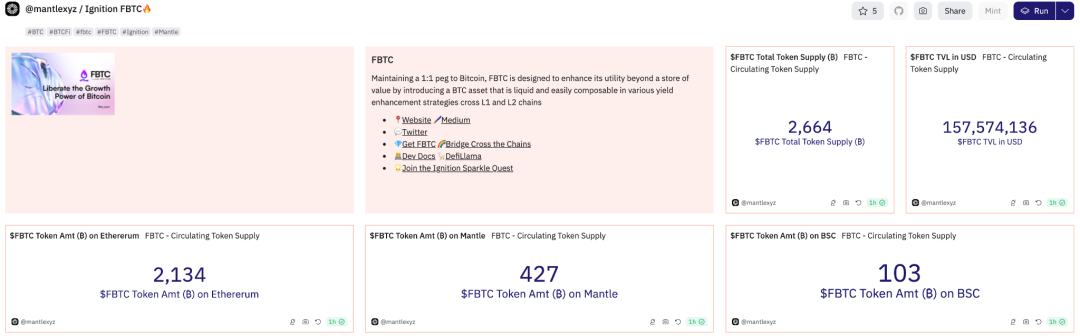
https://dune.com/mantlexyz/fbtc
In the DeFi ecosystem, composability is a core concept and a key building block—often referred to as "DeFi Lego." For bridged assets like FBTC, the diversity of use cases directly impacts demand strength. As such, the FBTC team has placed significant emphasis on expanding its application scope.
Currently, FBTC has been integrated with over 20 projects across the three launched chains, covering nearly all major DeFi sectors. Additionally, nearly ten more projects are undergoing integration testing and are expected to further expand the FBTC ecosystem.
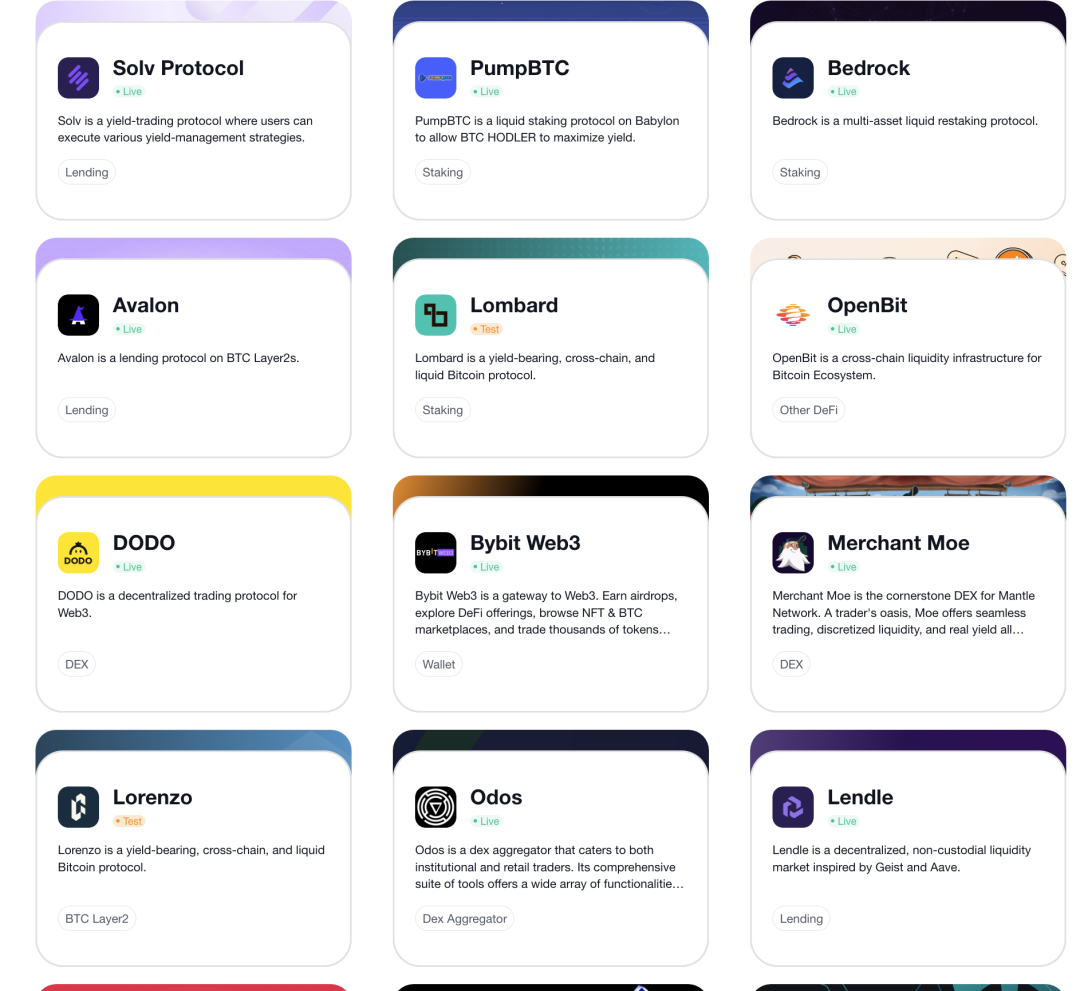
https://fbtc.com/ecosystem
During Babylon protocol’s first mainnet staking round, out of a 1,000 BTC staking cap, 418 BTC were staked via FBTC through platforms such as PumpBTC, Solv, and Bedrock. This makes FBTC an excellent exposure vehicle for users interested in Babylon.
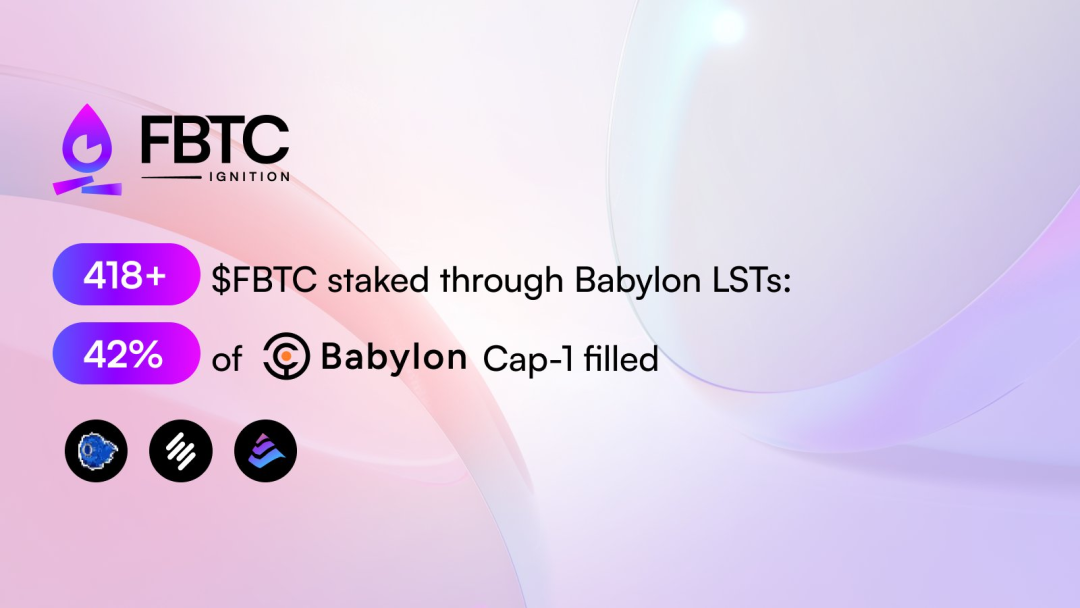
The rapid adoption and broad integration of FBTC reflect the market’s urgent need for efficient and secure Bitcoin-based DeFi solutions. As more projects integrate and user participation grows, FBTC is poised to create a network effect, playing an increasingly pivotal role in connecting the Bitcoin and DeFi ecosystems.
06 Potential Yields from FBTC
FBTC’s expansive ecosystem integration offers users a wide range of yield opportunities. Refer to Biteye’s one-page overview of FBTC ecosystem projects:

Main types of projects accessible via FBTC and their potential yields include:
1. Bitcoin Restaking Projects
These projects resemble LST (Liquid Staking Token) offerings on Ethereum and can further stake into Babylon. Users can deposit FBTC into various BTC liquid staking protocols to earn multiple layers of returns:
-
Project-specific boost points
-
2x–4x accelerated Sparks points (FBTC’s project points)
-
Babylon retroactive rewards for Babylon-integrated projects
Participating projects include PumpBTC, Bedrock, Solv Protocol, Pell Network, and Satlayer. These represent the best early opportunities for users to engage with the Babylon ecosystem.
2. Liquidity Pools
Users can deposit FBTC into various liquidity pools to earn:
-
Trading fee revenue
-
Additional Sparks and Powder points
Major liquidity pools include:
-
Merchant: mETH/FBTC and WBTC/FBTC pairs
-
Agni Finance: mETH/FBTC pair
-
Uniswap: WBTC/FBTC pair
-
DODO: WBTC/FBTC pair
-
Celopatra: WBTC/FBTC pair
These liquidity pools not only provide passive income but also help enhance FBTC’s market liquidity.
3. Multi-Chain Networks
By locking FBTC in other liquidity networks—including Karak, Mezo, Fuel Network, and Zircuit—users can earn:
-
Project-specific points
-
Sparks points
4. Staking and Lending
Users can deposit FBTC into various lending and staking protocols to earn:
-
Project points
-
Sparks points
Key protocols include:
-
Lending: Avalon, Lendle, Minterest
-
Staking: Astherus
FBTC’s yield model demonstrates significant diversity and flexibility. By participating in these different types of projects, users can select the optimal yield strategy based on their risk tolerance and investment goals.
Detailed interaction guides are available in Biteye’s tutorial:
https://x.com/BiteyeCN/status/1833812446831899055
07 Conclusion and Outlook
FBTC has a clear and focused positioning: to become the next-generation gateway asset for Bitcoin. Its core advantages manifest in three key areas:
Through carefully designed security mechanisms, FBTC effectively safeguards the cross-chain movement of Bitcoin, offering users a reliable asset management solution.
FBTC achieves true multi-chain liquidity, seamlessly integrating BTC assets into multiple blockchain ecosystems and vastly expanding value-capture opportunities. It not only unlocks new yield channels for Bitcoin holders but also enables EVM-native users unfamiliar with the Bitcoin chain to participate in native BTC protocols like Babylon. In this context, FBTC plays a crucial bridging role, effectively connecting disparate blockchain ecosystems.
FBTC excels in expanding its application landscape. Leveraging strong industry resources and a robust partnership network, FBTC continuously collaborates with high-quality projects, rapidly enriching its ecosystem. This broad applicability enhances both the utility and market competitiveness of FBTC.
These strengths have driven FBTC’s rapid development. Just two months after launch, its total TVL has surpassed $150 million—a milestone that not only highlights FBTC’s strong growth trajectory but also reflects the market’s urgent demand for innovative Bitcoin-derived assets.
If the BTCFi sector experiences explosive growth as anticipated, FBTC is well-positioned to become a strategic stronghold within the Bitcoin ecosystem. Through continuously optimized incentive mechanisms, FBTC has the potential to create a virtuous growth flywheel, further activating dormant BTC capital and unlocking the immense liquidity potential embedded within the Bitcoin network.
Join TechFlow official community to stay tuned
Telegram:https://t.me/TechFlowDaily
X (Twitter):https://x.com/TechFlowPost
X (Twitter) EN:https://x.com/BlockFlow_News
 @BiteyeCN