Opinion: The crypto world should continue building infrastructure, but not overvalued, unsubstantial infrastructure.
TechFlow Selected TechFlow Selected
Opinion: The crypto world should continue building infrastructure, but not overvalued, unsubstantial infrastructure.
Do you want to spend your life creating and trading memecoins, or do you want to build infrastructure and change the crypto world?
 Navigating Web3 tides with focused insights
Author: Rickey
Translation: TechFlow
Recently, I’ve heard too many people complain about Ethereum’s infrastructure, blaming venture capital firms for funding a large amount of meaningless infrastructure, arguing that oversupply of infrastructure has led to the industry’s difficulties, and attempting to create conflict between application developers and infrastructure organizations. They seem to portray the Ethereum ecosystem as a “Niflheim”—a cold, dark, misty world in Norse mythology, typically described as an uninhabitable place.
This narrative is neither fair nor convincing.
We need to clarify some misconceptions: What is real infrastructure?
Is it defined by grand narratives? Backed by top-tier VCs? Inflated with bubbles? Full of nihilism? Did it lose your money? Suffering from EBOLA (EVM Bullshit Logic Absence)?
Real infrastructure includes:
-
Protocols, EIPs (Ethereum Improvement Proposals), frameworks, tool stacks, and blockchain services that are not at the application layer.
-
Solutions designed to address specific problems, enhancing applications’ efficiency, user experience, decentralization, security, and privacy.
-
Open-source code, open to community contributions and audits.
-
Free offerings for application developers, even serving as full public goods.
-
Built by a group of genuinely idealistic and optimistic individuals.
The Evolution of Blockchain Infrastructure
I like to describe the development of blockchain infrastructure using the metaphor of git branches.
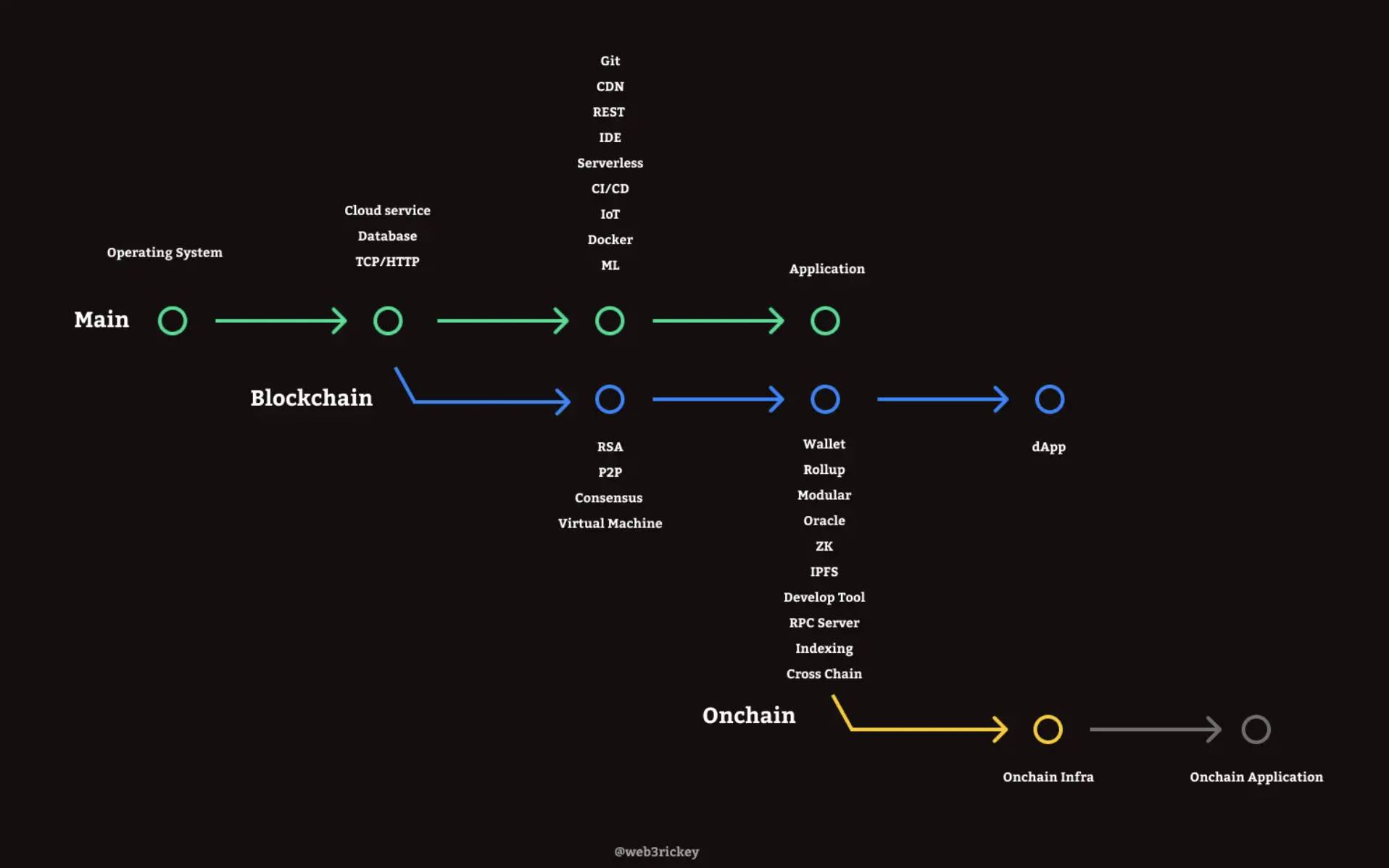
Blockchain resembles a new git branch. In the first stage of this branch, foundational elements such as cryptography, P2P networks, and consensus algorithms are added. These form the base for building Bitcoin, Ethereum, and other L1 networks.
In the second stage, various tools, facilities, and services built on Ethereum emerge, enabling developers to build wallets, DeFi applications, and Layer 2 networks. Interestingly, after this commit, a new on-chain branch is created. Its ultimate goal is to store user data entirely on-chain and implement application logic through smart contracts. Developers can then build truly verifiable, composable, and interoperable on-chain applications. Currently, we are in the phase of building on-chain infrastructure for this branch—and I believe we’re on the right path.
What does infrastructure bring us?
1. Reduce Monopolies
In any given domain, developers have more choices. Suppose you're a startup founder wanting to provide transaction data query services for your network—would you rather pay high fees for a proprietary block-scanning service, or deploy a free Blockscout instance?
2. Improve Efficiency
Developers migrate to more efficient tools and infrastructure. Here's how my application tech stack has evolved over the past year:
Chain: Tendermint → OP Stack
Development Tools: Truffle/Hardhat → Foundry
Contract Interaction: Web3.js / Ether.js → Viem
Storage: IPFS → BNB Greenfield
Block Explorer: Etherscan → Blockscout
Wallet: Extension Wallet → Coinbase Smart Wallet / AA
3. Increase Application Diversity
Sufficient infrastructure empowers developers to build interesting applications. A few years ago, we mostly built DeFi and NFT-related apps within the Ethereum ecosystem. Now, leveraging diverse infrastructure, you can build far more innovative products and applications:
Cloud Platform: Fleek
Authentication: Privy
Gaming: MUD, Dojo, Paima
Wallet Toolkit: Onchain Kit, rainbowkit
Open-Source Rewards: tea
Full-Stack ZK Proving Service: polyhedra
Trustless AI on Ethereum: ora
IP: StoryProtocol
4. Lower App Launch Costs
In practice, you only need to pay gas fees to deploy your contract. Thanks to mature infrastructure, even small development teams can quickly integrate existing services to achieve their desired functionality. Almost all infrastructure providers offer free developer plans—more than sufficient to support and validate early-stage ideas.
5. Accelerate Mass Adoption
This hinges on how infrastructure improves non-financialized applications and user experience. I believe this is also why many developers have shifted from building consumer crypto apps to focusing on infrastructure. It’s not that they care too much about technology—it’s that they must first resolve friction between efficiency and user experience before building applications to validate feasibility.
We may go through several phases before achieving true mass adoption:
Infrastructure Explosion Phase: Multiple different solutions emerge in the same domain, similar to Layer 2 approaches like OP, ZK, ZKEVM, and Plasma.
Infrastructure Culling Phase: The market eliminates infrastructure that lacks real utility and relies solely on tokens.
Infrastructure Stabilization Phase: Truly valuable infrastructure survives, and developers begin building diverse categories of consumer applications on top of it.
Mass Adoption Phase: Blockchain infrastructure delivers user experiences on par with Web2 services. Users don’t need to understand how blockchain works to use these applications, while enjoying better value distribution, ownership of digital assets, privacy, and censorship resistance.
6. Reduce Centralization Risks
Imagine if all our applications relied on a single infrastructure service, and one day, a government shuts it down—or arrests its core contributors or CEO—rendering the service unavailable. But because we have abundant infrastructure with alternative options, applications won't cease functioning just because one piece fails.
Keep Building Infrastructure
"Do you want to sell sugared water for the rest of your life, or do you want to come with me and change the world?" This was Steve Jobs’ line to Pepsi executive John Sculley when recruiting him to Apple.
Now I want to ask you:
"Do you want to spend your life making and trading Memecoins, or do you want to build infrastructure and change the crypto world?"
Infrastructure is the engine of the industry. It brings new narratives and visions—even if it’s just a new standard, a proposal, or an SDK. Countless builders need stories to strengthen their belief and sustain passion. Why do we believe in crypto? Why do we believe in on-chain? Become someone who builds cathedrals. If you don’t see yourself building a cathedral, get another job.
Join TechFlow official community to stay tuned
Telegram:https://t.me/TechFlowDaily
X (Twitter):https://x.com/TechFlowPost
X (Twitter) EN:https://x.com/BlockFlow_News
 @Web3Rickey