








How should Web3 bounty platforms for crypto enthusiasts ensure legal compliance?
TechFlow Selected TechFlow Selected
How should Web3 bounty platforms for crypto enthusiasts ensure legal compliance?
Web3 bounty platforms, as the frontier of blockchain technology innovation, have established a new interactive bridge between global users and project teams, while simultaneously facing a series of legal and compliance challenges.
 Navigating Web3 tides with focused insights
By ManQin Blockchain Legal Services
On July 30, the long-anticipated Layer3 officially launched on Bitget Exchange's Launchpool. This token launch event featured multiple staking mining pools and trading mining activities. By August 7, the total staked amount of its native token L3 had surpassed 100 million.
* Image source: Layer3 official Twitter
With the rapid rise of platforms such as Galxe (formerly Project Galaxy), Rabbithole, and Layer3, Web3 quest platforms have demonstrated significant potential within the blockchain ecosystem. However, the fast-paced development of this emerging industry has also triggered deep discussions about platform compliance. In this article, ManQin lawyers explore the key legal considerations for Web3 quest platforms.
Introduction to Quest Platforms
As a new digital marketing tool in the Web3 space, quest reward platforms offer project teams comprehensive solutions for campaign marketing and user engagement, while providing end users with opportunities to participate and earn incentives. Since 2020, Web3 quest platforms have undergone rapid innovation and expansion in application scenarios over just four years, evolving through three distinct phases:
Initial Transition Phase
Gleam.io, originally a Web2 social media marketing service provider, was among the first to serve the Web3 sector, catalyzing the emergence of Web3 quest platforms. During this phase, these platforms primarily focused on expanding project visibility via social media tasks, attracting users to engage with cryptocurrencies and blockchain technology.

* Image source: Gleam.io official website
Exploration and Maturity Phase
With the explosive growth of DeFi and NFTs, dedicated Web3 quest marketing platforms such as Galxe, Rabbithole, and Layer3 emerged and quickly became mainstream. While integrating new technologies, these platforms began supporting cross-chain functionality and prioritized improving user experience and enhancing liquidity.
Diversification, Transformation, and Innovation Phase
Quest platforms have expanded beyond social media promotion into broader applications such as public chain task management and data networks. They are gradually evolving from simple marketing tools into complex ecosystems aimed at driving user participation and community building across the entire Web3 landscape.
Through these three stages, Web3 quest platforms have continuously refined their services to adapt to changing market demands and technological advancements, demonstrating their growing importance and potential within the Web3 ecosystem.
Multidimensional Value and Services of Quest Platforms
Acting as an intermediary connecting projects and users, quest platforms leverage virtual asset incentive mechanisms to attract traffic. By offering a variety of airdrop tasks—such as following project social accounts, answering quizzes, and performing on-chain operations—they encourage user engagement with different projects and enable rewards in points, NFTs, or tokens.
From the user perspective, quest platforms provide intuitive guidance, educational resources, and hands-on task experiences that help Web3 newcomers learn blockchain technology and concepts while quickly mastering on-chain operations. Users can earn airdrop rewards and increase their activity levels. Moreover, by completing tasks, users accumulate verifiable records of on-chain and off-chain activities, efficiently building cross-platform reputation and enhancing their on-chain identity.

Beyond individual benefits, Web3 quest platforms typically collaborate with numerous projects, serving as effective channels for marketing and outreach:
First, precise marketing and user acquisition. Leveraging both on-chain and off-chain data analytics, platforms identify genuine and active target users. Through task distribution and reward systems, they assist projects in acquiring new users, increasing visibility, expanding user bases, and avoiding fake accounts and Sybil attacks.
Second, multidimensional marketing analytics. Platforms provide detailed dashboards and analytical tools, enabling projects to monitor campaign performance in real time—including key metrics like conversion rates, user engagement, and task completion rates—and dynamically adjust marketing strategies accordingly.
Third, technical support and customization. Quest platforms offer technical assistance including smart contract deployment, API integration, data interfaces, and KYC verification, along with customized services tailored to specific project needs.
Fourth, joint marketing campaigns. Platforms allow projects to partner with other initiatives or communities to run cross-project promotional events, strengthening brand exposure, sharing resources and user bases, and achieving mutual benefits. For example, Layer3 has partnered with several DeFi projects (e.g., SushiSwap and Aave) through co-marketing campaigns, where users complete tasks for DeFi projects to earn Layer3 rewards, as well as receive tokens or NFTs from the respective DeFi projects.
Transformation and Evolution of Quest Platforms
As the industry matures, quest platforms are exploring diversified use cases across public chains, data networks, tokens, Discord, and more, striving to maximize the value of accumulated user and project resources.
Galxe, a leader among Web3 quest platforms, holds a clear first-mover advantage in transformation. It has launched its native tokens GAL and G (with the latter set to replace the former) and officially unveiled the Gravity public chain in June this year, planning to fully launch its mainnet in Q2 2025. This aims to further strengthen cross-chain collaboration with major blockchains such as Ethereum, Binance Smart Chain, and Polygon. Additionally, Galxe is actively exploring data networks and Discord communities, working toward building a decentralized identity (DID) system and maintaining vibrant Discord communities. Through a multi-channel development strategy, Galxe seeks comprehensive growth across sectors, delivering richer and more diverse Web3 experiences.
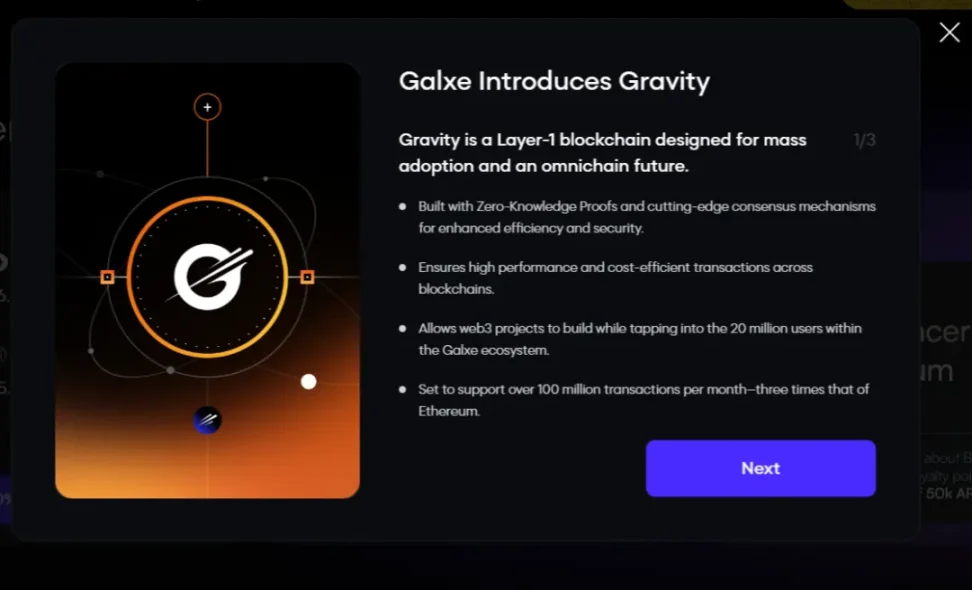
* Image source: Galxe official website
Since 2023, Soquest has accelerated its shift from a quest platform to a data network, launching a series of new features and services centered around data sharing, privacy protection, and data monetization. In this domain, Soquest grants users full control over their personal data, allowing them to profitably share data with various apps and services while preserving privacy.
Legal Compliance Considerations for Quest Platforms
As illustrated above, in today’s digital era, Web3 quest platforms represent a novel interactive model, offering a fresh channel for global interaction between users and projects. However, their global nature brings complex legal and compliance challenges:
Regulatory Compliance
Regulatory attitudes toward Web3 ventures vary significantly across jurisdictions. When establishing a global Web3 quest platform and attracting international projects and users, platforms face complex challenges regarding cross-border regulation, applicable laws, and jurisdictional issues. For instance, China prohibits token issuance, restricting domestic quest platforms from launching native tokens.
Moreover, certain countries (e.g., the United States, Singapore) may classify virtual currencies as securities. This means that token reward distributions by quest platforms must comply with securities laws—requiring either registration or qualifying for exemptions. Failure to do so could result in legal action and fines.

In addition, due to the anonymity associated with tokens and other blockchain assets, quest platforms may become conduits for money laundering and other illicit activities. To mitigate such risks, platforms should implement KYC procedures—ranging from strict to lenient—based on regional regulatory requirements. However, it is important to note that this conflicts with Web3’s core principles of decentralization and anonymity. Platforms must therefore strike a balance between compliance and user privacy.
Data Compliance
The diversified applications of quest platforms bring immense growth potential but also higher compliance expectations. Amid the trend toward data networks, data compliance must be a central focus for platform development.
Regarding data collection and sharing, platforms often gather users’ wallet addresses, transaction histories, and other on-chain and off-chain data to provide user insights to projects, track task completion, and distribute rewards. However, most major jurisdictions impose clear legal obligations on platforms regarding disclosure and user consent—for example, the EU’s General Data Protection Regulation (GDPR)—particularly concerning off-chain data collection and analysis. Take Galxe as an example: although it primarily relies on on-chain data, once additional user information (such as off-chain email addresses or social media accounts) is involved, Galxe must ensure that such data collection and usage complies with relevant data protection regulations.

Furthermore, cross-border data transfers pose sensitive legal concerns. In China, for example, Article 2(2) of the Data Security Law explicitly states: “Where data processing activities conducted outside the territory of the People’s Republic of China harm the national security, public interest, or lawful rights and interests of citizens or organizations of the People’s Republic of China, legal liability shall be pursued according to law.” This applies not only to foreign data processors but also to those based domestically whose data processing occurs abroad. Therefore, quest platforms must strictly adhere to relevant laws when transferring data across borders to avoid potential legal risks.
Criminal Risks
In operating Web3 quest platforms, if project teams conduct fraudulent airdrop schemes and execute RugPulls to steal user funds, they typically commit fraud—a criminal offense. If the quest platform provides technical support during such acts, it may bear certain criminal liability. Given the varying virtual currency-related criminal laws globally, platforms may face different levels of risk depending on the location of the project team or victims. For example, if either the project team or victims are located in China, and the quest platform clearly knows about the fraudulent intent of the project team, understands the nature and consequences of the actions, yet still provides assistance or participates extensively, it may be deemed jointly liable for fraud. If the platform fails to fulfill its statutory due diligence obligations in reviewing projects and becomes aware that a project is using the platform to commit crimes, it may be considered complicit through technical support, facing risks under aiding-and-abetting or "helping information network crime" provisions.
Therefore, platforms should establish rigorous review and monitoring mechanisms, strengthen due diligence during project promotion and user management, and proactively prevent and respond to potential fraudulent activities to reduce criminal risks.
ManQin Lawyers’ Summary
As a frontier of blockchain innovation, Web3 quest platforms bridge global users and projects, while simultaneously confronting numerous legal and compliance challenges. Based on the analysis above, ManQin lawyers offer the following recommendations:
-
Understand and comply with international laws. Ensure global operations align with local regulations, particularly securities and data protection laws, to maintain legal legitimacy worldwide.
-
KYC and AML measures. Implement robust customer identification and anti-money laundering protocols, balancing user privacy with compliance requirements.
-
Data protection. Adhere to data protection standards across jurisdictions, ensuring secure and lawful use of user data to build trust.
-
Cross-border data compliance. Follow regulations such as the Data Security Law to ensure legality and security in cross-border data transfers.
Risk management and due diligence: Establish project review mechanisms to prevent fraud and illegal activities, reducing criminal exposure.
Faced with regulatory scrutiny, data compliance demands, and criminal risk prevention, Web3 quest platforms must strike a balance between innovation and compliance. Only then can they fully unlock project potential, maximize user resource value, and drive the broader blockchain ecosystem toward higher-level development.
Join TechFlow official community to stay tuned
Telegram:https://t.me/TechFlowDaily
X (Twitter):https://x.com/TechFlowPost
X (Twitter) EN:https://x.com/BlockFlow_News










