The New Favorite for Traffic: Can Bitcoin Staking Lead the Next Wave of Liquidity Release?
TechFlow Selected TechFlow Selected
The New Favorite for Traffic: Can Bitcoin Staking Lead the Next Wave of Liquidity Release?
This article will review the latest developments and prospects in the Bitcoin restaking sector, analyze the underlying financial logic, and explore potential future directions and market opportunities.
 Navigating Web3 tides with focused insights
By Chandler, Foresight News
In recent years, Bitcoin's scalability has remained a central issue in the blockchain space. As Bitcoin is increasingly recognized as digital gold, its inherent limitations have driven market participants to continuously explore technical pathways to enhance its liquidity and scalability. From sidechains and the Lightning Network to Layer 2 scaling solutions, various attempts have emerged. However, these current solutions are still in their exploratory stages and have yet to achieve widespread adoption or consensus.
At the same time, staking yield has become an innovative way of capital utilization, gradually reshaping the financial logic of the Bitcoin ecosystem. Particularly in the realm of staking and restaking, users earn additional returns by staking Bitcoin, thereby enhancing asset liquidity while expanding Bitcoin’s application potential within DeFi. Especially following Babylon's mainnet launch, market attention toward restaking has reached new heights, with the resulting on-chain fee wars further highlighting the intensity of activity in this sector.
On August 22, Babylon launched the first phase of its Bitcoin staking mainnet. According to data from mempool.space, Bitcoin network transaction fees surged to over 1,000 satoshis per byte—compared to recent periods when fees were consistently below 5 satoshis per byte. Based on official information from Babylon, the initial cap of 1,000 BTC for staking was fully subscribed within just six Bitcoin blocks. Data from the Babylon staking platform shows that the confirmed total value locked (TVL) reached 1,000.04549438 BTC, with approximately 12,720 users participating in the staking event.
The launch of the Babylon mainnet not only attracted significant liquidity but also prompted market participants to reevaluate Bitcoin’s capital efficiency. Through restaking protocols, investors can optimize their capital returns without sacrificing asset security, thereby enhancing overall market liquidity. This model demonstrates strong appeal in the current market environment—particularly amid rising on-chain transaction costs—driving more users toward efficient restaking protocols.
In its report "Nine Sectors Set to Explode in Web3 in 2024," ArkStream Capital stated that the convergence of purism and market trends could unleash energy beyond the imagination of technological purists, noting that unlocking Bitcoin liquidity represents a gold mine yet to be fully excavated. After the narrative boom around inscriptions comes a wave of Bitcoin L2s and Bitcoin-native applications. With expectations that Bitcoin’s liquidity could increase by over 10%, BTCFi is poised to support a market exceeding $100 billion.
This article reviews the latest developments and future prospects in the Bitcoin restaking landscape, analyzes the underlying financial mechanics, and explores potential evolutionary directions and market opportunities.
Bitcoin Liquid Staking
As a proof-of-work (PoW) network, Bitcoin relies on miners contributing computational power to maintain network consensus. However, with the rapid development of DeFi, Bitcoin’s use cases continue to expand. Liquid staking is an emerging mechanism designed to enhance Bitcoin’s capital efficiency and liquidity. It allows users to lock Bitcoin into staking contracts to participate in consensus and earn rewards, while still maintaining asset liquidity.
A key advantage of liquid staking lies in its broad applicability within DeFi. As Bitcoin is regarded as an asset with high economic security, an increasing number of financial applications and blockchain projects are leveraging Bitcoin’s economic security to strengthen their own safety and credibility. The liquid tokens generated through Bitcoin staking can be used across decentralized money markets, stablecoins, insurance, and other financial applications, significantly improving capital efficiency for these platforms.
Currently, implementations of Bitcoin liquid staking fall into three primary categories, each with distinct characteristics, advantages, and trade-offs.
The first approach is on-chain self-custody. This method uses Bitcoin scripts to create staking contracts, incorporating advanced cryptographic techniques such as One-Time Signature (EOTS) and timestamping protocols to ensure the security and finality of staked assets. The core idea is to keep Bitcoin on its native chain while extending its security to other chains via remote staking technology. While theoretically very secure and preserving Bitcoin’s decentralization, this approach faces high implementation complexity, particularly in addressing cross-chain synchronicity and responsiveness challenges. Projects like Babylon belong to this category.
The second approach relies on centralized custodians. In this model, Bitcoin is transferred to regulated custody accounts and then mapped onto other blockchains through a combination of off-chain and on-chain operations. Its advantages include lower implementation difficulty, faster deployment, and enhanced user asset security due to reliance on trusted custodians. However, it offers lower decentralization, requiring users to trust centralized entities, which raises concerns about counterparty risk and security. BounceBit exemplifies this model.
The third approach involves custodial models based on Multi-Party Computation (MPC) and cross-chain bridges. This method stores Bitcoin in multi-signature wallets and leverages decentralized oracle networks and cross-chain bridge technologies to migrate Bitcoin assets to other chains for tokenization. MPC provides a degree of decentralization and security, while cross-chain bridges enable inter-chain asset transfers. However, the security of cross-chain bridges remains a potential vulnerability—especially when handling large volumes of assets. Additionally, upgradable smart contracts and centralized roles mean full asset security still requires further validation.
These three approaches each present unique trade-offs in enabling Bitcoin liquid staking. On-chain self-custody offers the highest level of decentralization and security but is complex to implement; centralized custody provides operational simplicity and faster rollout at the expense of decentralization; while MPC and bridge-based models strike a balance between security and decentralization but must address inherent bridge risks.
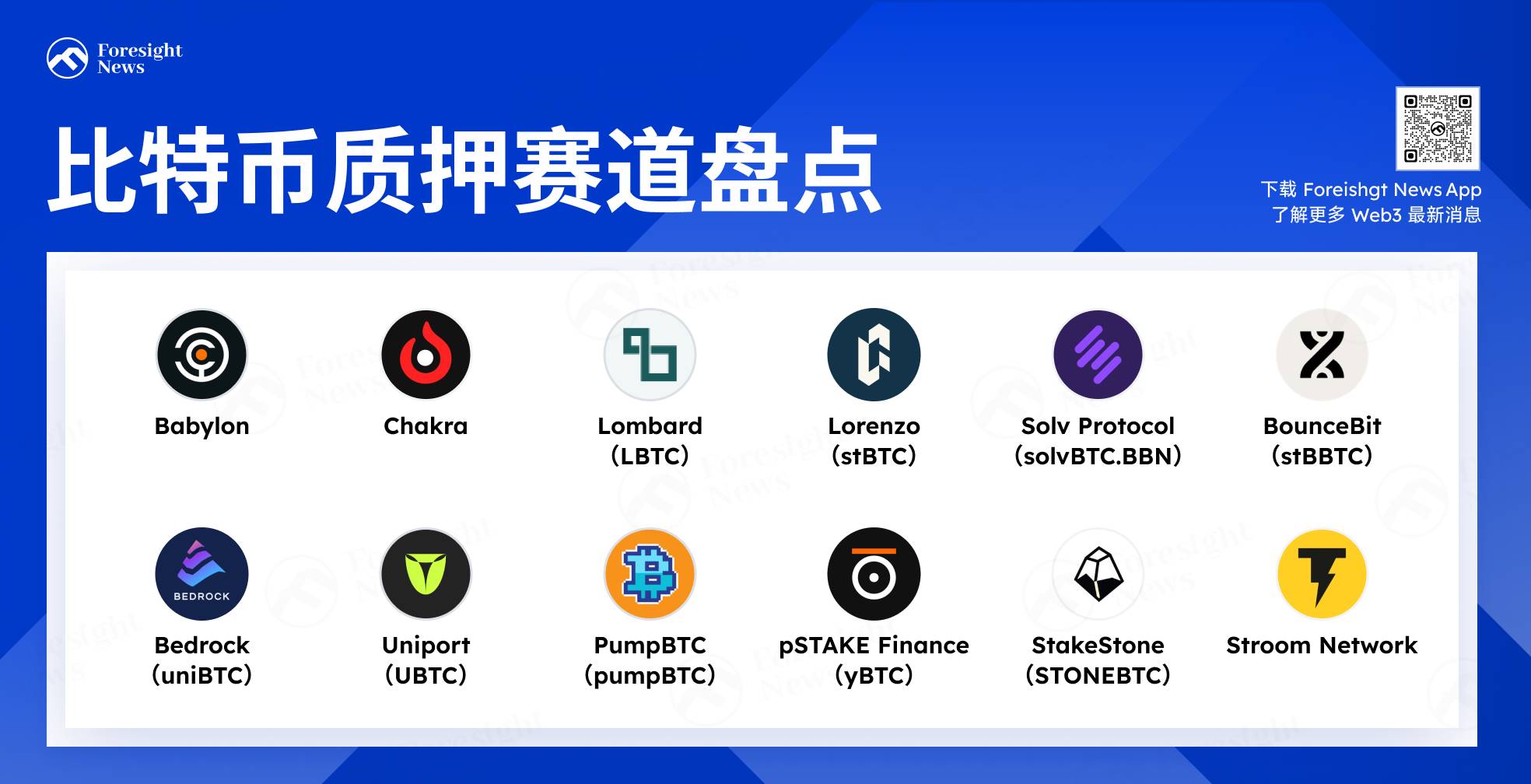
Babylon
Babylon is an innovative project that leverages Bitcoin’s native staking mechanism to provide proof-of-stake (PoS) security for other blockchains. Using cryptographic techniques, Babylon enables cross-chain staking of Bitcoin, allowing holders to earn on-chain yields while providing economic security to other PoS chains.
Babylon’s staking process relies on cryptography rather than third-party bridges or custodians. BTC stakers send transactions with two UTXO outputs: one locked via a timelock script, redeemable by the staker after the lockup period; the other sent to a temporary Bitcoin address meeting the “Extractable One-Time Signature (EOTS)” standard. When stakers run nodes on PoS chains and validate unique blocks, they sign using the EOTS private key. Honest validators receive staking rewards from the PoS chain, while malicious actors risk having their private keys exposed, leading to slashing of their staked BTC. Babylon does not rely on traditional cross-chain bridges but instead achieves “remote staking,” reducing dependency on bridges and minimizing additional security assumptions. However, the security of staking ultimately depends on the Babylon protocol itself—an assumption similar in nature to traditional bridge models.
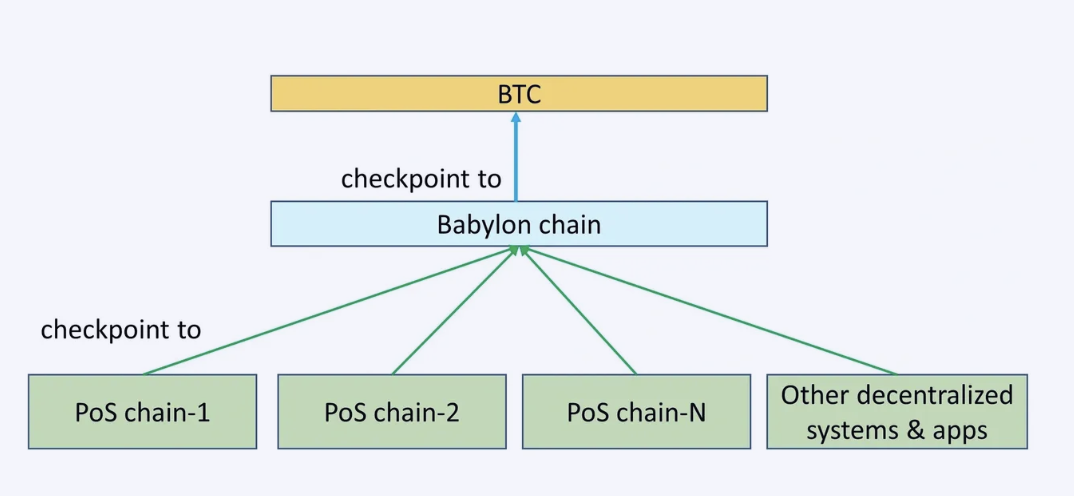
Babylon Architecture
Babylon’s protocol architecture consists of three layers: the Bitcoin network layer, control layer, and data layer. The Bitcoin network layer provides timestamping services for PoS consumer chains; the control layer comprises the Babylon blockchain network, connecting Bitcoin and Cosmos Hub while operating a marketplace matching Bitcoin staking rights with PoS chains; the data layer includes various PoS consumer chains that leverage Bitcoin’s economic security via the Babylon protocol.
Babylon’s design resembles EigenLayer, acting as an intermediary between base and upper-layer networks. However, Babylon’s distinction lies in its Bitcoin-based architecture, enabling it to deliver enhanced security to other blockchains. The protocol implements staking contracts via a Bitcoin covenant emulator, supporting staking, redemption, and slashing functions. Its slashing mechanism uses EOTS and finality gadgets to penalize malicious signers, ensuring network security. Furthermore, Babylon’s Bitcoin timestamping protocol supports fast unstaking, boosting BTC liquidity and offering advantages over other staking protocols.
Chakra
Chakra is a ZK-based Bitcoin restaking protocol that bridges Bitcoin and Ethereum-native BTC and ETH to the Chakra chain, forming an asset settlement hub for BTC L2s. Using lightweight client cross-chain technology, ChakraBTC and ChakraETH are deployed across multiple BTC L2s. Built on SCS (Settlement Consumption Services), Chakra provides restaking services for PoS chains.
Chakra employs the STARK zero-knowledge proof system to verify staking security, enabling off-chain validation of staking events to ensure privacy and integrity. Its self-custody staking model uses time-lock scripts and multi-signature vaults, allowing users to stake without transferring Bitcoin out of their wallets—eliminating third-party custody risks.
In May 2024, Chakra announced a new funding round backed by StarkWare, ABCDE, Bixin Ventures, Cogitent Ventures, Trustless Labs, Web3.com Ventures, and several angel investors. Specific funding amounts were not disclosed. As a modular settlement network, Chakra supports staking on the Bitcoin mainnet and seamless integration with other protocols. It has already integrated with Babylon, enabling users to stake BTC into Chakra and seamlessly transition to the Babylon mainnet to earn both Babylon staking rewards and Chakra’s Prana rewards. The ZK-STARK staking proofs generated by Chakra allow users to obtain liquid assets on Chakra Chain, Starknet, and other blockchains.
Lombard
Lombard is a restaking protocol within the Babylon ecosystem, aiming to advance Bitcoin’s role in DeFi by introducing LBTC—a cross-chain liquid token fully backed 1:1 by Bitcoin—and unlocking its vast economic potential.
LBTC enables liquidity and yield generation for Bitcoin in DeFi through a series of steps. Users first deposit native Bitcoin into Lombard. These Bitcoins are then staked into Babylon’s secure staking infrastructure, with Lombard managing all associated fees. Once staked, users can mint an equivalent amount of LBTC tokens on Ethereum. These tokens maintain a 1:1 peg with the staked BTC and are sent to a pre-specified Ethereum address. Despite being staked on Babylon, users retain access to staking yields through holding and utilizing LBTC.
In July 2024, Lombard raised $16 million in a seed funding round led by Polychain Capital, with participation from Foresight Ventures, Babylon, dao5, Franklin Templeton, HTX Ventures, Mirana Ventures, Mantle EcoFund, Nomad Capital, OKX Ventures, and Robot Ventures.
Lorenzo
Lorenzo is a liquid staking protocol built on Babylon, offering L2-as-a-service for rapid deployment. It aims to reduce slashing risks for stakers while unlocking liquidity for staked BTC assets. Users can stake Bitcoin into Babylon via Lorenzo and receive stBTC—a highly liquid token representing their staked BTC. Additionally, Lorenzo innovatively splits its liquid restaking token (LRT) into a Liquidity Principal Token (LPT) and a Yield Accruing Token (YAT), offering users a more flexible liquidity solution.
Lorenzo incorporates an EVM-compatible layer built on Cosmos Ethermint, enabling cross-chain operations across multiple blockchain networks and enhancing flexibility in cross-chain applications. It also uses a Bitcoin relay to bring mainnet data onto the Lorenzo application chain, facilitating issuance and settlement of Bitcoin liquidity restaking tokens.
Moreover, Lorenzo’s principal-yield separation mechanism and restaking plans further optimize yield distribution. After selecting a staking plan, users receive stBTC equal in value to their staked BTC and can separately accumulate and trade yield via YAT. This design mitigates liquidity fragmentation and offers users greater control over yield management and reinvestment.
On August 31, Lorenzo announced the official launch of its mainnet’s first phase, expanding to BNB Chain. Upgrades include opening BTCB staking and enhancing the Yield Accruing Tokens (YATs) section, allowing users to claim YATs on BNB Chain. Additionally, the second cap phase of pre-staking for Babylon has begun, now accepting native BTC and BTCB deposits. Beyond Babylon staking rewards and Lorenzo points, users will also receive additional YAT incentives thanks to Lorenzo’s innovative principal-yield split mechanism.
Solv Protocol
Solv Protocol is a cross-chain yield and liquidity distribution layer that tokenizes staking yields, restaking yields, trading strategy returns, and more across various networks, providing liquidity across ecosystems. Through deep integrations with MerlinChain, Babylon, BNBChain, and GMX, Solv rapidly accumulated over $1 billion in assets under management.
Solv Protocol partnered with crypto custodian Copper, integrating Copper’s ClearLoop network. Institutional clients of Solv can now hold assets within Copper’s infrastructure while delegating them to the Solv platform for management and trading.
In Babylon’s first staking round, Solv subscribed to 250 BTC, becoming the largest holder in Babylon’s LST category. Additionally, during the pre-staking phase, SolvBTC.BBN had already integrated with over ten public chains and DeFi projects.
BounceBit
BounceBit is a Bitcoin restaking infrastructure aimed at solving Bitcoin’s low liquidity and limited use cases on its native chain. By introducing a dual-token PoS structure, BounceBit creates a new liquidity ecosystem using wrapped BTCB instead of native BTC. BTCB is converted into BBTC and transformed into a liquid restaking token (LRT) called stBBTC through shared security mechanisms.
BounceBit’s architecture consists of three components: BounceBit Protocol, BounceBit Chain, and Share Security Client (SSC). BounceBit Protocol serves as its CeFi component, allowing users to deposit BTC and receive a 1:1 Liquid Custody Token (LCT), such as BounceBTC (BBTC). Deposited assets are held in MPC-managed custody accounts and generate returns through low-risk strategies like funding rate arbitrage, facilitated by a partnership with Binance, with profits returned to users.
In May 2024, BounceBit officially launched its mainnet. Running as an independent Layer 1 network, BounceBit Chain uses BB as its gas token. The mainnet introduced several new features including node staking and delegation, Premium Yield generation, liquidity custody, and cross-chain capabilities to BounceBit and BounceClub. In September, BounceBit partnered with intent-execution network dappOS, where dappOS’ intent assets will use stBBTC issued by BounceBit as one of their underlying yield sources, while retaining flexibility in native asset usage.
Bedrock
Bedrock is a multi-asset liquid restaking project that collaborates with Babylon to launch the LRT token uniBTC. Users can stake WBTC on Ethereum to receive uniBTC. Bedrock connects with Babylon through proxy staking and direct conversion: the proxy mechanism stakes an equivalent amount of native BTC on Babylon when users stake wBTC on Ethereum; direct conversion swaps WBTC for BTC and stakes it directly on Babylon. Holding uniBTC grants access to BTC yield and enables usage across other DeFi protocols.
Uniport
Uniport is a Bitcoin restaking chain that uses a Cosmos SDK-based UniPort zk-Rollup Chain to achieve multi-chain interoperability for BTC ecosystem assets. Its cross-chain solution converts native BTC into UBTC, managed via a centralized multi-sig cold wallet (with plans to transition to multi-sig contracts). UBTC will be deeply integrated with Babylon.
Technically, UniPort initially manages cross-chain assets through a multi-sig consortium to ensure security and decentralization. To further enhance security, UniPort implements mechanisms including economic design and reserve management, node staking and rotation, and safeguards against malicious behavior. For cross-chain transfers involving smart contract chains, UniPort employs zero-knowledge proofs and light client verification to ensure efficiency and security. UniPort has also optimized existing ZK proof systems, launching its proprietary UniVirgo proof system.
PumpBTC
PumpBTC is a liquid staking protocol built on Babylon. Partnering with licensed custodians Cobo and Coincover, PumpBTC ensures maximum protection for native Bitcoin assets. Staked Bitcoin can be used across various EVM-compatible chains and L2/L3 solutions. This multi-chain functionality allows users to employ their Bitcoin as collateral or liquidity provider tokens, significantly expanding utility across multiple blockchain ecosystems. Users earn native yields directly from the Babylon protocol.
During the first phase of Babylon’s mainnet staking, PumpBTC successfully delegated 118.4288 BTC, accounting for 11.8% of the total.
pSTAKE Finance
pSTAKE Finance is a cryptocurrency project focused on liquid staking services, initially launching in the Cosmos ecosystem. In July this year, pSTAKE Finance introduced a Bitcoin liquid staking solution on Babylon. The protocol sets a deposit cap of 50 BTC to ensure security.
Additionally, pSTAKE Finance plans to further improve user experience with its upcoming v2 version, which will introduce yBTC tokens on Ethereum. These tokens will offer auto-compounding Bitcoin yields similar to cTokens and will be integrated into major DeFi ecosystems across various blockchains, Ethereum L2s, and Bitcoin L2s.
StakeStone
StakeStone is a cross-chain liquidity infrastructure that deposits native BTC into Babylon for staking and issues STONEBTC—a cross-chain interest-bearing liquid BTC token.
In August, StakeStone announced a strategic partnership with Berachain, deploying its STONE token across the Berachain bArtio testnet. Users can now utilize StakeStone’s liquid assets—STONE, ssBTC, and STONEBTC—within the Berachain ecosystem to earn yields.
Stroom Network
Stroom Network is a liquid staking protocol for Bitcoin on the Lightning Network. By applying liquid staking mechanisms, Stroom enables users to leverage their Bitcoin capital in both the Lightning Network (LN) and DeFi in a decentralized manner.
In August 2023, Stroom Network announced a $3.5 million raise led by Berlin-based crypto investor Greenfield, with participation from Ankr’s venture arm Mission Street, Lemniscap, No Limit Holdings, and Cogitent Ventures. The funds will support team expansion and the launch of Bitcoin “liquid staking” on the Lightning Network, including releasing lnBTC—an Ethereum-wrapped token representing Lightning Network BTC.
Summary
Within the financial logic of Bitcoin staking yield, the value of liquidity release occupies a central position. As the world’s largest cryptocurrency by market cap, Bitcoin has traditionally served as a store of value, with its liquidity often locked in cold wallets or conservative storage methods. While this static holding model ensures asset security, it fails to fully unlock Bitcoin’s potential in capital markets. Liquidity release is precisely the key to breaking this limitation.
The core concept behind staking yield is combining Bitcoin’s security with other proof-of-stake networks to create dual value. On one hand, this model enables Bitcoin holders to participate in securing other blockchain networks and earn staking rewards—all while retaining sovereignty over their assets. On the other hand, for these PoS networks, integrating Bitcoin enhances their security and boosts user confidence, potentially driving substantial growth in TVL. Behind this win-win mechanism lies the pursuit of maximizing capital utilization, further expanding Bitcoin’s role beyond a mere “digital gold” store of value into a productive financial asset capable of generating continuous yield.
Looking ahead, as cross-chain technologies mature, one key evolutionary direction for Bitcoin staking yield will likely focus on improving cross-chain interoperability and optimizing liquidity management. Current cross-chain solutions still face challenges in security and efficiency. Once these bottlenecks are overcome, Bitcoin staking will no longer be confined to isolated blockchain networks but will flow freely across multiple chains. This would dramatically increase Bitcoin’s capital utilization and drive deeper integration across the broader crypto finance ecosystem, creating more yield opportunities for Bitcoin holders and participants.
Simultaneously, the deepening of the CeDeFi model will become a major trend in this space. By combining the efficiency of CeFi with the transparency of DeFi, CeDeFi delivers staking services that are both secure and efficient. This model is especially suitable for Bitcoin holders who demand high security but also desire liquidity. As CeDeFi infrastructure matures, it will attract more traditional financial institutions into the ecosystem, fostering a more stable and sustainable yield environment for digital assets. Moreover, as staking yield becomes more widespread, the derivatives market around Bitcoin is expected to expand further, offering rich hedging and speculative tools—and injecting fresh momentum for financial innovation into the Bitcoin staking ecosystem.
Join TechFlow official community to stay tuned
Telegram:https://t.me/TechFlowDaily
X (Twitter):https://x.com/TechFlowPost
X (Twitter) EN:https://x.com/BlockFlow_News
 Foresight News