Bitcoin ETF Investors Face $2 Billion Loss—What Should Retail Investors Do?
TechFlow Selected TechFlow Selected
Bitcoin ETF Investors Face $2 Billion Loss—What Should Retail Investors Do?
With three major uncertainties coexisting, investing can still allow one to "pluck chestnuts from the fire."
 Navigating Web3 tides with focused insights
Author: 10x Research
Translation: Odaily Planet Daily Wenser
Editor's Note: As interest rate cuts in September and the U.S. presidential debate approach, renowned crypto research firm 10x Research has once again conducted an in-depth analysis of current market conditions, identifying three major sources of uncertainty—particularly highlighting that Bitcoin ETF investors currently face potential losses of up to $2 billion. Odaily Planet Daily presents this translated summary of 10x Research’s insights for reader reference.
Impact of Market Uncertainties: Watching and Testing Support Levels
Currently, the two primary sources of market uncertainty are the Federal Reserve's actions in September and the outcome of the U.S. presidential election.
In the next two weeks, with the Fed entering its blackout period ahead of policy announcements, traditional financial markets may remain on hold.
Meanwhile, Bitcoin is testing technical support levels. (Odaily Planet Daily note: According to chart data, 10x Research believes Bitcoin’s technical support range lies between approximately $49,100 and $52,599.)
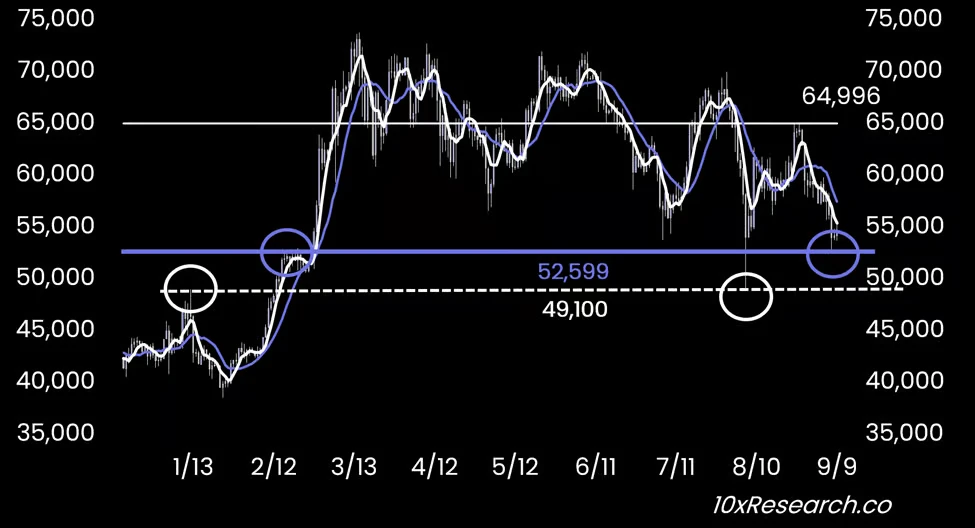
Bitcoin Testing Technical Support
We expect the Federal Reserve to cut rates by 50 basis points to stay ahead of economic volatility. Given the lagging effects of monetary policy over subsequent quarters, a 25-basis-point cut might still be insufficient to prevent greater economic damage.
Although a 50-basis-point rate cut could signal deeper concerns to the market, the Fed's main focus remains mitigating economic risks rather than managing market reactions. Despite the current 29% probability assigned to a 50-basis-point cut, this outlook contradicts both our view and growing consensus. There is increasing belief that the Fed is behind the curve—having been caught off guard by various market data in July, it overlooked signs of labor market weakness.
Trump Has Higher Probability of Winning; Presidential Debate May Clarify Election Outlook
In politics, prediction market Polymarket shows Trump has a 51% chance of winning the election versus Kamala Harris at 46%. Prominent political analyst Nate Silver also provides similar figures: Trump has a 63.8% chance of victory, while Harris stands at just 36%, marking a new high in Trump’s support. This shift stems largely from the Democratic National Convention, where Harris reaffirmed her commitment to a high-tax policy agenda.
However, Allan Lichtman, who used the "13 Keys" method to correctly predict nine out of the past ten presidential elections, currently forecasts that Harris will win this year’s election, as she holds eight of the 13 keys in his model (equivalent to an 8/13 probability).
The upcoming “Harris vs. Trump” presidential debate on Tuesday, September 10, is expected to bring greater clarity to the race. So far, Harris has avoided extensive media exposure, relying instead on favorable press coverage rather than direct voter engagement—a strategy that gives the impression that Democratic leadership, not Harris herself, is orchestrating her campaign narrative. While established power structures coordinate efforts behind the scenes, we still lean toward a Trump victory, just as we predicted in 2016.
CPI Release Imminent, Bitcoin Rebound Underway
The U.S. CPI report released the day after the debate will carry more significance than usual. Markets currently anticipate a sharp decline from 2.9% to 2.6%, which could provide strong justification for a 50-basis-point Fed rate cut. The current Fed funds rate stands at 5.25%–5.50%, and monetary policy above 3.0% is generally considered restrictive, suggesting a potential easing range of about 200 basis points. This view is somewhat confirmed by 2-year Treasury yields, which price in expectations of a 160-basis-point rate cut. Unless CPI remains at or above 2.9%, we anticipate a 50-basis-point reduction.
Earlier this year, markets widely expected six rate cuts in 2024. However, during the March FOMC meeting, Fed Chair Powell emphasized the need for a more flexible approach due to persistent economic uncertainty, especially amid mixed inflation data and signs of slowing growth. He also acknowledged the significant challenge of reaching the Fed’s 2% inflation target. Bitcoin reached a price peak following higher-than-expected CPI data in March but dropped sharply after the FOMC meeting, underscoring the critical importance of the coming ten days.
After the March FOMC meeting, inflows into Bitcoin spot ETFs lost momentum. Although inflows recovered somewhat in May and July, the average ETF entry price remains near $60,000. Thus, $17 billion in inflows now faces potential losses of $2 billion (with BTC currently around $53,000). This week, the U.S. presidential debate may help alleviate some election-related uncertainty. Conversely, the FOMC meeting could increase uncertainty—especially given recent downward revisions in labor market data, which may prompt the Fed to emphasize concerns about downside economic risks.
Following last week’s sharp decline, Bitcoin is attempting a price rebound. Two out of three reversal indicators have recovered from deeply oversold levels, further signaling potential for short-term and countertrend rallies. Historically, the last three times the stochastic indicator reached similar levels, Bitcoin marked relative lows.

Stochastic Indicator Suggests Potential Reversal Ahead
Trading Guidance: Tactical Approach with Key Watch Levels at $52,600 and $49,100
Given current technical analysis, initiating new short positions at higher levels may be more favorable.
A tactical approach could involve covering shorts and waiting for Bitcoin to approach the $58,000 level, particularly before the “Harris vs. Trump” debate, when traders may become broadly optimistic about a “Trump win.”
After breaking below the $56,000 support level, Bitcoin fell precisely to $52,600—the price peak seen in February 2024—forming a medium-strength support zone. In February, Bitcoin rebounded by month-end, followed by MicroStrategy purchasing 3,000 BTC, then acquiring another 21,000 BTC by mid-March, marking the peak of that rally.
Tactical long positions based on short-term technical reversals ahead of Tuesday’s debate should use $52,600 as a stop-loss level. The next support level sits at $49,100, which was the price high when Bitcoin spot ETFs launched in January and also triggered a reversal during Bitcoin’s downturn in early August.
Notably, while these rebounds may only be temporary, they could offer tactical opportunities for longer-term trades. Lower CPI data might also give bulls temporary momentum. However, with the FOMC meeting likely to heighten uncertainty next week and the U.S. election result still uncertain despite rising optimism around a potential Trump victory (peaking during Tuesday’s debate), Bitcoin may continue seeking stronger support to fuel a more substantial year-end rebound.
In summary, the three key uncertainties—the U.S. presidential election, CPI data release, and the Fed’s FOMC meeting—may increase market volatility, but tactical traders can still leverage this uncertainty for profit.
Join TechFlow official community to stay tuned
Telegram:https://t.me/TechFlowDaily
X (Twitter):https://x.com/TechFlowPost
X (Twitter) EN:https://x.com/BlockFlow_News