Russia cannot do without cryptocurrency
TechFlow Selected TechFlow Selected
Russia cannot do without cryptocurrency
On the financial battlefield, Russia has long become reliant on cryptocurrency.
 Navigating Web3 tides with focused insights
Article: TechFlow
In 2011, when Li Xiaolai was still a teacher, he described Bitcoin as "a force that turns the world upside down." Bitcoin marked the first time in human history that private property became truly inviolable through technological means.
This statement may sound abstract, but by 2022, ordinary Russians had experienced its true meaning firsthand.
When financial sanctions crippled traditional financial infrastructure, cryptocurrency emerged as Plan B. Stablecoins like USDT became settlement currencies for international trade, and many Russian oligarchs turned to crypto for wealth transfer.
The Russian government has since passed legislation allowing the use of digital currencies in cross-border transactions and exchange trading starting September 1, 2024, and will legalize cryptocurrency mining in Russia beginning in November.
Yet surprisingly, Russia's current cryptocurrency capital is not Moscow, but Dubai—thousands of miles away.
Russia Needs Cryptocurrency
Under the shadow of the Ukraine war, cryptocurrency (Crypto) has found its most fertile ground in Russia, thriving amid crisis.
As early as the beginning of the conflict, Reuters reported that a large number of Russian billionaires brought hundreds of millions of dollars worth of cryptocurrency to Dubai to cash out—even purchasing local real estate directly with Bitcoin, as the UAE did not join U.S. and EU sanctions against Russia.
With Western financial sanctions forcing numerous European and American companies to exit the Russian market and disrupting international banking systems, cryptocurrencies like USDT stepped into the spotlight.
In April 2024, the U.S. Deputy Treasury Secretary formally stated before the Senate Committee on Banking, Housing, and Urban Affairs that Russia is using Tether’s USDT stablecoin to circumvent economic sanctions.
This shift hasn’t gone unnoticed—even Chinese entrepreneurs doing business in Russia are feeling crypto’s pulse.
After the Russia-Ukraine conflict, Western nations blocked automobile exports to Russia, making China the primary car supplier. Many Chinese traders spotted an opportunity; Lin Xiang was one of them.
They typically order new vehicles in Xinjiang, register them locally with license plates and insurance, then de-register them and export them as used cars. These vehicles are transported via land border crossings such as Khorgos, enter Kyrgyzstan’s capital Bishkek, and from there move into major Russian cities like Moscow or St. Petersburg—taking advantage of favorable tariff agreements between Kyrgyzstan and Russia.
For example, the Chinese-made Li Auto L9—with its spacious interior, fridge, TV, premium seats, and heating—is seen by Russians as a "budget Range Rover," gaining popularity among wealthy Russians. According to recently published national sales data for January–February 2024, the city with the highest Li Auto sales wasn't Beijing, Shanghai, Guangzhou, or Shenzhen—it was Ürümqi, Xinjiang.
The Tank 500 and Li L9 sell for around 400,000 RMB in China but fetch over 9 million RUB (approximately 700,000 RMB) in Russia.
However, these Chinese traders profiting in Russia face their own challenges: they earn rubles, but converting them back into RMB is difficult and vulnerable to extreme exchange rate fluctuations, so they prefer not to hold rubles.
As a result, some have begun converting rubles into USDT or receiving payments directly in USDT, fueling a booming underground USDT/RUB OTC market, where USDT trades at about a 1% premium compared to USD/RUB rates.
You might wonder, why not just use RMB for transactions?
Bloomberg addressed this in a July report titled “Direct RMB Payments Growing Harder: Russian Firms Gambling When Trading With China.”
Several major Russian commodity exporters said that after the U.S. expanded its sanction criteria in June, direct RMB payments were increasingly being frozen or delayed, turning trade with China into a game of chance. Threats of U.S. sanctions and secondary sanctions have made more and more Chinese banks reluctant to process payments or facilitate foreign trade with Russia.
Companies facing issues usually find alternative methods—such as using cryptocurrency or routing transactions through former Soviet states like Kazakhstan or Uzbekistan—but these options increase costs.
Senior executives from at least two large Russian metal producers revealed they’ve started using Tether’s stablecoins and other cryptocurrencies to settle part of their cross-border transactions, primarily with Chinese clients and suppliers.
The surge in crypto usage has helped Russia bypass financial sanctions, prompting the Russian government to revise its crypto policies and offer support.
On July 30, 2024, Russia’s State Duma passed a bill in its second and third readings permitting the use of digital currencies—including Bitcoin (BTC), Ethereum (ETH), and stablecoins like USDT—in cross-border and exchange trading starting September 1, 2024—marking a significant shift in Russia’s stance toward cryptocurrency.
Additionally, Russia passed another law legalizing cryptocurrency mining starting in November. Russian legal entities and individual entrepreneurs registered with the Russian Ministry of Digital Development will be authorized to engage in crypto mining.
According to Russian outlet Kommersant, Russia plans to establish at least two new cryptocurrency exchanges—one based on the Saint Petersburg Currency Exchange focused on foreign trade, and another planned for Moscow, with the main idea being to create a stablecoin pegged to the RMB and a BRICS currency basket.
Amid financial sanctions, blockchain and cryptocurrency have provided Russians with a decentralized, relatively censorship-resistant financial infrastructure at minimal cost.
It’s fair to say that today, Russia and cryptocurrency have become symbiotic.
Dubai: Russia’s Crypto Capital
Here’s a little-known fact: Russia’s cryptocurrency capital isn’t Moscow—it’s Dubai.
Dubai offers political stability with low transparency, sunny weather with legal gray zones, residency visas through property purchases, and no extradition treaties with Western nations. This makes it the top destination for Russian oligarchs and elites seeking to evade sanctions and transfer wealth—a paradise for cryptocurrency development.
As mentioned earlier, when the war began, vast numbers of Russian billionaires arrived in Dubai with billions in cryptocurrency to cash out—even buying local properties directly with Bitcoin—contributing significantly to rising Dubai property prices.
With so many crypto-rich individuals pouring in, many local Dubai real estate developers now accept cryptocurrency payments.
For instance, DAMAC Properties, a leading luxury developer in Dubai, began accepting cryptocurrency payments this year. Emaar Properties, the developer behind the Burj Khalifa—the world’s tallest building—now accepts Bitcoin, Ethereum, and other cryptocurrencies for its properties.
In Dubai, real estate and cryptocurrency are so closely linked that many real estate professionals have one foot in the crypto world. At Dubai’s crypto events, real estate agents are everywhere, giving rise to uniquely Dubai-style crypto projects—Web3 Real Estate.
Examples include Dubai-based Web3 real estate platforms HouseLux and Directly, which tokenize Dubai properties, allowing investors to purchase RWA assets and gain ownership in Dubai real estate.
Meanwhile, a growing number of Russian businesses and individuals are relocating to Dubai.
Russian faces are now ubiquitous across Dubai, prompting long-term residents to exclaim, “Russians have taken over Dubai.”
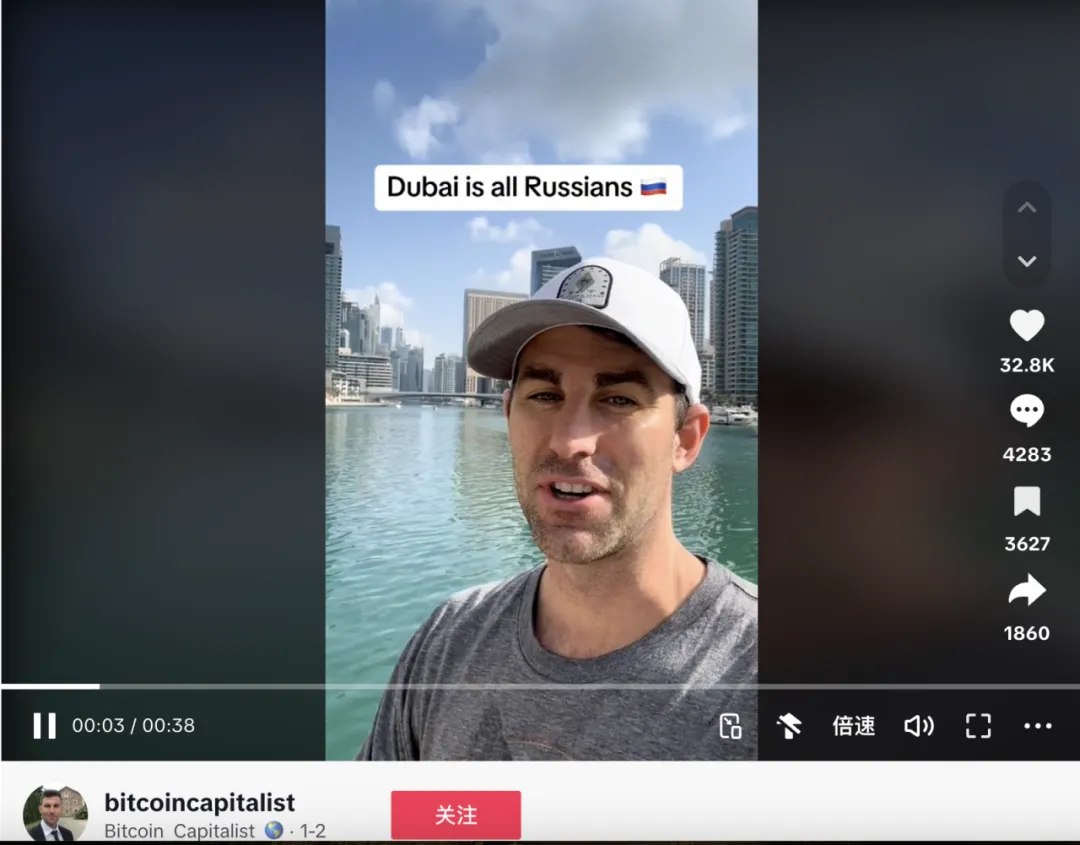
Dubai’s International Free Zone Authority (IFZA), created to attract foreign investment, has seen explosive growth. IFZA Executive Director Jochen Knecht stated, “The number of Russian entrepreneurs and startups has increased tenfold compared to last year.”
Take Telegram, the messaging app founded in Russia—its headquarters are now in Dubai. Its founder, Pavel Durov, holds a UAE passport and resides in Dubai.
The core of the entire TON ecosystem is also centered in Dubai.
According to insiders, all board members of the Ton Foundation now live in Dubai. Moreover, TOP (The Open Platform), the core development team behind the TON ecosystem, is headquartered in Dubai. Its founder Andrew is also a member of the TON Foundation.
TOP develops multiple tools and projects within the TON ecosystem, including Wallet in Telegram, standalone wallet TonKeeper, and Notcoin, which already boasts several million users.
DWF, a well-known Russian-backed crypto market maker, also has one of its main hubs in Dubai.
In Dubai, offering crypto financial services to wealthy Russians has become a profitable business—but it has also drawn the attention of U.S. sanctions.
In 2023, the U.S. Department of Treasury’s Office of Foreign Assets Control (OFAC) sanctioned 22 individuals and 104 entities for helping Russia evade sanctions. Among them was John Hanafin, founder of Dubai-based Huriya Private, accused of assisting Russians with asset transfers and investment citizenship. His Ethereum wallet was flagged by OFAC—an address that received approximately $4.9 million in cryptocurrency, mostly USDT.
In an era of escalating regional conflicts and geopolitical tensions, cryptocurrency—often associated with the gray economy—is becoming intricately intertwined with Russia in clever and self-sustaining ways.
The arrest of Telegram’s founder in France was widely interpreted as a move in the geopolitical chess game between the West and Russia. Beyond the physical battlefield, multiple invisible parallel wars are unfolding—on the financial front, Russia has already become inseparable from cryptocurrency.
Join TechFlow official community to stay tuned
Telegram:https://t.me/TechFlowDaily
X (Twitter):https://x.com/TechFlowPost
X (Twitter) EN:https://x.com/BlockFlow_News
 深潮TechFlow