Sorting Through Ethereum Foundation's Public Spending: $170 Million in Project Grants Issued Becomes the Budget "Main Component"
TechFlow Selected TechFlow Selected
Sorting Through Ethereum Foundation's Public Spending: $170 Million in Project Grants Issued Becomes the Budget "Main Component"
More than $170 million has been allocated to date, once accounting for 60 percent of the annual budget.
 Navigating Web3 tides with focused insights
By Nancy, PANews
Transparency issues surrounding the Ethereum Foundation (EF) have once again come under scrutiny. Recently, EF faced community backlash following large-scale ETH sales. In response, the foundation stated these were part of routine financial management activities and revealed an annual budget of approximately $100 million, primarily allocated to grants and salaries. However, in recent years, EF has not publicly disclosed detailed expenditure records, leading to growing criticism over its lack of operational transparency.
Meanwhile, Hudson Jameson, a former EF employee, shared insights into the foundation’s budgeting practices, noting that funds are mainly used to support various global initiatives and projects. He highlighted that the foundation distributes substantial grants annually, which constitute a significant portion of its budget.
Over $170 Million Disbursed to Date, Once Accounting for 60% of Annual Budget
Looking back at EF's project funding history, it dates to April 2015 with the DEVgrants program, designed to financially support Ethereum ecosystem projects. The program offered between $1,000 and $10,000 per project but only funded around 15 projects or individuals in its initial round, totaling about $2.565 million, with no further updates afterward. Starting in March 2018, EF launched multiple phases of the Ethereum Foundation Grants, awarding over $19 million to more than 70 projects.
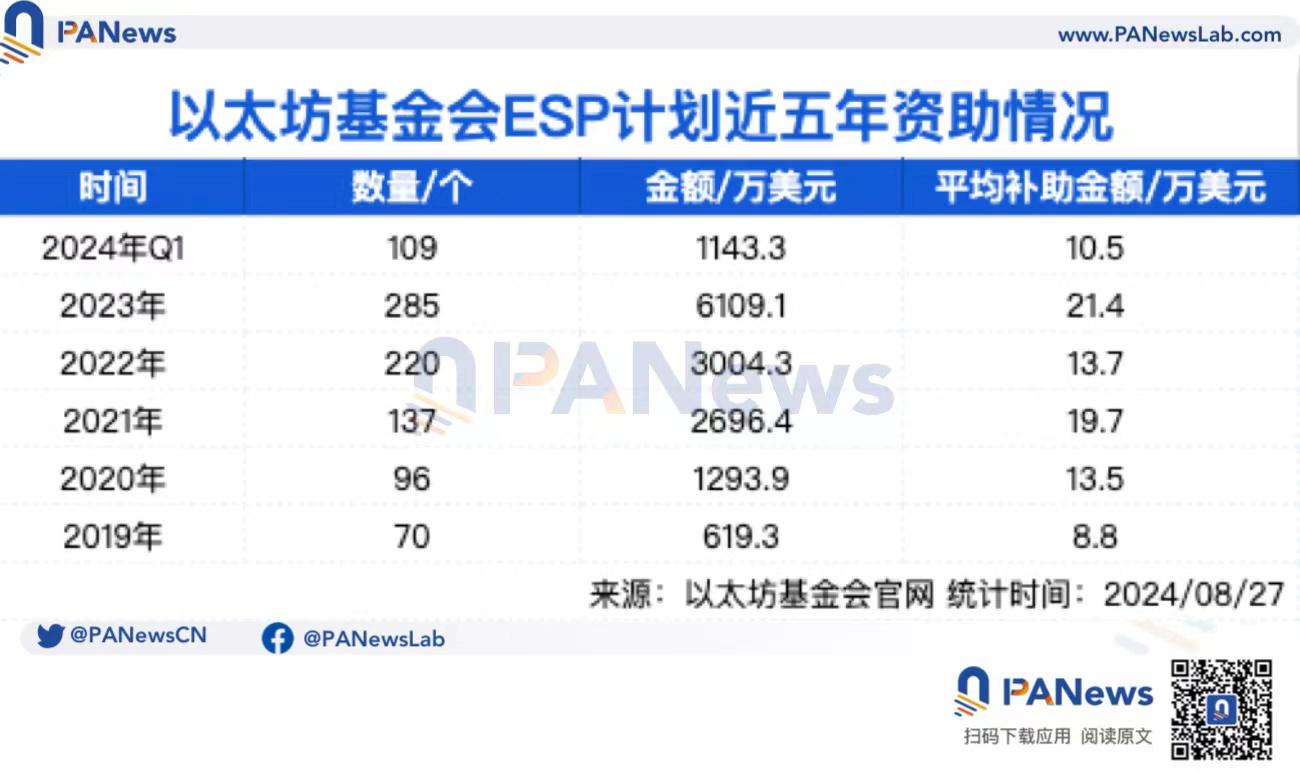
The Ethereum Software Patrons (ESP) is currently EF’s primary grant program, established in 2019 as a dedicated branch providing financial and non-financial support to the Ethereum ecosystem, with a strong focus on funding. According to data compiled by PANews from ESP team announcements, over the past five-plus years, ESP has granted over $148 million to 917 projects—an average of nearly $162,000 per project or community—amounting to roughly $27.45 million in annual donations.
In terms of funding scale, ESP allocations have generally increased year-on-year, particularly peaking in 2022 and 2023. In 2023 alone, ESP supported 285 projects with $61.09 million, accounting for 60% of the annual budget, averaging $214,000 per project—several times higher than in other periods. In 2022, 220 projects received $30.04 million, averaging $137,000 each. In terms of project categories, ESP shows clear preferences for community & education, cryptography, and zero-knowledge proofs. For instance, last year, EF funded 97 community and education projects and 87 cryptography and ZK-related projects. Other areas of interest include developer experience and tools, consensus layer, execution layer, protocol growth and support, and Layer 2 development.
In addition, EF has launched several other grant programs. For example, the "Next Billion Fellowship" offers applicants mentorship from experts, access to EF and Ethereum community resources, and financial support. EF has also participated in Gitcoin Grants, a quadratic funding platform. According to Gitcoin Grants’ official website, since its inception in 2019, 170 rounds of quadratic funding pools have been established, distributing over $60 million to 3,715 projects. Fundraising volumes have grown rapidly—from $700,000 in 2019 to $21.4 million in 2022, a 30.5-fold increase. Another example: in June this year, EF partnered with several ZK-focused projects to launch a $900,000 prize pool aimed at advancing zero-knowledge proof technologies.
Sale Methods and Spending Transparency Spark Concerns, EF Faces Renewed Controversy
As a nonprofit organization committed to developing Ethereum—the world’s second-largest cryptocurrency by market cap—EF has become embroiled in controversy, especially due to frequent large-scale ETH sales.
Regarding this, Suji Yan, founder of Mask Network, offered an explanation: “Some institutions (e.g., universities, charities) immediately sell ETH upon receipt, often at suboptimal prices. It would be better if they could collectively sell at favorable prices. Also, newly registered NGOs may lack the capacity to open exchange accounts (nonprofit account setup takes longer). Furthermore, certain organizations involved in public policy, political science, or international relations—and those with political affiliations—are typically denied services by major exchanges. This is mainly because such entities often employ former high-ranking government officials or have staff who later join new administrations, and PEP (Politically Exposed Persons) involvement can be highly sensitive and不宜公开.”
Aya Miyaguchi, Executive Director of the Ethereum Foundation, echoed this in her latest statement, noting that some grantees can only accept fiat currency. Additionally, she explained that (regarding the latest large transfer) the foundation had been advised not to conduct any financial activity for much of the year due to complex regulatory environments, preventing earlier disclosure of plans.
However, SIGNAL, co-founder of Sundial Mirage, argued that given the value generated by EF, even an annual operating budget of $100 million is far below market standards. For instance, Netflix, valued at $295 billion, paid just two executives $80 million in compensation and $72 million in salaries in 2024 alone, while Ethereum’s market cap stands at $332 billion. In reality, managing $100 million in liquidity does not significantly impact asset prices, though execution methods might cause slight, temporary fluctuations.
“People today vastly overestimate the influence of the Ethereum Foundation and Vitalik Buterin. They’re merely road workers following a roadmap; the real builders of this beautiful era are all of us,” said Chen Mo, a crypto KOL.
Liu Feng, former editor-in-chief of ChainNews, also believes a $100 million annual budget isn’t excessive for an organization like EF, given its size and responsibilities—not to mention it’s sufficiently bureaucratic (not pejoratively, but factually). Still, he pointed out that EF’s one-time release of an annual report was a good attempt, yet it was never continued. Given its tendency to attract criticism, EF should proactively improve transparency.
In fact, EF did release its 2021 financial report, showing expenses of $48 million that year. But according to crypto KOL Ignas, EF currently holds ETH worth $845 million, representing 0.25% of total ETH supply. At the current spending rate of $100 million per year, EF’s reserves would last only about eight years.
Suji Yan also acknowledged that EF’s lack of spending transparency is indeed problematic, though he suspects much of the information may only be auditable rather than fully disclosable. Could zk-based solutions offer verifiable yet privacy-preserving disclosures? In the U.S., most government and public institutions can be requested for data via FOIA (Freedom of Information Act), but whether they comply is uncertain—and requesters may even face retaliation.
“Only after public protests do we see any information released—that’s a huge problem. Honestly, how hard is it to publish a quarterly report including financial data and basic updates: expenditures, expected sales, fund allocation, team size and distribution? Lack of transparency forces everyone to focus on negative aspects, instead of allowing the community to appreciate how EF spends significant funds advancing Ethereum,” said eric.eth, an Ethereum core developer.
For example, when Polkadot published its treasury report, it sparked discontent due to high spending and insufficient revenue—but compared to Ethereum, Polkadot deserves credit for its transparency.
Zhu Su, co-founder of Three Arrows Capital, frankly stated that EF’s issue isn't selling tokens before their value is realized—they were born as dumpers. The real problem is their current inability to provide a coherent roadmap or effective leadership for the ecosystem.
“Today, the Ethereum Foundation has become a burden to ETH. This highly ideological organization has turned into a net liability for Ethereum and its ecosystem,” said Web3 venture investor @LordWilliamUK, outlining six sins of EF: institutionalization resembling a “congress” captured by special interests; most ETH-funded members engaged in theoretical research while ignoring innovative grant applicants; opaque $100 million annual spending; the Ethereum community obsessing over “orthodoxy” rather than use cases; failure to support high-potential quality projects; and slow iteration.
Join TechFlow official community to stay tuned
Telegram:https://t.me/TechFlowDaily
X (Twitter):https://x.com/TechFlowPost
X (Twitter) EN:https://x.com/BlockFlow_News
 PANews