








Darya, CEO of Layer3: We've created a super portal "Web3 Google" that users want to access
TechFlow Selected TechFlow Selected
Darya, CEO of Layer3: We've created a super portal "Web3 Google" that users want to access
Layer3 has generated nearly $10 million in revenue, serving hundreds of thousands of users monthly.
 Navigating Web3 tides with focused insights
Source: Block Media
Layer 3 (L3) aims to make Web3 technology more accessible and user-friendly. Our goal is to build a decentralized ecosystem where users can more directly own value, addressing structural issues in existing platform distributions and helping them actively participate in the Web3 ecosystem.
Layer3's primary objectives include enhancing user experience, increasing engagement, incorporating gamification elements, and enabling decentralized governance. To achieve this, we simplify complex blockchain technologies through gamified tasks and rewards, while encouraging participation via reward systems and governance mechanisms.
Currently, Layer3 has built distribution infrastructure used by over 100 cryptocurrency projects, including Uniswap, Base, Arbitrum, Linea, Polygon, and Celo. It serves more than 3 million unique users across 120 countries worldwide and supports 25 blockchains, including both EVM and Solana ecosystems.
In June this year, Layer3 raised $15 million in Series A funding, bringing its total funding since 2021 to $21 million. Moving forward, we plan to offer faster and cheaper services by collaborating with various Layer 2 solutions. Block Media sat down with Dariya Khojasteh, Co-Founder and CEO of Layer3, to learn about their vision of becoming the "Google of Web3."
Q: Please briefly introduce Layer3.
A: I'm the Co-Founder and CEO of Layer3. We're building comprehensive solutions to help crypto protocols and users navigate the industry. Our goal is to improve the efficiency of crypto distribution through the Layer3 protocol, and to create the best consumer platform, identity framework, and open-source tools for incentive distribution.
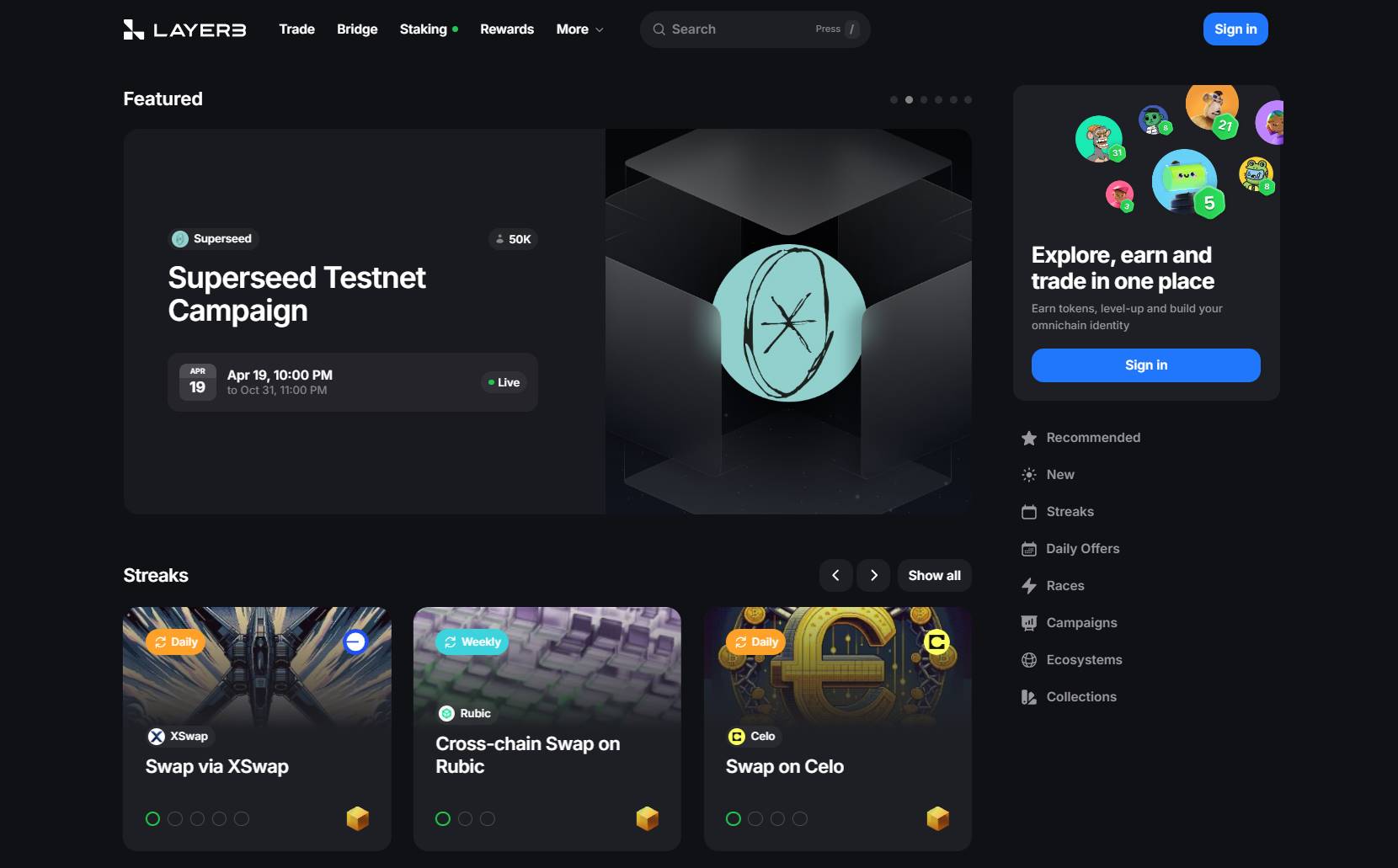
Cross-chain identity, token distribution, and incentive infrastructure
Q: What are the main problems Layer3 is currently focused on? I'm particularly curious about your goals related to blockchain and network infrastructure.
A: One of the key issues Layer3 aims to solve is that blockchain teams don't have the same level of distribution efficiency that internet builders get from platforms like Facebook or Google Ads.
New teams must consider all deployment strategies from day one. We need ways to gather Twitter followers and distribute tokens to the right users. This process often leads to inefficiencies that hinder overall growth.
That’s why we’re developing and optimizing crypto-native solutions to address these challenges. We’ve created a structure that allows users to discover projects they’re interested in and claim tokens. This enables protocols and blockchain teams to acquire the users they want, optimizing for long-term user retention rather than short-term speculation.
Q: There seems to be widespread awareness and criticism regarding marketing for Web3 projects. How does Layer3 address this issue?
A: Currently, there is no platform in the Web3 ecosystem optimized specifically for cryptocurrency usage. Layer3 is dedicated to creating an integrated ecosystem where users can trade cryptocurrencies, discover new projects, and earn tokens—all in one place.
The major advantage of Layer3 is that all these functions are unified. Any crypto-curious consumer can easily find what interests them on this platform, and the entire process is structured to be highly engaging.
At the end of the day, crypto users want fun and profit. If you can deliver both on a single platform, users will stay and keep coming back. In this sense, I believe Layer3 is a highly impactful product. Getting people to visit multiple times daily and return consistently for hundreds of days is extremely rare in the Web3 space.
If you look at the Layer3 leaderboard, you'll see that top users have visited consecutively for 100, 200, 300 days—even up to 800 days or more. This kind of sustained engagement is exceptionally uncommon in the Web3 ecosystem.
Traditional internet companies clearly understand how much each customer contributes to their business. If a customer spends $100 at your company, acquiring them at a lower cost is considered a successful outcome. However, the crypto industry largely lacks this long-term perspective.
For example, when working with Base, we estimate that a single user could be worth $1,020 in the long run—even though we can’t predict exactly what the ecosystem will look like ten years from now. With that understanding, Base can implement a strategy to acquire users at less than $1,020 per user. This ensures sustainable business results and gives users a valuable sense of ownership.
If we fail to do this, both users and protocols suffer, which could ultimately harm the entire industry. That’s why we’re taking this approach to build a sustainable ecosystem.
Q: It's said that Layer3 aims to become the "super highway of Web3," or the "Google of Web3." As Layer3 may evolve into a centralized platform similar to Google or Facebook, how do you plan to maintain decentralization?
A: That’s an excellent question. Our mission is to decentralize the attention economy currently dominated by platforms like Meta and Google.
To achieve this, we’re building a platform centered around Layer3—an interface users visit daily, designed so that they earn direct rewards simply by spending time or investing capital on it.
The tokens users earn within the Layer3 ecosystem are rewards based on their time and attention spent on the platform. For instance, when a user discovers and uses the XYZ protocol via Layer3, they receive tokens from that protocol. This stands in stark contrast to Google or Facebook, which monetize user attention for massive profits—on Layer3, users are the ones who earn.
Moreover, our ultimate goal is to challenge the dominant, centralized model of large-scale internet platforms. While Layer3 sits at the center, users capture most of the value—and they also gain control over that value. This represents a significant innovation compared to traditional internet business models.
Q: In a multi-chain, multi-protocol environment, what is Layer3’s strategy? Do you have plans to support OmniChain protocols?
A: Our protocol is compatible with all EVM (Ethereum Virtual Machine) chains. Given how easy it is to launch new chains today, it's crucial that we support any new chain from day one, along with teams building within its ecosystem.
For users, this provides opportunities to explore everything within emerging ecosystems, discover alpha, and earn tokens. That’s why we take a cross-chain approach. In the coming years, many non-EVM chains will likely emerge, and we’re preparing to ensure our users can extract maximum value from these chains starting from day one.
Whenever a new chain launches, Layer3 will be there. That’s our commitment.
Q: How will the L3 token be used within the platform?
A: Within the Layer3 ecosystem, tiered staking aligns incentives with long-term user retention. Users who hold L3 tokens gain access to more parts of the ecosystem than those who don’t. Additionally, staking L3 tokens unlocks further access, while locking tokens grants access to an even broader range of ecosystem features.
This creates inclusive participation opportunities for all users, while ensuring those most aligned with our values receive the greatest long-term benefits. Many complain that airdrops degrade the crypto consumer experience, often leading to short-term gains, token dumping, and project failure.
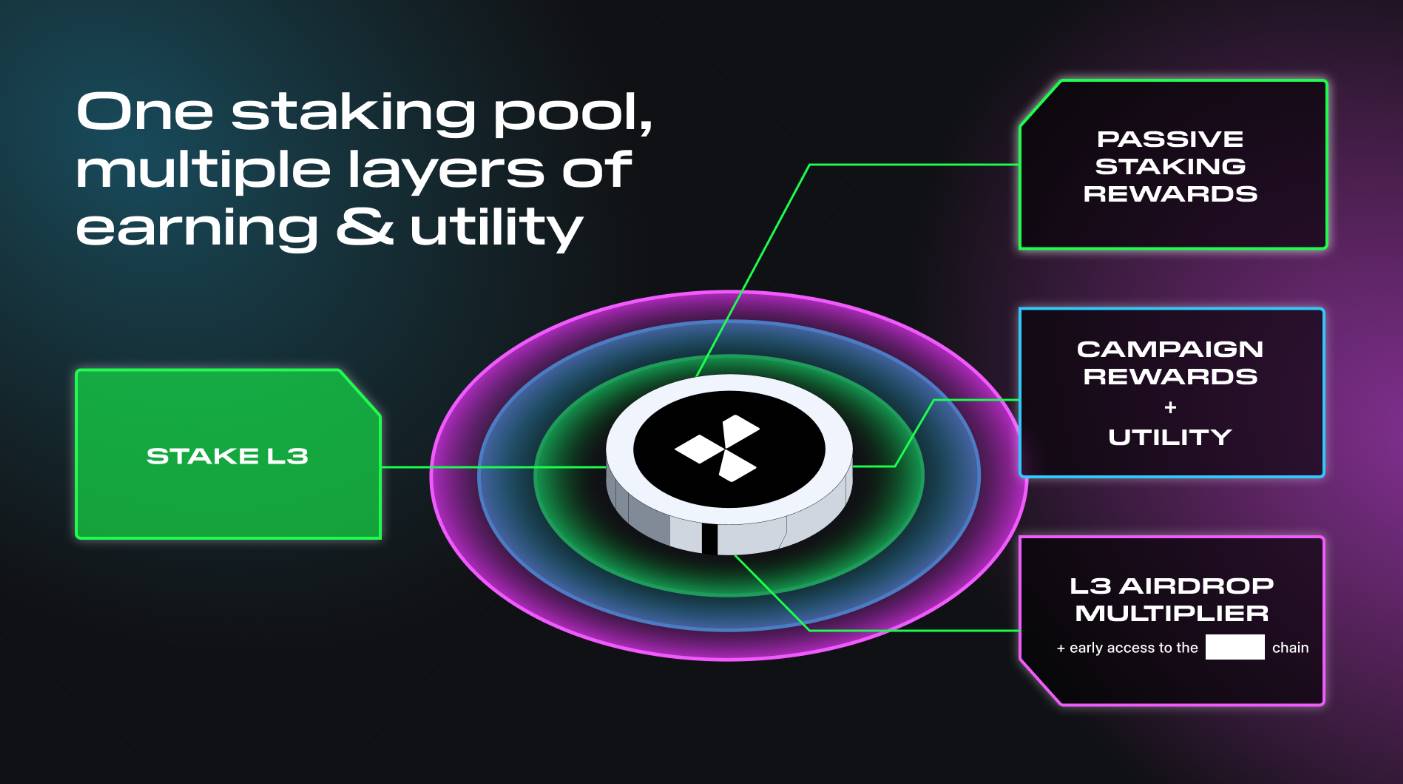
Layer3 staking tokenomics
We focus on delivering real value to users. What matters to us is how much long-term contribution users can make to our protocol and how sustainably we can maintain this ecosystem.
In the end, we believe long-term aligned incentives are the right model for any ecosystem. Ultimately, this is where true token utility comes from.
Q: What has been the feedback since launching the L3 token? Are there any concerns related to tokenomics?
A: Currently, the circulating market cap of the L3 token is around $20 million, with daily trading volume at approximately $3 million (as of August 23, Korea time). This is a significant gap between market cap and volume. We’re analyzing various factors behind this high interest.
I believe it stems from the fact that consumers using the L3 token greatly appreciate its utility. The ability to immediately use a token upon receiving it makes it highly attractive. Its popularity seems driven by wide availability across exchanges, numerous practical applications for users, and cross-layer functionality.
User feedback is extremely important to us. Among crypto projects, we believe we’re among the best at analyzing what users find interesting and what they truly value.
We've received diverse feedback—some positive, some critical—but most users are asking for more activities and richer experiences. One key request is for a Launchpad.
A Launchpad makes particular sense in environments where tokens are issued through centralized exchanges and services are provided to issuers. Existing methods typically involve simple farming or passive token staking.
However, the Launchpad we’re building at Layer3 aims to give users an immersive and rewarding experience before a token launch. This means tokens go not just to passive stakers, but to those who genuinely engage with and support the project.
Q: What potential new partnerships and future plans can Layer3 users expect?
Among upcoming partners, two stand out as particularly exciting. One involves the launch of a highly anticipated blockchain; the other is an infrastructure project that recently secured substantial funding. Both have generated significant buzz on social media and among users, and we plan to promote their entire supported ecosystems. These two projects are set to launch on Layer3’s Launchpad.
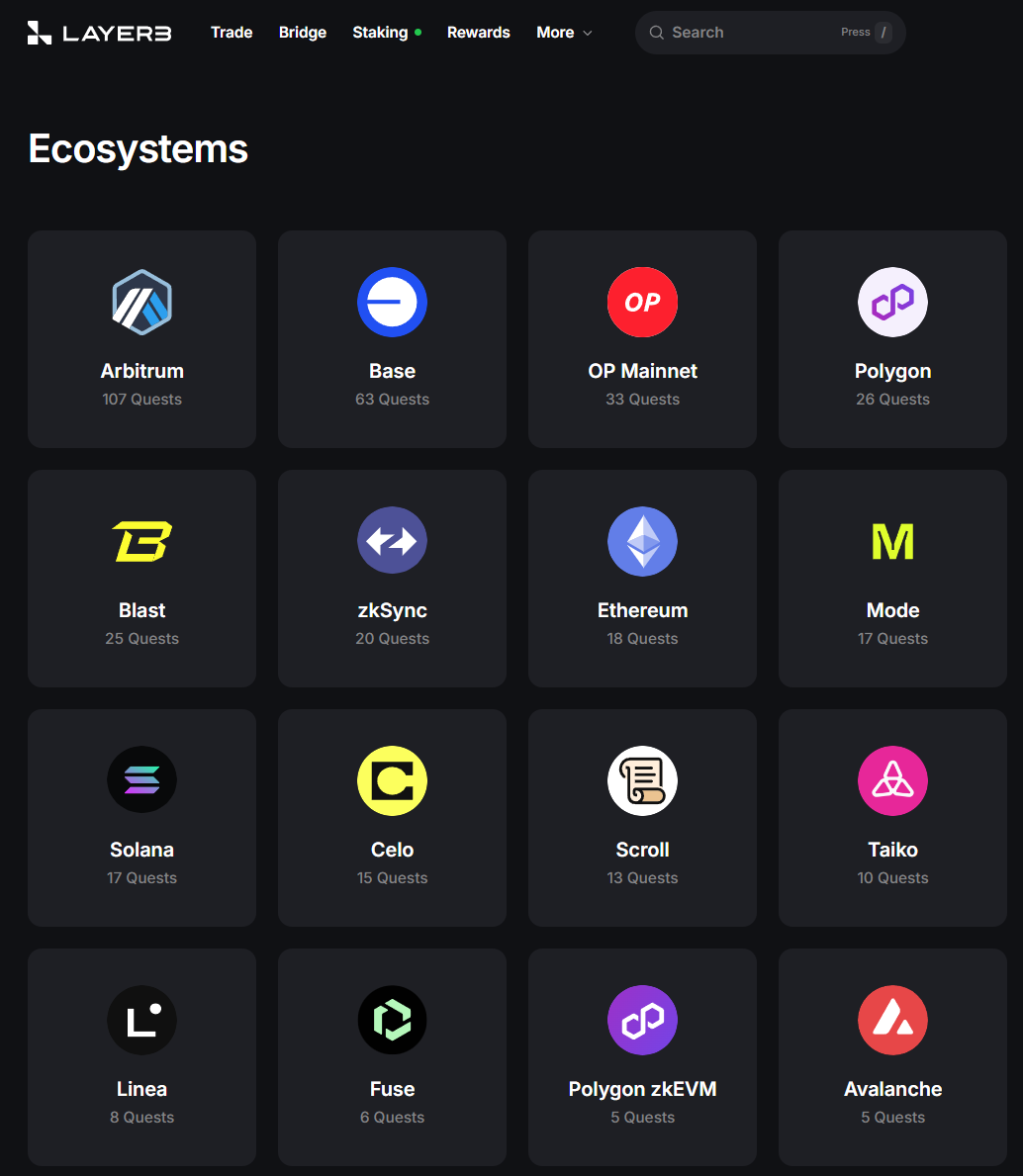
Layer3 onboarding ecosystem list
We also plan to deploy on non-EVM chains. Our goal is to ensure users across different ecosystems can enjoy all the benefits of Layer3. We intend to bridge tokens to these chains so that users holding liquidity solely within those ecosystems can stake their tokens and receive the same utilities as EVM users.
Q: Please share a final message with investors in Korea’s Web3 ecosystem.
A: Layer3 has generated nearly $10 million in revenue, issued around 30 million credentials (CUBEs), and distributed corresponding incentives. We serve hundreds of thousands of users every month.
To date, over 110 million Layer3 tokens have been staked, driving demand for the token. This is because users need L3 tokens to stake and access utilities within the ecosystem.
Looking ahead, I believe that as we collaborate with more projects, bring in new users, and expand onto additional chains, we’ll continue growing the platform and truly realize our vision of becoming the "Google of Web3."
If you haven’t tried Layer3 yet, I encourage you to sign up and give it a try. I’d also love to hear your feedback. If you have any questions about Layer3, please don’t hesitate to ask. Let’s work together to help Koreans participate in the Layer3 ecosystem.
Join TechFlow official community to stay tuned
Telegram:https://t.me/TechFlowDaily
X (Twitter):https://x.com/TechFlowPost
X (Twitter) EN:https://x.com/BlockFlow_News
 @with_blockmedia


