








Using entertainment to break through mass adoption of Web3: MEET48's ambitious fan economy vision
TechFlow Selected TechFlow Selected
Using entertainment to break through mass adoption of Web3: MEET48's ambitious fan economy vision
With Web3 and AI as its two major strengths, MEET48 has forged a unique path and become a game-changer in the entertainment industry.
 Navigating Web3 tides with focused insights
Let's rewind to 2007, the year that marked the dawn of virtual idols. A blue-haired girl from Japan burst onto the scene with electronic music—her name was Hatsune Miku. With no physical form or real-life voice actor, she quickly surpassed many real-world celebrities in influence within just a few years, becoming the pioneer of the virtual idol industry and laying the foundation for the UGC (user-generated content) model.
By 2012, Hatsune Miku had already generated over $6 million in total commercial revenue worldwide. As her popularity and commercial value grew, more virtual idols emerged globally, especially across Asia. Prominent examples include Japan’s Hololive and Nijisanji, as well as South Korea’s PlayV and PLAVE. However, unlike Hatsune Miku, these newer idols rely heavily on PGC (platform-generated content) models—professionally produced and managed by dedicated teams using advanced technologies like motion capture and real-time rendering to enable immediate audience interaction.
Although these PGC-based virtual idols have achieved varying degrees of success, this company- and platform-led model faces growing challenges. High production costs are a major issue: creating virtual idol content demands significant resources, including character modeling, motion capture, and post-production rendering—all requiring substantial financial and technical investment. Additionally, PGC content is often slow to produce, struggling to keep up with audiences’ ever-increasing and diverse demands. Furthermore, content under this model tends to be tightly aligned with corporate strategies, lacking creativity and flexibility, making it difficult to establish deep emotional connections with fans.
If the virtual idol industry seemed trapped in a room dominated by the PGC model, then AI, the metaverse, and Web3 are the keyholders opening the door—ushering back into the spotlight user-driven UGC virtual idols, where users reclaim greater creative control.
The ability to freely create and share virtual idol content without relying on big corporate resources makes the ecosystem more open and inclusive, better aligning with today’s internet users’ desire for participation. This is the "new fan economy" that emerging technologies like AI, the metaverse, and Web3 bring to the entertainment industry—and MEET48 is precisely such a metaverse project integrating multiple cutting-edge technologies.
MEET48: Redefining Virtual Idols
Over the past year, I’ve attended numerous Web3 conferences and traveled through some of the most vibrant Web3 hubs—Hong Kong, Dubai, Japan, Singapore—and almost every time, I encountered one particularly high-profile project: MEET48. This metaverse-based virtual community, built on AI and Web3.0 with a diverse UGC entertainment ecosystem, is quietly reshaping the landscape of virtual idols.
After further research, I learned that MEET48 is a metaverse virtual community rooted in an AI and Web3.0-powered diversified UGC entertainment ecosystem. At the beginning of last month, I interviewed MEET48’s COO Kai, gaining deeper insight into this ambitious metaverse project spanning virtual idols, AI, and Web3. For more, read: MEET48’s AI-Powered UGC Ecosystem: The Business of Fan Economy Ambitions.
You may not have heard of MEET48 yet, but you’re likely familiar with SNH48—home to stars like Ju Jingyi. On August 3rd this year, SNH48’s annual general election brought in a staggering 110 million RMB. That remarkable earning power stems directly from the deep bond between fans and idols.
Virtual idols, as AI creations, face inherent challenges in building communities and cultivating fan culture; most failed virtual idols “fell into this trap.” MEET48’s solution draws directly from the proven decade-long success of the “48-series” idol model: continuous platform-fan interaction and annual election voting empower fans to deeply participate in an idol’s growth journey, fostering a far stickier idol culture.
Truly brilliant—by adopting a battle-tested model, MEET48 skips the trial-and-error phase altogether, achieving massive returns at minimal cost.
When mentioning MEET48 to people in the Web3 space, many immediately respond: “Oh, that metaverse project renting out an entire street in Hong Kong’s Lan Kwai Fong.” Clearly, their marketing efforts have paid off—this bold promotional strategy vividly demonstrates their ambition and strength in the virtual idol arena. In a recent conversation with one of MEET48’s investors, they told me MEET48 is the most star-quality project they’ve ever invested in.

MEET48 rented an entire street in Hong Kong’s Lan Kwai Fong
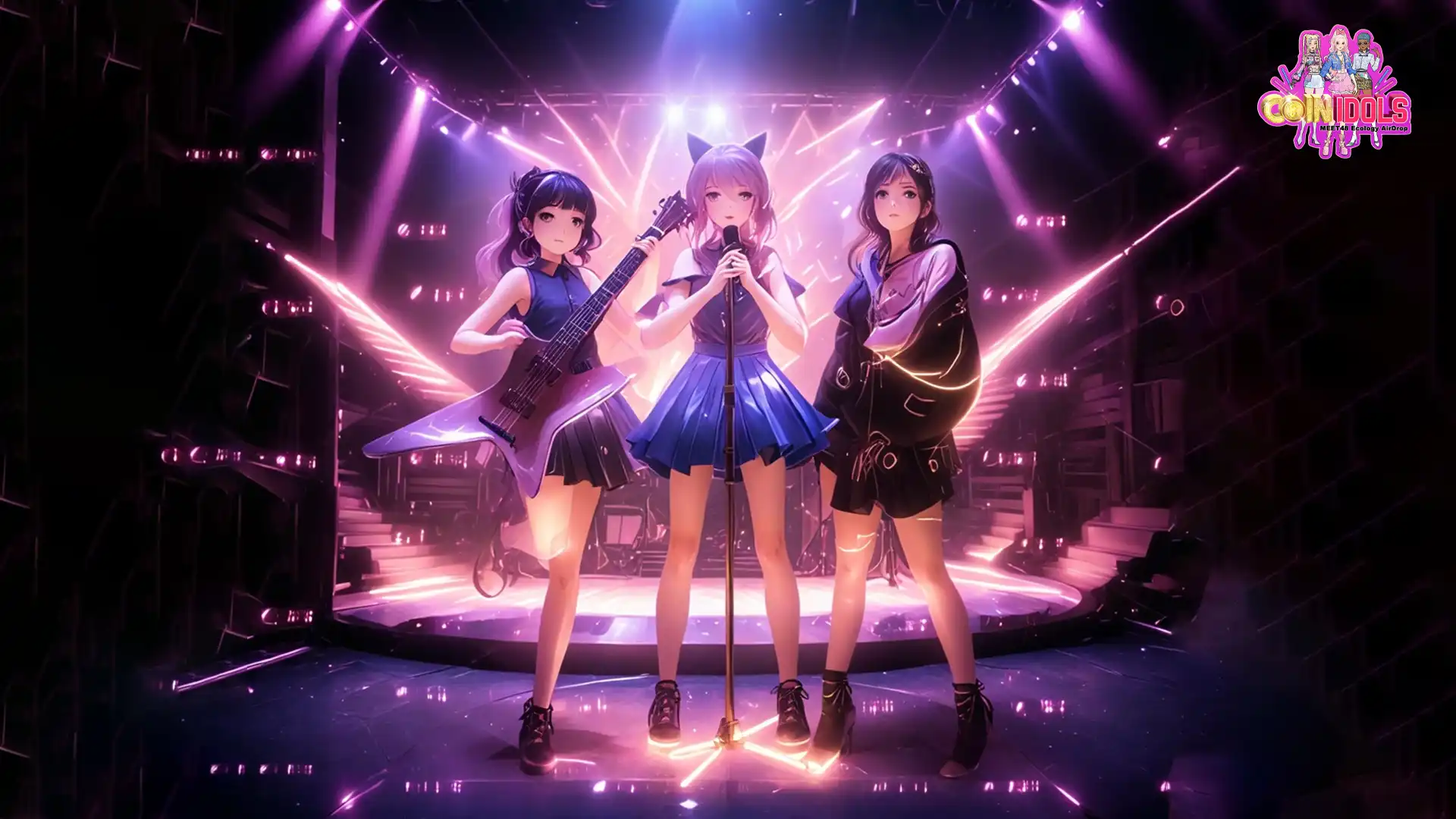
Beyond its current on-chain voting platform, MEET48 has expanded into broader ecosystem applications. Recently, it launched CoinIdols—an airdrop game on the TON ecosystem and H5 platforms—that strongly resonates with MEET48’s cultural identity. Meanwhile, MEET48 Labs has incubated the Coin Fish project, aiming to attract fans of idol culture into the MEET48 ecosystem through multi-channel promotion and traffic acquisition.
AI + UGC: A New Golden Age for Virtual Idols
Using AI to drive virtual human content creation is essential to overcoming technological and market bottlenecks. Without frequent, high-quality content, virtual humans cannot develop distinct personalities or achieve large-scale reach. Yet, high production costs limit participation to only a few well-funded corporations. For example, Yuehua Entertainment, China’s top-tier entertainment company, relied on ByteDance’s technology to launch the A-SOUL girl group. To regain full control, Yuehua even spent 30 million RMB acquiring the technology rights from ByteDance.
In contrast, MEET48 leverages its proprietary multimodal large model, specifically trained for virtual performers’ music and dance acts, and has developed accessible AI tools and an MaaS editor. These allow users to easily create their own virtual personas and performances—including full virtual idol group concerts—through low-barrier UGC. This is the core of MEET48’s competitive edge.
In my earlier conversation with MEET48’s COO Kai, he revealed the impressive scale of their music-and-dance large model, trained on an initial dataset of 500TB of high-quality audiovisual material—a process ongoing for over a year. For comparison, OpenAI used approximately 570GB of text data to train GPT-3. MEET48’s dataset is nearly 1,000 times larger. While GPT-3’s data is primarily textual, MEET48’s includes video and audio, offering a multidimensional training base. Even so, this comparison underscores the sheer depth and breadth of MEET48’s data accumulation.
To date, no similar vertical large models exist in the market. Built on this foundation, MEET48’s IdolGPT allows users to upload photos and generate a virtual idol based on their likeness—including male, female, and non-human versions. Through simple text input, IdolGPT can also generate songs and choreography for virtual idol performances. Currently in closed beta, the tool has attracted 2,500 testers.
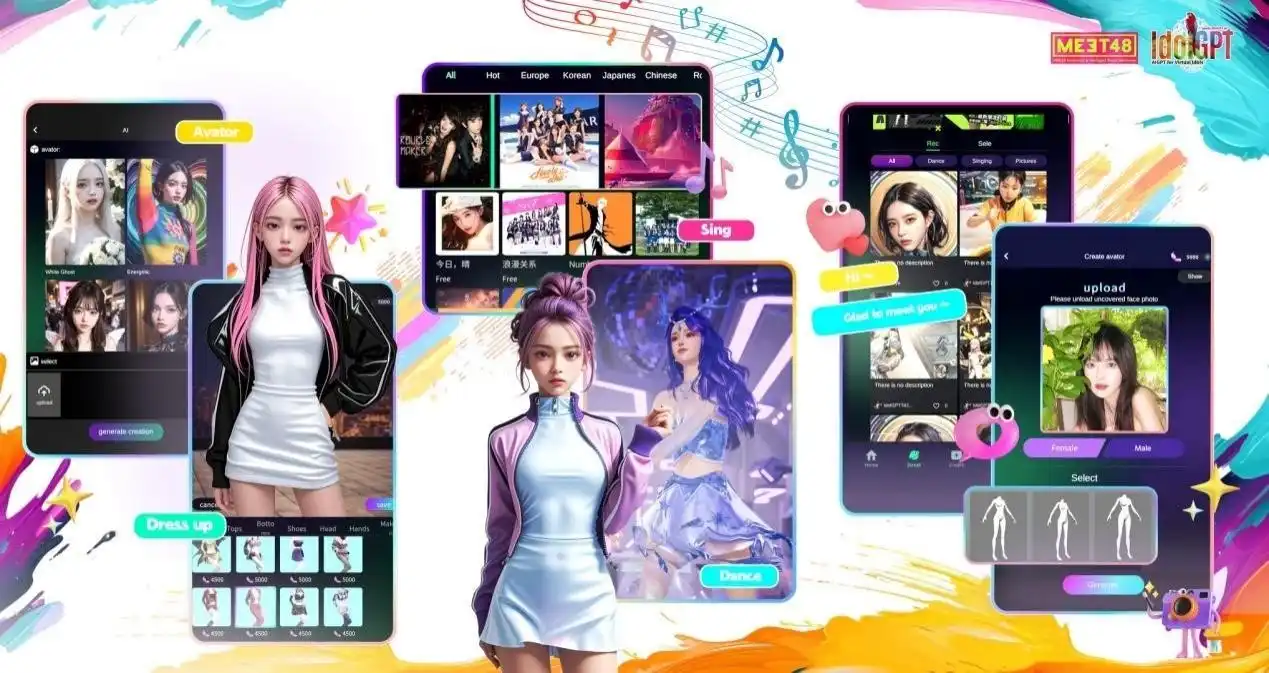
Leveraging existing AI technologies, MEET48 is launching a next-generation UGC virtual idol community. Integrating virtual avatars and AI-generated music/dance content, powered by LLM music-and-dance models and MaaS services, this platform will bridge Web2 and Web3 eras. It will provide rich tools and resources not only for UGC and PGC creators but also open new frontiers in UGA (User-Generated Assets) and PGA (Player-Generated Activities).
This means MEET48’s UGC virtual idol community will attract a flood of content creators and catalyze Web3-native systems for nurturing both virtual and real-life idols. MEET48’s UGC intelligent social metaverse will serve as the graphical social backbone of this entire ecosystem.
Current data suggests MEET48’s vision is far from theoretical. Their UGC fan community has already reached a notable level of vitality: over 24,000 user-uploaded UGC videos and more than 10 million cumulative views—all largely attributed to authentic individual users.
A longtime K-pop fan once told me: “Idol fandom is about projecting your ideal self onto them—it expands your sense of self. After that, the idol becomes part of who you are, doing things you can’t do yourself.” In the past, the barrier to “standing under the spotlight” was too high, leaving fans only able to project themselves onto idols. Now, MEET48’s AI tools empower fans not only to become “idol makers” and “partners” in idol development but also help everyone realize their “idol dreams,” competing alongside real idols in the MEET48 metaverse.
Looking back at the evolution of virtual idols, it’s clear this field has been marked by ups and downs. From Hatsune Miku’s breakthrough to Luo Tianyi’s rise, and recently, waves of “inactive” virtual idols—the industry has undergone a major shakeout. Traditional PGC models brought temporary prosperity but failed to sustain fan enthusiasm or long-term market growth.
Now, the virtual idol industry is returning to the UGC stage, entering a new era of opportunity. By combining Web3’s decentralization with AI’s content generation capabilities, MEET48 is pioneering a revolutionary path for the idol industry.
Web3 + Fan Economy: A New Hope for Mass Adoption
It’s not just the virtual idol sector seeking breakthroughs—Web3 itself urgently needs a “killer app” capable of driving mass adoption.
In Web3, everyone talks about Mass Adoption, yet nearly all protocols and apps hit a natural ceiling—the “100k curse.” Once genuine user numbers approach 100,000, growth stalls or even declines.
MEET48, however, operates as a private-domain entity. Its strategic partner, SNH48 Group, commands a real fan base exceeding 30 million, with 15% being international users. If MEET48 converts just 1% of these active users, it would capture half of the current Web3 user base. Already, MEET48’s Dapp boasts 50,000 daily active users—making true Mass Adoption in Web3 not just possible, but imminent.
Over the past few years, MEET48 has built its own Web3 platform and wallet, launching an on-chain metaverse voting channel. Fans earn points by creating content, watching videos, and completing daily tasks. These points can be exchanged for NFT voting tickets to support their favorite idols. Every vote is recorded on-chain, ensuring immutability, transparency, and fairness.
MEET48’s on-chain data this year shows explosive growth compared to last year. Its Dapp activity page has ranked first on DappBay’s social category, and the “MEET48 2024 GIPR2” voting event Dapp has accumulated over 3 million registered users.
The traditional voting model has been completely disrupted by MEET48’s integration of Web3. Blockchain enables a fair, transparent Web3 voting platform—no longer requiring physical product purchases. Instead, fans earn points through content creation, viewing, and task completion, which convert into NFT voting tickets. Each vote is permanently recorded on-chain, eliminating past inefficiencies and fraud.
Beyond voting, Web3 grants fans greater rights and rewards. Governance tokens and NFTs ensure every act of support is permanently recorded on the blockchain, giving fans opportunities for value appreciation. While governance tokens and NFTs may seem novel to outsiders, the “social token economy” model is already mature within Web3 circles.
More importantly, MEET48 uses Web3’s property rights framework to redefine the idol-fan relationship. Fans are no longer mere supporters—they are business partners in the idol’s journey. Through governance tokens and NFTs, every fan action is tracked on-chain, and holders gain access to value-added benefits. This two-way dynamic empowers fans with greater rights and returns.
These votes and revenues not only delivered stellar results for this year’s election but also lay the groundwork for future global idol competitions. In 2025, MEET48 plans to integrate SNH48 idols for a global idol election in Hong Kong, expanding the international reach of MEET48 and the entire 48-series, attracting fans and participants worldwide for a grand event where virtual and real idols compete side by side.
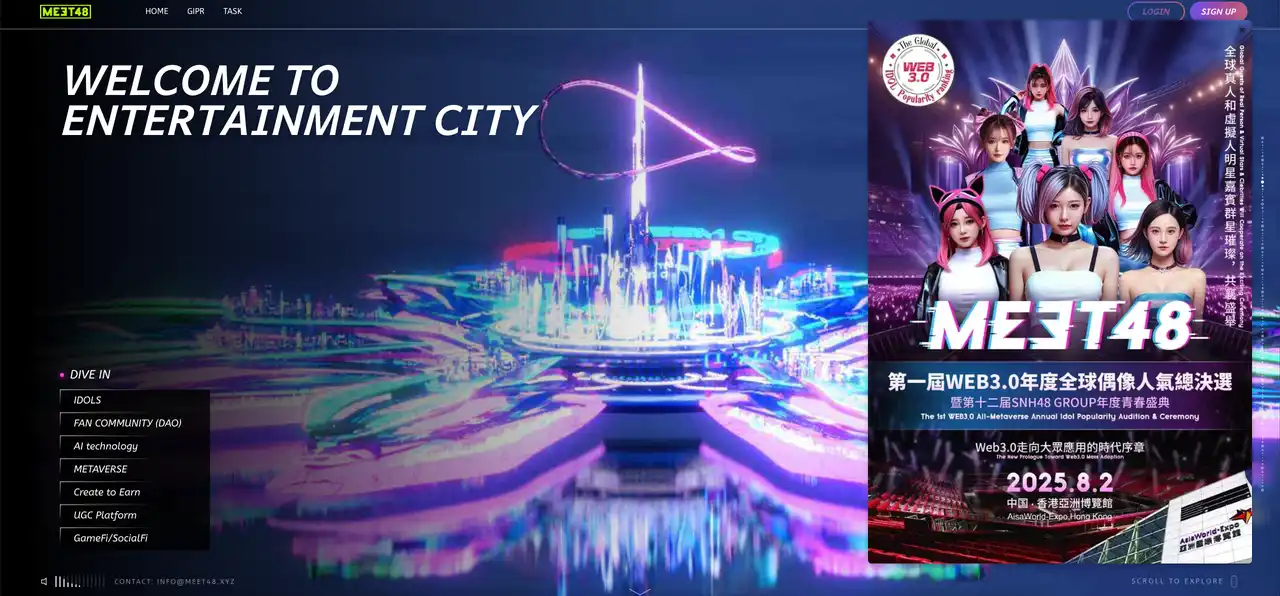
With MEET48 establishing an office in Japan this month and its Korean office set to open on October 1st, the project will participate in and host multiple events over the next two months, deepening its presence in overseas markets.
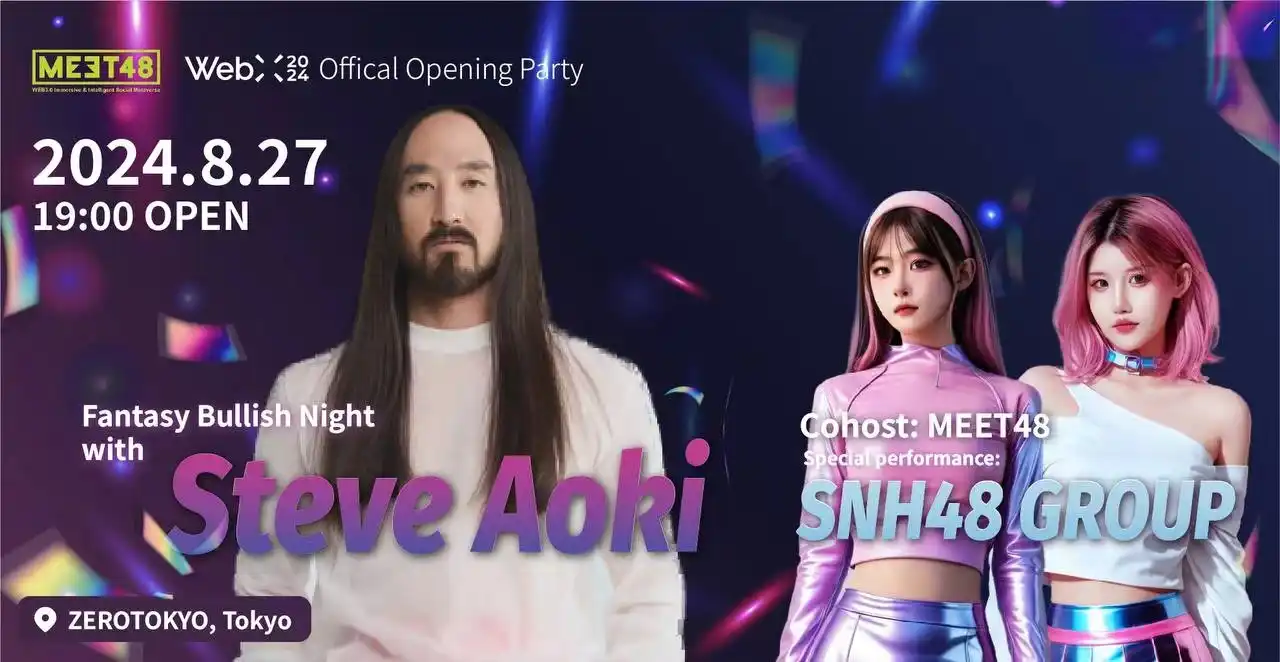
At the official opening party of Japan’s WebX event on August 27, co-hosted with Line Next, MEET48 served as title sponsor, bringing together performers from SNH48 and other renowned Japanese idols. On September 4, again in Japan, MEET48 sponsored the Tokyo leg of SNH48’s Top 16 tour, showcasing how MEET48 leverages high-profile international events to amplify its influence and advance its global strategy in virtual idols and Web3.
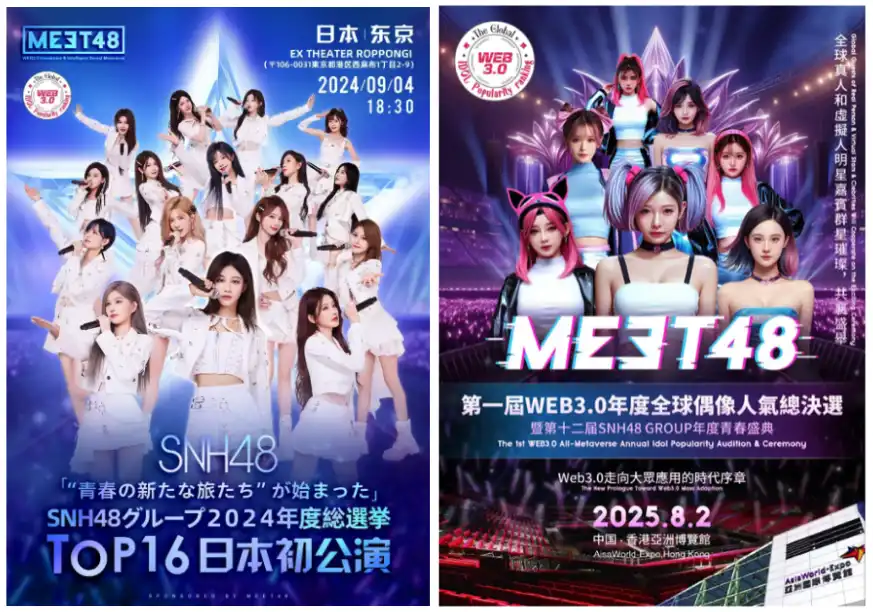
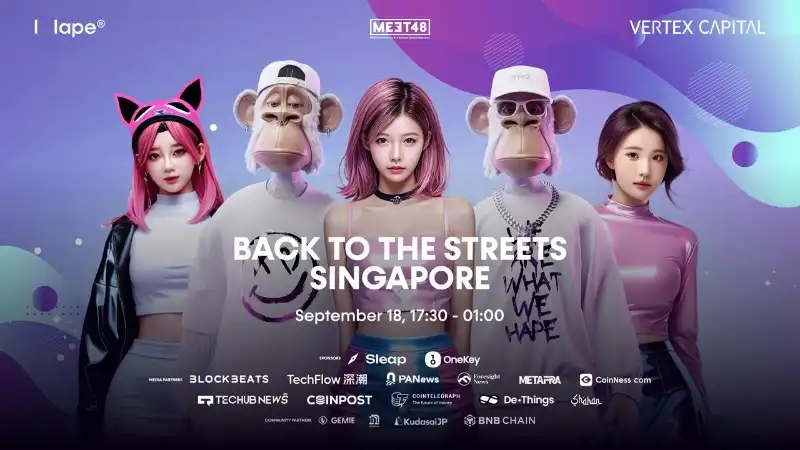
Beyond Japan, during Singapore’s Token2049 event, MEET48 will co-host a major AI+Web3 side event titled “Back To The Streets” with Hape on the evening of September 18. MEET48 will also be a platinum sponsor of Token2049, further highlighting its global strategic footprint and pivotal role in the Web3 ecosystem.
MEET48 isn’t just dividing or expanding the pie—it’s baking an entirely new one. Armed with Web3 and AI, MEET48 has forged a unique path, emerging as a true disruptor in the entertainment industry.
Soon, countless user-created virtual idols will emerge on the MEET48 platform. The most outstanding among them will rise through elections to become top-tier KOL idols, performing and competing alongside real idols—truly realizing a metaverse platform where virtual and real converge, co-created and co-built by all.
Join TechFlow official community to stay tuned
Telegram:https://t.me/TechFlowDaily
X (Twitter):https://x.com/TechFlowPost
X (Twitter) EN:https://x.com/BlockFlow_News
 meet_48






