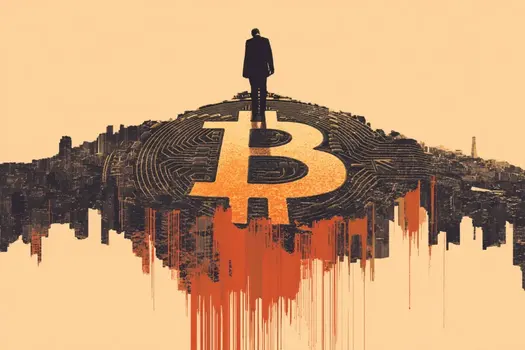
Bitcoin's next destination is underway: from digital gold to L2, from store of value to programmable platform
TechFlow Selected TechFlow Selected
Bitcoin's next destination is underway: from digital gold to L2, from store of value to programmable platform
Bitcoin established a baseline level of trustworthiness, and this trust continues to grow.
 Navigating Web3 tides with focused insights
Author: NOTDEGENAMY, RAM & JOMO
Translation: TechFlow
Introduction
In 2009, an anonymous individual named Satoshi Nakamoto released Bitcoin—the world’s first decentralized cryptocurrency. It enabled peer-to-peer money transfers without intermediaries such as banks.
Due to its early origins, anonymous founding team, vast miner network, and lack of traditional fundraising methods, Bitcoin has become the most decentralized cryptocurrency. With no single controlling entity, it is extremely difficult for malicious actors to rewrite transactions on the Bitcoin network. Even if multiple parties collude, coordinating an attack to compromise the network's integrity remains challenging due to its decentralization. To understand the degree of Bitcoin’s decentralization, consider the Nakamoto coefficient—a single number representing decentralization. This coefficient indicates the minimum number of participants or node operators required to control more than one-third of the entire network. Bitcoin’s Nakamoto coefficient is estimated at approximately 7,000. At the time of writing, the second most decentralized network is the Mina Protocol, with a coefficient of 151. Other notable networks include Solana (coefficient: 18) and BNB (coefficient: 7). Bitcoin stands out due to its exceptional level of decentralization.
Beyond decentralization, Bitcoin is also unique because of its fundamental characteristics. Its supply is capped at 21 million bitcoins (BTC), making it an attractive hedge against inflation and economic instability. As a result, Bitcoin is often referred to as “digital gold.”
In summary, Bitcoin:
-
Has simple functionality—it enables peer-to-peer money transfer
-
Is highly decentralized—it far surpasses all other cryptocurrencies
-
Is secure—it is resistant to attacks, with over 15 years of proven security
These factors have earned Bitcoin the highest level of regulatory transparency. It is classified as a commodity, indicating institutional recognition of its decentralized nature. Its ETF was approved in January 2024, bringing Bitcoin into traditional financial markets.
The bottom line is: Bitcoin has established a baseline level of trustworthiness, and this credibility continues to grow. If we can build applications atop Bitcoin, they will benefit from second-order effects.
However, this is not easy. Bitcoin was not originally designed to serve as a foundational layer for other applications.
First, transactions on Bitcoin are expensive and slow
If I send you 5 BTC, that transaction must be recorded within the Bitcoin network. More precisely, the transaction must (1) be included in the ledger, and (2) the updated ledger must be distributed across thousands of computers. Including a transaction in the ledger requires numerous miners to compete in solving cryptographic puzzles to validate and confirm the transaction—an intensive and costly process. Ensuring the distribution of the ledger also slows down the number of transactions we can process per second. Ordinary consumer-grade computers do not have infinite storage capacity. Here, we observe that Bitcoin’s emphasis on decentralization results in trade-offs between cost and speed.
Second, Bitcoin is not friendly to smart contracts
Suppose we want to do something more complex than simple peer-to-peer money transfers. For example: programming a vending machine on the Bitcoin network. Based on input value, the vending machine dispenses a product, and the remaining inventory is continuously tracked by the Bitcoin network. This vending machine functions similarly to a smart contract: a set of rules that automatically execute based on specific trigger conditions.
Bitcoin does not natively support smart contracts, a limitation stemming from two deliberate design choices:
-
Bitcoin uses a restricted stack-based scripting language that is intentionally non-Turing complete, lacking advanced features like loops and complex conditionals. In other words, writing complex logic on Bitcoin is difficult. Only basic operations such as digital signatures and timelocks are supported.
-
Bitcoin uses the Unspent Transaction Output (UTXO) model to track state—that is, the current status of all information on the blockchain—which is efficient for tracking wallet balances but less efficient for tracking states of other types of transactions.
These architectural decisions prioritize security and predictability over programmability. Therefore, while Bitcoin excels at secure value transfer, it is poorly suited for supporting the complex state-dependent logic required by smart contract applications. Networks like Ethereum later emerged as solutions to these limitations.
Early attempts to overcome these limitations—SegWit, Lightning Network, and Taproot
Bitcoin’s first major upgrade, called SegWit, was released in 2017. It enabled faster Bitcoin transactions and allowed transaction IDs to be modified before blockchain confirmation. This made it possible to securely batch multiple transactions. Ultimately, multiple off-chain transactions could be consolidated into one transaction and then stored on-chain.
This led to the creation of the first Bitcoin Layer 2 (L2), known as the Lightning Network, launched in 2018. An L2 is a protocol that settles transactions on top of a base-layer L1—in this case, Bitcoin serves as the L1.
Here’s a brief explanation of what happens in the Lightning Network:
-
If I send you 10 BTC and you send me back 5 BTC, there would normally be two separate transaction records. The Lightning Network creates a new mini-ledger between the two transacting parties. It settles the net outcome after a period (e.g., A sends 5 BTC to B), reducing the number of entries on the main ledger from two to one.
-
The Lightning Network batches multiple transactions into one and records only that single transaction on the Bitcoin blockchain. While involving some trade-offs in decentralization, the Lightning Network offers significant flexibility. For small transactions, users benefit from increased speed and lower fees. A typical Bitcoin transaction fee is around $1, whereas Lightning Network fees are about $0.001 per transaction.
The Lightning Network improves speed but does not support programmability or other interesting use cases. With the Lightning Network, I still cannot send you a stablecoin secured by the Bitcoin network, let alone program smart contracts on Bitcoin.
The Taproot upgrade, activated in 2021, laid the groundwork for smart contract programming on Bitcoin. Essentially, it relaxed restrictions on the amount of arbitrary data that can be embedded within Bitcoin transactions.
Introducing Ordinals
Thanks to Taproot, users can now inscribe data directly onto individual satoshis (100,000,000 satoshis equal 1 bitcoin). More precisely, a satoshi can (1) be assigned a specific ordinal number for future reference, and (2) carry data such as text, images, or complex files. This process effectively transforms fungible satoshis into non-fungible ones, creating what are commonly known as non-fungible tokens (NFTs).
Ordinals have received mixed reactions.
On one hand, Bitcoin Ordinals can be considered superior to NFTs stored on other blockchains.
Why? When NFTs are inscribed and stored directly on the Bitcoin network, the actual data—images, videos, etc.—resides on-chain. In contrast, non-Ordinals NFTs typically store only metadata or URL pointers on-chain, rather than the actual content. Thus, Ordinals are more resistant to censorship, link rot, and data loss.
On the other hand, many in the Bitcoin community believe forcing Bitcoin nodes to download and store images wastes resources. Below is a well-known Ordinals collection: the Taproot Wizards collection.
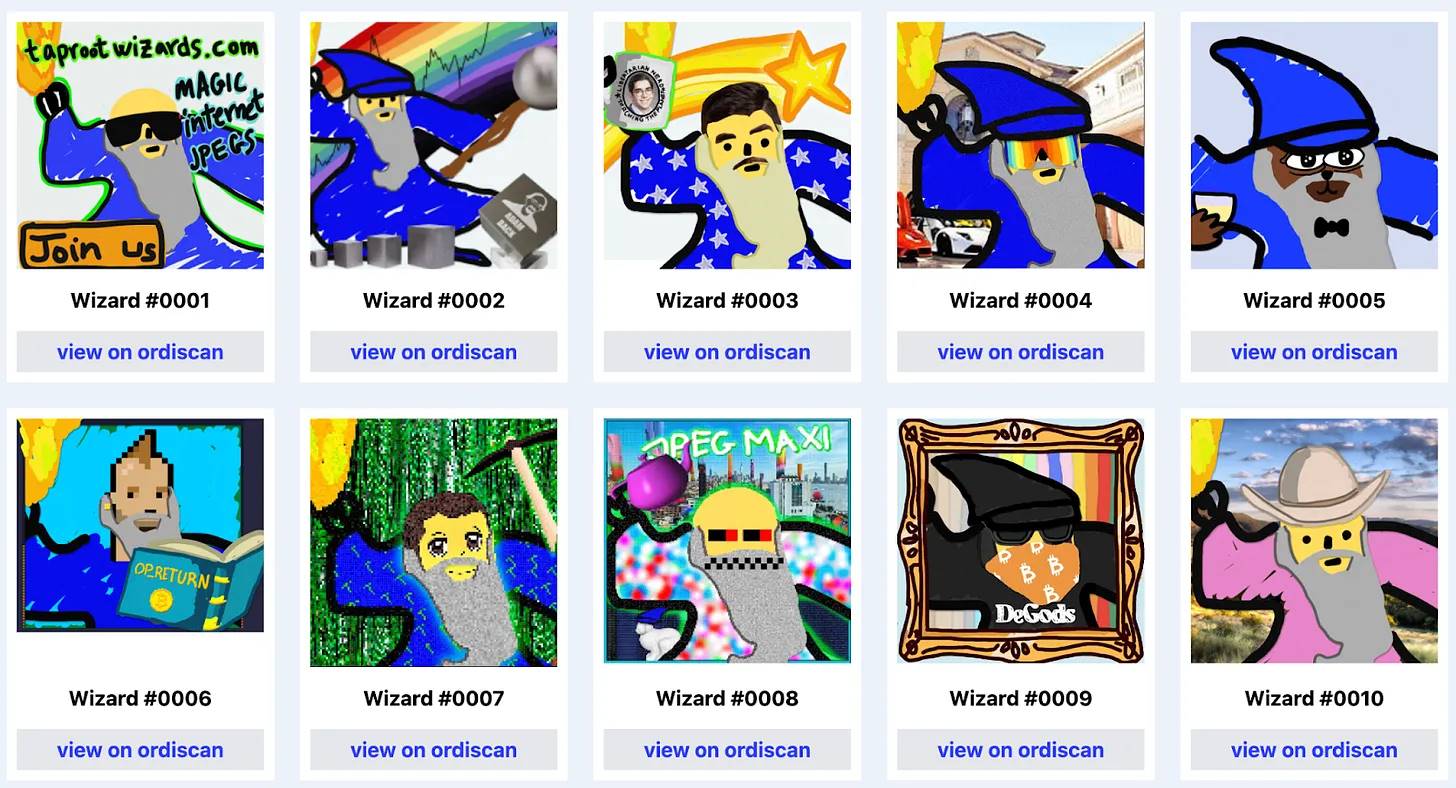
Some NFTs from the Taproot Wizards collection
In practice, Ordinals currently attract less attention compared to several months ago. As shown in the chart below, both the effort spent creating Ordinals and the total number created have declined.
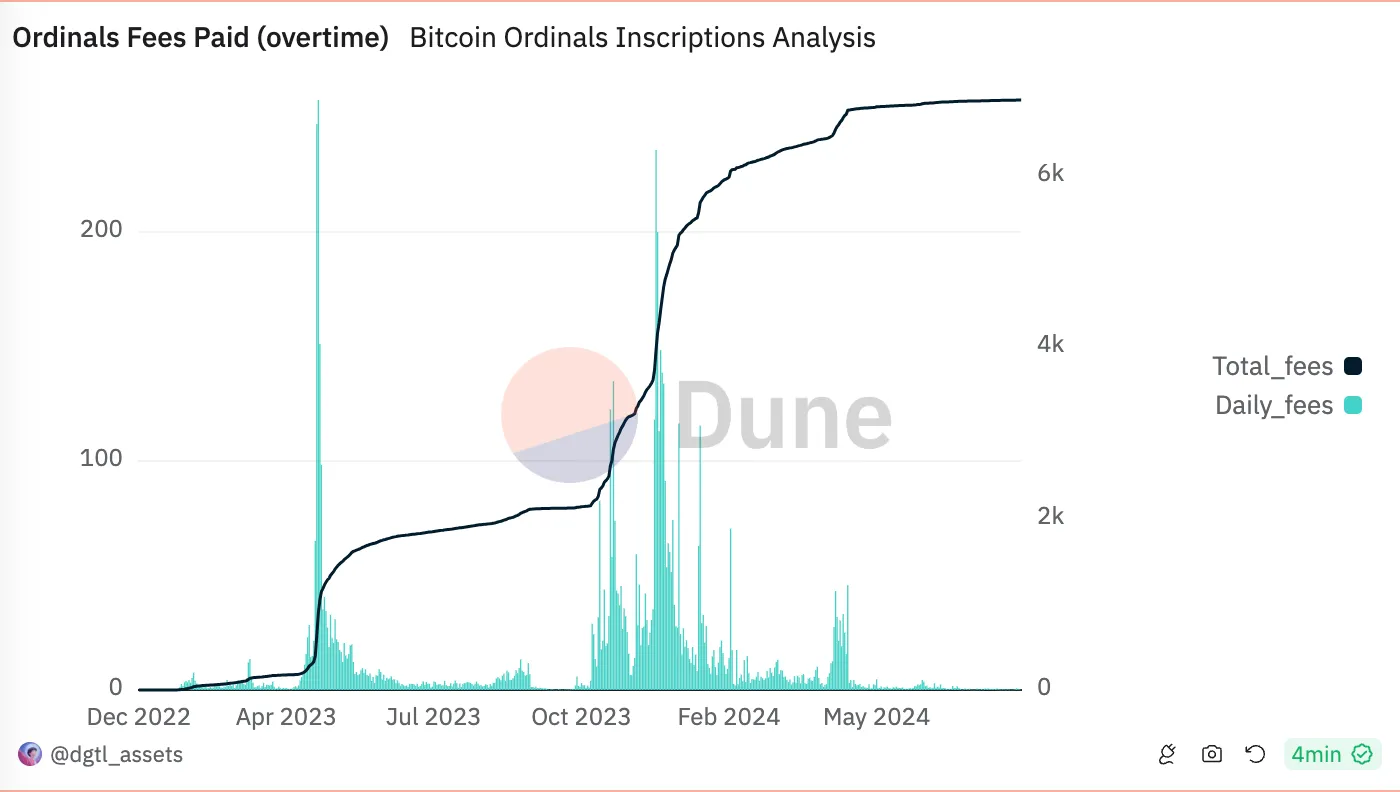
Declining effort in creating Bitcoin Ordinals over time (Source: Dune Analytics)
Concerns about whether Ordinals should occupy valuable block space on the Bitcoin network are a key driver behind this slowdown. However, it's worth noting that this is not solely an Ordinals issue. Interest in NFTs may have waned due to market oversaturation.
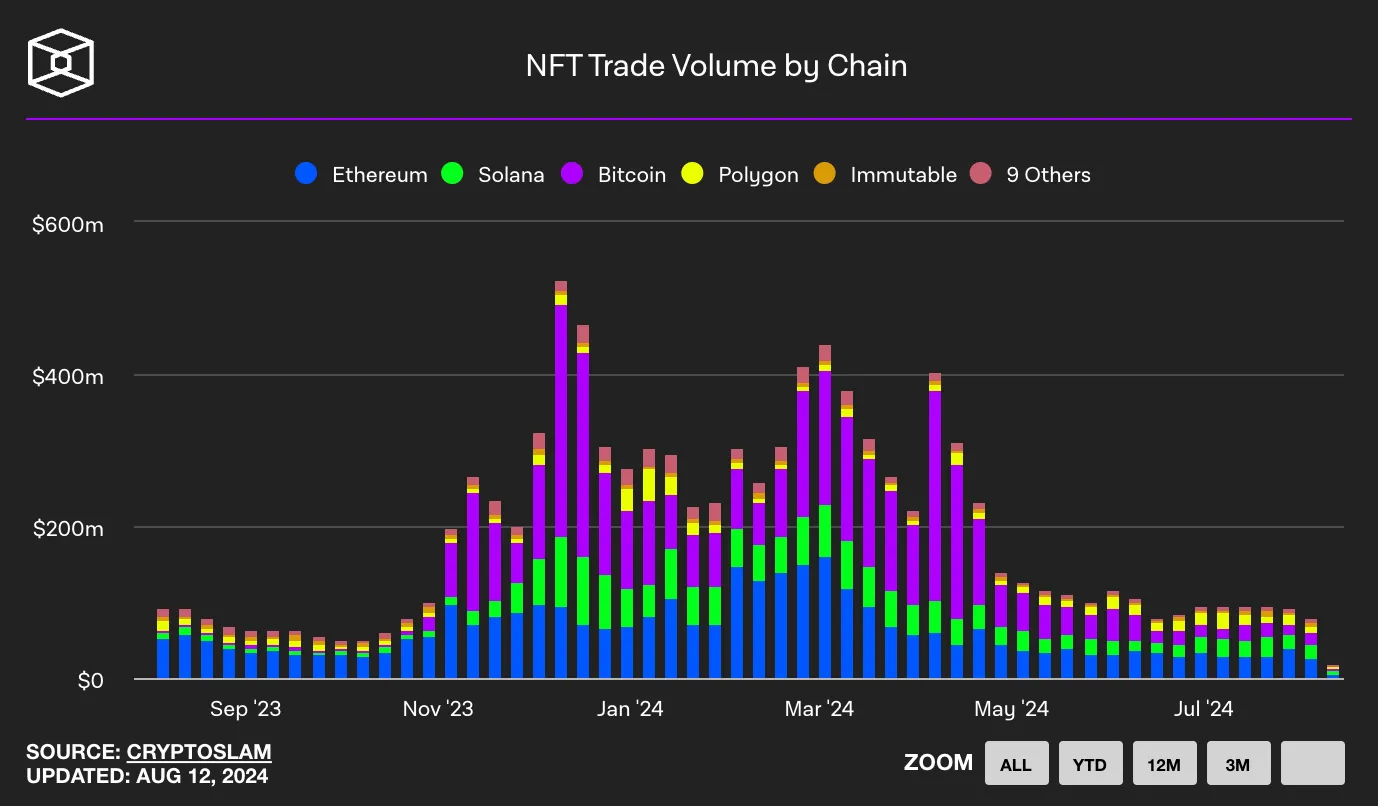
This cooling trend isn't unique to Bitcoin Ordinals—it reflects a broader downturn in the NFT space (Source: The Block)
So far, this article has repeatedly emphasized Bitcoin’s prioritization of security and decentralization, which inherently limits scalability. This is why Ordinals face criticism—many argue that images aren’t worth the additional congestion imposed on the Bitcoin network. This brings us to Bitcoin’s Layer 2s.
Enter Layer 2s (L2s)
Understanding L2s
Before diving deeper into Bitcoin-specific developments, it’s essential to grasp the basic concept of L2s. L2s can be confusing because different people define them differently. In this article, we categorize L2s into two main types: sidechains and rollups. At Ocular, we consider rollups to represent true L2s.
Sidechains
Sidechains are independent blockchains that do not settle their transactions on the main chain. In other words, not every transaction on the L2 can be directly verified on the L1.
The Liquid Network is a prime example of a Bitcoin sidechain. You can bridge BTC from the Bitcoin network to the Liquid Network by sending BTC to an address managed by “watchmen”—a pool of roughly 65 trusted members elected by the community, including representatives from exchanges, financial institutions, and Bitcoin-related companies. For each BTC transferred to this watchman-managed address, users receive a synthetic BTC called LBTC. This is a two-way peg mechanism.
Liquid Network’s security relies on these watchmen and their ongoing reputational incentives; thus, it does not inherit security from Bitcoin L1. If most watchmen collude or get compromised, the sidechain’s security could be jeopardized. The main advantage of Liquid Network is that it enables faster and private transactions for parties who need them, without fully leaving the Bitcoin ecosystem—users enjoy faster speeds and can trade stablecoins, other tokens, and LBTC on the network.
Rollups
We regard rollups as genuine L2s because every transaction is backed by a proof submitted to the L1, which can be directly verified on the L1. In rollups, multiple transactions are rolled up into one. Then, this aggregated transaction, along with a validity proof, is submitted to the L1. The validity proof says: “Hey, I’ve checked these transactions and can confirm they follow all the rules. You can verify my proof and gain cumulative certainty—you don’t need to check each transaction individually!”
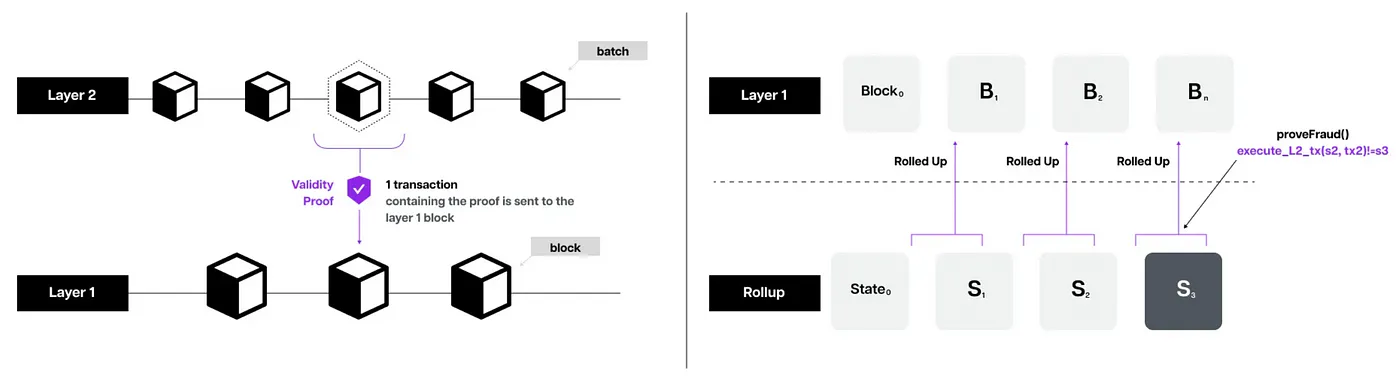
Illustration of the connection between L1 and L2 (Source: Limitless Insights)
Since every transaction is protected by a verifiable proof, rollups inherit high security from the Bitcoin blockchain and can therefore be considered true L2s. Examples of rollups helping make Bitcoin more programmable include MerlinChain, BOB, BEVM, Bitlayer, and Botanix.
Other Approaches
Stacks demonstrates a method that is neither a rollup nor a sidechain, yet still inherits a certain degree of security from Bitcoin L1.
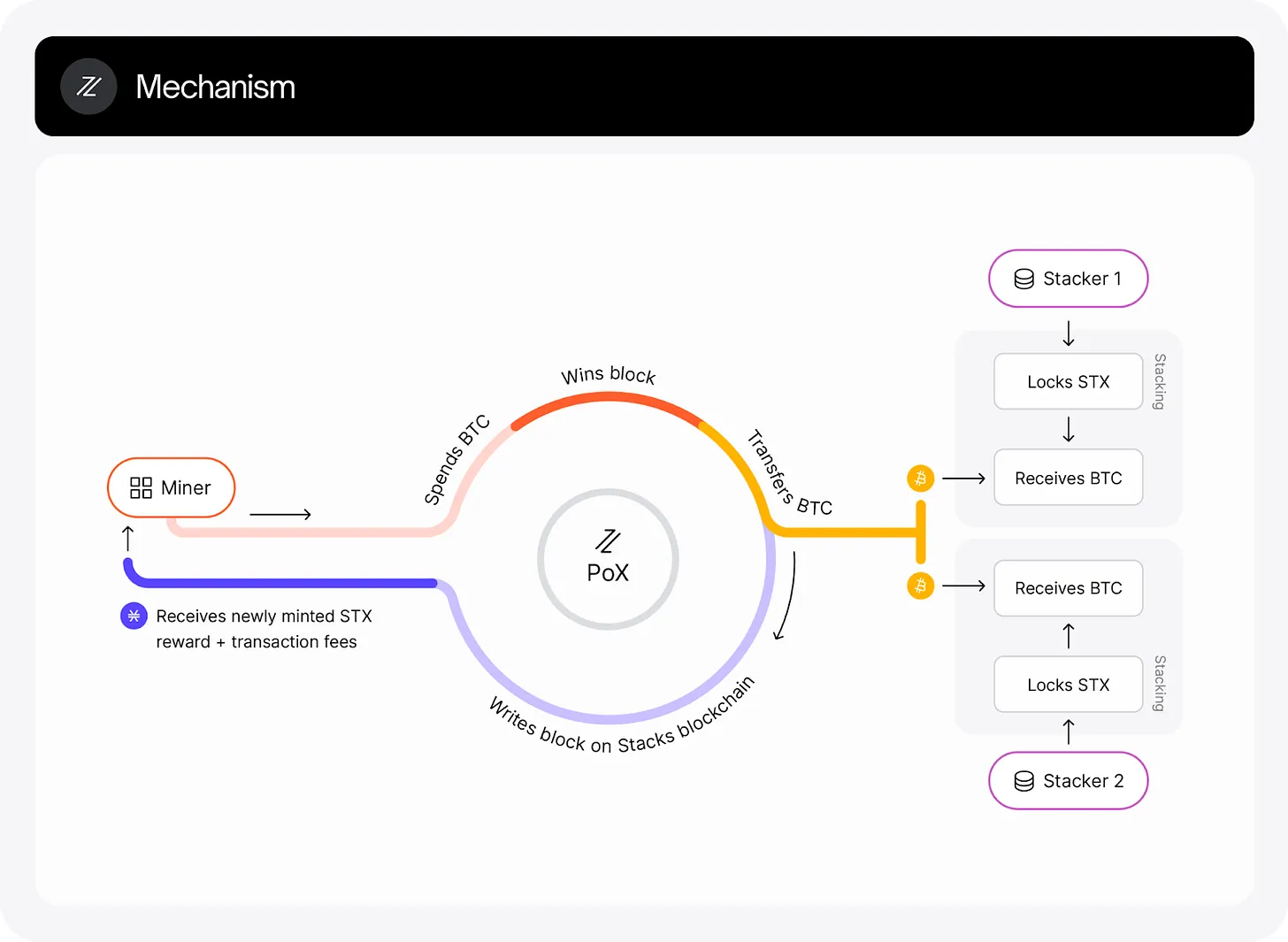
How Stacks intertwines with Bitcoin: Stakers receive BTC, Bitcoin miners receive STX, linking the two blockchains (Source: Stacks Documentation)
Stacks is essentially an independent blockchain that calls upon Bitcoin miners to validate its blocks in exchange for rewards. However, Stacks does not publish any proofs or hashes on the Bitcoin blockchain, so it is not directly tied to Bitcoin in the same way as rollups.
Other exciting programming efforts on Bitcoin
B² Network
The B² Network is an example of a true L2 where we can explore rollups in depth. Transactions on B² are batched and generate a verifiable proof attesting to the correctness of the batch. This proof is then recorded on the L1 Bitcoin blockchain.
The type of proof used by B² is a zero-knowledge (zk) proof, widely regarded as the optimal implementation because it allows on-chain verification of batch validity without revealing underlying data. In simple terms, zk proofs ensure privacy. Additionally, the B² Network is compatible with the Ethereum Virtual Machine (EVM), meaning code written for Ethereum can run the same applications on B². This makes B² particularly appealing to developers.
L2s like B² expand the Bitcoin ecosystem by supporting user-facing platforms such as Master Protocol.
Master Protocol
Master Protocol is a financial platform within the Bitcoin ecosystem designed to facilitate interest rate swaps and operate yield farms using liquid staking tokens (LSTs) and other yield-generating assets.
Master Protocol enhances liquidity in the Bitcoin ecosystem in several key ways:
-
Asset Aggregation: Master Protocol acts as an aggregator of users and assets, deeply integrated into the Bitcoin ecosystem. It consolidates various LSTs and yield-generating assets from different protocols and L2 solutions, creating a centralized liquidity hub.
-
Yield Market Platform: Master Protocol’s flagship product, the Master Yield Market, packages Bitcoin ecosystem assets into Master Yield Tokens (MSY), which are then split into Master Principal Tokens (MPT) and Master Yield Tokens (MYT). This allows users to trade these tokens, creating a yield market and improving overall liquidity.
-
Simplified Access: By aggregating multiple assets and protocols, Master Protocol simplifies user interactions within the Bitcoin ecosystem. Users can access yield opportunities across different protocols without constant switching, increasing participation and liquidity.
-
Liquid Staking and Restaking: Master Protocol allows users to stake Bitcoin across various L2 networks and receive LSTs as staking receipts. These LSTs can be reinvested or restaked to earn liquid restaking tokens (LRTs), enhancing capital efficiency and asset liquidity without affecting the original stake.
-
Interest Rate Swaps: As an interest rate swap market, Master Protocol facilitates trading of yield-bearing assets, helping manage liquidity risk and optimize capital efficiency.
-
Ecosystem Synergy: As a one-stop yield trading center for the Bitcoin ecosystem, Master Protocol not only improves adoption rates but also directs traffic and users to multiple Bitcoin ecosystem protocols, promoting overall liquidity.
-
Solving Fragmentation: Master Protocol helps address fragmentation caused by the growth of Bitcoin L2 solutions, improving composability and operability within the Bitcoin ecosystem. Integration of various DeFi protocols and Layer 2 solutions enhances overall liquidity flow.
Master Protocol serves as a central hub connecting Bitcoin enthusiasts with diverse applications, supporting the development of new apps and enhancing the overall utility of Bitcoin infrastructure. Moreover, it addresses fragmentation resulting from the expansion of Bitcoin L2 solutions by improving composability and interoperability.
Babylon
Babylon is an innovative project aiming to extend Bitcoin’s unparalleled security to various proof-of-stake (PoS) chains, especially those within the Cosmos network.
By leveraging Bitcoin’s powerful proof-of-work (PoW) consensus mechanism, Babylon enhances the security of PoS chains through a process called “restaking.” This involves locking Bitcoin on its network and using it to secure other PoS chains, providing economic security while enabling Bitcoin holders to earn staking rewards. The protocol facilitates this process using advanced cryptography and consensus innovations, without requiring complex smart contracts.
Babylon’s architecture is built on the Cosmos SDK and is compatible with Inter-Blockchain Communication (IBC), enabling seamless aggregation and communication between Bitcoin-linked chains and other Cosmos application chains. By combining Bitcoin’s security properties with the flexibility of PoS networks, the Babylon protocol is poised to play a pivotal role in the future of the Bitcoin ecosystem, driving a more secure, scalable, and interconnected blockchain landscape.
The next frontier of Bitcoin programming and areas we’re watching
The Ocular team closely monitors applications being built on Bitcoin and has identified the following areas as focal points for innovation:
-
More L2 Solutions: Improved L2s are needed to increase transaction speed and reduce costs while preserving Bitcoin’s security.
-
Smart Contract Platforms (remorachains): Initiatives like RSK (Rootstock) that bring Ethereum-style smart contract capabilities to Bitcoin are becoming increasingly relevant. These platforms enable the development of decentralized applications (dApps) and DeFi services on Bitcoin.
-
Cross-Chain Compatibility: Platforms enabling applications from other blockchains (e.g., Solana) to run on Bitcoin represent exciting investment opportunities in the blockchain interoperability space.
-
DeFi on Bitcoin: As programmability increases, so does the potential for a robust DeFi ecosystem on Bitcoin. Projects focused on lending, decentralized exchanges, and stablecoins natively built on Bitcoin could be compelling investment areas.
-
Bitcoin-Native Application Platforms: These platforms aim to enhance Bitcoin’s programmability while maintaining its core principles of security and decentralization.
-
Zero-Knowledge Proof Technology (ZK-Proof Technology): Bitcoin projects implementing zero-knowledge proofs may offer enhanced privacy and scalability features, making them attractive investment prospects.
-
Custody Solutions: As programmability expands, demand will grow for secure custody solutions that meet Bitcoin’s evolving functionality while upholding the principle of “Not your keys, not your coins.”
-
Developer Tools and Infrastructure: With increasing focus on Bitcoin programmability, there may be a surge in demand for developer tools, SDKs, and infrastructure to support this new wave of Bitcoin applications.
Conclusion
These areas represent the frontier of Bitcoin’s evolution—from a simple store of value toward a more versatile and programmable platform. As the ecosystem matures, it is likely to attract more developers, users, and investors, potentially catalyzing the next phase of growth for Bitcoin and the broader crypto market.
Join TechFlow official community to stay tuned
Telegram:https://t.me/TechFlowDaily
X (Twitter):https://x.com/TechFlowPost
X (Twitter) EN:https://x.com/BlockFlow_News