Methodology for Successful Consumer-Grade Crypto Applications: Finding Your Product-Market Fit
TechFlow Selected TechFlow Selected
Methodology for Successful Consumer-Grade Crypto Applications: Finding Your Product-Market Fit
It doesn't matter which chain is chosen, as long as the user experience is not affected.
 Navigating Web3 tides with focused insights
Author: Aryan Agarwal
Translation: TechFlow
How to Define a Consumer Application?
Before diving into any topic, I’d like to clarify my understanding of consumer apps, which will set the context for what follows.
A consumer refers to anyone who uses your platform daily—essentially, the platform becomes a habit. For example, just as users wake up in the morning and open X (formerly Twitter) or read the newspaper, they should also open your app upon waking. Your app should become part of their daily life. If you have 100 such users, then you have a consumer application.
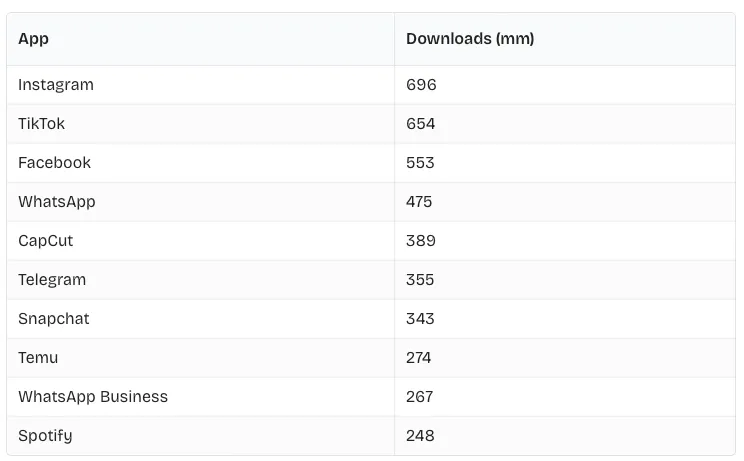
We can cite some non-crypto examples from app store rankings.
Some crypto app examples include dripdothaus, warpcaster, hey, pumpdotfun, frienddottech, puffpaw, and skytrade, all of which are applications I personally find very interesting.
The teams behind X and Dialect deserve special mention, as X has become a crypto-driven application with the arrival of Blinks.
Why Focus on Consumers?
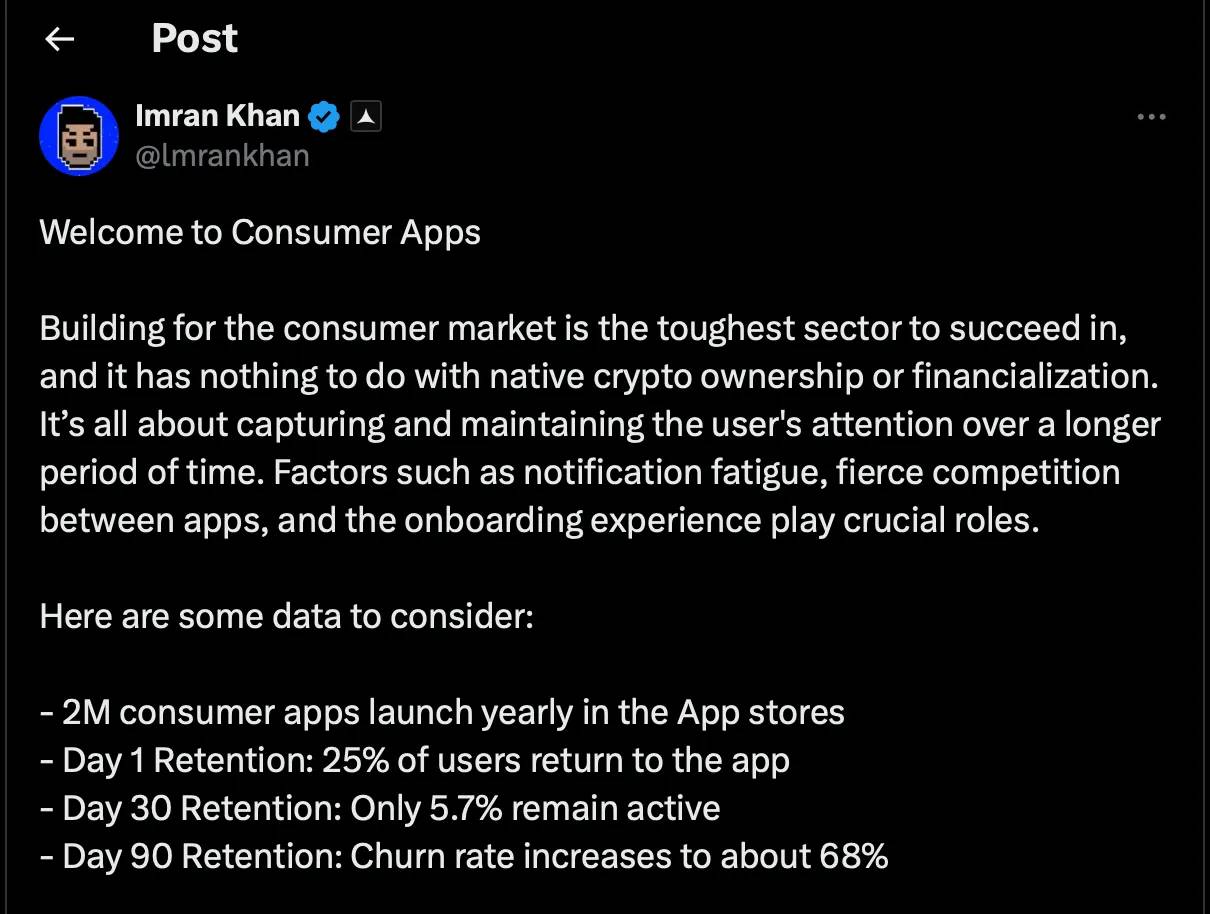
Imran from AllianceDAO says: We’re all tired of infrastructure—every time we open CT, we see only a few crypto infrastructure startups raising funds. We need more consumer apps—much more. The entire crypto community knows only a handful of consumer crypto apps.
If you want to bring more people into crypto, consumers are key.
"Consumer is hard in crypto," "not enough users," "infrastructure isn’t mature yet," "user experience is terrible"—there are many reasons not to build, but consumer is the hardest challenge, whether in crypto or outside of it.
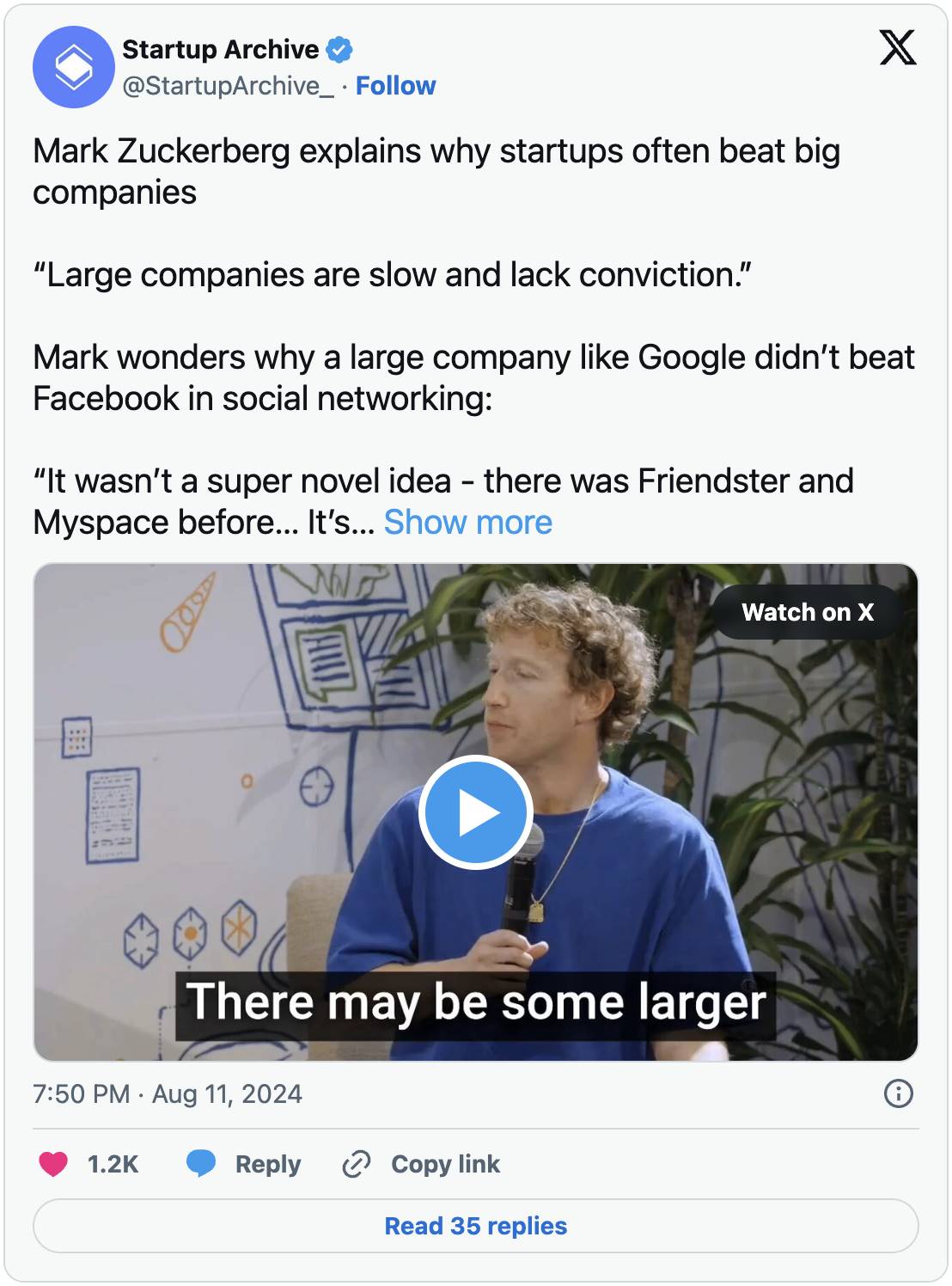
According to Zuckerberg, small startups with strong conviction can beat any big company.
Do We Have the Infrastructure?
We’ve been talking about infrastructure for a long time—"Hey, I want to build this app, but the infrastructure isn’t ready yet," "Hey, I’ve been waiting for the team to release this feature, but they’re dragging," "Hey, question #420, why can’t they just build this app?"
In 2024, infrastructure is mature—whether on EVM or SVM. Let’s first look at EVM.
Lens Protocol
Lens Protocol is one of the earlier social protocols that allows developers to build on top of it. The developer experience is excellent—you can launch a web app in under 30 minutes.
Lens was initially built on Polygon and has seen over $30 million in funding across 10 projects building on it. (Currently, there are over 100 apps built on Lens.)
In May this year, Lens migrated from Polygon to zkSync in search of a more scalable solution.
Farcaster
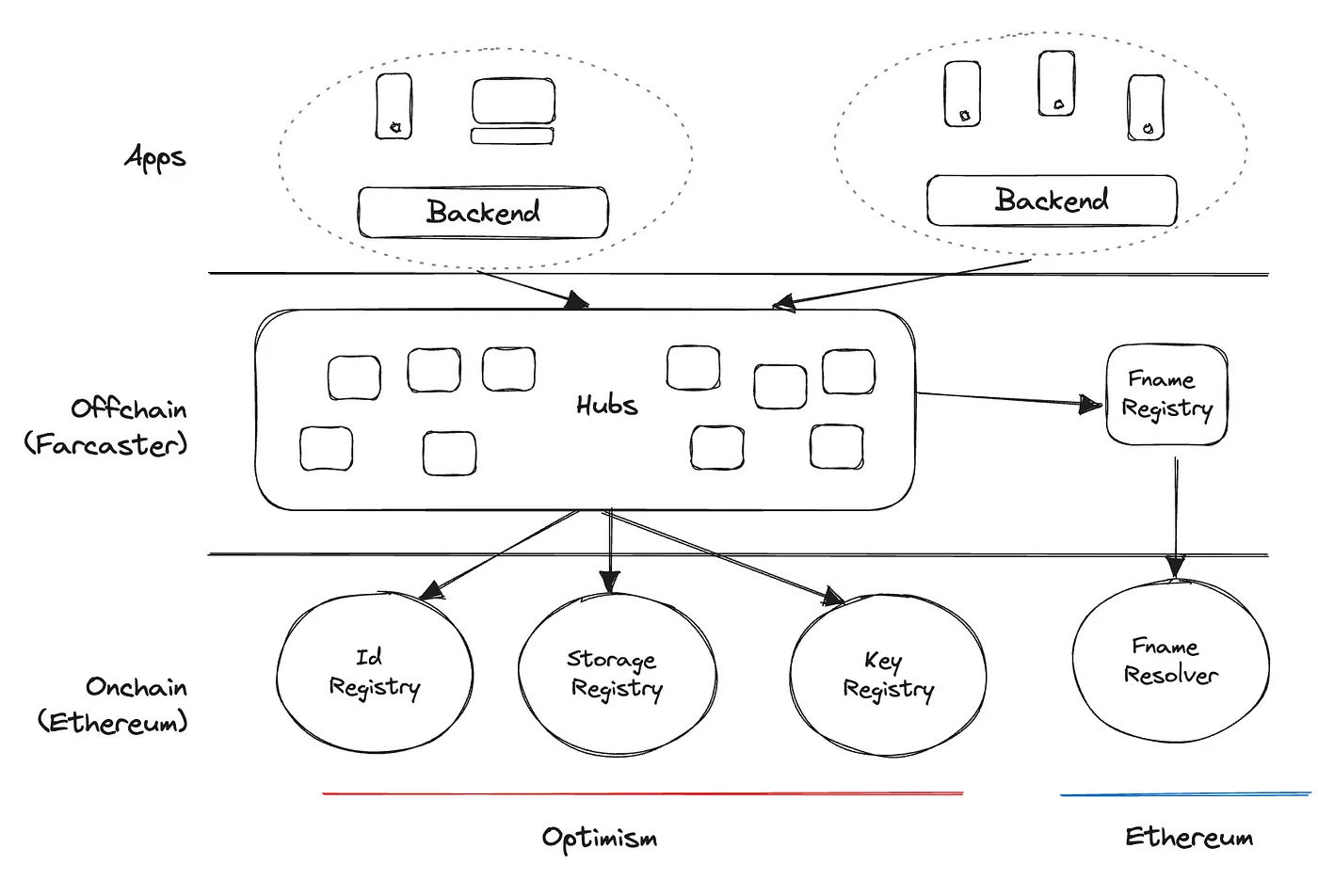
Farcaster launched initially on Ethereum, later moving its main contracts to Optimism. It has an interesting structure: user identities and payments for data storage rent are stored on-chain, while data itself is stored off-chain in nodes called hubs, which act as validators for Farcaster data.
Farcaster Architecture
The above is an architectural overview from Farcaster documentation, describing the overall flow of the application. Developer experience on Farcaster is also quite good—using services like Neynar, you can easily launch an app within 30 minutes.
State of SVM
Solana, Solana, Solana. There isn’t currently a social protocol like this built on Solana. The reason isn’t clear. Previously, teams like Gum Protocol and Solarplex (based on at-proto) attempted to build such protocols but had to shut down. While there are apps like drip.haus, Helium, and Hivemapper, there is no underlying protocol.
With the recent release of universal zkCompression, SVM API, and the upcoming arrival of Firedancer, now seems like the perfect time to develop consumer protocols on Solana.
Universal zkCompression enables storing any data at extremely low cost.
SVM API can be used to create a layer on Solana, giving protocol builders greater flexibility for custom use cases and reducing costs—for example, Joe from Anza Labs built a state channel where people transact off-chain and submit results on-chain.
Firedancer will make Solana stronger and improve overall blockchain performance.
Taking all this into account, now is an excellent opportunity to create consumer applications.
What to Consider Before and During Consumer App Development?
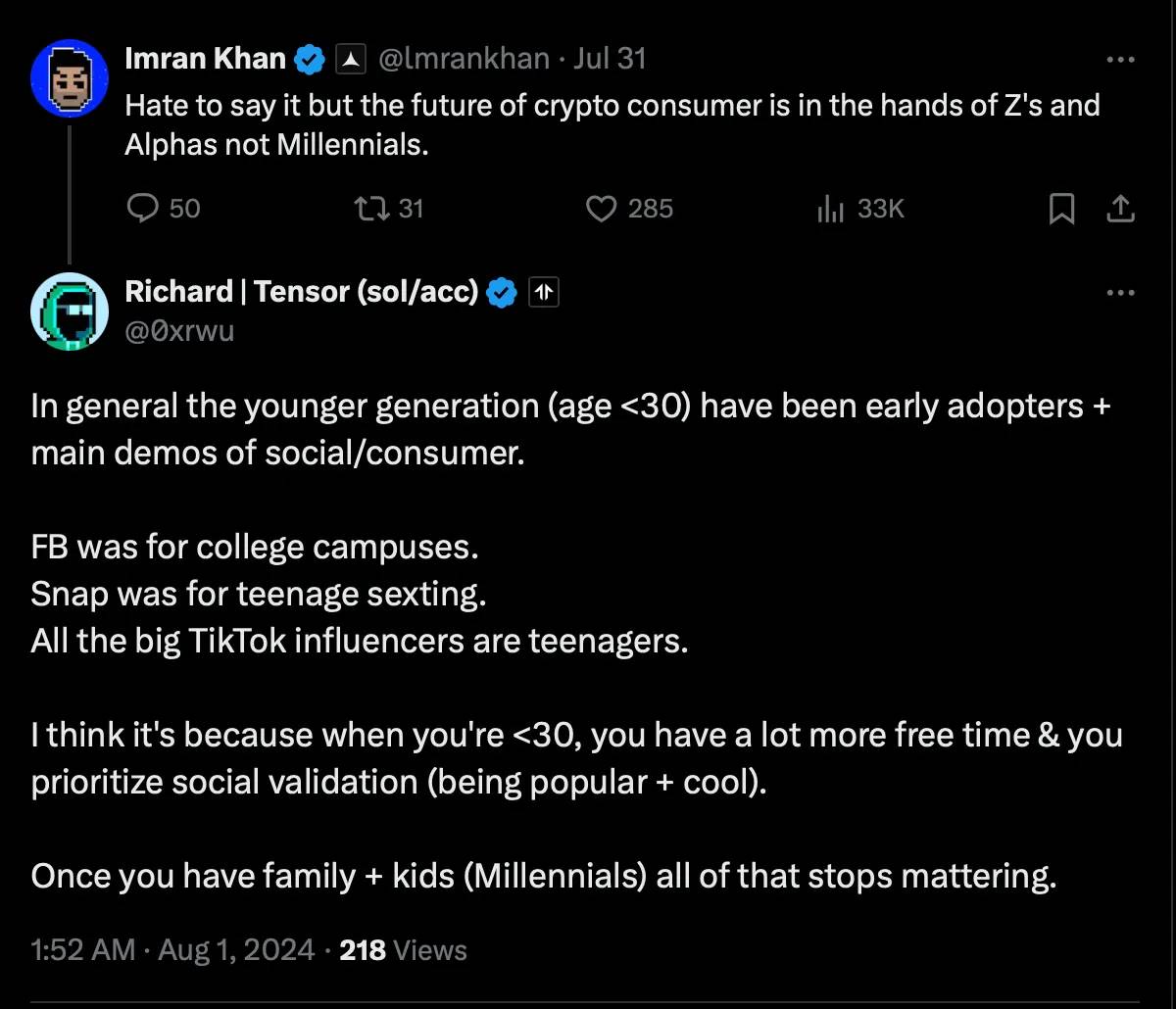
Imran Khan: I hate to say it, but the future of crypto consumption lies in the hands of Gen Z and Gen Alpha—not millennials.
Richard | Tensor (sol/acc): Generally speaking, younger generations (age <30) are early adopters and primary users in social and consumer spaces. Facebook was created for college campuses, Snapchat for teen communication, and all well-known TikTok influencers are teenagers.
I think this is mainly because when you're under 30, you have more free time and place higher value on social validation (being popular and cool). Once you have a family and kids (millennials), these things matter less.
Audience
The first thing is defining your audience, which is extremely important. You cannot build an app everyone loves, but you can build one loved by 100 users—and scale from there.
Selecting those 100 users is critical, as it defines your target market. These users should be closely related to you. For example, Facebook's initial audience was college students. Puffpaw, an app built on Berachain aimed at helping people quit smoking, benefits from its founding team’s decade-plus experience in vaping and pharmaceuticals, giving them a competitive edge.
Mobile-First
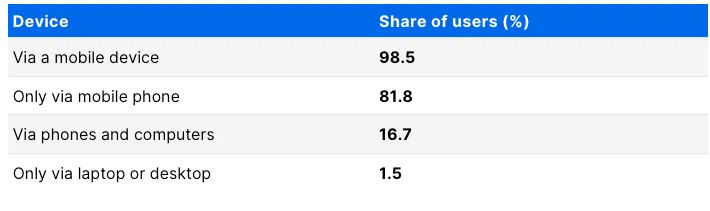
Mobile-first development is crucial. However, if going fully mobile significantly delays your time to market, you may focus on building a PWA or web app initially. Still, mobile must remain on the product roadmap.
Facebook Device Share
I’ll frequently reference Facebook because no one can deny it’s one of the greatest consumer apps ever built—so they clearly did something others didn’t.
Use off-chain technologies whenever possible, and go on-chain only when necessary. This is another point validated by Farcaster—the protocol keeps parts on-chain while storing messages off-chain. This approach significantly reduces fees, improves UX, and gives the platform more control.
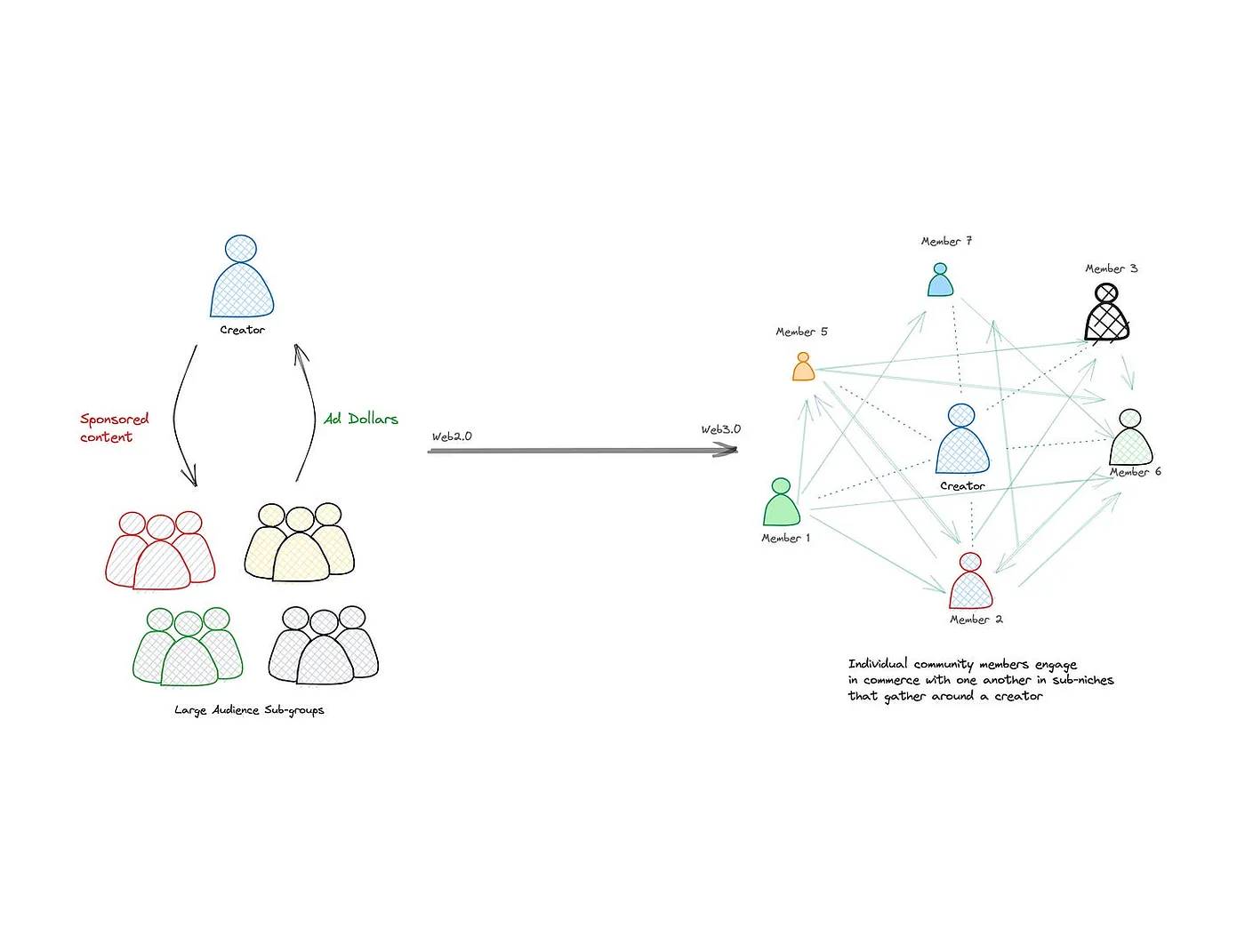
Personalization and recommendation feeds are often overlooked aspects in many crypto consumer apps. Any app can leverage crypto’s open graph to create far better recommendation pages than non-crypto apps.
Crypto Model — 1
Who Are You Selling To?
We've discussed selecting an audience, but this dives deeper given its importance.
Take Facebook as an example: it started as a college campus social network. If from day zero they had aimed to serve the entire world—imagine if Facebook’s tagline was “Revolutionizing global communication”—they likely wouldn’t be where they are today. Defining your Serviceable Available Market (SAM) and keeping it specific is vital for any app.
You’re not building to attract the next billion users—you’re building to attract the next 100. The billion will come naturally.
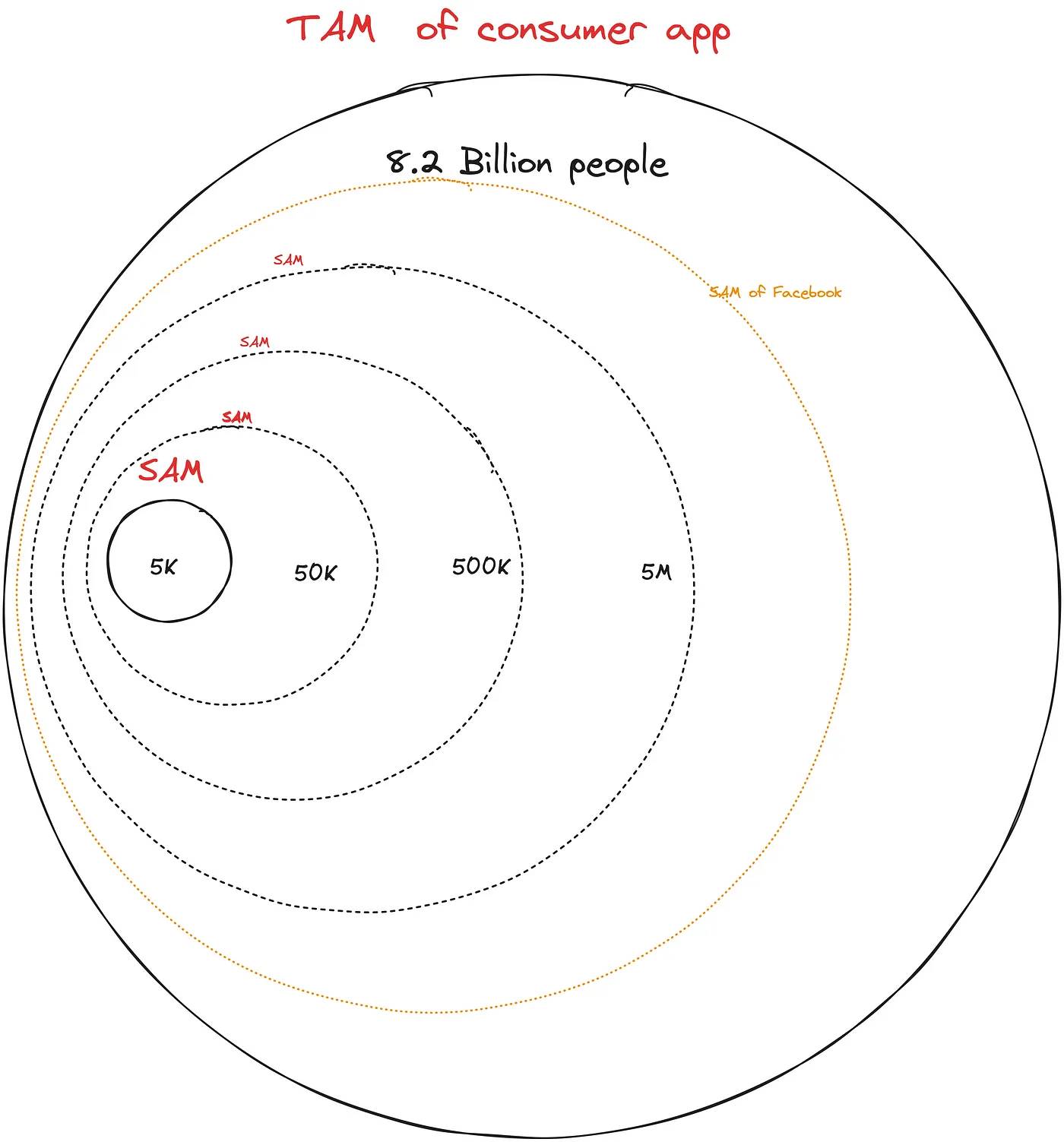
SAM Over Time
The chart above illustrates how a consumer app’s SAM should evolve over time. In short, if you first cover crypto-native SAM, only then should you expand to non-crypto audiences.
There’s a thread by Dan (Farcaster) discussing a similar idea, clearly outlining his vision for the platform.
Dan Romero: Identity depends on utility. Massive consumer value through entertaining and fun content is needed to earn identity rights. This is why email, phone numbers, and services like Apple and Google became login options for mass-market consumer apps.
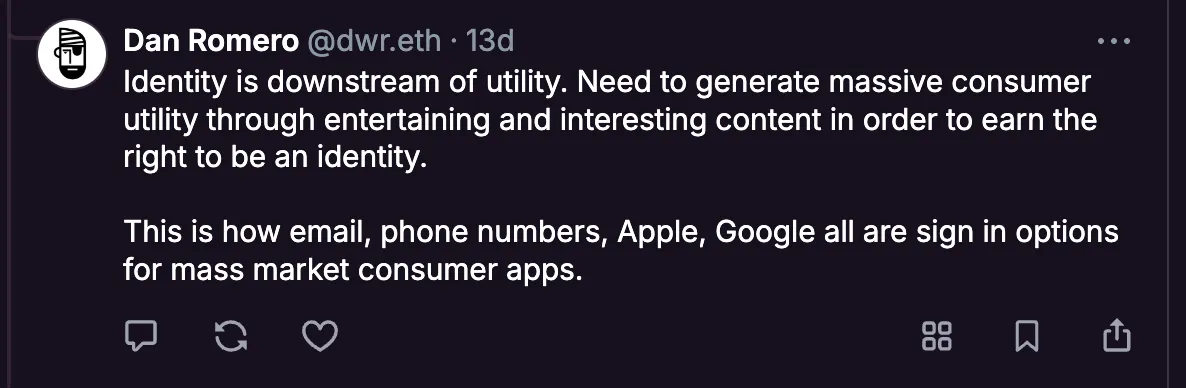
The discussion above also suggests that one of the main goals of any consumer app should be becoming an identity.
Perspectives
There are multiple ways to tackle this challenge. We’ll review each previously attempted solution and analyze their successes and failures.
Are Protocols the Only Solution? Farcaster and Lens
Both Farcaster and Lens chose the protocol model—building a protocol first, then developing apps on top.
Farcaster adopted a product-led growth (PLG) strategy. Essentially, Warpcast is the leading client on Farcaster, owned and operated by the Farcaster team. This allows them to control key aspects of the app layer and deliver a solid user experience. When launching new features, demonstrating them via their own client makes adoption easier.
The app’s login flow is also quite user-friendly for regular users.
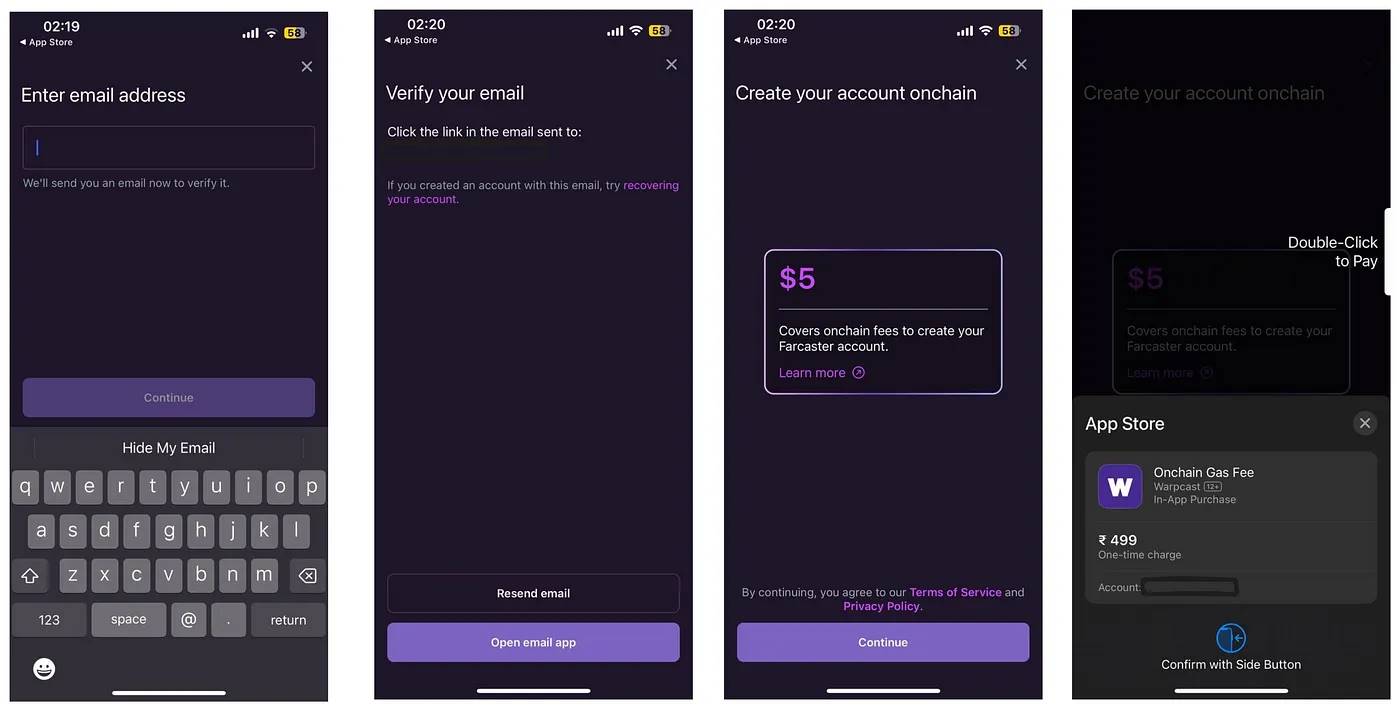
Warpcast Login Flow
This is a fully Web2-like experience—users don’t even need to connect a wallet, and can pay on-chain fees via Apple Pay, making Warpcast an excellent consumer app in terms of UX.
I’m somewhat dissatisfied with certain design choices in Warpcast (possibly intentional to force logins)—users cannot browse the app without logging in. This restriction resembles X, where users can view posts via links but cannot navigate within the app.
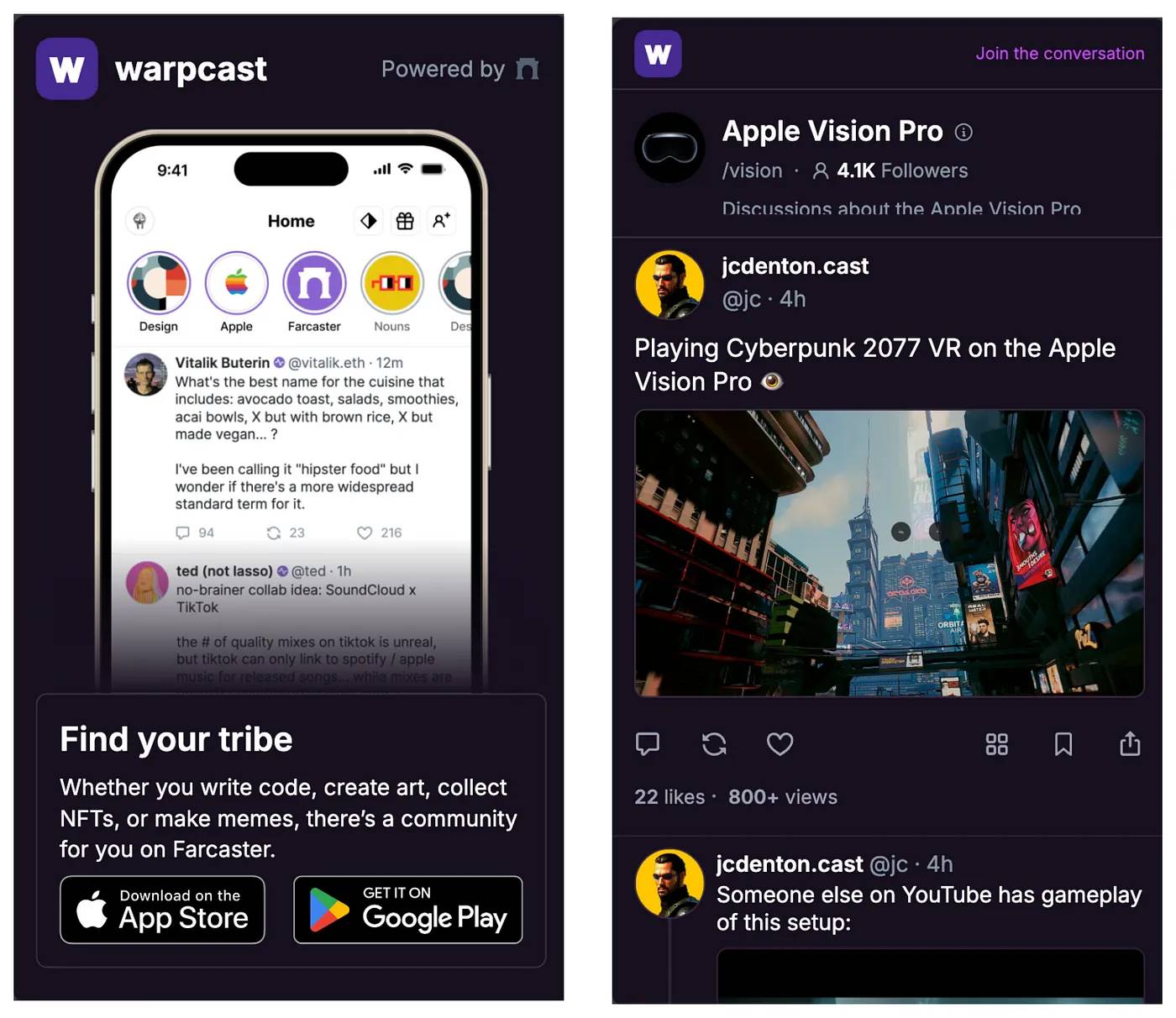
Left: Homepage. Right: Cast Link
There’s also discussion around market share—apps like Supercast are great clients, but due to Warpcast’s dominance, Supercast is often seen as a backup option used only when Warpcast fails. There are many mini-apps on Farcaster, but Warpcast remains the most widely used.
Lens took a different route—inviting founders to build apps on it, relying on the ecosystem to bring users. With a large user base, apps can leverage this for growth.
This approach grants more power to clients. Although hey is the primary client and fully open-source, other clients serve different purposes, each with unique use cases and active user bases. Orb is a frequently used mobile client. As a result, apps built on Lens have raised around $30 million—whereas no app has yet raised funds on the Farcaster protocol.
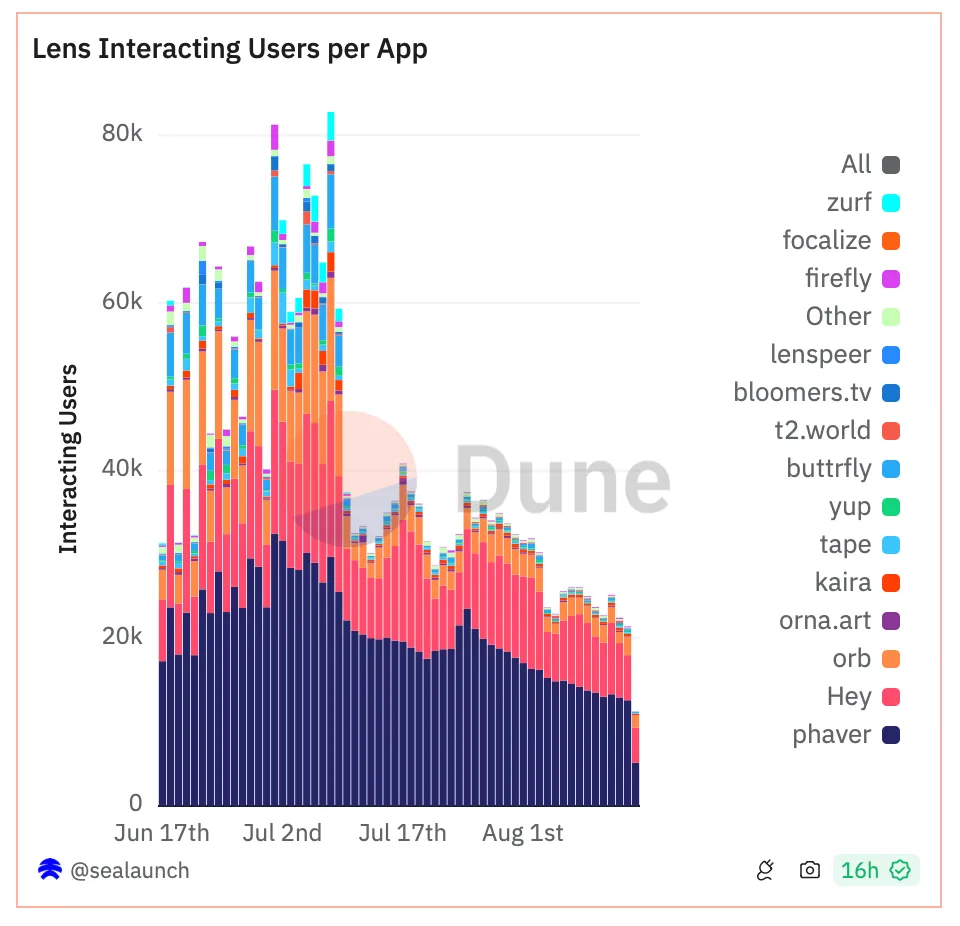
Share of Apps Built on Lens
In Poster (then Lenspost), we were among the early participants experiencing the community firsthand. Users were high-quality and genuinely interested in the protocol. The Lens team actively supported every project building on it, helping us lay the foundation for our app.
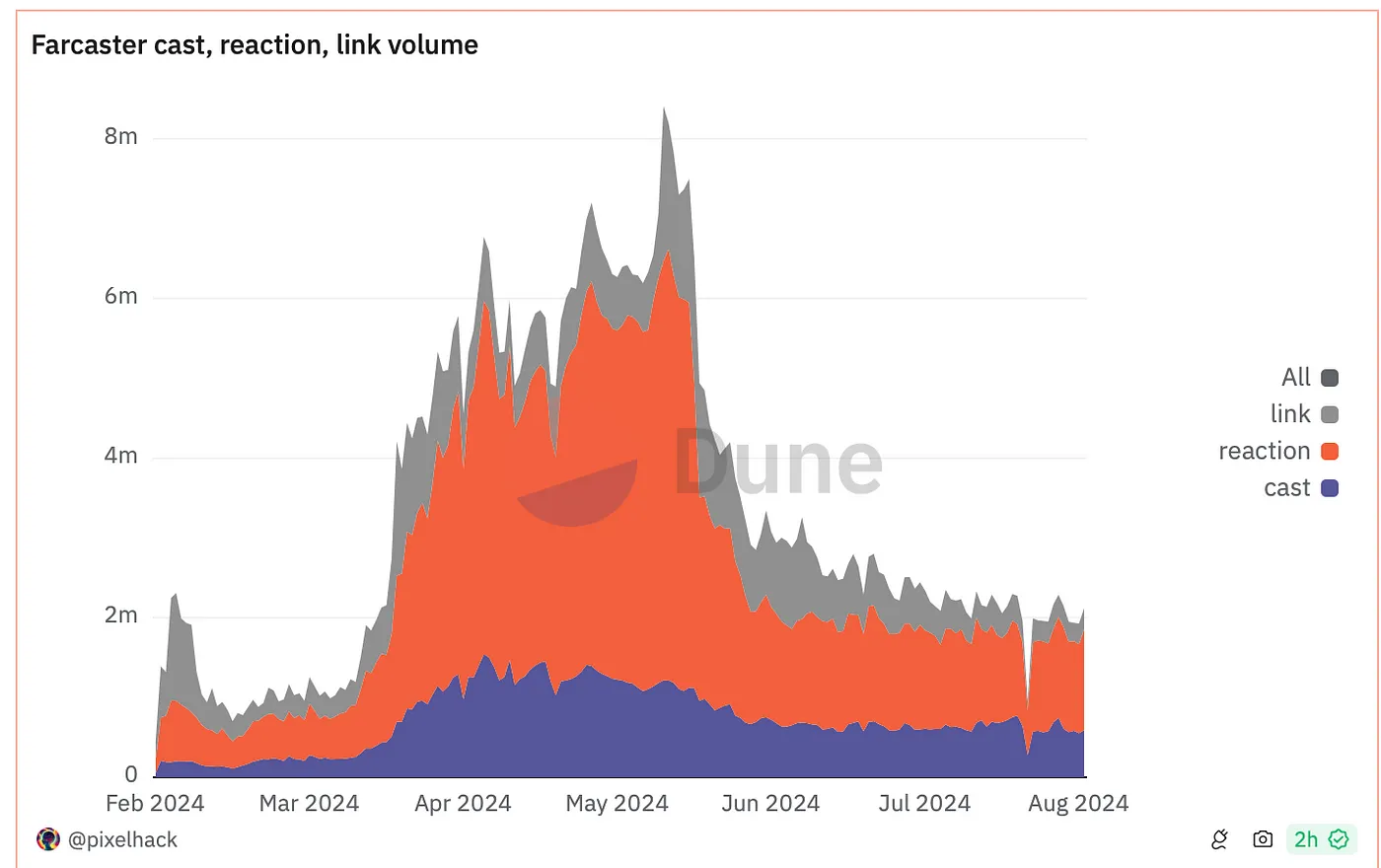
Source: Dune
Farcaster saw significant DAU growth after launching its Frames feature in January this year. As users began using Farcaster to launch tokens—starting with degen culture, followed by many others replicating the model—activity reached an all-time high. I previously admired Farcaster for its high-quality daily active users (qDAUs), though post-airdrop speculation caused a temporary dip. Now it’s recovering. (Sounds selfish, haha—I still use Farcaster, it’s just a bit crowded now.)

Source: Dune
Lens usage also hit an all-time high last year, fueled by rumors of an airdrop and its early invite-only functionality, which gave users a sense of status—people were willing to buy usernames on secondary markets for $300–$400.
This raises the question: Is speculation the only way? Friend.tech / Fantasy.top
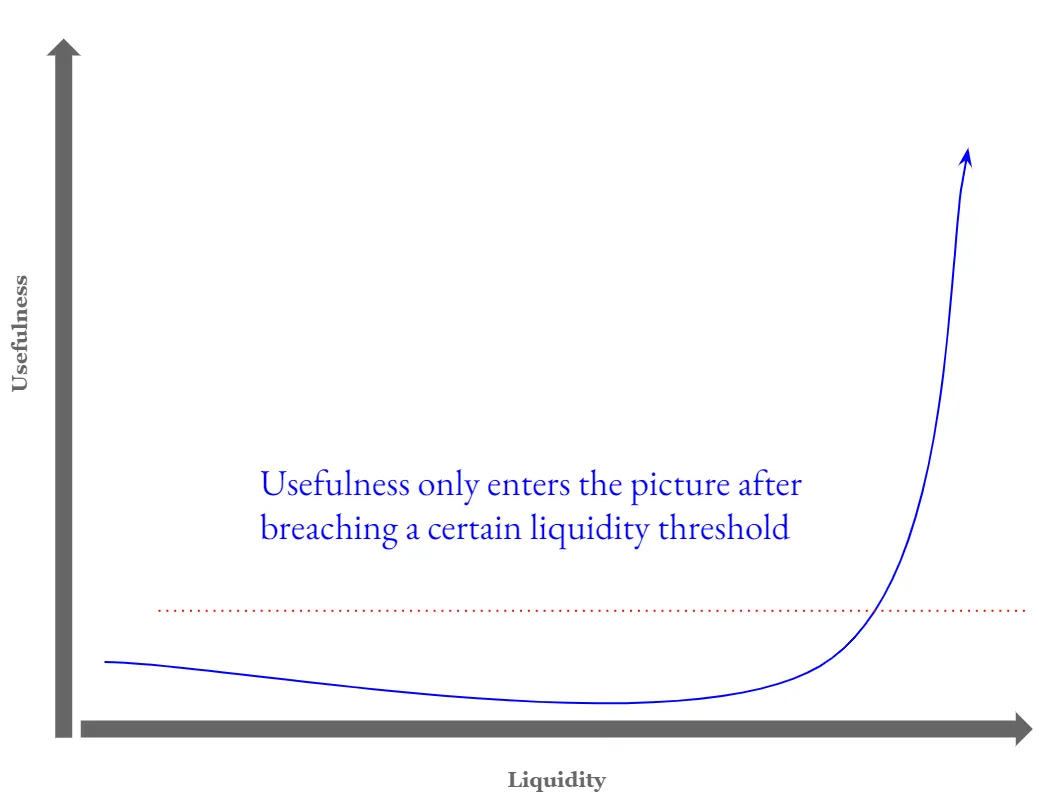
From Mhonkasalo’s Substack article
The excerpt above comes from a decentralized blog. Every app needs a certain amount of liquidity to gain attention. Each app must find the key factor that helps it break through. In Farcaster’s case, Frames was the breakthrough catalyst; in Lens’s case, early invite-only access generated buzz and fueled airdrop speculation.
Now here’s the issue. A tweet once said something along the lines of—People earn airline points when flying, but even without points, people would still choose to fly.
Users should use your app even without points or tokens—those should be added value.
Josh Cornelius: I find it hard to imagine the first wave of killer crypto apps won’t revolve entirely around finance or speculation. Speculation and financialization are crypto’s most distinctive killer features—they unlock experiences fundamentally different from Web2, ones that are uniquely compelling. This isn’t pessimism. These winners will have ample opportunities to gradually introduce more meaningful social interactions and contexts, attracting users with weaker financial motivations. Over time, the social roles they serve can begin to balance financial incentives. But ignoring this reality risks irrelevance.
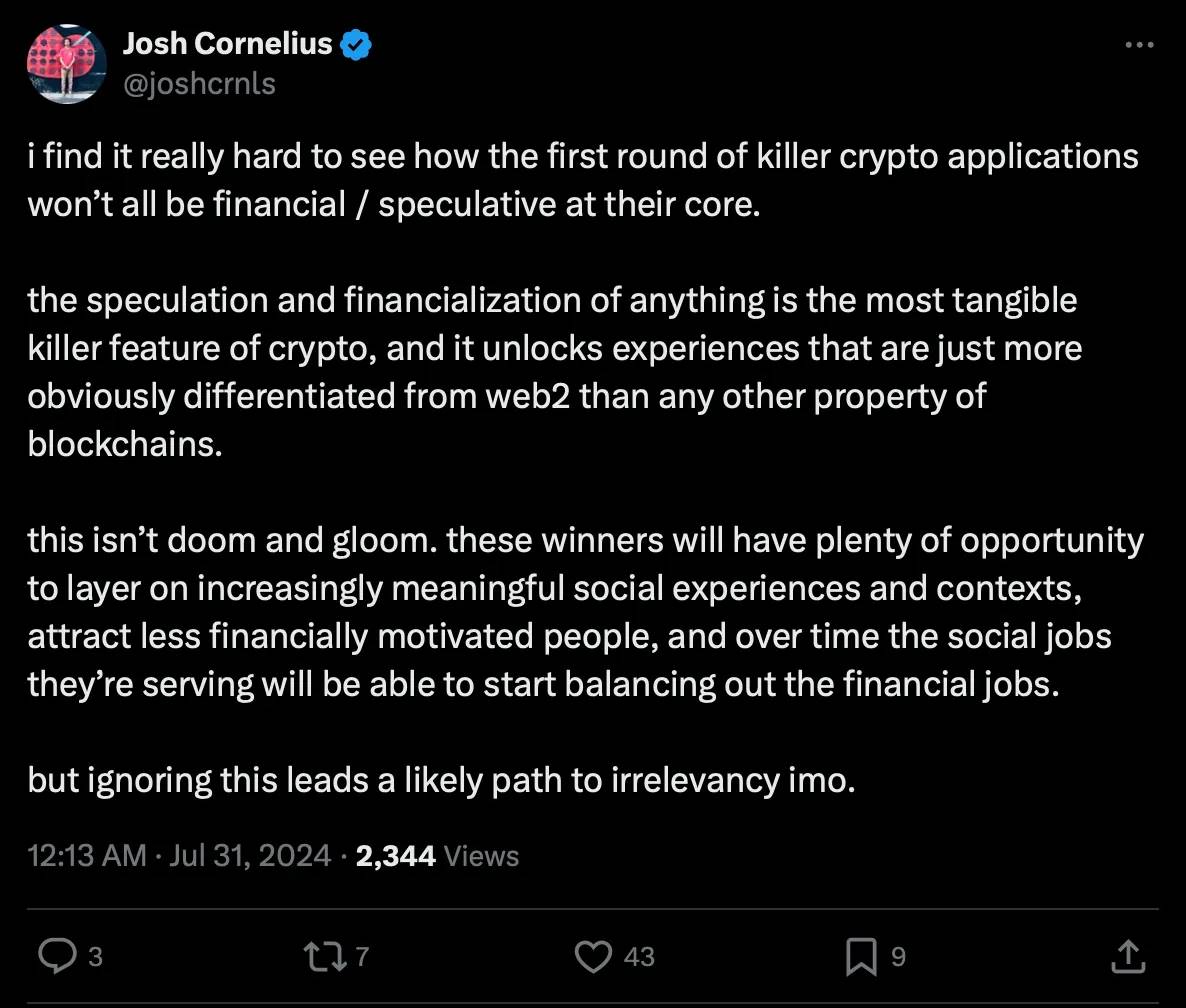
The tweet above emphasizes the importance of speculation and financialization, but apps should focus on combining long-term incentives with tokens or points.
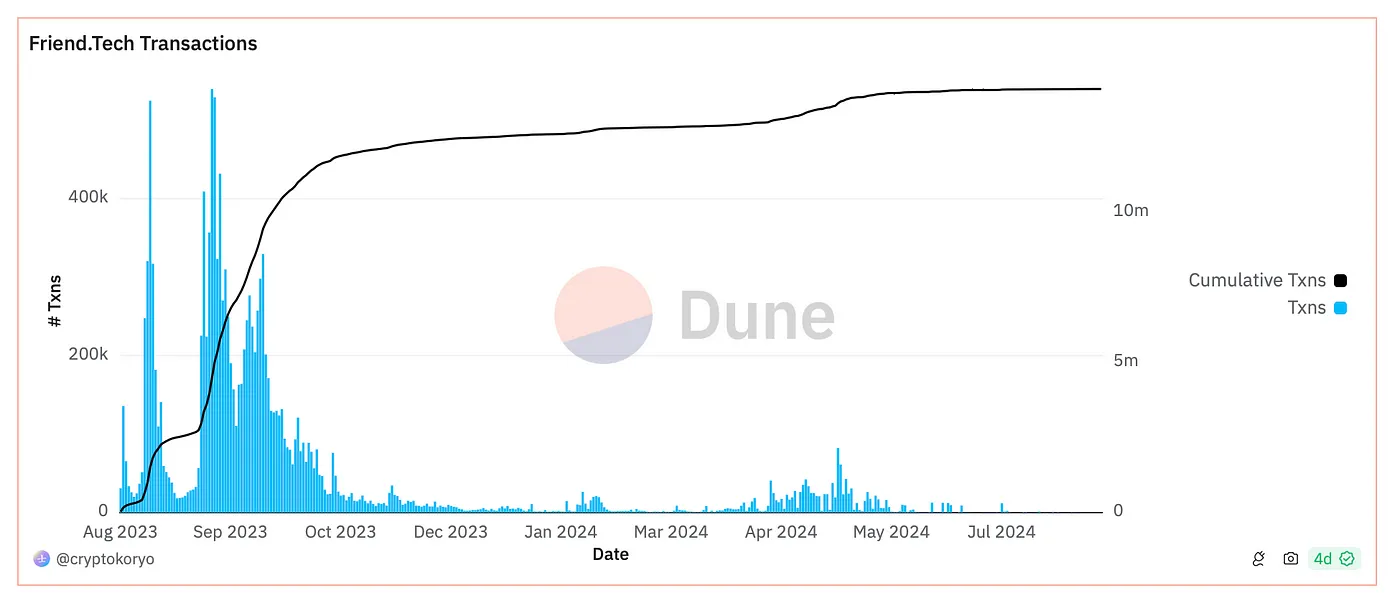
Friend.tech and Fantasy.top are apps that leveraged speculation to gain attention. They achieved strong traction temporarily, but ultimately lost momentum. This clearly shows one core problem: short-term incentive mechanisms. The idea behind friend.tech was positive—users trading access to people’s time—but it was mostly exploited for profit.
The charts below clearly show both apps peaking in activity during a specific period, then dropping nearly to zero.
Source: Dune

Source: Dune
What About Solana? Drip.haus and Pumpdotfun
Drip.haus—no discussion of crypto consumers is complete without it.
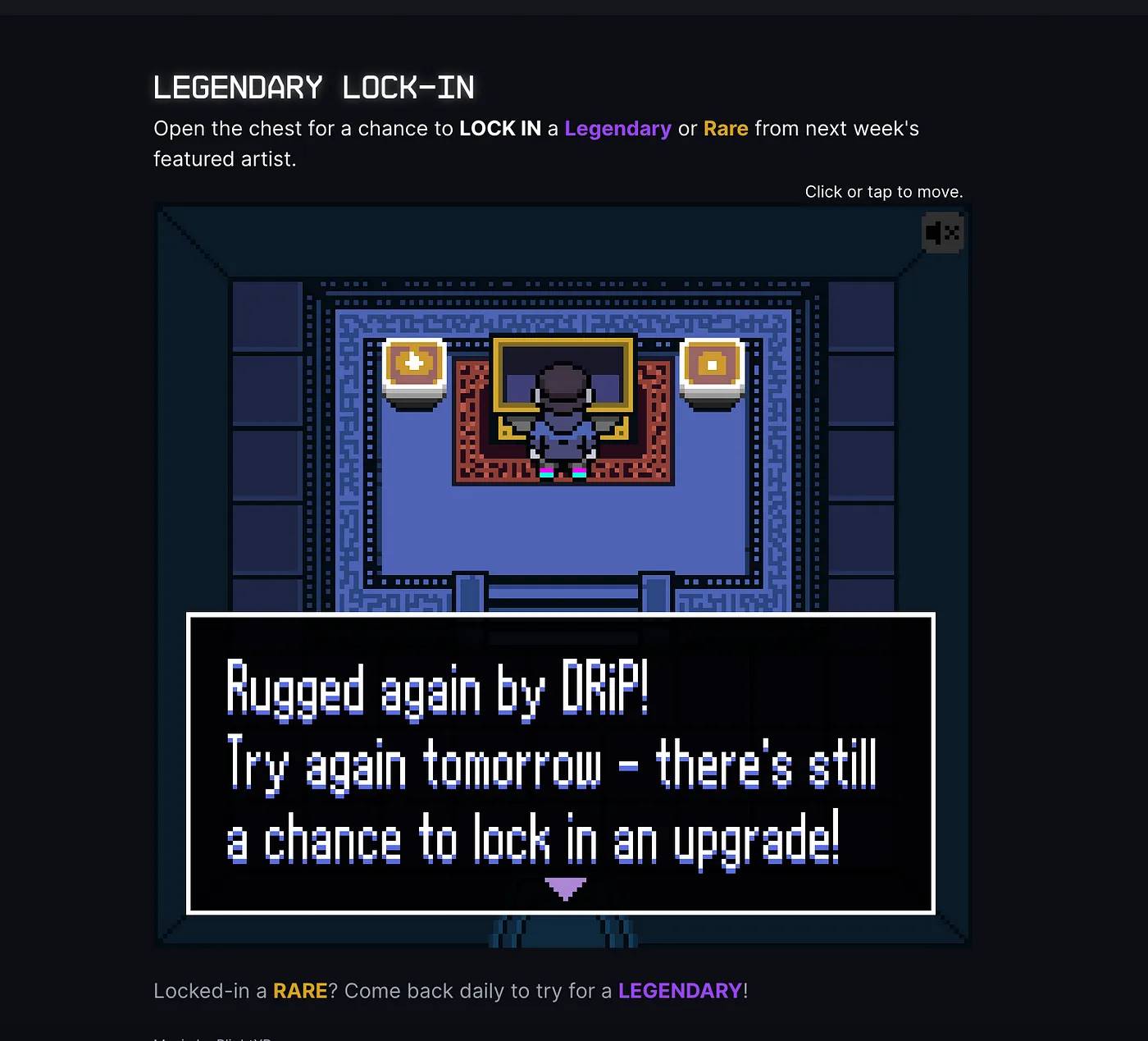
Drip has always been about rug pulls.
Drip is a creator-focused app allowing creators to distribute any artwork to a massive audience at negligible cost (“drip”). Users can tip creators using something called droplets—you can think of droplets as the platform token (though not on-chain). Users must purchase droplets to collect art or tip creators, while creators receive droplets redeemable for USDC.
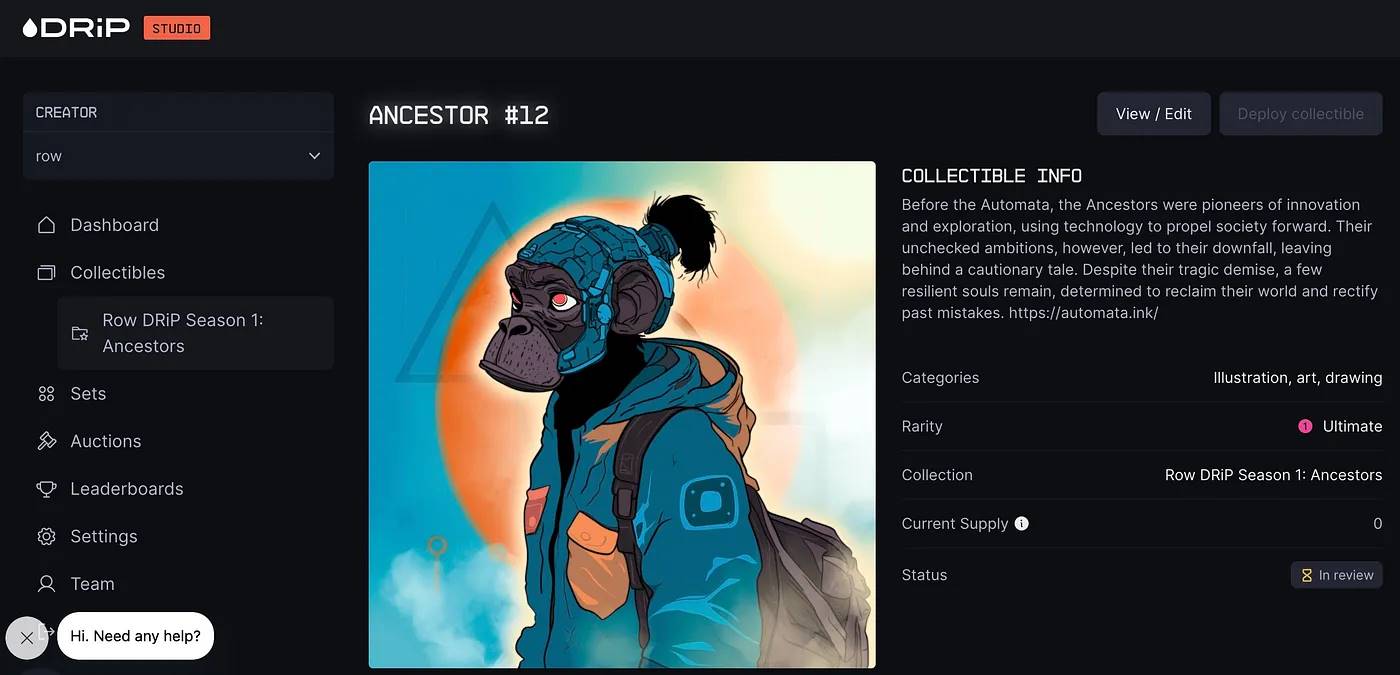
For creators, Drip recently launched a studio to simplify the process of releasing artwork.
Source: X
Drip also includes a mechanism where users unlock a treasure chest daily to obtain rare or legendary artworks. In-app mini-games like chests, droplet mechanics, and rarity tiers helped Drip become one of the top consumer apps across all chains.
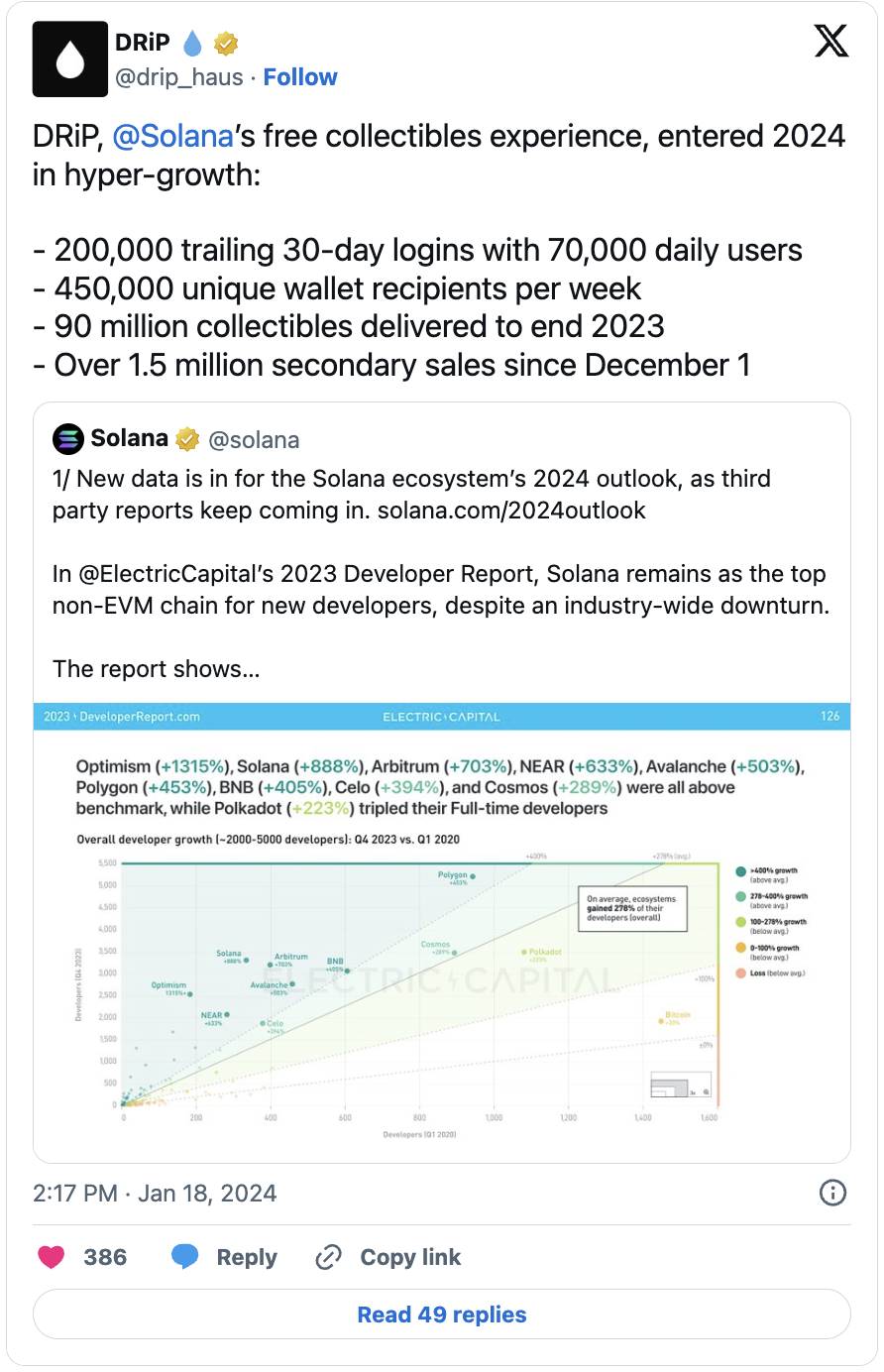
Drip is currently developing a mobile app, already listed on the Saga store, expected to launch at Solana Breakpoint 2024.
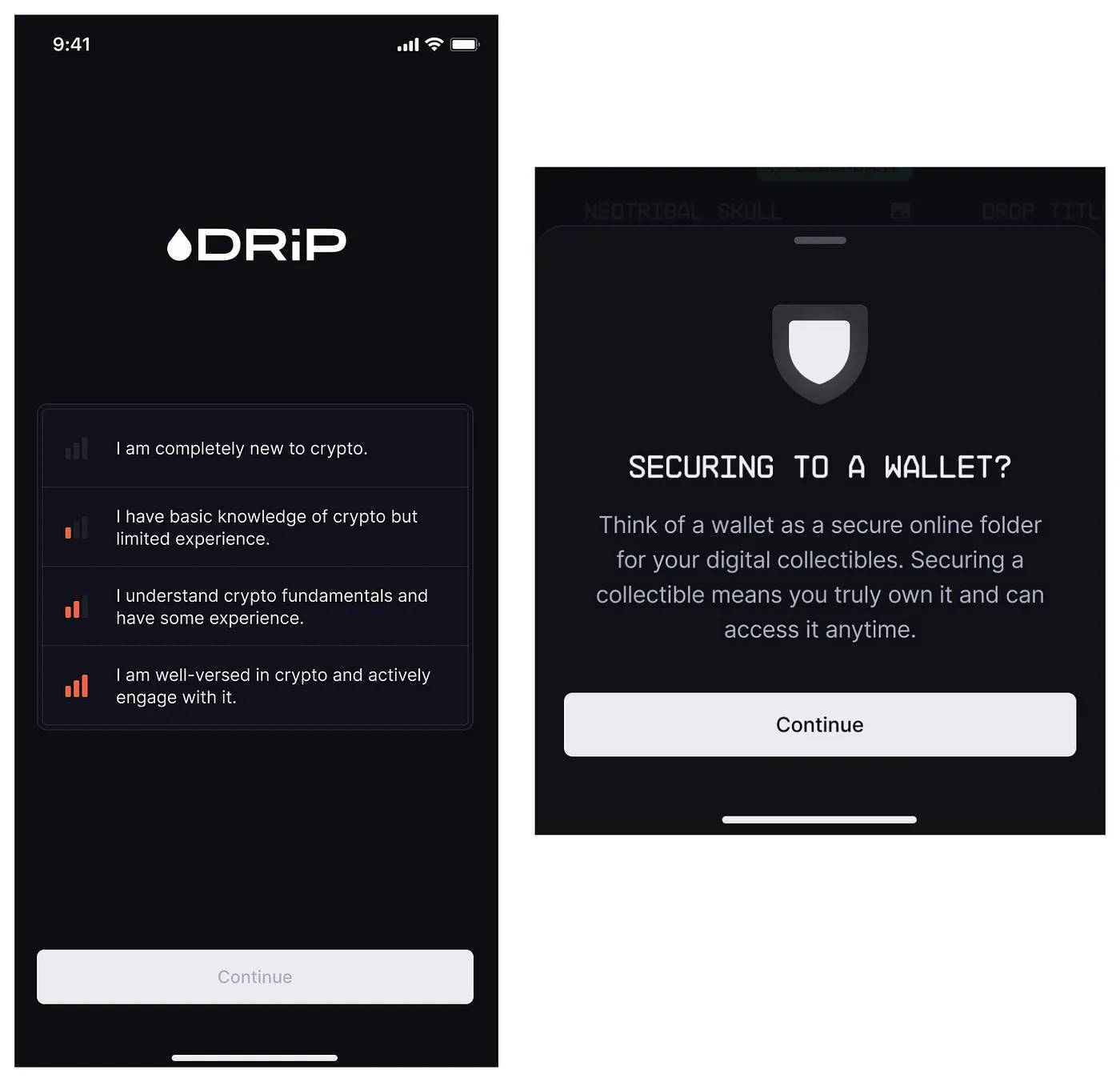
The above screenshots from Vibhu’s tweets make you reflect on how to focus on building consumer apps and what details to prioritize. The left screenshot shows user options, each with completely different login flows.
Pumpdotfun—memecoins as crypto content
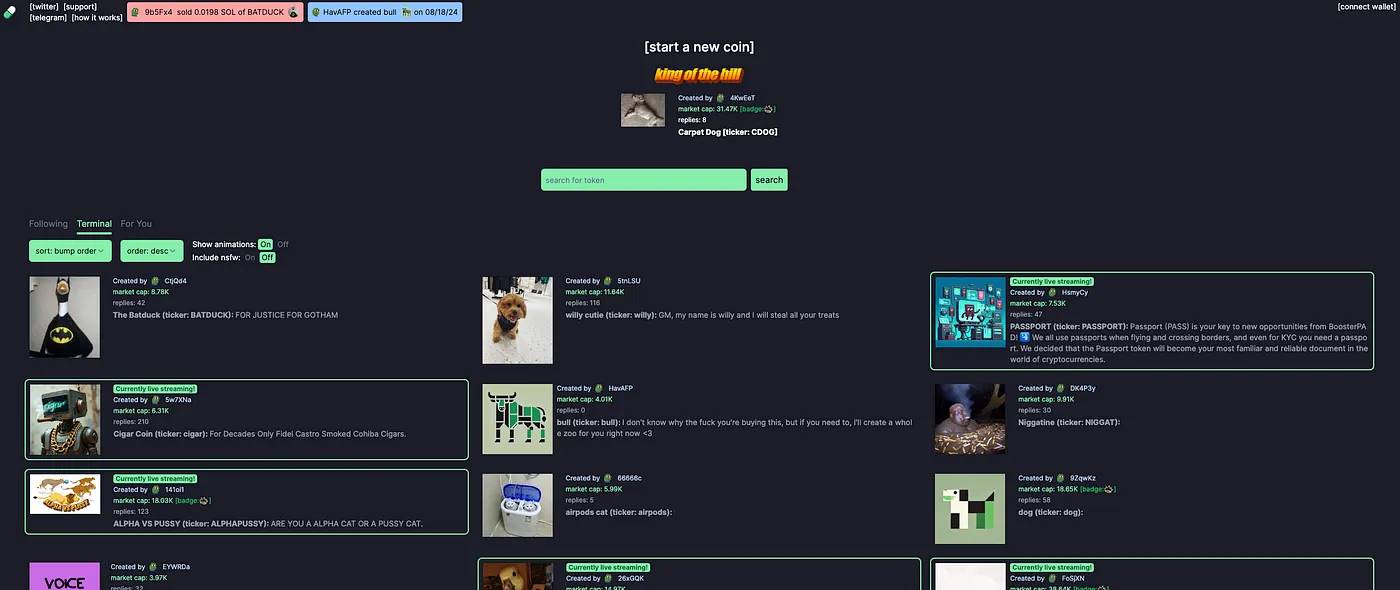
If you have product-market fit (PMF), UI doesn’t matter.
Within minutes of any global news event, thousands of memecoins are created on Pumpdotfun. Users can trade these coins until the bonding curve reaches a $69K market cap, after which a Raydium pool is created. These coins symbolize real-world events and can be viewed as content.
The ability to freely deploy memecoins with one click makes it an incredibly powerful platform.
I’d like to quote this passage from Manan’s article:
“A mix of real humans and bots rush to capture trends and events, then tokenize them, hoping for a breakout. Used well, pump.fun’s terminal transcends Twitter’s trending hashtags.”
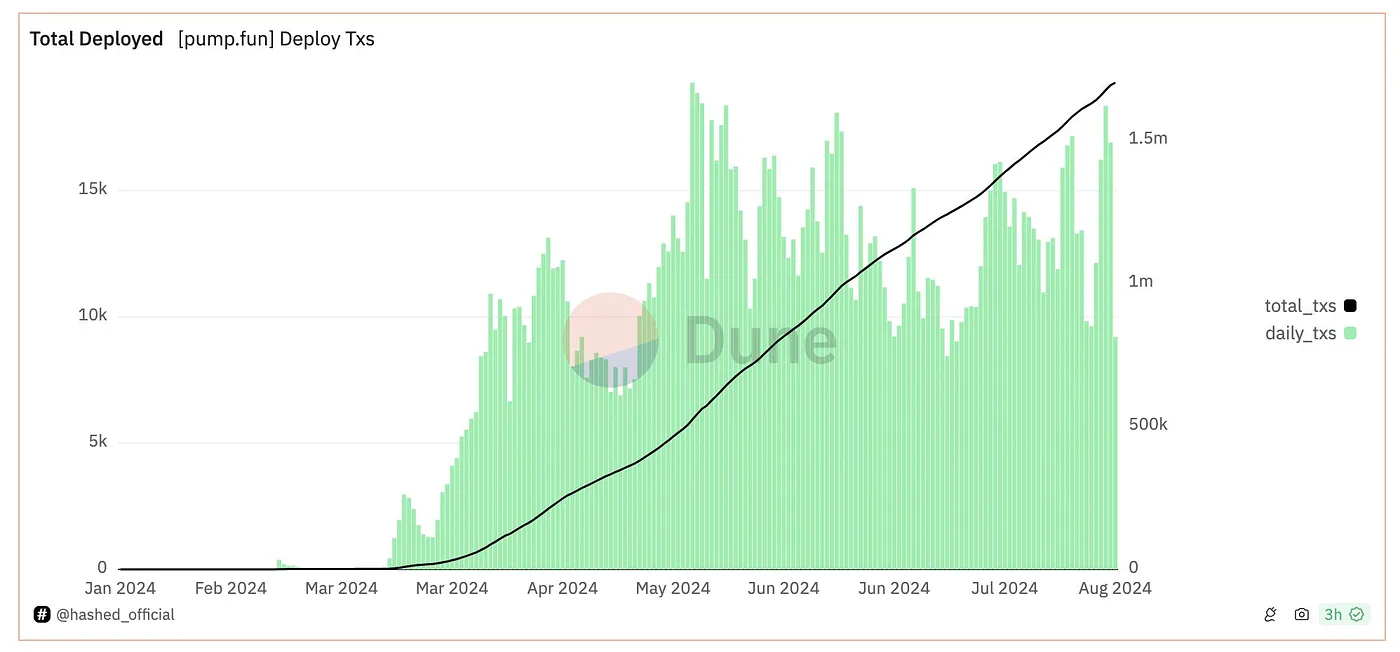
This is also one of the few apps that hasn’t seen declining users. Recently announcing free deployments and rewarding creators who complete bonding curves with 0.5 SOL, this number will only grow further.
Tiplink and Privy—Saviors of User Experience
Tiplink
On Solana, over 20 apps can be accessed without a wallet—you can log in via Google using Tiplink.
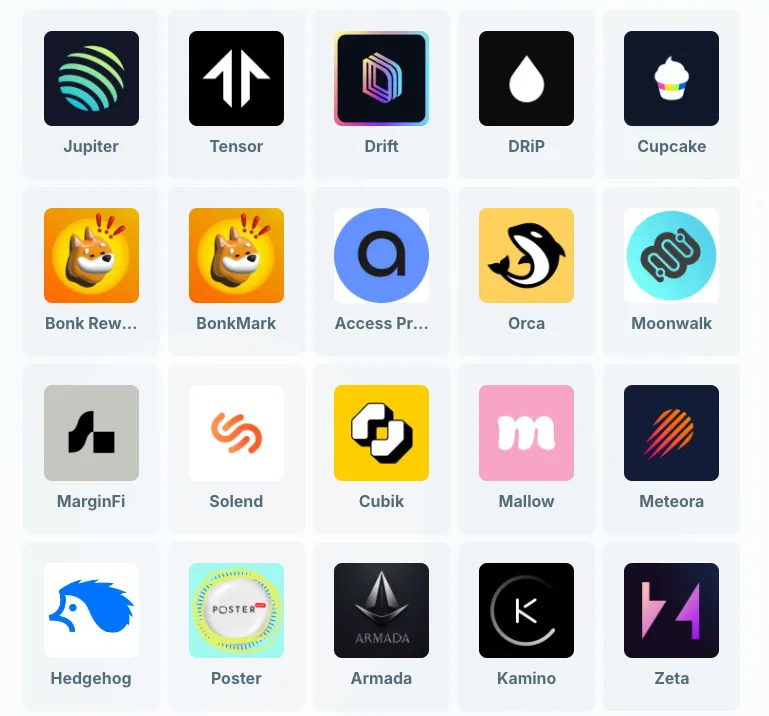
Some apps using Tiplink login
If you’ve interacted with the Solana ecosystem, you’ve likely encountered Tiplink somewhere. The concept is simple—the link itself is the account.
You can send a link loaded with USDC to anyone globally, and they can withdraw it directly to their bank account.
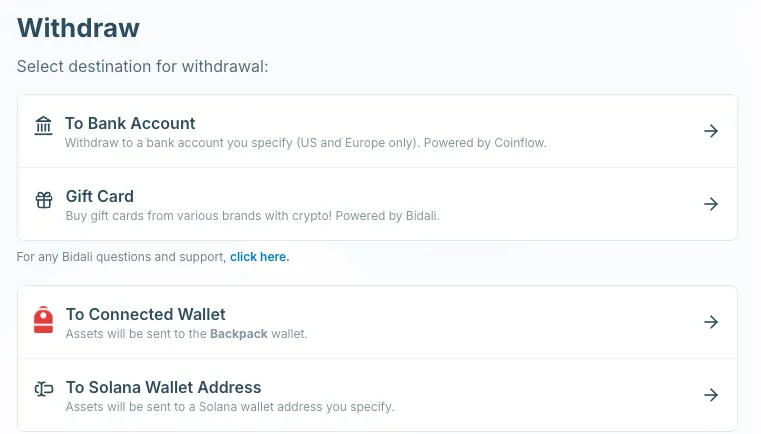
Anything doable in a wallet can be done via Tiplink. The team behind Tiplink continues to enhance user experience across Solana.
Privy
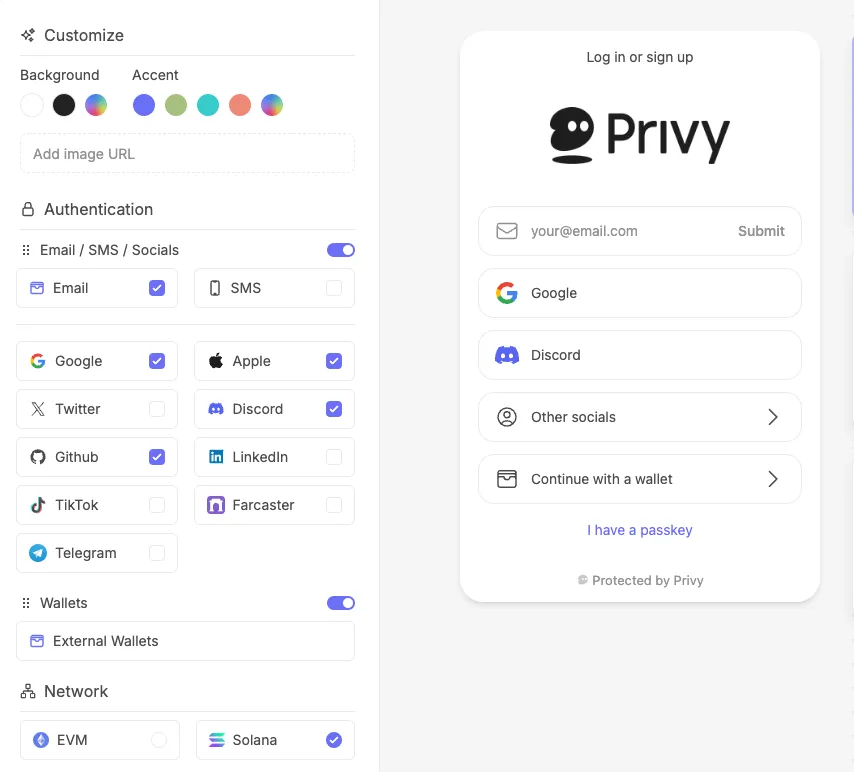
Privy Login Options
Privy excels in user onboarding, supporting multiple OAuth providers like Google and Twitter, and recently added Solana support—very promising.
Teams like OpenSea, Zora, Hyperliquid, and Blackbird use Privy for user login due to the superior experience it offers. If users opt for social login, an embedded wallet is created and password-protected. Users can choose to migrate this wallet to other apps or create a fresh one for new apps.
Privy also provides fiat on/off-ramps via MoonPay and Coinbase. Recently, they launched a feature called Native Bridge, enabling users to pay from any chain, with the app receiving funds only on the requested chain.
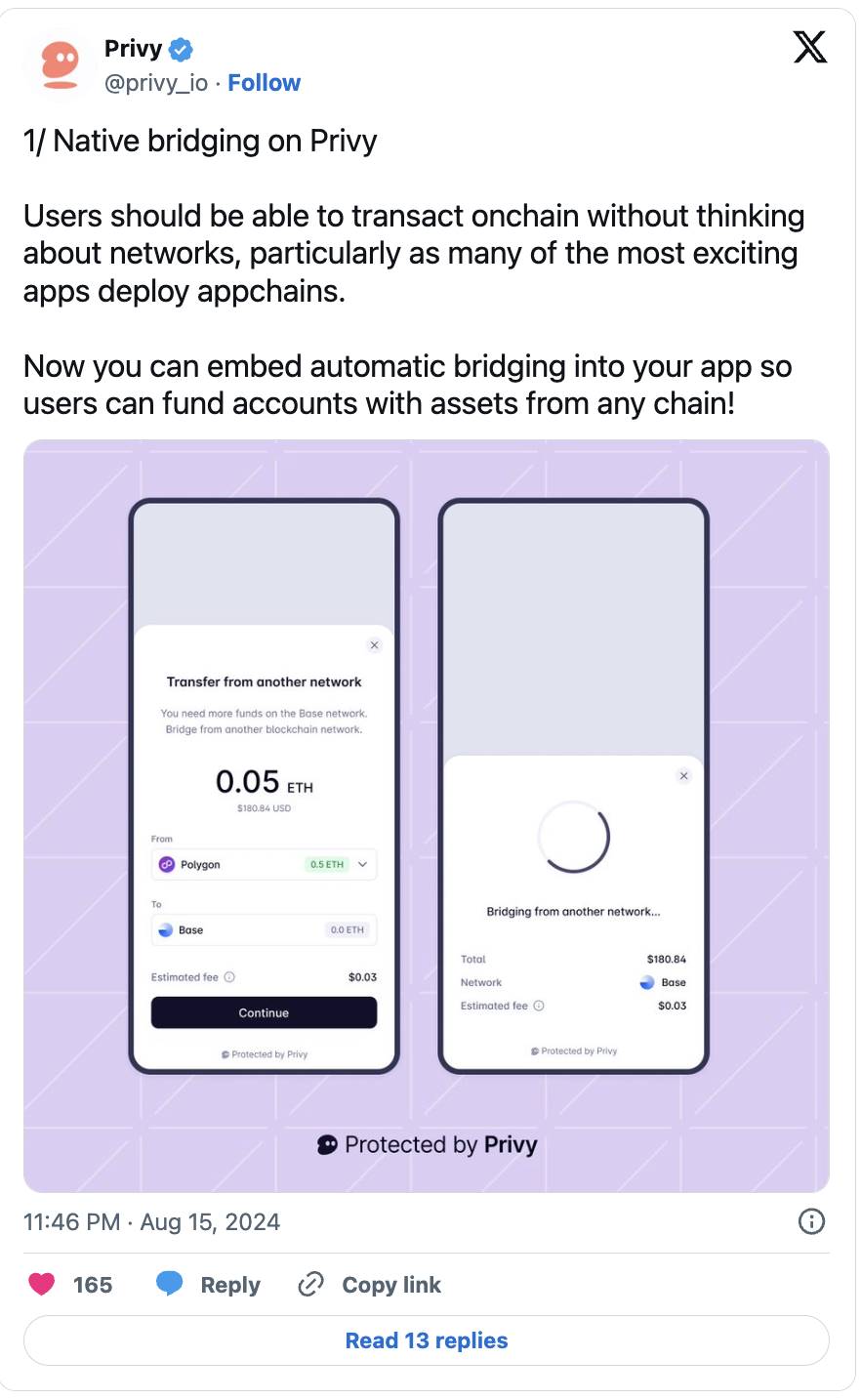
These thoughtful design decisions have enabled Privy to onboard over 3 million users across platforms into the ecosystem.
Consumer Meets Real World—An Interesting Space
I recently realized that some crypto apps create unique user experiences by integrating real-world elements. Though this generation may be lifelong online dwellers, they still crave real-world experiences. Notable apps in this space include Skytrade, Puffpaw, and Hivemapper.
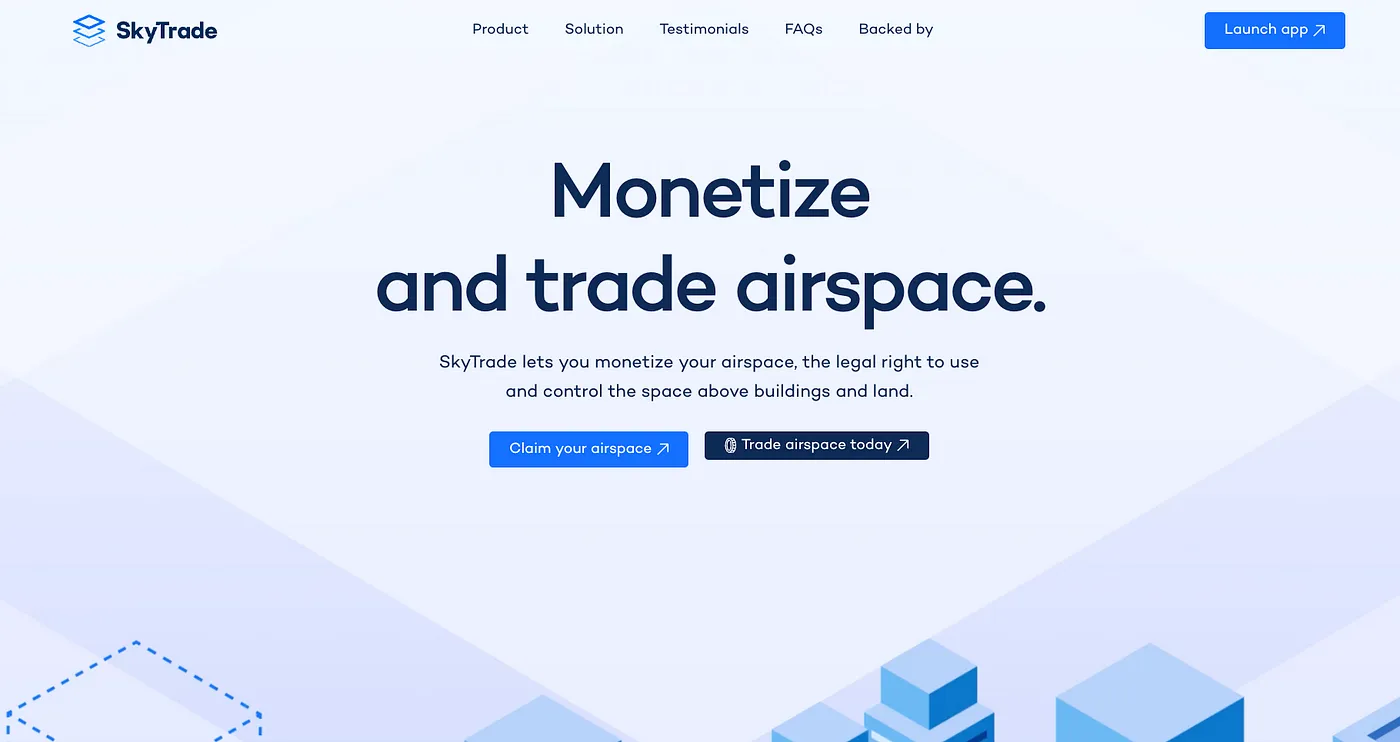
Skytrade Homepage
Skytrade allows people to own air rights above their homes. Drone operators can buy tokenized airspace transactions for that property, enabling participation in this accessible market. Though still early, Skytrade has facilitated over $30 million in airspace transactions on its platform.
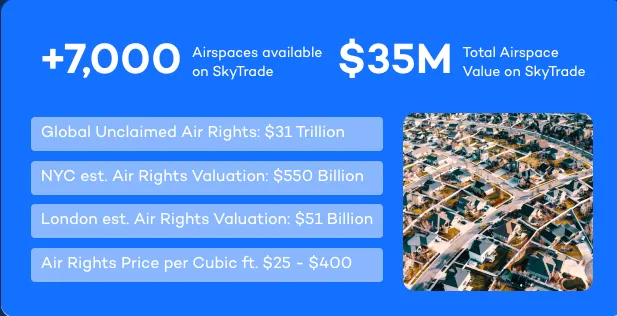
I’m optimistic about projects like Skytrade because back in 2018, I worked at an ultra-local drone delivery startup. Getting permission to fly over residential areas was extremely cumbersome—requiring approval from local police and district offices before every flight. It’s 2024 now, and little has changed.
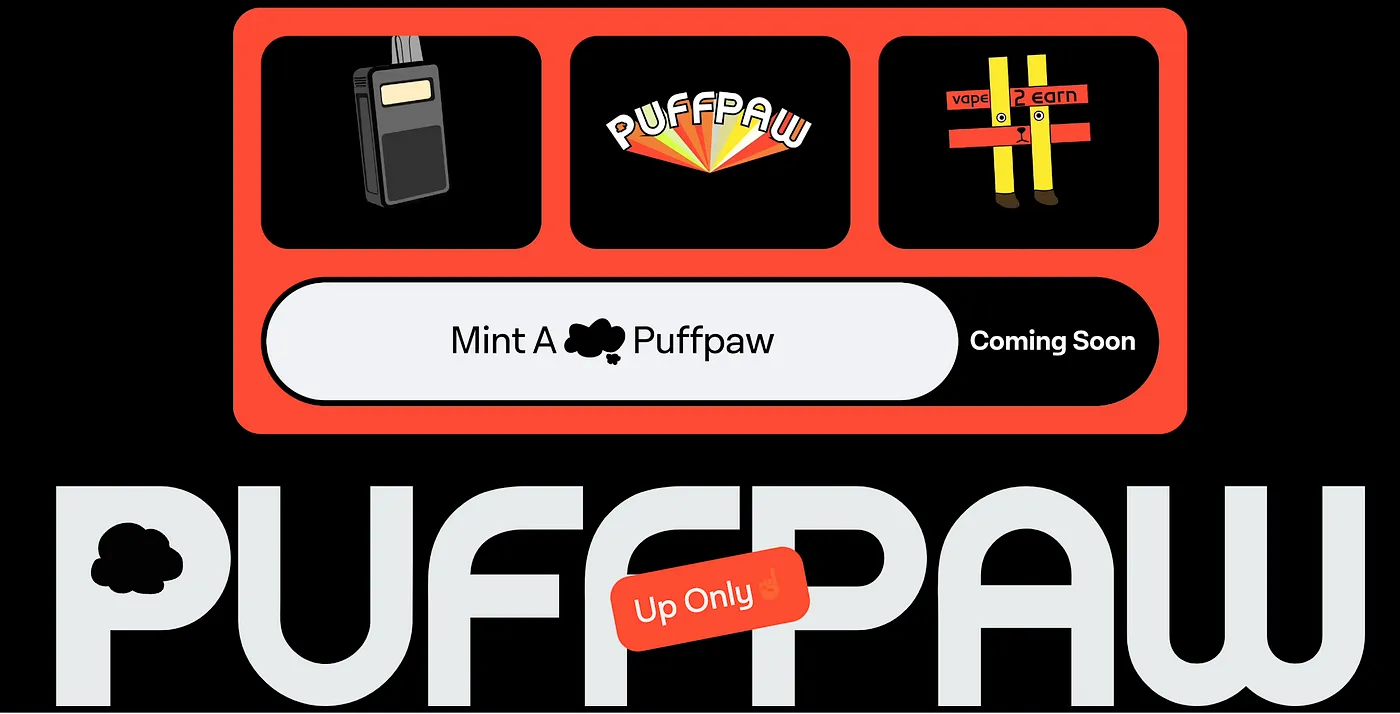
Puffpaw Homepage
Puffpaw is another intriguing project aiming to help people quit smoking. It creates its own vaping device or node with a daily smoking limit that affects gameplay. The vape offers various flavors and nicotine levels.
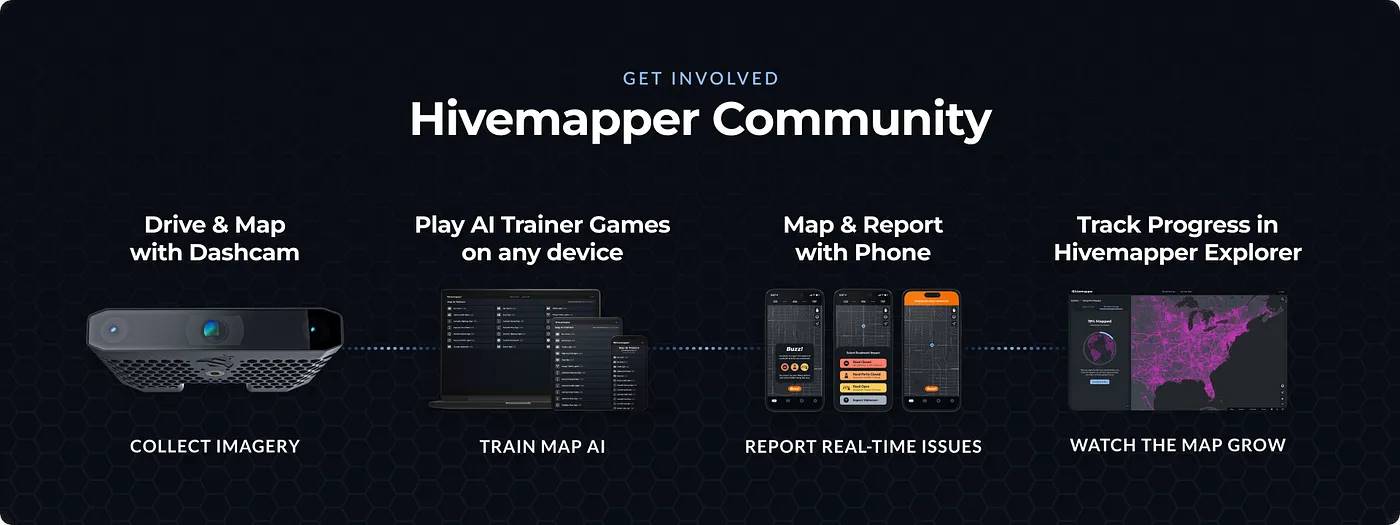
Imagine earning money by driving around the world—Hivemapper is doing exactly that. Install a dashcam in your car and contribute to improving global mapping systems.
Since dashcams cost nearly $500, users on the platform are genuinely interested. The user base grows monthly.
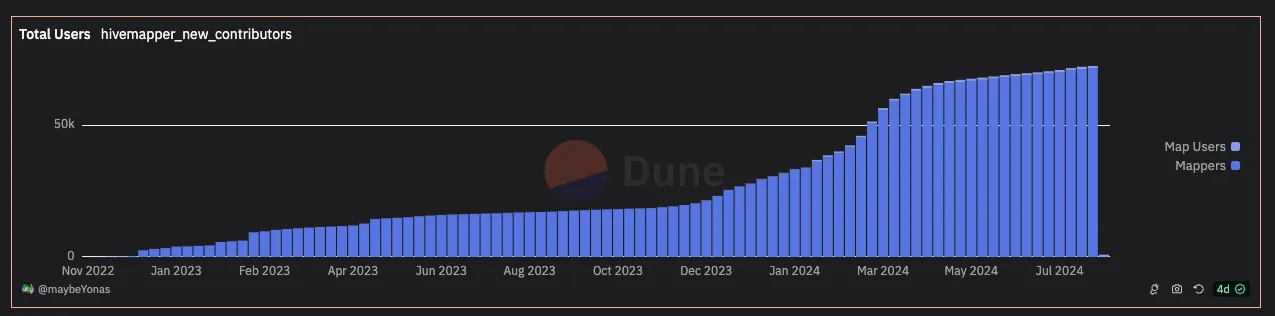
Source: HiveMapper (dune.com)
Why Telegram Could Become the Largest Crypto Consumer App?
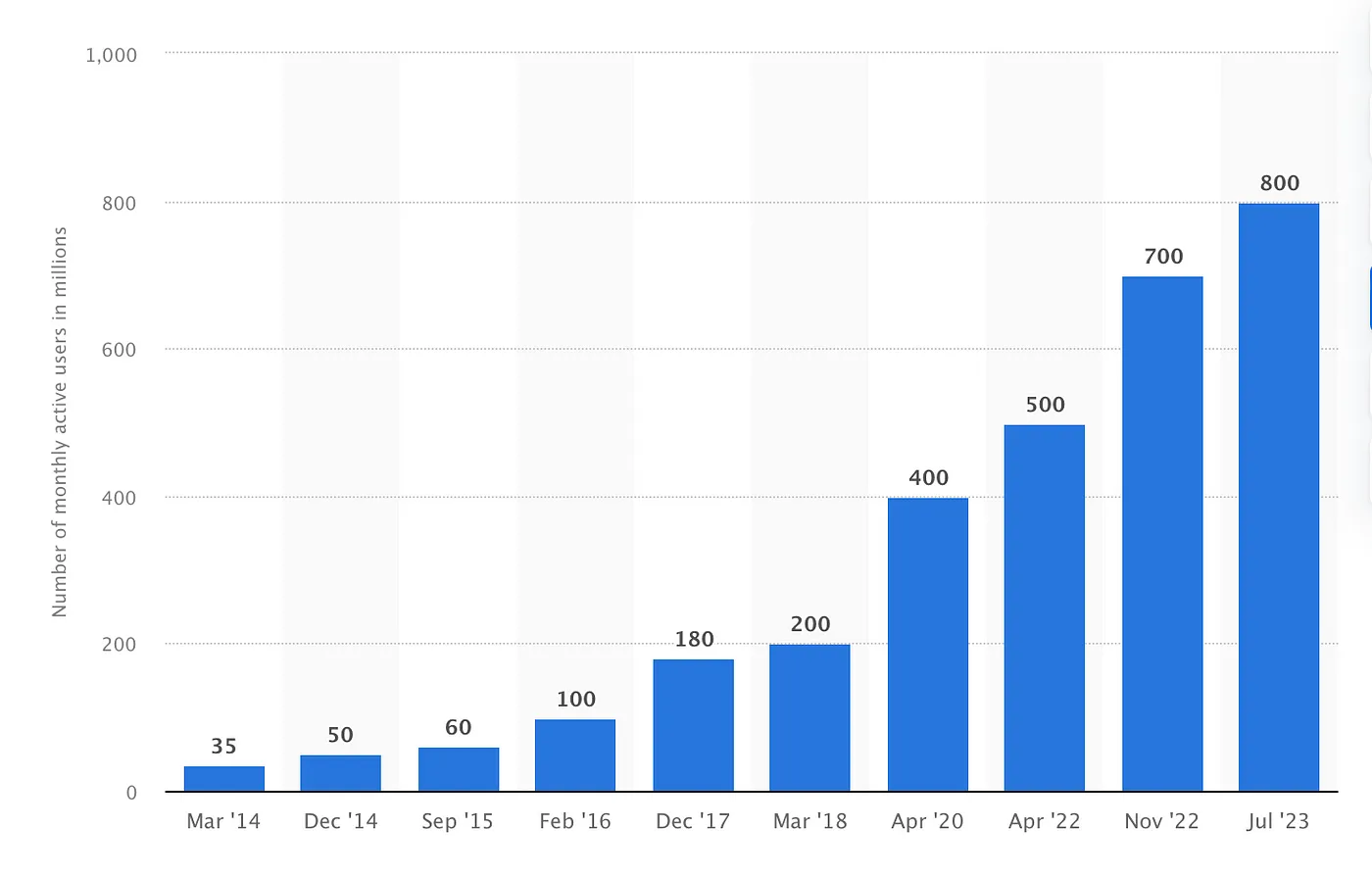
Telegram Monthly Active Users (MAU) in thehundreds of millions
The Telegram team launched the Telegram Browser, supporting TON-hosted websites on mobile and desktop, enabling seamless switching between messages and websites. This exposes nearly 1 billion users to crypto.
Mini-apps have seen remarkable success—500 million users (out of Telegram’s 950 million) use mini-apps monthly.
Within the Farcaster ecosystem, several mini-apps stand out. Here are a few examples:
-
Hamster Kombat—a game where you manage a virtual crypto exchange and raise your hamster within Telegram.
-
Fartapbot—a simple tap-to-earn app where tapping the screen earns points redeemable for rewards.
-
Dialect Operator—a mini-app seamlessly integrated with Phantom Wallet for trading.
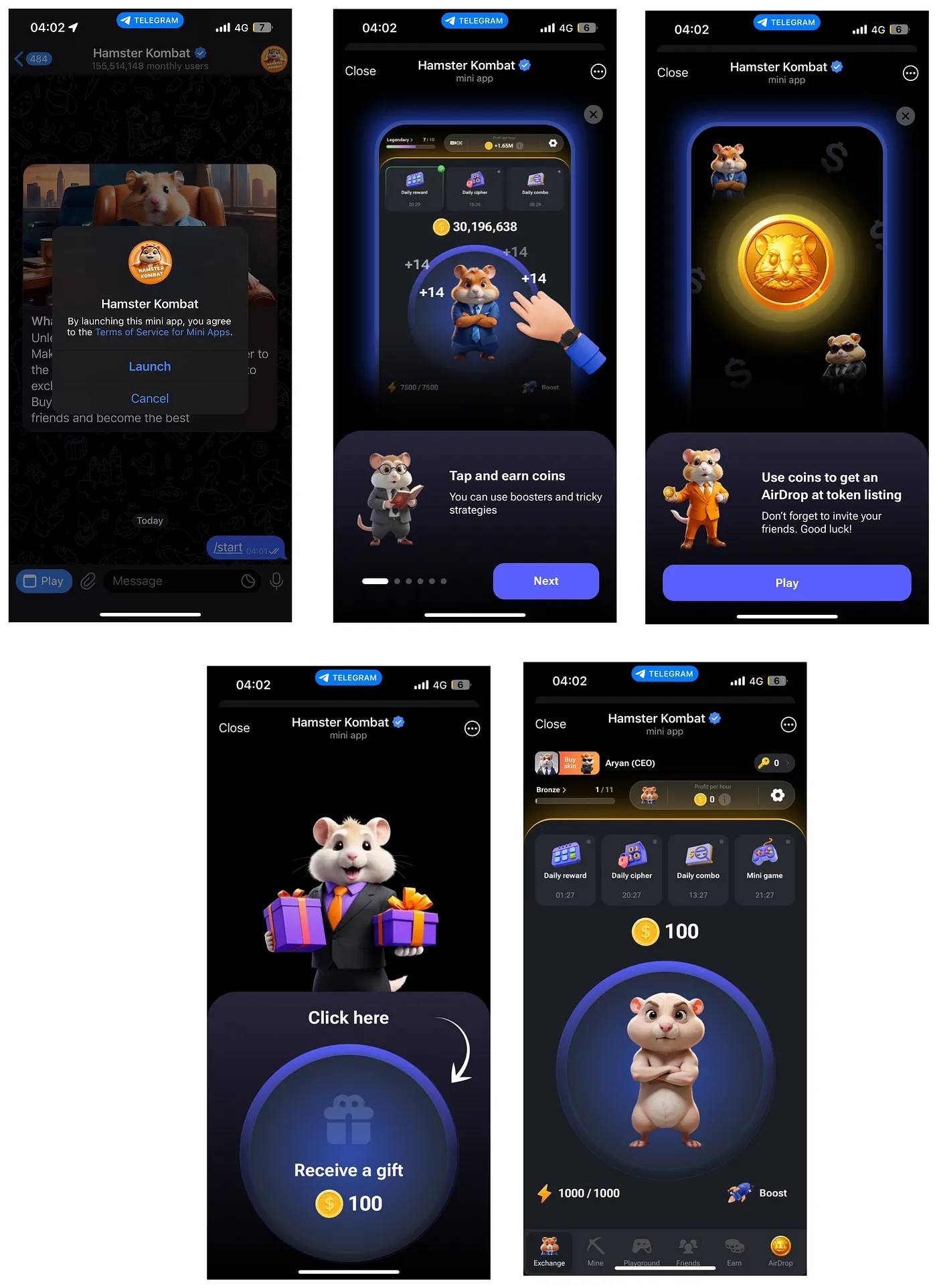
User Onboarding Flow in Hamster Kombat
No authentication is required anywhere—mini-apps leverage Telegram’s context to pre-authenticate users.
Will Blinks Save the Internet (and Crypto)?
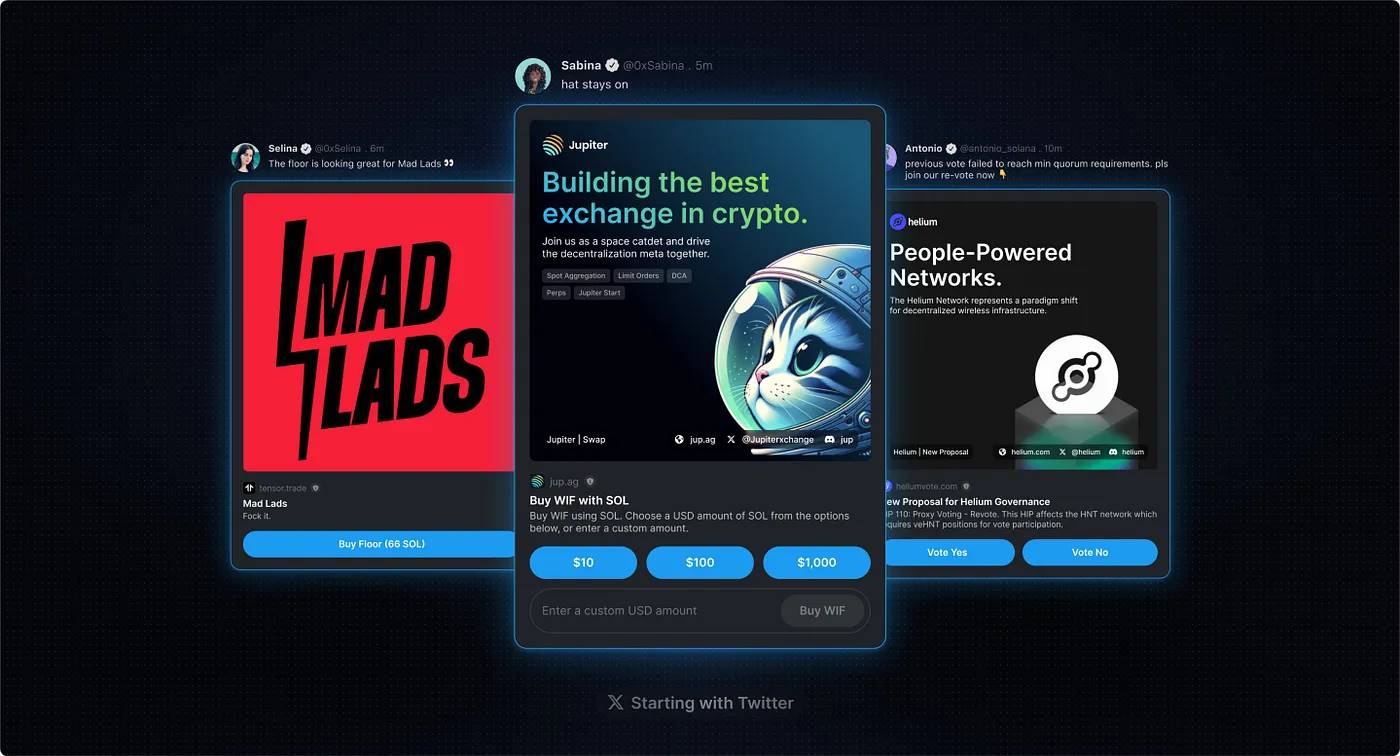
X Preview
URLs have long been the foundation of the internet. They are the only thing universally shareable and renderable via metadata—this is where Blinks (Blockchain Links) shine.
Any link can be enhanced to enable crypto transactions anywhere.
Here’s a metaphor I love: Blinks meet users, and eventually, if enough users demand Blinks, platforms will be forced to offer native support.
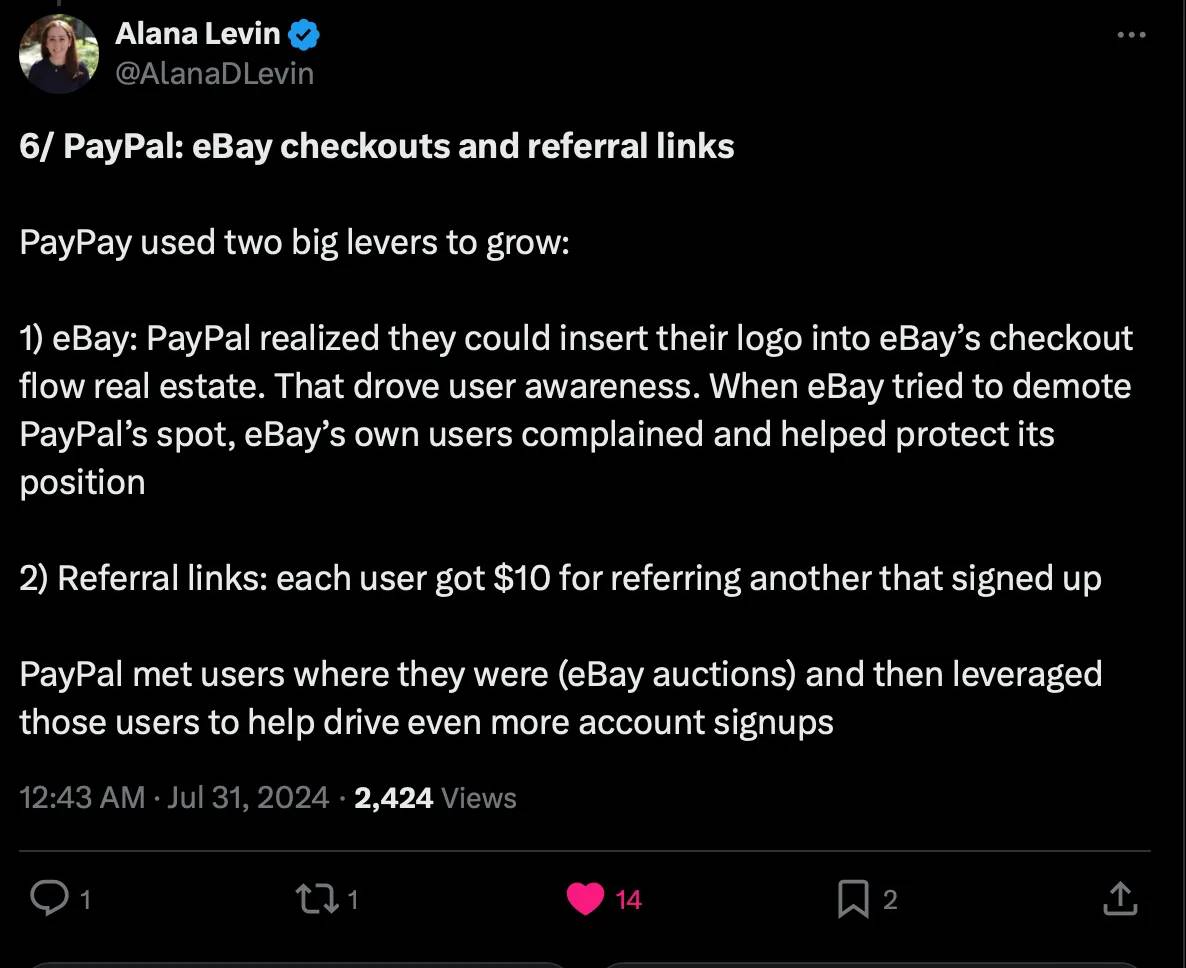
You can learn more about Blinks here.
And here’s an amazing thread showcasing what Blinks could enable.
The Missing Piece in Solana
The EVM side now has sufficient infrastructure to build consumer apps. Services like Airstack and Neynar are doing solid work connecting the dots.
What I feel Solana lacks is a social graph—a place where you can input any address and see its usage preferences, interacting apps, interests, etc.
Additionally, mobile support is inadequate. Integrating Solana Mobile Wallet Adapter is tedious and non-standard. You must follow deep-link guidelines for each wallet individually, and iOS support is especially frustrating.
Conclusion
We’ve come a long way in crypto. Now is the best time to build consumer startups.
It doesn’t matter which chain you choose—as long as user experience isn’t compromised.
We’ve also reviewed past attempts—both successful and failed—so you can form your own perspective on the type of consumer app you aim to build.
Join TechFlow official community to stay tuned
Telegram:https://t.me/TechFlowDaily
X (Twitter):https://x.com/TechFlowPost
X (Twitter) EN:https://x.com/BlockFlow_News