








There's rarely a dark myth in the crypto world, just as utilitarians rarely possess a sense of mission.
TechFlow Selected TechFlow Selected
There's rarely a dark myth in the crypto world, just as utilitarians rarely possess a sense of mission.
The audience for crypto products has never been genuine users.
 Navigating Web3 tides with focused insights
Text: David
On August 20, *Black Myth: Wukong*, a game long anticipated by countless domestic players, arrived as promised.
You might not be a gamer, but recently you've likely heard something about *Black Myth*:
China's first self-developed AAA title; a shining moment for local game industry capabilities; a cultural export rooted in the Journey to the West theme; covered by Xinhua News reporters on day one; swiftly leveraged by Luckin Coffee for a collaboration...
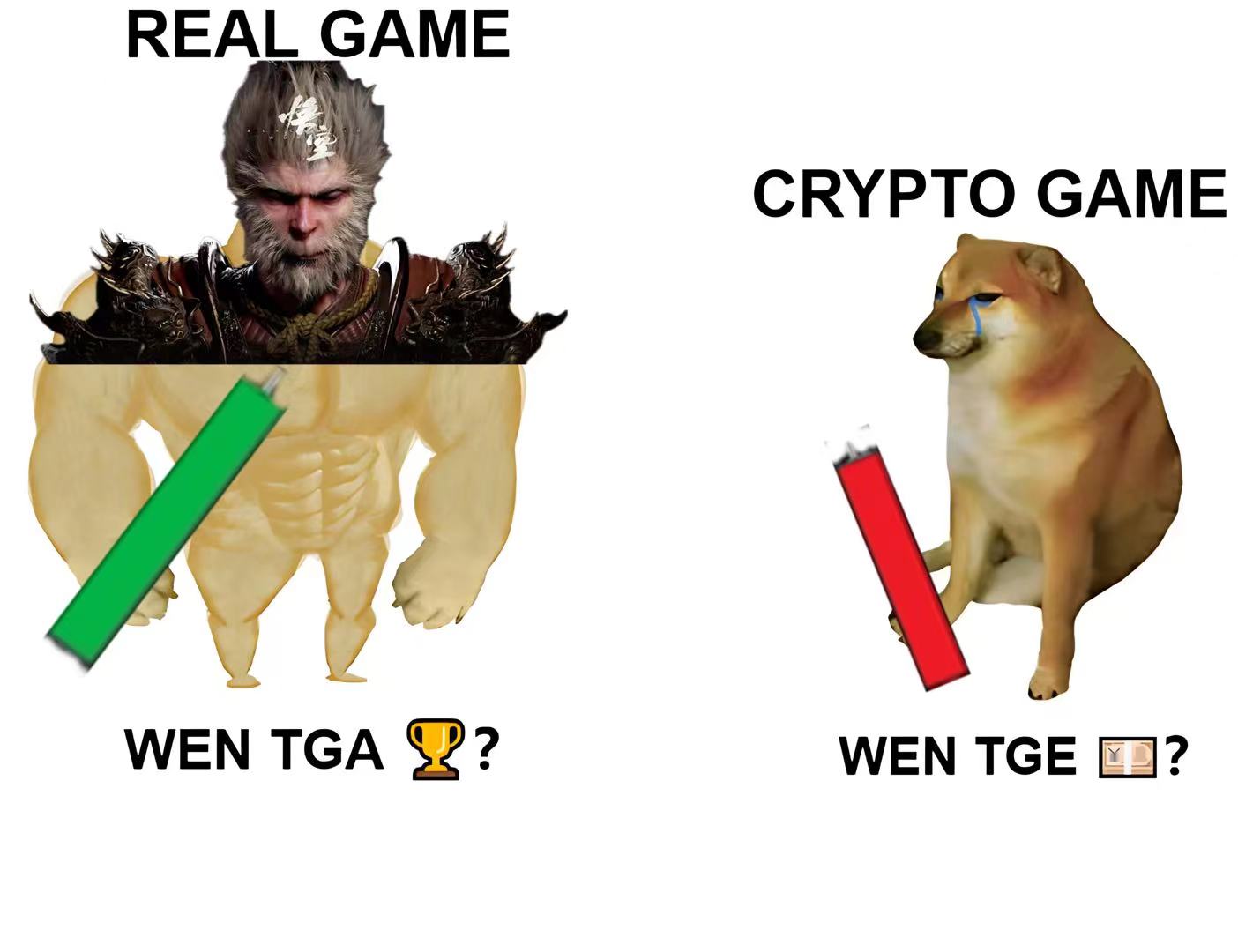
And above all, every Chinese player is eagerly hoping that Wukong will contend for TGA (The Game Awards, the Oscars of gaming), to earn recognition for Chinese games on the global stage and validate their passion with the belief that gaming is "not electronic opium."
The domestic gaming industry, players, and public opinion desperately need a *Black Myth: Wukong*.
Yet at this very moment when everyone is talking about Wukong, the crypto world stands ironically silent.
In contrast, blockchain games constantly shout about "mass adoption," trying to signal how they can attract more users and solve traditional gaming’s problems.
Anything popular in mainstream culture usually gains traction in crypto circles—but when *Black Myth* sparks no discussion within the space while blockchain games still claim mass adoption, it reveals one truth clearly:
Crypto will never have its own Black Myth—crypto products were never made for real gamers.
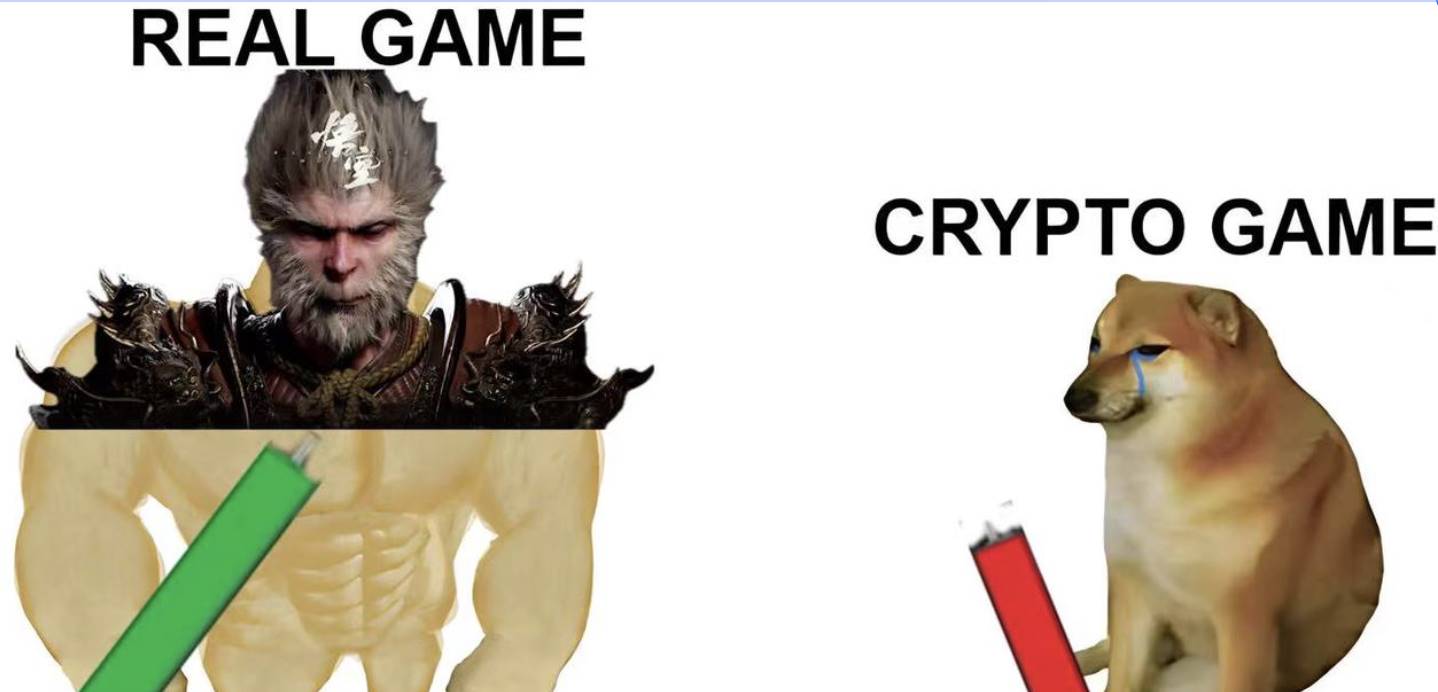
Just like the meme shown at the beginning of this article: when Wukong appears, gamers are wondering when it'll win TGA; but when a crypto-native game launches, degens are only asking when it’ll do TGE (token generation event).
Different missions, different positioning—different outcomes.
So what exactly went wrong with games—and other products—in the entire crypto industry?
Dopamine in Crypto, Endorphins in Black Myth
The reason crypto lacks a product with the spirit of *Black Myth* lies largely in an implicit premise upon entering the space—you're here for dopamine.
Dopamine is a reward mechanism that delivers instant gratification—cheap and easily accessible.
Wild, chaotic, judgment-free, full of both opportunity and danger… I’m here to make a quick profit. This may well be the raw, unfiltered mindset of most degens—or even industry insiders—once the mask comes off.
In contrast, *Black Myth: Wukong* operates more like endorphin-based compensation—a mechanism far stingier in release, typically requiring pain or effort to trigger.
The development of *Black Myth: Wukong* resembles film production: long cycles, high initial investment, with all resources and energy focused for years on perfecting the craft. Simply put, it's a "four years dormant, then feast for four years" model.
Or possibly, fail completely and lose everything.
Feng Ji, founder of Game Science, the studio behind the game, revealed in a media interview that developing just one hour of polished, playable content costs between 15 million and 20 million yuan.
This means refinement demands meticulous attention, deep dedication, and caution—enduring a painful process before finally presenting the work to market judgment.
No short-term dopamine hits along the way. All hardship is a bet on that single moment of delivery.

Image: Feng Ji, creative lead of Black Myth, once made a satirical short video mocking himself being beaten black and blue for failing to deliver what players wanted
When contrasted, you realize that *Black Myth* truly represents building a project—product first, profits later.
Most crypto games, however, put assets first and product second, waving banners about "solving traditional gaming issues" while creating even more problems—token death spirals, lack of gameplay, rug pulls, etc.
Though we can't entirely blame the project teams.
If your sole purpose is returns, and VCs invest only to unlock and dump tokens, and project teams suddenly receive massive capital during bull markets—getting listed feels like ascending to heaven—do you really think they’ll keep slaving away on game design?
The entire industry runs on dopamine-driven behavior patterns. To borrow a line from a Bilibili comment:
"It’s turned out this way—everyone here is complicit."
Moreover, years ago, Feng Ji wrote an essay titled "Who Killed Our Games?" in which he sharply exposed the state of China's online gaming industry:
"What lies behind online game operators? Capital.
To capital, China's vast population of disillusioned people are nothing but the freshest, juiciest flock awaiting slaughter; a super gold mine unmatched anywhere else in the world; a perfect, untouched, fertile virgin land.
Please remember, to capital... corpses are its delicacies, tears are its condiments—it thrives on them, endlessly and joyfully."
Looking back now, these words seem to describe crypto's extractive dynamics and PvP (player versus player) economy even better.
Nothing here is about art—everything is about commodities.
Pragmatists Rarely Achieve Flow or Mission
Looking back, the kind of environment a community fosters directly shapes the works and participants it produces.
At its core, what is crypto’s pragmatism really about?
In my view, crypto is essentially a hyper-compressed version of the startup ecosystem—both temporally and spatially.
What does that mean? Patience and room to maneuver are extremely limited. In terms of time, investors rarely give you the luxury of silently building toward a breakthrough before expecting returns. Spatially, your audience is narrowly confined—if your project drifts too far from core trading needs or major narrative trends, interest vanishes instantly.
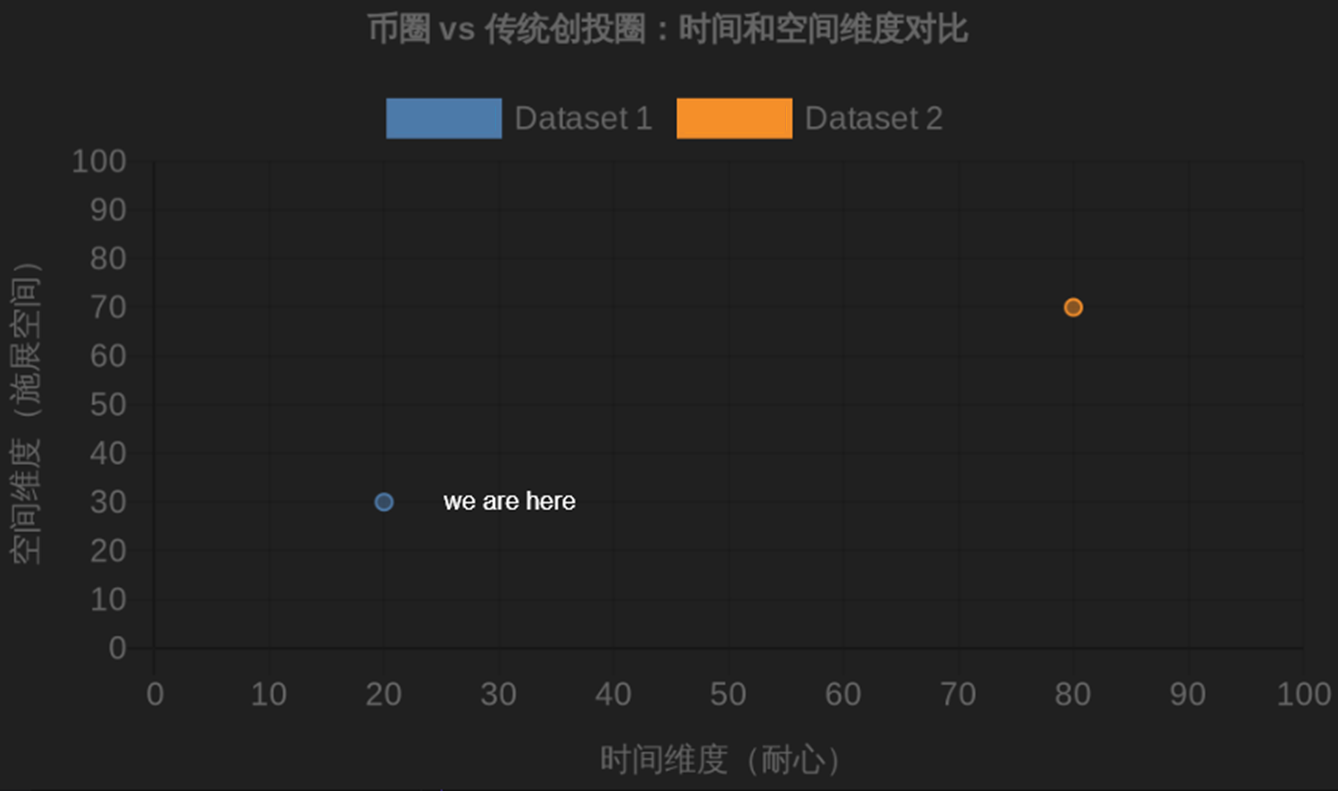
In such an environment, it's nearly impossible to calmly refine a product, focus on building, or let your work speak for itself.
When investors pressure you about token unlock schedules, NFT sale deadlines force asset sales, key exchange listing metrics demand fabricated data, or smart contract alerts compel liquidations...
Under constant pressure, would you ever find the mental space to enjoy a luxurious entertainment experience like *Black Myth*, which demands two uninterrupted hours of immersion into story and combat?
A pragmatic environment rarely allows relaxation.
Breaking news floods in nonstop, market moods flip in seconds, side events buzz with networking—where do you find the undivided time needed for sophisticated emotional engagement through entertainment? Scrolling Twitter and reading Chinese-language gossip is about as much as you can manage.
And if creators themselves don’t lean toward—or even get the chance to experience—this kind of game, how can we expect them to build crypto games that genuinely rival AAA titles?
In a world where quitting or joining a job requires manifestos proving loyalty, hashtags, public validation—as if the whole world must know—how can true building ever happen?

The contradiction starts at the source.
Pragmatists struggle to develop a sense of mission. They cannot withstand opposition or resist pressure to realize their ideal vision. Instead, they compromise between token and product, doing their best under the constraints of the crypto paradigm.
But works like *Black Myth* emerge precisely from mission-driven passion—not top-down planning or strategic foresight, but pure heart, stubborn determination, and hard-won exploration.
Less greed, more lone-wolf courage.
Where greed dominates, building remains merely a tool—not the goal.
When every action is calculated as a means to an end, there’s no room for crafting genuine entertainment. True leisure requires relaxation—no space for pragmatism. Crypto thrives on pragmatism—leaving no room for relaxation.
Thus, crypto games may not be “entertainment gone too far,” but rather “so devoid of entertainment that they die.”
Ponzi-like models may appear playful, but in reality, they’re serious, precise economic architectures—carefully orchestrated supply-demand mechanics serving hidden extraction agendas.
They are anything but simple, lighthearted fun.
Conclusion
This space has never truly cared about games—so naturally, it lacks works with the soul of *Black Myth*.
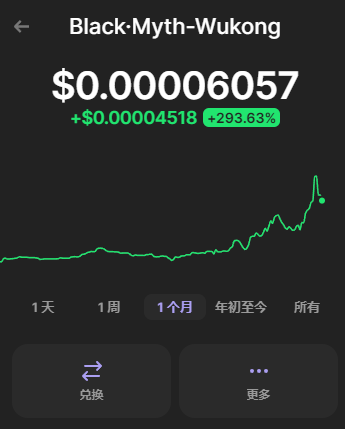
And if some KOL suddenly pushes a meme coin named "Wukong," and they hear it’s pumped X-fold last month, they’ll probably jump in, pretending to hail "Black Wukong" as the greatest thing ever.
The crypto stage we see today traces back ultimately to Bitcoin.
Bitcoin’s success was the inevitable triumph of idealists—an anonymous Satoshi embedding a sarcastic jab at failing banks in the genesis block, combining mature cryptographic technologies in elegant harmony, launching the era of crypto assets, embodying the ideal of denationalized money.
Seemingly impractical, yet historically destined.
Today’s fleeting viral surges or so-called "successes" in crypto feel more like accidental victories for pragmatists. The setup was just right, liquidity happened to surge, narratives spread perfectly—all appearing like coordinated, intentional schemes producing a lucky token.
Perhaps this space needs to do something meaningful. Embrace more ease.
Don’t live in crypto while locking your mind away.
Cherish relaxation. Applaud those truly building entertainment projects. Applaud *Black Myth: Wukong*.
Join TechFlow official community to stay tuned
Telegram:https://t.me/TechFlowDaily
X (Twitter):https://x.com/TechFlowPost
X (Twitter) EN:https://x.com/BlockFlow_News
 @0x_cryptodada









